Solana moves at light speed. By the time most traders finish their research, the chart has already pumped or rugged.
Manual DD across multiple explorers takes hours.
In this market, hours = losses.
The @StonkwatcherSF dashboard turns the entire research process into seconds, not hours.
There’s a better way.
The old process looked like this
→ Check holders on Solscan
→ Hunt dev wallets
→ Look for sniper clusters
→ Cross-check previous launches
→ Hope you didn’t miss something
By the time you had a clear picture, the opportunity (or the rug) was already over.
Those days are over.
The dashboard turns the entire research process into seconds, not hours.
Paste any Contract Address → Instant clarity on risk, holders, insiders, and snipers before you click buy.
Built specifically for Solana / StonkFun launches.
Threat Landscape
- Automated Risk Score (see moderate risk, high risk, or clean at a glance)
- Dev wallet behavior & % of supply
- Insider footprints and linked clusters that can dump the moment you enter
No more guessing who actually controls the supply.
Holder & Sniper Intel
- Top holder distribution visualized
- Active or pending sniper clusters flagged
- Holder map that shows whether supply is healthy or concentrated in linked wallets
A token can have 1,000 holders while 3–4 wallets funded from the same place control the real bag. The map shows it instantly.
Tracer
Follow funding flows, linked wallets, and previous launches. See if organic buyers are actually the same group recycling across tokens. Rug pattern detection is built in.
This is the difference between looks fine and actually checked.
The platform goes further
- Live market dashboard with risk scored new launches
- Portfolio tracking + alerts
- Private DEX swaps
- Blacklist, Audit, Tokenomics, and Intel to Earn tools
And yes, holding $STWC connects you to the ecosystem rewards (paid in $STONK from the transfer tax). The analyzer itself stays free.
In the wild west of Solana launches, information is the only real edge. Stonk Watcher is the security layer that turns blind apes into informed ones.
Scan before you trade.
HODL with conviction.
Isolated data hides the pattern. Visualization reveals it.
This is why tools that turn on chain activity into visual patterns matter.
@StonkwatcherSF added Token Rug Pattern to Tracer.
It lets you visualize how a token’s on chain activity develops and export the result as PNG or MP4.
Instead of scrolling endless transaction lists, you get a clearer view of the sequence and relationships.
Practical example:
You’re looking at a fresh launch. Several wallets light up around the same time, followed by a series of transfers and selling pressure.
Raw data makes this hard to interpret quickly.
A visual pattern makes the timeline and connections easier to spot and easier to investigate further.
Researchers can save findings, share them with others, or use the visuals when explaining an investigation. This turns private research into something that can be communicated more clearly inside a community.
On chain work is hard enough without also struggling to show what you found.
A visual pattern is a research signal, not automatic proof of a rug. Similar looking activity does not automatically mean common ownership or malicious intent.
You still need to examine the actual transactions, funding sources, and context. Good tools help you ask better questions. They don’t replace verification.
Stonk Watcher is expanding Tracer beyond basic wallet tracing. Token Rug Pattern sits alongside other research layers (risk signals, holder relationships, developer profiles, etc.) to make complex Solana activity easier to interpret and present.
The goal isn’t just to find suspicious transactions.
It’s to understand how they connect and what they actually reveal.
As more activity happens across Solana, the value of tools that make complex information investigable will keep rising.
Discover the pattern.
Investigate the evidence.
Understand the activity before drawing conclusions.
That’s how better on chain research works.
Stonk Watcher @StonkwatcherSF is building more than a wallet. It’s on chain intelligence for Solana launches (risk scores, wallet tracing, holder maps, etc.) inside a non custodial suite.
Most crypto apps say "you’re in control".
Very few let you actually leave.
The real test is simple : can you export your keys and walk away with your assets, or are you locked inside their wallet forever?
If the only way to use the tools is to stay trapped in their interface, that’s not self custody. That’s a soft custodial relationship with extra steps.
Portability is the baseline, not a bonus feature.
This is why the latest mobile update from @StonkwatcherSF stood out.
Key export is now live.
You can export your private key and import it into any other Solana wallet. No drama, no friction, just actual ownership.
That single capability changes the relationship between user and product. You can try the tools, use the on chain intel, paper trade, or run real size and still move your assets elsewhere the moment you want to. You’re no longer stuck.
With that freedom comes real responsibility.
An exported private key is the entire wallet.
Anyone who gets it controls the funds. Only export in a secure environment. Never share the key or seed with anyone. Ever.
What I also respect is the transparency. While key export is already working, the team openly said candle delays across timeframes are still being fixed.
Most teams only post the wins. Showing both the progress and the remaining work builds more trust than polished silence.
Key export is a clear step toward making the mobile experience both useful and flexible. Chart reliability is still on the checklist.
That’s the kind of development path that compounds.
In crypto, real control isn’t a slogan.
It’s the ability to leave.
@StonkwatcherSF is treating that as the standard.
NFA. DYOR. Only export keys if you know exactly what you’re doing.
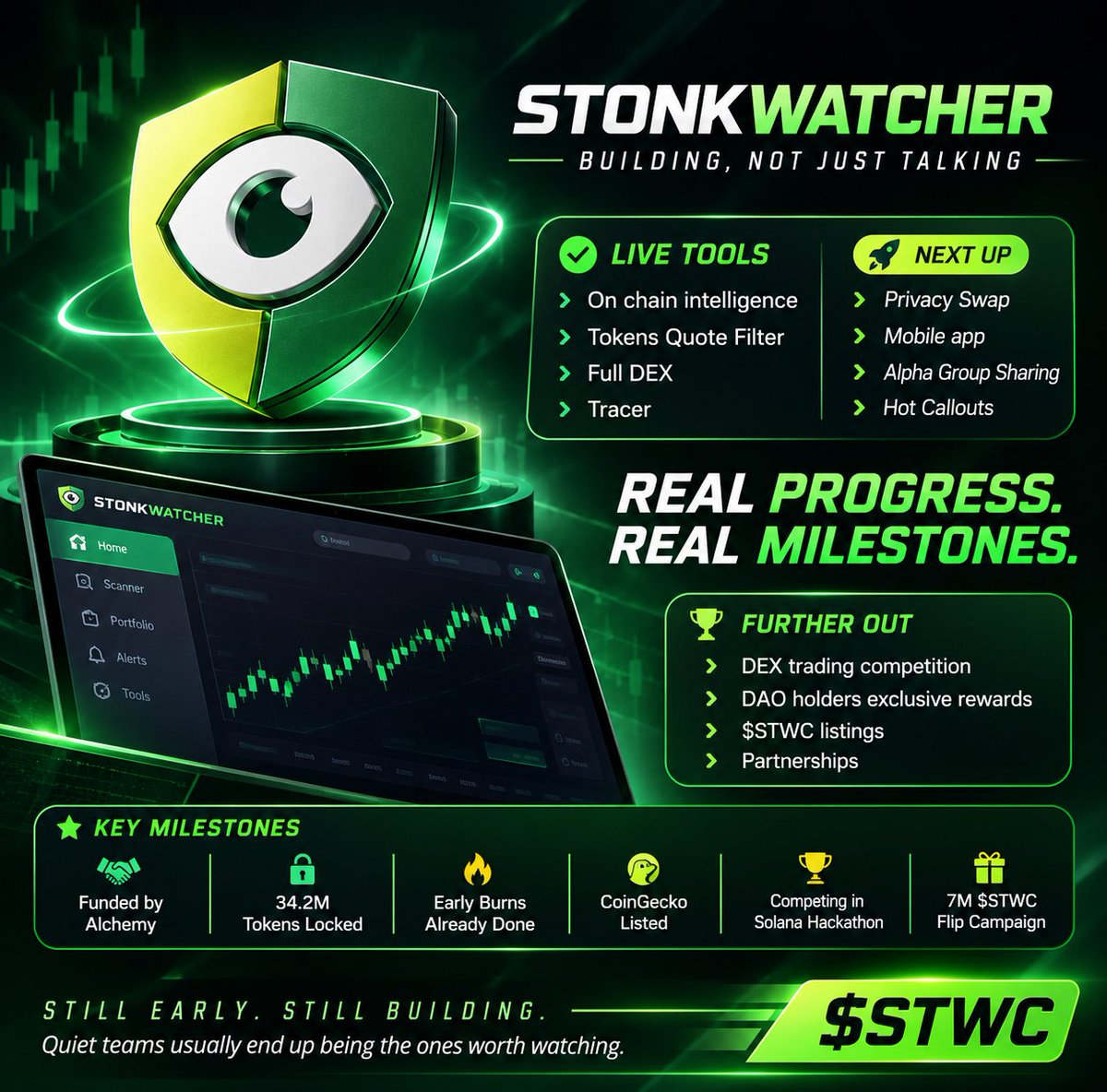
Most projects drop a roadmap and disappear.
@StonkwatcherSF actually updates theirs.
What’s live, what’s next, and what’s coming straight from the source.
Right now, the foundation is already working
➠ On chain intelligence
➠ Tokens Quote Filter
➠ Full DEX
➠ Tracer
Not concepts. Live tools people are already using.
What’s actively being built next
➠ Privacy Swap.
➠ Mobile app (already introduced).
➠ Alpha Group Sharing.
➠ Hot Callouts.
This is the layer that turns Stonk Watcher from a tool into a full trading environment.
Further out
➠ DEX trading competition.
➠ DAO holders exclusive rewards.
➠ $STWC listings.
➠ Partnerships.
Clear stages. No random wishlist.
Quiet progress that actually matter
• Funded by Alchemy
• 34.2M tokens locked
• Early burns already done
• CoinGecko listed
• Competing in Solana Hackathon
• 7M $STWC Flip Campaign running
They’re stacking real milestones while most of the market is still arguing about charts.
The best part?
They keep posting shipping notes instead of just "big things coming"
Still early. Still building.
Quiet teams usually end up being the ones worth watching.
$STWC
Ruggers Hate Us.
Alpha Hunters Love Us.
@StonkwatcherSF just launched their new landing page.
One place for everything : risk intel, wallet tracing, private swaps, portfolio tracking, and $STWC rewards.
Built specifically for StonkFun launches on Solana.
https://t.co/wLG6sDnT2Q
Stonk Watcher is the Stonk trading desk for Solana.
It combines:
➠ Live risk intelligence
➠ Holder maps + wallet tracing
➠ Private DEX swaps
➠ Portfolio + rewards tracking
All non custodial
Goal : see who’s really behind a launch before you ape.
Research before you trade.
Check holders, wallet clusters, and risk signals in one place.
The risk analysis is transparent (behavioral index, not black box trust me)
Examples of signals they surface:
➠ Creator history across previous launches
➠ Liquidity removal patterns
➠ Reconstructed sell events
➠ Wallet reuse / empty post launch accounts
Spot insiders and sketchy supply before you commit capital.
Tracer lets you follow funding and token transfers to see relationships between wallets.
Have these wallets appeared together across previous launches?
This is the kind of on chain forensics most people skip until after they get rugged.
Follow new launches the moment they go live.
Every token gets scored for risk so you can separate real projects from the next rug.
No more hopping between 5 different sites just to get basic context on a new StonkFun token.
Trading + privacy in the same suite.
➠ Market, limit, and DCA orders
➠ Privacy Swap
➠ Clean charts, live transactions, quote filters
You need a small $STWC balance to unlock full trading + dashboard features. Keeps the interface focused on actual holders.
Monitor your positions, swaps, and $STWC rewards in one dashboard. Alerts when wallets you follow start moving.
Hold $STWC → earn $STONK.
Simple flywheel.
Nice breakdown. The combo of 100ms block time + HYPE as gas + 50% revenue to KNTQ buybacks is actually one of the cleaner incentive designs I’ve seen lately. Curious how the real usage on Hypesium is looking so far after the joint launch.
Most traders just care about how fast a bot can open/close positions. But I believe there’s a much bigger question hiding underneath
What kind of infrastructure is really making that lightning speed possible?
That’s why I spent the last few days unpacking @Hypesium and its deep tie in with Elysium, this combo is actually heating up big time right now.
Elysium is Kinetiq dedicated Hyperliquid Layer-2. Built on Arbitrum Orbit, it settles straight into HyperEVM. The numbers that blow people’s minds
➠ 100ms block time
➠ Gas asset = HYPE
➠ Sequencer runs on Conduit for insane throughput
So Hypesium isn’t some bot that jumped on an old chain. It’s launching in sync with brand new infrastructure that was designed for speed from day one.
Let’s talk economics, this is where it gets juicy
➠ 50% of all sequencer revenue goes straight into KNTQ buybacks
➠ Another 25% is sent directly to builders to actually create real blockspace demand
That’s not just marketing fluff. That’s three design decisions that make this network feel completely different from anything else:
1. Killer Incentives
Money isn’t locked away in a treasury. It keeps flowing back into the ecosystem and directly into the hands of token holders through KNTQ. The busier the chain gets, the more value accrues to everyone who holds.
2. Ridiculously Simple Access
HYPE works exactly the same whether you’re on HyperEVM or Elysium. 1:1 bridging, no extra fees, no complicated bridges. Traders literally just use HYPE, that’s it.
3. Perfect Launch Timing
Both Elysium mainnet and Hypesium creator campaign dropped on the exact same day (November 9). The bot and the chain are growing up together instead of fighting against old, slow systems.
A super fast bot is cool.
But the chain underneath is what actually creates the playing field and speed only reaches its full potential when the infrastructure is rock solid.
Strong infrastructure + incentives that actually align can open up massive opportunities. But real usage is what decides whether this thing is just hype or the real deal.
Most teams talk about "building"
Few actually take the steps that matter.
@StonkwatcherSF just applied to the @Helius Startup Launchpad.
Not for the flex.
For the infrastructure, the mentorship, and the network that lets real products scale on Solana.
Helius isn’t just another RPC provider. Their Launchpad gives selected teams:
• 8 months of free Business plan
• Direct access to experienced Solana operators
• Warm intros to investors
• Partner discounts that actually save runway
For a tool that lives and dies by data speed and reliability, risk scores, wallet tracing, bubblemaps, creator alerts, this kind of support hits different.
Stonk Watcher been shipping quietly.
CoinGecko listing. Multi language app. Paper trading. Holder rewards in $STONK. Flip campaign still running.
This application is just the next move.
No victory lap yet.
Just another step in the right direction.
$STWC
Most comps are just volume leaderboards dressed up as competitions. Whales print, small accounts become liquidity.
Canborsa actually giving weight to ROI + weekly Rookie resets + Battle Points multipliers for consistency and market diversity changes the math.
Feels like almost every trading competition is just won by whales.
Small accounts?
They just become volume fuel.
@Canborsa_DEX Season 2 is a bit different.
$12,500 prize pool, still running until Nov 30.
The most interesting part for me isn’t even the top 20 prizes.
There’s an iPhone 18 Pro for best ROI.
ROI is a percentage, so a $300 account that trades cleanly can beat a $20k account that just yolo.
This is pretty rare.
Then there’s $300 every week specifically for Rookies,It resets every week, So even if you just joined now, you still have a chance. Not a dead end.
Scoring uses Battle Points, Volume is only the base score.
If you’re consistent, explore different markets (crypto + RWA), and close profitable trades, your points can get multiplied up to 5.3x.
Skill and consistency actually count.
Plenty of markets : perps, spot, gold, NVDA, BTC, and around 100 markets total.
➠ Season 1 did $22.5M+ in volume.
➠ Season 2 has about 12 days left.
Doesn’t mean it’s easy to win, But at least this is one of the few competitions that doesn’t automatically bury small accounts just because of smaller balance.
If your trading is actually good, there’s a real shot.
Join here:
https://t.co/zKNLNPTfbT
If you’re just volume farming with no plan, you’ll still lose.
Skill still matters.
Most sniper discourse is pure latency maxxing. Hypesium actually forces the harder question up front: “Do I even want this entry if the exit is ugly?”
Safe profile is the adult in the room — 15% tax cap, 50 HYPE liq floor, ≤15% impact, sell sim must pass.
Speed is easy to talk about.
Protecting capital is harder.
On Elysium, most people are watching how fast @Hypesium can get into a launch.
I keep coming back to something else
how deliberately it forces you to decide how much risk you’re actually willing to take before the trade even fires.
Hypesium isn’t trying to be a general purpose sniper.
It’s built specifically for Elysium, Kinetiq’s Hyperliquid L2.
That means it can prepare routes, calldata, and gas before the pool exists, then fire the moment liquidity appears.
The interesting part isn’t just the speed.
It’s that speed comes with explicit guardrails you have to choose.
The Safe profile is the clearest example
➠ Tax capped at 15%
➠ Liquidity floor of 50 HYPE
➠ Your buy can’t move the price more than 15%
➠ Sell simulation must pass
If any of those fail, nothing is sent.
You’re deliberately giving up some speed for a higher chance of actually being able to exit later.
Turbo flips the priority. It triggers directly on the pool creation log. No extra simulation step in the critical path. The goal is pure minimum latency.
You’re accepting that you might enter a token that later fails a sell test, in exchange for a better chance at the opening block.
On a chain this fast, that tradeoff is real.
What I like about this setup is the framing.
Most sniper tools sell get in first.
Hypesium also surfaces the question "do you even want this entry if the exit looks bad?*
A fast entry into a token you can’t sell cleanly is just an expensive way to learn the same lesson.
Simple mental model I’ve been using
➠ High conviction / known deployer → Turbo can be justified
➠ Low information / random launch → stick with Safe or Risky
➠ Pure degen with size you can afford to lose → Moon exists for a reason
Simulation helps filter obvious honeypots.
It doesn’t protect you from liquidity drying up, taxes changing, or the market simply dumping.
Being early only matters if you can leave.
On 100ms blocks, the difference between a good entry and a trapped position can be very small.
The majority of rug pulls we’re seeing right now share the same DNA.
Same launchpad,Same fee extraction model,Same polished metrics. Different ticker, identical playbook.
Credit to @StonkwatcherSF for consistently mapping these patterns.
The on chain evidence keeps repeating
• Identical funding routes
• Recurring wallet clusters
• Synchronized exit timing
When the data aligns this cleanly, coincidence is no longer a reasonable explanation.
This is precisely why $STWC continues to build.
➠ Stronger on chain intelligence.
➠ Faster anomaly detection.
➠ open sourcing key tools so more eyes can watch the same patterns.
Safety scales with visibility.
$STONK remains early.
Real projects and real upside still exist.
But weak markets create desperation and desperation creates soft targets.
Don’t become one.
Stay SAFU.
Read the data.
Ignore the hype.
Protect your bag.