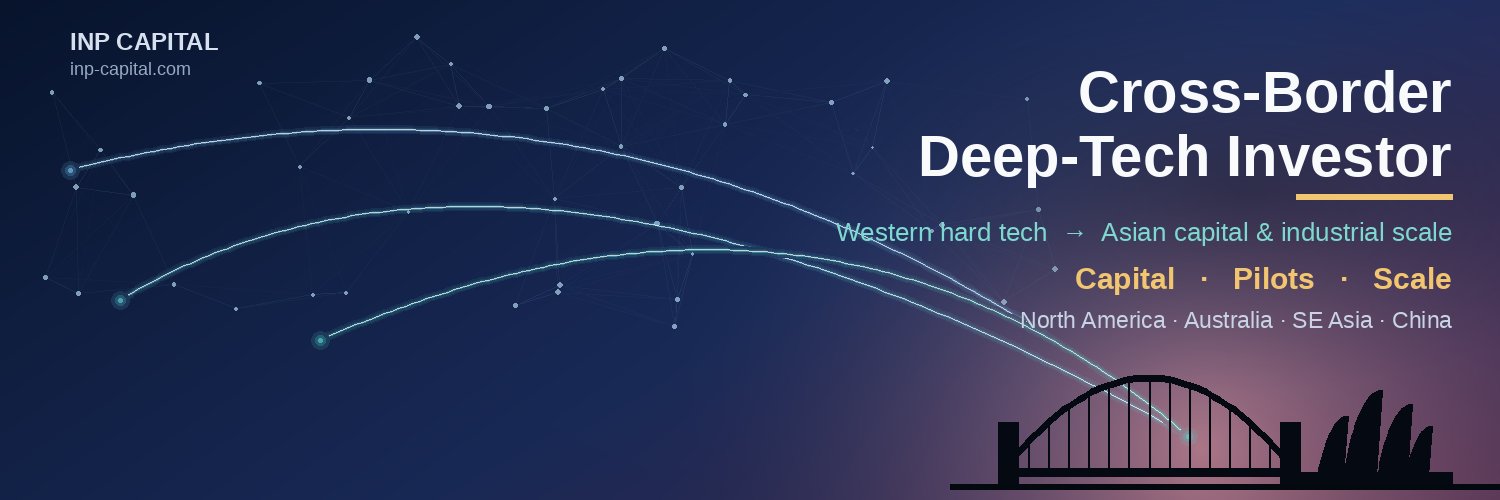
What I do: I invest in Western deep tech — climate, materials, bio, food — and help it scale with Asian capital and industrial muscle.
I'm not a commentator. I'm in the room: ~20 years in finance, $5B+ in cross-border deals, 4 unicorns in 6 years, ex-PwC — on the ground in Australia and North America.
On this account I break down the hard-tech companies quietly rebuilding physical industries, and what actually makes them investable from the frontline.
Follow for the operator's view, not the sideline's.
(General information, not investment advice.)
@LongmireMD Useful model. The constraint I'd stress-test: how much of the saved time is documents and data cleaning vs. patient enrollment and site activation? If agents mostly compress paperwork, capacity doubles on paper but enrollment still sets the clock. Does your model split those?
@burhansebin@coeff_giving Useful breakdown. The structure point is the one founders will miss: if a team takes the pre-seed as a nonprofit or PBC, does the $2M-$20M seed have to go into that same entity, or can a new structure raise it later?
Q-CTRL's US$290M Series C made it Australia's first quantum unicorn. The word I'd watch isn't "unicorn", it's "DPI": the founder says early backers got liquidity. Australian deep tech rarely lacks invention. It lacks capital that comes back and gets recycled.
@PaulFDietz@johnrhanger Thanks, will listen. If containment had to grow that much, that's a redesign that costs schedule and financing, not just steel. For investors the asset isn't unit 1, it's a licensed, repeatable design. Late licensing changes push out the point where units 2-4 get cheaper.
CoreWeave Q3: $3.66B revenue, $132.5B backlog, $846M interest, $709M net loss.
The GPUs aren't really the asset. The signed contracts are.
AI infrastructure is becoming a credit business. The question isn't how fast revenue grows, but who carries the risk if a customer walks.
Two AI companies using the same cloud can have different vulnerabilities. In LP diligence, I would check the exact region and critical services, the last fallback test, and the time and cash needed to switch.
https://t.co/9N7vvk4nIQ
A day after Broadcom closed up 8.8%, Nvidia was down about 6% Tuesday. Same demand, different claim on the cash flows.
Anthropic's IPO targets ~US$1.4T fully diluted, plus a US$26B supplier placement at the offer price. If vendors also buy the equity, what is being underwritten?
Samsara Eco’s enzymatic recycling is reaching two core lululemon run styles in a limited AU/NZ launch. Each uses at least 50% enzymatically recycled polyester by weight.
A useful commercial milestone. The next tests I’d watch: repeat orders, production cost and reliable supply at scale.
https://t.co/PkACTFyBtq
Australia’s GDP per hour worked rose 0.5% in 2025–26. My tech investment test: which bottleneck does it remove, at what adoption cost, and who captures the savings? The productivity case needs measurable operating results.
https://t.co/gGqW2i5hmk
@jessebeharrell I'd start with the production design and certification path. If those keep changing, manufacturing cost and the funding need remain hard to estimate. The test I'd use is a repeatable, compliant unit at an agreed cost, with a clear owner for getting there.
Australian deep tech rarely stalls on the science. It stalls between a working prototype and the first 1,000 units: supplier qualification, certification, manufacturing engineering.
Teams that cross early treat scale-up partners as product work, not a later procurement step.
@fresh1142362193 I'd look for a named budget owner, a dated restart trigger and continued use by the same cohort. If paid renewals and usage hold while procurement slips, delay is more plausible. Falling usage, smaller renewals and no restart condition point to weaker demand.
Monday drew a line inside AI.
One side was repriced on key-person risk. The power side on contracts: Constellation raised guidance and has signed ~8,500 MW of long-term deals this year.
Signed megawatts can be underwritten. That's when technology becomes an asset.
For a deep-tech pilot, I want three things: a customer-defined acceptance test, a repeat-order trigger and a costed route to production. Then map cash needed before customer payments arrive. That funding gap belongs in the investment case from day one.
@MeghanKReynolds I'd assess the fund and co-invest together: total company exposure, follow-on reserves and who handles monitoring. Fee savings help only if the LP has the people and decision speed to underwrite the extra concentration before the round closes.
@martin_casado How much of the extra capital funds new experiments, versus keeping mature companies private longer? Both expand private markets. For LPs, the distinction matters for entry price, holding period and net returns.
@PaulKlayVC Manager readiness and LP capacity can diverge. Before launching Fund II, I'd test likely re-up amounts, remaining Fund I reserves, and the minimum fund size that still supports the strategy. LP conviction matters, but so does when they can actually commit.