This has quietly been a miracle month in medicine.
In the last 5 weeks we’ve got news on:
- retatrutide, the triple agonist GLP-1 from Lilly, basically melting fat and body-wide inflammation at record levels
- RevMed’s new pancreatic cancer drug showing unprecedented abilities to extend life
- small trial of a one-and-done PCSK9 gene editing therapy for slashing LDL cholesterol
- Mayo’s AI-assisted radiology showing vastly improved cancer detection
- this new therapy for metastatic solid tumors
This stuff is at varying levels of evidence. Retatrutide is ~100% on its way, other stuff needs more clinical trial data. But put it together and we’re maybe on the verge of majorly reducing the mortality of heart disease and cancer, the two leading causes of death in America.
It should be pretty obvious at this point that AI is a "force multiplier" not a "labor substitute".
It helps experts be better at things they are already good at. It doesn't let beginners match experts.
If you can't write, anything you write with AI will be unmitigated slop.
If you aren't a software engineer, anything you vibecode with AI will have security holes and won't be able to scale past a toy demo.
If you blindly trust AI to deliver on a research task without knowing the subject matter, you won't be able to fact-check it.
There's this weird misconception of AI as something that completely levels the playing field. I don't see it that way at all. There are mathematicians deriving novel lemmas with off-the-shelf models. Normal people can't do that.
AI is a tool that makes experts better. It doesn't make everyone into an expert.
I am not a military analyst. I'm a financial analyst focused on macroeconomic risk.
That different lens might explain why I see something most military strategists and investors are missing.
---
The New Rules of Warfare—And Why We Can't Opt Out
For nearly a century, warfare belonged to whoever controlled the biggest defense budget. Aircraft carriers. Stealth bombers. Multibillion-dollar weapons systems.
That model is changing in ways many aren't appreciating.
Ukraine and Iran are showing the West what 21st-century conflict actually looks like: decentralized, highly iterative, fast-changing, unmanned, and cheap. Neither the US nor Russia—beginning in 2022—appears prepared.
We might now have no choice but to show we can fight and win such a war.
The Ukraine Approach
Faced with a small defense budget, a much smaller population, and a vastly outnumbered army, Ukraine had to get creative. They couldn't match Russia's industrial capacity or spending. So they abandoned that playbook entirely.
They developed an entirely new way to fight, highly decentralized, iterative, and most importantly, cheap.
They also created Brave1—a completely new way to conduct war.
Frontline commanders log into an iPad and bypass central command entirely. They spend digital points to purchase equipment directly from hundreds of (Ukrainian) manufacturers. When they encounter a new threat, they message the manufacturer directly and work with the engineers to find a solution, even if that means they visit to the front. The result is hardware or software upgrades that once took months now take days.
Here's the crucial part: hundreds of manufacturers compete fiercely for these dollars by offering the best possible product as fast as possible. This isn't centralized procurement. It's a market. Competition drives innovation at scale. Weapons evolve as the enemy evolves in real time.
Units are also awarded points for confirmed kills, uploaded from drone video—a powerfully eloquent way to grade effectiveness.
But the real innovation might be how they decentralized manufacturing itself. Instead of building weapons in massive, centralized factories that make perfect targets for Russian bombing, Ukraine distributed production across hundreds of small manufacturers—workshops, machine shops, garages, and yes, kitchens. Each produces components or complete systems. This approach serves two purposes: speed and survival.
You can bomb a tank factory. You destroy production for months. You cannot bomb ten thousand kitchens. If one workshop gets hit, ninety-nine others keep producing. The network regenerates faster than Russia can destroy it. This is why the manufacturing process includes actual kitchens—it's not a metaphor. It's a strategy.
The Metric That Defines a New Era
The result is staggering: at least 70% of battlefield casualties now come from drones. This is the first time in over a century that the primary cause of combat death is neither a bullet nor an artillery shell. Since World War I, industrial warfare meant industrial killing. Ukraine has broken that equation entirely.
As a result, Russia is now controlling less territory than at any point since 2022 and going backward. In March, Ukraine made gains while Russia recorded no gains for the first time in two and a half years, and Drone-led offensives recaptured 470 square kilometers while paralyzing 40% of Russian oil exports.
Ukraine has lowered the "cost per kill" to less than $1,000 per casualty—a 99.98% reduction from the millions of dollars that were common in the post-9/11 wars. This isn't an incremental improvement. This is a complete inversion of modern military economics.
Yet the Western defense establishment is not learning from this.
Rheinmetall CEO Armin Papperger mocked Ukraine's entire approach. In The Atlantic, he called Ukrainian manufacturers "housewives with 3D printers," dismissing their work as "playing with Legos." They are not studying this revolution. They are mocking it.
And the "housewives with 3D printers" are beating the Russian army!
Ukraine Is Now in the Middle East
The US Military and Gulf states face an eerily similar problem. Iran's Shahed drones threaten shipping in the Strait of Hormuz—a chokepoint that funnels 21% of global oil. They cannot fend off Iran by firing a $4 million Patriot missiles at $20,000 drones.
They need what Ukraine has discovered: a decentralized, rapidly adaptive defense network that doesn't require centralized industrial capacity.
That's why Ukraine just signed historic 10-year defense deals with Saudi Arabia, Qatar, and the UAE.
Over 220 Ukrainian specialists are now on the front lines of the Persian Gulf—exporting not just weapons, but a completely new doctrine of how to fight.
The precedent is set. The model works. Everyone is watching.
Mosaic
On April 1st, Trump threatened to bomb Iran "back to the stone ages" if they don't reopen the Strait within weeks.
It's the classic 20th-century playbook: overwhelming offense force, massive bombardment, industrial-scale destruction.
The problem? That playbook doesn't work against distributed, cheap, rapid-iteration systems—especially when your enemy is organized under a mosaic structure.
Iran's "Mosaic Defense" doctrine is a decentralized command system where authority and capability are distributed across multiple geographic and organizational nodes.
Each region operates semi-autonomously with overlapping chains of command and pre-planned contingencies. It's designed so that when you destroy the center, the edges keep fighting. You cannot decapitate a system with no head. You cannot out-bomb your way to victory when your enemy is not centralized; this was the solution for 20th-century industrial warfare.
Defense Wins Championships
21st-century asymmetrical threats require defensive shields, not aggressive offenses. Ukraine has built exactly that: rapid-iteration defenses, decentralized manufacturing, commanders empowered to buy solutions in real time and rewarded for success.
That same defensive model may hold the key to opening the Strait of Hormuz. Not through massive offense, but through the ability to adapt and defend quickly.
Why We're Stuck
Whether you viewed this as a war of choice or not, it has now become a war to keep global trade open. And that makes it inescapable.
This is precisely why the US cannot declare victory and walk away from the Strait of Hormuz— or TACO.
Every adversary on the planet will interpret American withdrawal as confirmation that cheap asymmetric systems work against powerful centralized platforms.
And these adversaries might have sent us a message last month. In mid-March 2026, an unauthorized drone swarm penetrated Barksdale Air Force Base in Louisiana, home to the U.S. Air Force's Global Strike Command.
The fact that this happened not overseas but in the United States, and that these tests occurred just weeks ago, underscores how close this threat is now.
They didn't attack. They announced their presence. Every adversary watching learned that cheap drone networks can reach into the US.
The Global Supply Chain Risk
If the US abandons the Gulf while Iran holds the Strait contested, markets will price this as validation that cheap systems can hold global trade hostage. The current market disruptions will become permanent.
Supply chains will have to pivot from "just-in-time" efficiency back to "just-in-case" redundancy. Inflation returns as safety costs money. Trade routes diversify away from vulnerable chokepoints. The global friction tax becomes permanent.
The Unavoidable Truth
Once you prove that cheap, asymmetric systems can hold global trade hostage, that knowledge spreads globally and irreversibly. Every adversary learns the same lesson: you don't need a $2 trillion Navy—you need $20 million in drones and the will to use them.
Withdrawing while the Strait remains contested would permanently validate this model. Supply chains shift to "just-in-case" redundancy. Insurance costs rise. The friction tax becomes structural—baked into every global transaction for decades.
The cost of staying is measured in months. The cost of leaving is measured in decades of economic drag.
We cannot leave unfinished business.
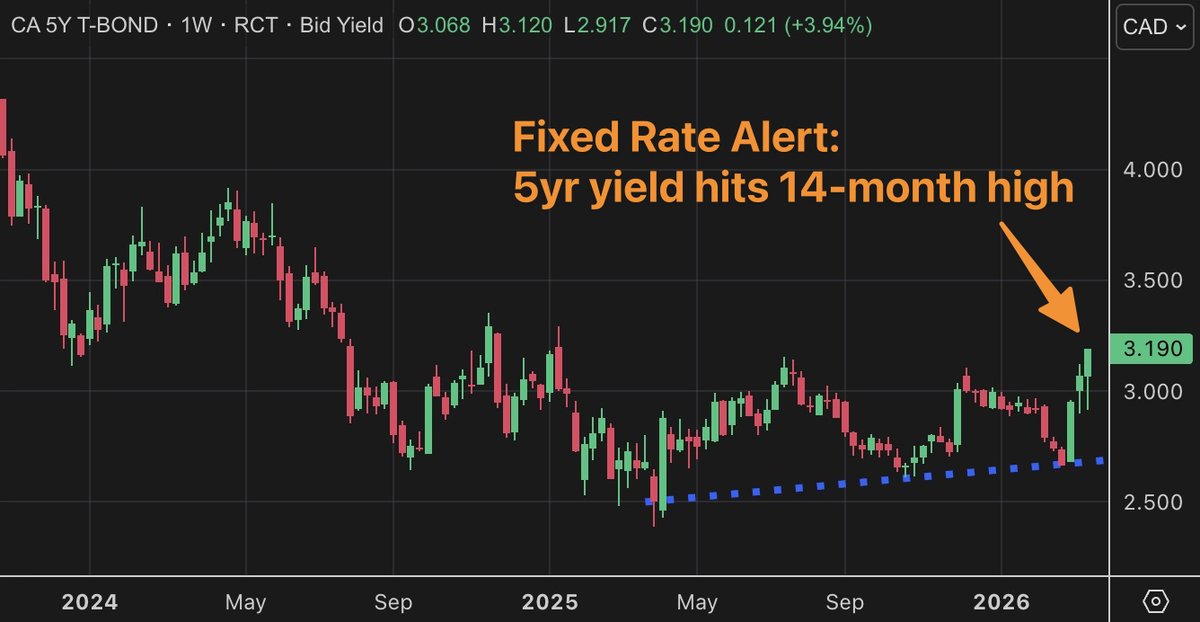
Canadian yields are on a rocketship. More fixed rate hikes incoming.
The @bankofcanada "is at risk of letting inflation get the upper hand again," warns Scotia's Derek Holt.
Meanwhile, Bay Street's consensus is still "hold all year."
One of these two forecasts will age badly.
Oil Breaks Through $100 A Barrel & Mortgage Rates Go Up As 5 - Yr Canada Bond Yields Jump 9% In A Week
What to do if you are in the middle of purchasing a home or have a Mortgage Renewal in the next 3 months?
LOCK IN A RATE NOW!
There are a few low rates still around today
2/
A Wake up call!
Canada has seen this movie before. and it did not end well.
In the 1980s, when the United States under Ronald Reagan pivoted decisively toward supply-side economics and pro-growth reform, Canada chose the opposite path. Rather than adapting to the new North American reality, the Liberal Party and Pierre Elliott Trudeau leaned into a narrative that cast the U.S. as the villain and used that resentment to justify doubling down on progressive, interventionist policy. And unfortunately, the Canadian electorate bought it.
The result was not moral victory, but national decline. Of historic proportions!
As the U.S. unleashed investment, cut taxes, and reoriented its economy toward competitiveness and productivity, Canada sank deeper into high-tax, high-spend, anti-growth orthodoxy. By the early 1990s, the country was widely regarded as a fiscal basket case, an honorary member of the Third World in the eyes of global markets and institutions. Sovereignty rhetoric did not protect Canada from the brutal reality of debt, stagnation, and lost credibility.
Global Capital markets are unforgiving, and will not buy the Proformative policy’s and moral virtue signalling that many Canadians are apt to fall for.
At the same time, today’s Bank of Canada governor Tiff Macklem appears to be following in the footsteps of John Crow, reprising a hardline, backward-looking central banking mindset just as the global regime is shifting under his feet.
Today, the script is being dusted off. Mark Carney and the current Liberal establishment appear intent on replaying the PET playbook: demonize a resurgent, supply-side America; cling to progressive dogma; and subordinate growth to ideological vanity. It is a dangerous delusion. In an era of deglobalization, reindustrialization, and strategic competition, a Canada that chooses post-national lectures over hard-nosed economic alignment will not be admired, it will be marginalized.
The warning is stark: if Canada insists on repeating the 1980s error in a far less forgiving world, it should expect a harsher verdict than “honorary Third World.” This time, there may be no easy way back.
I have been posting repeatedly on X about the extraordinarily fast collapse of births across the planet: in rich and poor countries, in fast-growing and slow-growing economies, in religious and secular societies, under right-wing and left-wing governments, with high taxes and with low taxes. The pattern is universal.
I knew this trend would continue. Still, the figures released this morning left me genuinely speechless. China’s government announced on Monday (see screenshot below) that births in 2025 fell to 7.92 million, a staggering 1.62 million fewer than in 2024, and that the total fertility rate has dropped to 0.93.
Few economists have been more forceful than yours truly in arguing that births are collapsing, yet even I was surprised by these numbers. I was forecasting around 8.5 million births, not 7.92.
To put this into perspective: if China could somehow sustain 7.92 million births per year from now on, its population would eventually stabilize at roughly 625 million, far below today’s 1.405 billion. In reality, as smaller cohorts reach childbearing age, births will fall well below 7.92 million. Hence, 625 million is a very generous upper bound, even under implausibly optimistic assumptions about life expectancy.
Put differently, there were fewer births in China in 2025 than in 1776, the year the United States declared independence.
I am still trying to process these numbers. This is the defining issue of our time.
1/5
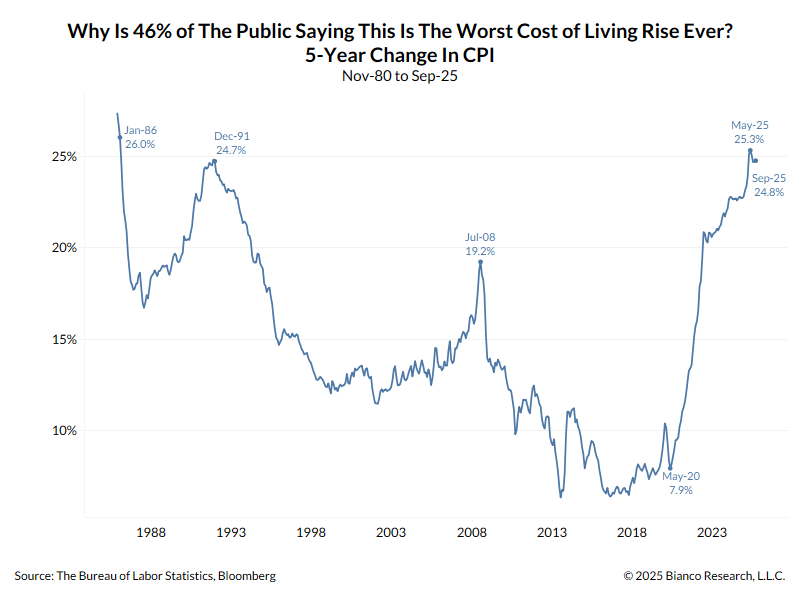
Revisiting the repost below ...46% of the public said affordability is the worst they have ever seen.
They are not wrong.
What question were they answering?
The last time CPI inflation rose this much over five years was almost 40 years ago.
If You're Looking For 3 Or 5 Year Fixed Rates: Make A Call To The Lender TODAY
If you are interested in Fixed Rates & have been in the middle of negotiating a Renewal or Purchase
Call the Lender or Broker TODAY & lock the rate in
Because 3 & 5 Year Bond Yields just BLEW UP
2/
While I'm sure the causes are complicated, no nation has leaned more into "diversity is our strength, we don't need a melting pot we have a salad bowl" immigration insanity than Canada.
It has the highest foreign-born share of the population in the entire G7 and its living standards have stagnated.