Technical Deep-Dive: R-VBS Protocol (Rialo-Verifiable Blob Streaming)
The R-VBS protocol is designed to transform passive video surveillance into a High-Integrity Digital Asset (HIDA). It operates by separating the "Data Blob" (the video) from the "Verification Logic" (the on-chain proof).
1. The Execution: Fragmented RISC-V Verification
Instead of storing massive video files on the blockchain, the camera at the edge generates a Cryptographic Hash Tree of each video segment.
The Process: Rialo’s RISC-V execution layer processes these hashes in sub-second timeframes.
Immutable Integrity: Only the root hash and the Time-Stamping Metadata are committed to the Rialo ledger.
On-chain Logic: If a single pixel in the video is altered by a hacker, the hash will not match the on-chain record, instantly triggering an alert via Rialo’s Reactive Transactions.
2. The Privacy: REX-Shielded Encryption
Using Real-world Privacy (REX), R-VBS ensures that video data is encrypted before it ever leaves the local network.
Zero-Knowledge Access: When a user wants to view their footage, Rialo uses Zero-Knowledge Proofs (ZKP) to verify the user’s identity through Native Account Abstraction (e.g., Email or Biometrics) without the cloud provider ever seeing the decryption keys.
Data Sovereignty: The decryption happens only on the user's local device, ensuring that even under a full server breach, the footage remains a useless, encrypted blob to the attacker.
3. The Economy: Perpetual Storage via SfS
To ensure the camera never stops recording due to "empty wallets," R-VBS utilizes the Stake-for-Service (SfS) model.
Yield-Powered Security: Users stake a set amount of Rialo tokens.
Continuous Operations: The yield from these tokens automatically generates Service Credits, which pay for the bandwidth and the R-Cloud storage vesta in real-time. This creates a "Set and Forget" security system that operates autonomously for years.
In the decentralized landscape of 2026, security is no longer a monolithic concept. For a developer or a startup like R-Cloud, understanding the duality between Personal Security (The Individual Lock) and Community Security (The Collective Fortress) is essential for building resilient systems on the @RialoHQ protocol.
1. Personal Security: Sovereign Data Custody
Personal security in Web3 focuses on the individual's control over their assets and identity, ensuring that no third party can access or manipulate their private information.
Native Account Abstraction (AA): Traditional personal security relies on the "Seed Phrase" bottleneck. Rialo shifts this to the protocol level, allowing for programmable security logic such as 2FA, social recovery, and biometric signing. This eliminates the single point of failure inherent in private key management.
Zero-Knowledge Privacy (REX): Through Real-world Privacy (REX), personal security becomes a matter of "selective disclosure." A user can prove they are a verified home-owner (for an RWA listing) without revealing their actual name or address on the public ledger.
Execution Sovereignty: By using the RISC-V instruction set, personal logic is executed in a deterministic sandbox. This ensures that even if the network is busy, your specific "secure fence" remains unbreached and your code executes exactly as written.
2. Community Security: Collective Network Resilience
Community security refers to the integrity of the network as a whole. It ensures that the "public square" remains open, functional, and resistant to systemic attacks.
Multiple Concurrent Proposers (MCP): Community security is maintained by decentralizing the power of block production. By allowing multiple nodes to propose blocks simultaneously, Rialo prevents any single "Leader" from monopolizing the network, thereby resisting censorship and MEV (Maximal Extractable Value) attacks.
Consensus Integrity: The network's safety is guaranteed by the collective agreement of validators. If one node fails or acts maliciously, the community's consensus mechanism (powered by Rialo's sub-second E2E latency) automatically bypasses the threat to maintain uptime.
Stake-for-Service (SfS) Stability: The community is economically secured through Staking. By locking capital, participants provide the "fuel" (Service Credits) that powers the entire ecosystem's infrastructure, ensuring that shared services like Native HTTPS or Oracles remain available and stable for everyone.
🔒 Rearchitecting Data Security: From Isolated Private Servers to Protocol-Enshrined @RialoHQ Infrastructure
For years, enterprises and privacy-conscious users have relied heavily on Private Servers (On-Premises / Private Cloud) as the ultimate shield for data security. The logic was simple: keeping data within a closed perimeter prevents external leaks. However, in today's hyper-connected landscape, isolated private servers face massive operational hurdles—ranging from complex port forwarding vulnerabilities to a lack of native, cross-organization verifiability.
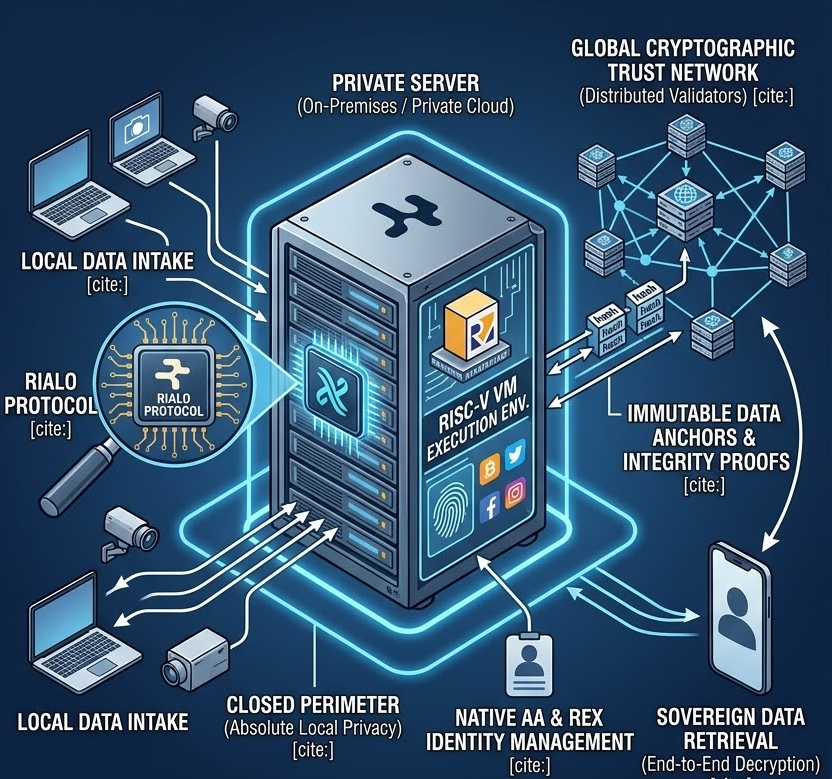
By rearchitecting traditional private server frameworks and connecting them directly through the Rialo Protocol, developers can build an immutable, Sovereign Data Infrastructure that maintains absolute local privacy while gaining global cryptographic trust.
1️⃣ The Vulnerabilities of Traditional Private Servers
While private servers excel at keeping data out of public cloud data centers, they suffer from critical architectural bottlenecks:
The Port Forwarding Trap: To access data remotely, administrators are forced to open network ports or maintain complex VPNs. This leaves the private server exposed to automated IP scanners and brute-force entry points.
Lack of Data Integrity Proofs: If an internal bad actor or an advanced persistent threat (APT) breaches the server and alters a log, a database entry, or an video frame, there is no decentralized ledger to prove the data was tampered with.
Centralized Access Control: Traditional identity management (passwords, centralized IAM) remains highly susceptible to credential stuffing and phishing attacks.
2️⃣ The Rialo Rearchitecture: Connecting Private Infrastructure
Integrating the Rialo Protocol natively restructures the data flow of a private server. Instead of treating the private server as an isolated, passive vault, it transforms it into an Active Secure Node within a globally verified ecosystem.
DTCC has been the backbone of global markets for over 50 years with $114T in custody and $3 quadrillion cleared every year.
This July they begin piloting tokenized securities trading, with a full launch in October. BlackRock, JPMorgan, Goldman Sachs, Nasdaq, Circle, Ondo, and Ripple are among the 50+ firms at the table.
This is what the next chapter of finance looks like.
AI policy is a badly tuned PID controller. It's trying to correct error without being able to measure error.
Every scandal triggers overshoot. Every demo triggers undershoot.
The fix isn't more regulation or less. It's better instrumentation.
This is huge!
What started as an internal tool for managing agents, now it will enable you & everyone unleash agents securely!
Sign up 👉 https://t.co/P12bb0WAq7
Agents outnumbering humans already.
Yet all our controls are human-speed.
Shadow employees (agents) will also soon outnumber actual human employees.
We need agent-native control mechanisms
🌐 Web3 Data Security & RWA Trends: Real-World Application of R-Cloud
The decentralization wave of 2026 has pushed Web3 far beyond isolated digital assets like speculative tokens. Today, the core focus has shifted toward securing physical infrastructure, private user information, and Real-World Assets (RWA) on-chain. As projects bridge the physical and digital domains, traditional centralized server models are proving insufficient to protect sensitive physical data.
Below is a deep-dive analysis of these security trends and how R-Cloud practically addresses them at the protocol level.
1️⃣ Macro Trends in Web3 Data Security & RWA
🛡️ Trend 1: Zero Trust & Edge Sovereignty
Organizations are moving away from trusting third-party cloud data centers. The new standard demands data encryption right at the source (the physical device or "Edge") before it ever hits the internet.
📁 Trend 2: The Emergence of Verifiable Heavy Data
For physical RWAs (like tokenized real estate, logistics tracking, or security infrastructure), simply tokenizing an asset is not enough. The accompanying "heavy data"—such as legal documents, continuous data streams, or sensor logs—must be stored immutably to prevent tampering.
🔑 Trend 3: Invisible Web3 Onboarding (Native AA)
To achieve mass adoption, systems must hide complex seed phrases. Users expect to interact with secure on-chain networks using familiar, frictionless authentication methods like biometrics, email, or SMS.
2️⃣ R-Cloud’s Practical Application Architecture 🔄
R-Cloud tackles these shifting paradigms by integrating seamlessly with the Rialo Protocol, transforming vulnerable hardware setups into a distributed, unbreachable data fortress.
📍 Stage 1: Local Capture & Traditional Cloud Decoupling
The Application: Security cameras or local IoT devices capture raw footage or physical data streams.
The Secure Fence: Unlike traditional platforms that ship raw streams straight to centralized corporate servers (leaving them prone to leaks and administrative abuse), R-Cloud isolates data locally at this phase.
⚙️ Stage 2: Hardware Enforcement via RISC-V VM
The Application: The raw physical data is instantly routed into an intelligent gateway or an embedded system running Rialo’s RISC-V Virtual Machine.
The Secure Fence: It performs end-to-end encryption (REX-Shielded) immediately at the edge. A cryptographic verification hash tree is computed directly on the hardware, establishing an unalterable proof of origin before any bytes touch the network.
🗄️ Stage 3: Parallel Storage & The SfS Economic Engine
3A: Decentralized Storage Blobs: The heavy, encrypted data blocks are split up and distributed across R-Cloud’s storage layer. Instead of recurring monthly fees, this is sustained by Rialo's Stake-for-Service (SfS) model—users stake tokens to continuously generate service credits for perpetual uptime.
3B: On-chain Verification Index: Simultaneously, the root hash and immutable timestamps are recorded onto the Rialo Blockchain. If a hacker manages to breach the physical storage and modify even a single pixel of a video stream, the on-chain hash mismatch immediately voids the data's integrity, exposing the breach in real time.
Stage 4 & 5: Sovereign Access & Client-Side Decryption
The Application: End users access their surveillance data or asset logs through consumer applications via a Web3 wallet infrastructure like Keplr.
The Secure Fence: Identity is verified through Zero-Knowledge Proofs (ZKP) and Native Account Abstraction (using email or biometrics) without exposing the user's private key or PII. The encrypted payload is downloaded directly to the user's device, where Sovereign Local Decryption occurs. The R-Cloud operators never hold or see the decryption keys.
🚀 Real-World Impact
By taking a localized physical infrastructure problem—such as vulnerable security camera storage—and addressing it with protocol-embedded tools (RISC-V execution, REX privacy, and SfS token economics) all in one with @RialoHQ , R-Cloud moves Web3 security from conceptual theories into day-to-day practicality. It provides standard consumer environments with institutional-grade data sovereignty, proving that when the truth of data is anchored on-chain, its security and real-world value increase exponentially.
🔒 Rearchitecting Data Security: From Isolated Private Servers to Protocol-Enshrined @RialoHQ Infrastructure
For years, enterprises and privacy-conscious users have relied heavily on Private Servers (On-Premises / Private Cloud) as the ultimate shield for data security. The logic was simple: keeping data within a closed perimeter prevents external leaks. However, in today's hyper-connected landscape, isolated private servers face massive operational hurdles—ranging from complex port forwarding vulnerabilities to a lack of native, cross-organization verifiability.
By rearchitecting traditional private server frameworks and connecting them directly through the Rialo Protocol, developers can build an immutable, Sovereign Data Infrastructure that maintains absolute local privacy while gaining global cryptographic trust.
1️⃣ The Vulnerabilities of Traditional Private Servers
While private servers excel at keeping data out of public cloud data centers, they suffer from critical architectural bottlenecks:
The Port Forwarding Trap: To access data remotely, administrators are forced to open network ports or maintain complex VPNs. This leaves the private server exposed to automated IP scanners and brute-force entry points.
Lack of Data Integrity Proofs: If an internal bad actor or an advanced persistent threat (APT) breaches the server and alters a log, a database entry, or an video frame, there is no decentralized ledger to prove the data was tampered with.
Centralized Access Control: Traditional identity management (passwords, centralized IAM) remains highly susceptible to credential stuffing and phishing attacks.
2️⃣ The Rialo Rearchitecture: Connecting Private Infrastructure
Integrating the Rialo Protocol natively restructures the data flow of a private server. Instead of treating the private server as an isolated, passive vault, it transforms it into an Active Secure Node within a globally verified ecosystem.
Technical Deep-Dive: R-VBS Protocol (Rialo-Verifiable Blob Streaming)
The R-VBS protocol is designed to transform passive video surveillance into a High-Integrity Digital Asset (HIDA). It operates by separating the "Data Blob" (the video) from the "Verification Logic" (the on-chain proof).
1. The Execution: Fragmented RISC-V Verification
Instead of storing massive video files on the blockchain, the camera at the edge generates a Cryptographic Hash Tree of each video segment.
The Process: Rialo’s RISC-V execution layer processes these hashes in sub-second timeframes.
Immutable Integrity: Only the root hash and the Time-Stamping Metadata are committed to the Rialo ledger.
On-chain Logic: If a single pixel in the video is altered by a hacker, the hash will not match the on-chain record, instantly triggering an alert via Rialo’s Reactive Transactions.
2. The Privacy: REX-Shielded Encryption
Using Real-world Privacy (REX), R-VBS ensures that video data is encrypted before it ever leaves the local network.
Zero-Knowledge Access: When a user wants to view their footage, Rialo uses Zero-Knowledge Proofs (ZKP) to verify the user’s identity through Native Account Abstraction (e.g., Email or Biometrics) without the cloud provider ever seeing the decryption keys.
Data Sovereignty: The decryption happens only on the user's local device, ensuring that even under a full server breach, the footage remains a useless, encrypted blob to the attacker.
3. The Economy: Perpetual Storage via SfS
To ensure the camera never stops recording due to "empty wallets," R-VBS utilizes the Stake-for-Service (SfS) model.
Yield-Powered Security: Users stake a set amount of Rialo tokens.
Continuous Operations: The yield from these tokens automatically generates Service Credits, which pay for the bandwidth and the R-Cloud storage vesta in real-time. This creates a "Set and Forget" security system that operates autonomously for years.
The internet's access model was built for humans.
Passwords. Sessions. API keys. OAuth tokens. Wallet keys.
Different shapes, same assumption: if you hold the secret, you can act.
That assumption breaks when the actor is software.
Early access is open: 👉 https://t.co/BtYLOQoLvH
🎉 I've successfully bound my wallet for the DSCVR Airdrop!
Early community members are being rewarded.
Have you checked yours yet?
👉 https://t.co/f9Gsr3CJzd
#DSCVR#Airdrop
It's nomi time.
I'm selecting:
✨ 1 Ritualist
✨ 1 Ritty
✨ 1 Ritty Bitty
If you think you're worthy of a nomination, tell me why in the comments.
- What have you contributed?
- How have you supported the community?
- Why should your name be on the list?
Convince me.
The most genuine, dedicated, and impactful community members will have my attention.
Let's see who stands out. 👀
Recently, I went through one of those short-lived relationships that felt meaningful for a moment.
At first, I thought it might turn into something real. We talked every day, shared plans, and imagined where things could go.
But some people are only meant to be chapters, not the whole story.
After everything settled, I realized there was one thing that never left, never changed, and was always there when I came back.
Ritual.
Markets changed.
People changed.
Feelings changed.
But Ritual stayed.
So maybe the temporary love story wasn't the one I lost.
Maybe it was just there to remind me that my most lasting relationship has been with Ritual all along. ❤️
The Github breach is the latest in a series of exploits which will multiply quickly in an agentic world. Simple and effective governance over agents is one of the most urgent issues at this point in time - and therefore a key focus of our team at @Subzero_Labs .
Stay tuned 🫡
🌐 Web3 Data Security & RWA Trends: Real-World Application of R-Cloud
The decentralization wave of 2026 has pushed Web3 far beyond isolated digital assets like speculative tokens. Today, the core focus has shifted toward securing physical infrastructure, private user information, and Real-World Assets (RWA) on-chain. As projects bridge the physical and digital domains, traditional centralized server models are proving insufficient to protect sensitive physical data.
Below is a deep-dive analysis of these security trends and how R-Cloud practically addresses them at the protocol level.
1️⃣ Macro Trends in Web3 Data Security & RWA
🛡️ Trend 1: Zero Trust & Edge Sovereignty
Organizations are moving away from trusting third-party cloud data centers. The new standard demands data encryption right at the source (the physical device or "Edge") before it ever hits the internet.
📁 Trend 2: The Emergence of Verifiable Heavy Data
For physical RWAs (like tokenized real estate, logistics tracking, or security infrastructure), simply tokenizing an asset is not enough. The accompanying "heavy data"—such as legal documents, continuous data streams, or sensor logs—must be stored immutably to prevent tampering.
🔑 Trend 3: Invisible Web3 Onboarding (Native AA)
To achieve mass adoption, systems must hide complex seed phrases. Users expect to interact with secure on-chain networks using familiar, frictionless authentication methods like biometrics, email, or SMS.
2️⃣ R-Cloud’s Practical Application Architecture 🔄
R-Cloud tackles these shifting paradigms by integrating seamlessly with the Rialo Protocol, transforming vulnerable hardware setups into a distributed, unbreachable data fortress.
📍 Stage 1: Local Capture & Traditional Cloud Decoupling
The Application: Security cameras or local IoT devices capture raw footage or physical data streams.
The Secure Fence: Unlike traditional platforms that ship raw streams straight to centralized corporate servers (leaving them prone to leaks and administrative abuse), R-Cloud isolates data locally at this phase.
⚙️ Stage 2: Hardware Enforcement via RISC-V VM
The Application: The raw physical data is instantly routed into an intelligent gateway or an embedded system running Rialo’s RISC-V Virtual Machine.
The Secure Fence: It performs end-to-end encryption (REX-Shielded) immediately at the edge. A cryptographic verification hash tree is computed directly on the hardware, establishing an unalterable proof of origin before any bytes touch the network.
🗄️ Stage 3: Parallel Storage & The SfS Economic Engine
3A: Decentralized Storage Blobs: The heavy, encrypted data blocks are split up and distributed across R-Cloud’s storage layer. Instead of recurring monthly fees, this is sustained by Rialo's Stake-for-Service (SfS) model—users stake tokens to continuously generate service credits for perpetual uptime.
3B: On-chain Verification Index: Simultaneously, the root hash and immutable timestamps are recorded onto the Rialo Blockchain. If a hacker manages to breach the physical storage and modify even a single pixel of a video stream, the on-chain hash mismatch immediately voids the data's integrity, exposing the breach in real time.
Stage 4 & 5: Sovereign Access & Client-Side Decryption
The Application: End users access their surveillance data or asset logs through consumer applications via a Web3 wallet infrastructure like Keplr.
The Secure Fence: Identity is verified through Zero-Knowledge Proofs (ZKP) and Native Account Abstraction (using email or biometrics) without exposing the user's private key or PII. The encrypted payload is downloaded directly to the user's device, where Sovereign Local Decryption occurs. The R-Cloud operators never hold or see the decryption keys.
🚀 Real-World Impact
By taking a localized physical infrastructure problem—such as vulnerable security camera storage—and addressing it with protocol-embedded tools (RISC-V execution, REX privacy, and SfS token economics) all in one with @RialoHQ , R-Cloud moves Web3 security from conceptual theories into day-to-day practicality. It provides standard consumer environments with institutional-grade data sovereignty, proving that when the truth of data is anchored on-chain, its security and real-world value increase exponentially.
MODERN INTEGRATION TREND (HYBRID & BLOCKCHAIN MODEL)
The current data infrastructure security trend (which is being strongly applied in new generation security projects) is to blur the boundary between Cloud and Local with decentralized protocols:
Zero Trust Architecture: Trust no one, whether on the local LAN or on the Cloud. All data access requests must be continuously authenticated via solutions such as Account Abstraction or biometrics.
Decentralized authentication on Chain (On-chain Verification): Big data (such as videos, heavy files) is still stored in Cloud or Private Cloud storage, but the integrity proof (Cryptographic Hash) is recorded on a public, secure Blockchain. This helps completely prevent hackers from penetrating the Cloud to edit or delete traces of data sent from the local network.
So RCloud builds on @RialoHQ's trend and strategy of focusing on data infrastructure
Increase speed, save costs, more security, more power in every bit of data
We are constantly thinking about and developing new infrastructure for R-Cloud to ensure stability and flexibility in data bits.