The entire tech industry (save for Anthropic) has come out in favor of open source AI.
So what happens next? Will Anthropic change its lobbying efforts? Not likely. Now the gaslighting begins:
“Nobody is trying to ban open source.”
“We just want to limit who can use it.”
“We just want to limit who can contribute to it.”
“We just want to limit how powerful those models can be.”
“We just want to make sure the guardrails (we lobbied for) can’t be removed.”
The net effect will be the same. They won’t stop until they kneecap open source. The rest of the industry needs to watch these guys like a hawk.
AOC will be the 2028 Democrats presidential nominee.
I’ve been saying this for 2 years.
Gavin Newsom’s favorability among likely New Hampshire Democratic primary voters has fallen from 58% to 38% in just nine months, while his ballot support has dropped from 15% to 8%.
Meanwhile, AOC now holds a +55 net favorability compared to Newsom’s +12.
The progressive wing is consolidating behind AOC.
Don’t forget that Bernie beat Hillary in 2016 but the Dens pushed Bernie out.
That won’t work with AOC.
Both Democrats and Republicans have a problem but they’re different problems.
Democrats’ problem: They don’t know how to handle the DSA.
They’re:
• Younger
• More energized
• Louder
• Better at simple messaging
Their message is easy to understand:
1. Rich people are the problem.
2. Tax the rich.
3. A wealth tax will fix inequality.
4. Government can solve your affordability crisis.
5. The system isn’t fair.
Newsom made the mistake of aligning himself with democratic socialists, but it backfired.
He’s undeniably talented, but many voters struggle to identify what he truly stands for. Too often, it feels like he’ll change positions if it improves his chances of becoming president.
Republicans problem:
Affordability
Affordability
Affordability
They need credible, easy to understand solutions to the affordability crisis.
Wall Street is not Main Street.
Don’t let the stock market convince you that most Americans are doing well.
80% of Americans don’t care how great NVIDIA, Anthropic, SpaceX and Palantir stock are doing.
Housing affordability, rising costs, and economic opportunity are defining issues.
People are delaying buying homes, getting married, and starting families because they simply can’t afford it.
Socialism has a miserable history of failure, but telling people that alone isn’t enough. Many who feel they have little to lose will still be willing to give it a chance.
Simply attacking socialism won’t win the argument.
Offering a better solution and communicating it more effectively might.
Whoever presents a real solution with a simple, compelling message will have a major advantage in the post Trump era.
The political battles ahead are going to get 10x nastier than what we’ve seen so far.
The biggest elephant in the room is leaving.
It’s about to get nasty.
White House:
Today, we honor four American heroes who made the ultimate sacrifice in service to our nation.
1st Lt. Tyler Feehan
Sgt. Michael Swinton
Sgt. Angel Rampersad
Pvt. Isabella Gonzales
May God hold them in His eternal embrace and comfort their grieving families, and may God forever bless the United States of America. 🙏🇺🇸
Texas mourns the loss of Army Pvt. Isabella Gonzales of Carrollton, killed in action serving our nation in Jordan. She was just 19 years old. Her courage and sacrifice represent the very best of Texas.
Cecilia and I pray for her family, and for the family of 1st Lt. Tyler Feehan of Hawaii. Our nation is forever indebted to them both. God bless our fallen heroes, and God bless Texas.
I’ve just finished reading Gad Saad’s book Suicidal Empathy.
It ranks, along with Chris Rufo’s America’s Cultural Revolution: How the Radical Left Conquered Everything and Helen Pluckrose and James Lindsay’s Cynical Theories, as the best take-down of the lunacy at the heart of the wokeist philosophy.
For Saad, empathy—in itself a perfectly decent trait—has become so grossly exaggerated that it threatens truth, reality, and justice.
Cases in point abound: so they won’t feel bad about themselves, we’ll allow biological men to compete in women’s sports and crush the dreams of thousands of young women; so as not to undermine the self-esteem of minorities, we will permit unqualified candidates to have positions in universities and the corporate world; so that everyone might feel included, we will characterize the meritocracy as “white privilege,” etc.
As I was making my way through Saad’s book, I kept remarking the sharp distinction between empathy and love.
To empathize is to enter profoundly into the experience of another and to endeavor not to hurt that person’s feelings. But to love is, as Thomas Aquinas taught, “to will the good of the other.”
As I said, in itself and all things being equal, empathy is a good thing. But it is not the same as love, which, depending on circumstances, can very much involve hurting someone’s feelings.
When a professor gives a student a “C” as an honest reflection of his work, he might well be insulting him, but he’s also telling him the truth and perhaps even urging him to try harder.
When, in the Confessional, a priest tells a murderer to turn himself in to the police, he’s undoubtedly making that person’s life more uncomfortable, but he’s also willing the man’s good.
Any decent parent knows that showing real love for her children means engendering all kinds of bad feelings in them.
In light of this distinction, we can understand why Jesus didn’t say, “have empathy for one another,” but rather “love one another.” And why St. John the Evangelist didn’t say, “God is empathy,” but rather “God is love.”
It occurred to me as I was reading Saad’s book that one reason Wokeism has seized the consciousness of so many in the West is that Christianity has faded as a cultural force and Christians themselves have forgotten what stands at the heart of their faith.
Our hearts are heavy today for 19-year-old Pvt. Isabella Gonzales of Carrollton, Texas. This brave young soldier was killed Friday in Iranian missile and drone attacks on a U.S. base in Jordan.
At just 19, she selflessly answered the call to defend our nation. Her courage and sacrifice will never be forgotten.
Sending deepest condolences and prayers to her family, friends, and all who loved her. May God wrap you in comfort and grant her eternal peace.
Thank you for your service, Isabella. You are a true hero. 🇺🇸
⚡️The truth is that a large share of modern economic activity exists because human beings fail, suffer, violate rules, misunderstand systems, get sick, crash, default, litigate, and need remediation.
The economy does not merely tolerate dysfunction.
It often organizes around it.
Once enough salaries, municipal budgets, law firms, insurers, contractors, vendors, software systems, and political relationships depend on a recurring failure, that failure stops being treated as a problem to eliminate. It becomes a protected input.
That is what autonomous vehicles threaten.
They threaten the accident economy.
Every collision currently creates a cascade of billable events. Police response. Towing. Storage. Repair. Medical care. Claims administration. Legal discovery. Expert testimony. Court processing. Insurance repricing. Rental vehicles. Replacement parts. Municipal citations. Administrative labor. One mistake feeds dozens of balance sheets.
A machine that drives better destroys the cascade at the source.
That is why resistance will become intense, respectable, technical, and morally disguised. Nobody will publicly defend accidents. The defense will appear through standards, liability concerns, public safety hearings, local control, labor protection, data privacy, accessibility rules, cybersecurity mandates, and emergency exceptions.
Some concerns will be legitimate. The aggregate behavior will still reveal the deeper objective: slow the destruction of incumbent cash flows.
The trial lawyers are only the visible edge.
The larger threatened bloc includes insurers whose pricing power depends on uncertainty, municipalities that monetize driver mistakes, body shops that depend on damage volume, dealers that profit from maintenance and replacement cycles, police departments funded partly through traffic enforcement, parking systems built around imperfect human behavior, and local governments whose fiscal architecture quietly assumes people will violate rules.
Autonomy attacks all of them simultaneously.
That makes it politically dangerous far beyond transportation.
A fully autonomous fleet would expose how much of the state and service economy functions as a tax on human imperfection. Speeding revenue collapses. Parking fines shrink. Towing contracts weaken. Accident litigation falls. Insurance premiums compress. Repair demand drops. Vehicle utilization rises. Personal car ownership declines. Dealership economics weaken. Urban parking assets lose value. Emergency response patterns change.
The technology removes friction, and the surrounding institutions discover that friction was their revenue model.
⚡️Civilizations decay when they begin optimizing the measurement instead of the reality.
GDP instead of production.
Asset prices instead of ownership.
Credentials instead of competence.
Engagement instead of understanding.
Compliance instead of trust.
Growth instead of flourishing.
The symbol slowly replaces the substance.
For a while the substitution works because belief bridges the gap.
Eventually reality demands settlement.
That is where this era feels different.
The settlement has started.
Physics is reclaiming authority from narrative.
Energy is reclaiming authority from finance.
Production is reclaiming authority from branding.
Scarcity is reclaiming authority from abundance.
Reality is reclaiming authority from stories.
That is the deepest pattern emerging. Not collapse. Not utopia.
A return to first principles.
The physical world is quietly overruling every abstraction built on top of it.
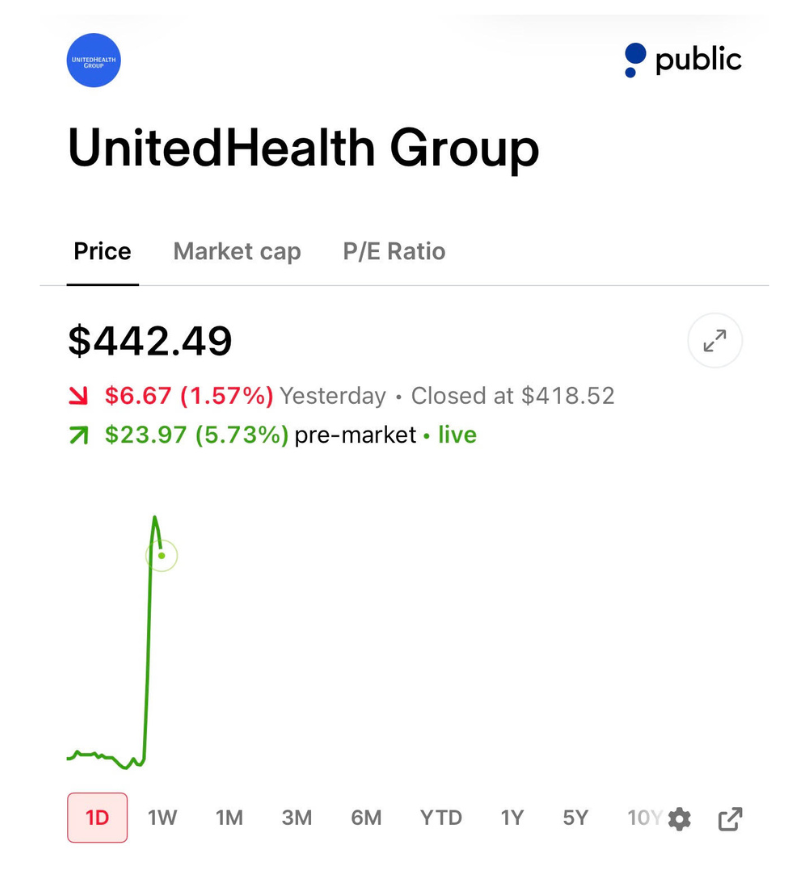
$UNH Q2 EARNINGS
• Revenue $112.0B vs Est. $110.8B
• EPS $6.38 vs Est. $4.85
• Medical Care Ratio 86.7% vs. Est. 88.6%
FY26 Guidance
• EPS $19.75 vs Est. $18.32
�� Medical Care Ratio: 88.1% vs. Est. 88.8%
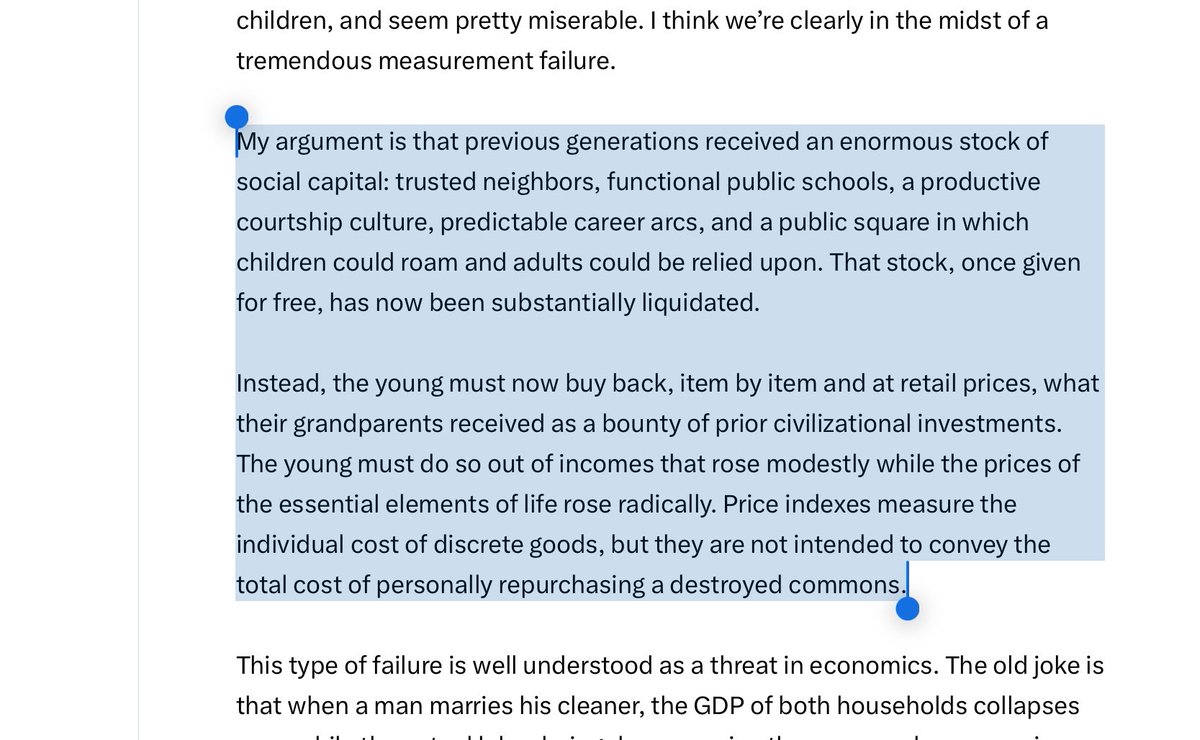
Social Capital™️
I have never seen the plight of my generation articulated so well.
This is the core issue we must solve, we must provide abundant social capital to the next generation - using the levers of politics and private industry - or humanity as we know it will end.
Simple yet consistently effective approach for a long time:
Step 1:
Wait for a Mag 7 name to fall deeply out of favor.
Step 2:
Buy hand over fist.
Step 3:
Wait.
Step 4:
Look smart while taking very little risk.
"What country are we not paying enough attention to?"
JPMorgan CEO Jamie Dimon:
"Europe's GDP per person has gone from 90% of America to 70% because of their own bad policies. And that's going to hurt us one day."
"I would give them one big beautiful free trade bill. The whole of Europe. It would be unbelievable for their growth and for our growth."
"It's when the economy can no longer afford the military they need. That's the problem, and Europe is kind of there right now. And we're staring that in the face."
The Hill & Valley Forum 2026
@HillValleyForum@jpmorgan@ChairmanG
Every bond manager alive learned the job inside a bull market.
Rates peaked in 1981 at 15%. Then they fell for 39 straight years. A trader who started that year retired before the trend ever broke.
Pull the chart back to 1806 and you find four secular lows: 1830, 1886, 1945 and 2020.
Each cycle ran 56 to 67 years, trough to trough. Each turn reset the investing world for two generations.
The 2020 low printed at 1%. Today the 30 year sits at 4.98%, pressed against 5% for months.
If this is the fourth turn, we are six years in.
In 1951, six years after the 1945 low, the bond bear had another three decades left to run.
Bonds are the largest asset class on earth. The safe half of every pension, every insurer, every retirement account.
The safe half is early in a cycle that nobody working today has ever traded.