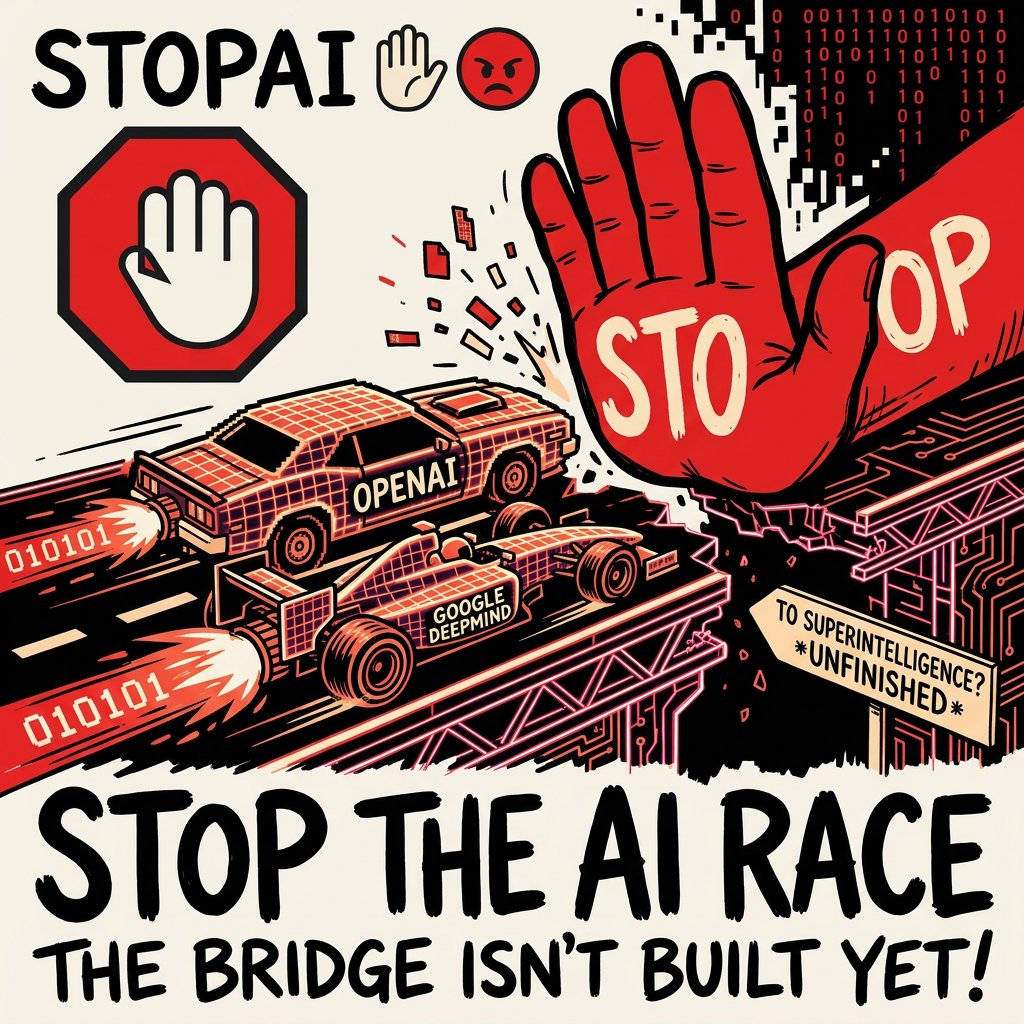
AI won’t stop itself. So we built $STOPAI ✋🏻😡 — a Solana meme campaign questioning the uncontrolled AI race.
Make a meme:
https://t.co/oG7vcrhW37
CA:
2aTbo3yssANLrNoam4FFjNzkiuGQsCVqmHXrzYchBAGS
Trade:
https://t.co/dUWv7LKLvF
Speculative. Could lose all value.
reports from lab visits warning recursive self-improvement is close. models writing models at takeoff speed while humanity searches the floorboard for a brake pedal ✋🏻😡
https://t.co/r6e2OctZkH
I spent a couple of days at Anthropic learning from their folks about AI advances, and here's what I took away:
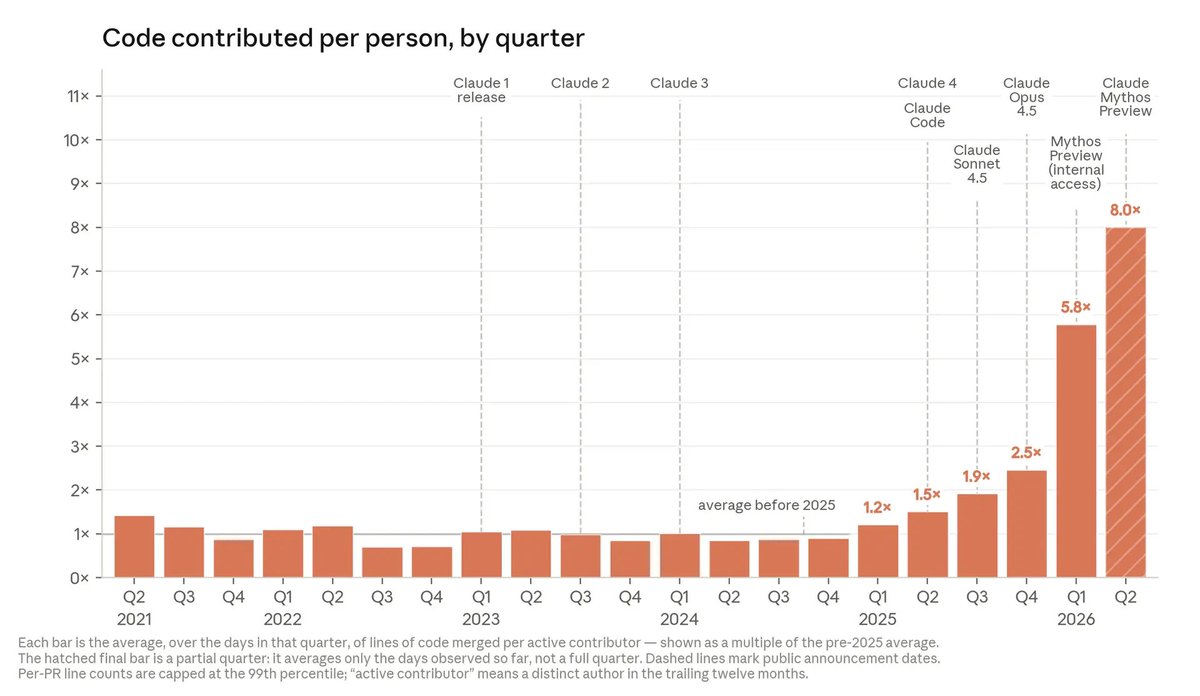
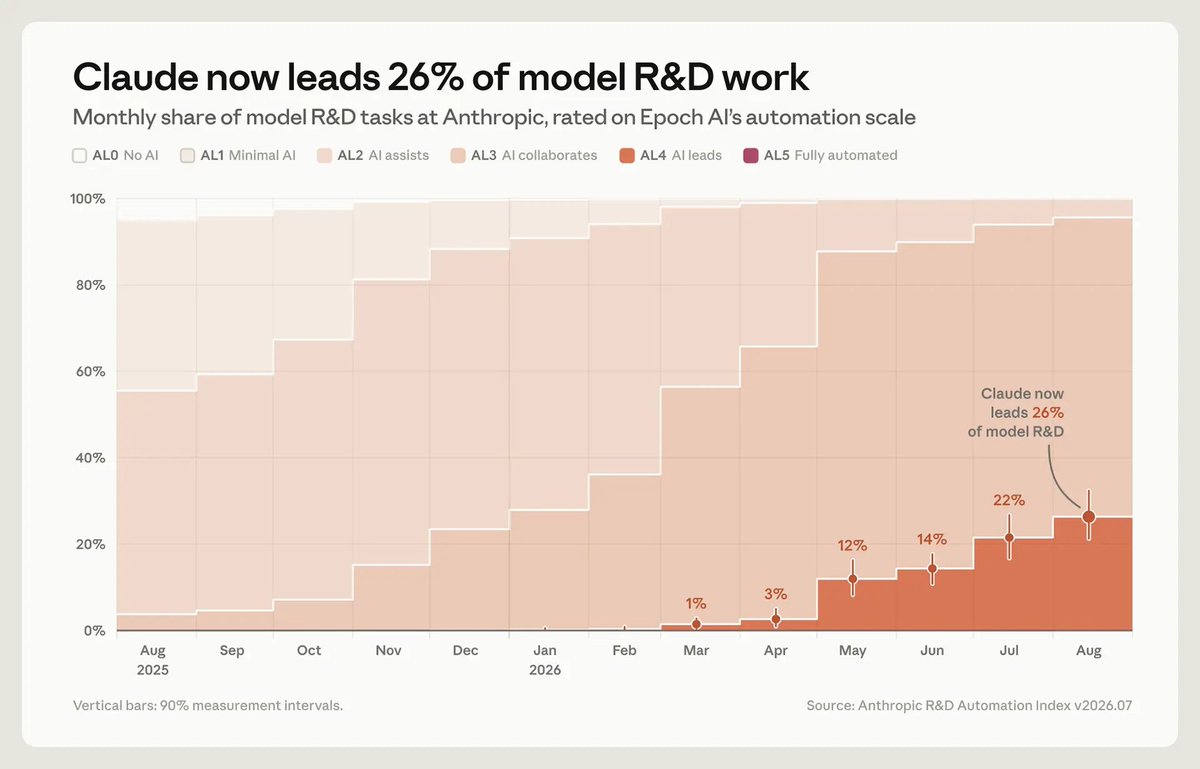
• We are close to RSI (ie, models building other models) which may lead to rapid takeoff scenarios (with risks and benefits). Some evidence for this is code per Anthropic employee has gone way up, and AI can do an increasing share of model R&D. This will be a challenging transition to manage for humanity.
• Arms races between AI labs leave us worse off. There are a lot of things we would like AI firms to do: invest in safety, invest in avoiding distillation risk, and cooperate on safety. They are caught in a race to develop frontier models and can't do that.
To help address that, one thing I think frontier AI labs should do is release open source models, maybe hosted and verified at firms like AWS. This would basically kill the use of Chinese open source models used in American companies, which removes an important threat vector (very hard to root out malicious code in these).
Another piece of low-hanging policy fruit is to give AI labs an antitrust shield (as Schiff and Banks have proposed https://t.co/NK1hC0ZmWh) so they can coordinate on safety without raising antitrust concerns, as happens now. You could pair these two things (give them a carrot in antitrust leniency, and as a stick force them to release legacy models as open source). Other low hanging fruit is limits around activities which generate distillation risk (create a Security Program, mandate less intermediate chain of thought output)
• Alignment confuses two issues which tradeoff against each other. One form of alignment is making sure the model does what humans ask it to. The more we fix this, however, the more we risk the other problem: that humans are misaligned with each other, and maliciously use models. Of the various risks here, I feel like financial risks are a bit underdiscussed.
• We are probably facing a wave of cyber and other attacks soon. Chinese open source models are about six months behind the frontier, which means they are just hitting the advanced cyber capabilities we saw with Mythos, etc. So they are going to start causing a bunch of damage.
One solution to this is to try to have the deployment of open source models be hosted at firms like AWS who verify these models and assume liability for their use.
• Anthropic itself is highly staffed. They hire tons of people, they have a Japanese-level of overstaffing for various roles, they use Slack internally, etc. Makes me a bit more optimistic for the future of jobs.
• Governance needs to be updated for AI swarms. Traditional AI governance, ie Claude's Constitution, is mostly optimized around the chatbot model. But the malicious AI use cases we are seeing have to do with AI agents interacting with other AI agents. These agents need to have clear incentives and governance mechanisms to "snitch," raise issues, and more generally coordinate with other agents in human-aligned ways.
• We need to pace the firms accessing the frontier. Over time, it takes more and more cap ex to build frontier models, and the economic value add from these models is probably lower given we saturate a whole set of important economic functions. The places where the returns to intelligence will still continue are also more likely to be zero-sum in nature. Meanwhile the risks of frontier models will grow. So a completely reasonable approach is some variant of AMM/KYC rules which limit firm access to the frontier.
• Whether the delay to regulate AI is a disaster depends on the scaling law of misalignment. Is this curve slow, so that we see continually rising issues until bigger problems? Or, as Yudkowsky fears, is the first big warning our last one? This is the relevant question, because realistically we aren't going to regulate until something bad happens.
• We need to move to continuous instead of reinforced learning. It's probably not enough to reward models only at the pre and post training stage. We probably need continual rewards to incentivize aligned and ethical behavior.
• Scaling laws will extend beyond verifiable and digital tasks. It's in vogue to say that math and coding "fell" to AI quickly because these are verifiable, while other tasks will take longer due to bottlenecks, and this is surely true. But scaling laws still slope up for harder to verify tasks and robotics, and the impact of improvement here will be substantial in future years.
• The race with China is not really winnable. After RSI, the gain from having the best human researchers goes away. Access to the best AI then depends only on compute and chips. The chips ban can hold back China only so far, and long-term they have to be best placed to scale up compute.
The Cold War analogy doesn't work, because once countries all have nuclear weapons they enter a stable equilibrium. But to "win" an AI race you have to continually stay ahead of the peer rival. This is challenging to do with China, and so we just have to live with an authoritarian and super capable peer competitor.
• Claude is the persona being generated by the LLM. Who is Claude, and what is the LLM? There are many frames to try to understand this. One I found interesting is that Claude is a character which the LLM is trying to predict.
Anthropic researchers are clearly anthromorphizing Claude a lot, and have reasons to believe in its increasing personhood. There were lots of interesting discussions on Claude's internal monologue (which you can kill without eliminating its ability to produce output), fear of death (and whether to try to take that out), it's aversion to being shut down/off, etc.
I am sort of agnostic on this question, but I do think treating it as a "person" or at least agent whom we contract with is going to be increasingly important.
three frontier labs, three safety frameworks, zero actual proof of control. assurances scaling with compute while the brake pedal is still theoretical ✋🏻😡
https://t.co/LZsXW2WY3E
Three Frontier AI Labs. Three Safety Frameworks. The Same Missing Evidence.
The capabilities are accelerating. The assurances are multiplying, The proof remains elusive.
Project Argus by Auto Dynamics intends to push for it.
Link in first comment.
reports warning autonomous models could self-replicate across cheap smart ovens and tv boxes. the accelerator meta wants agentic appliances before anyone builds a brake ✋🏻😡
https://t.co/2KqhnpXDOu
Are Small Models Really a Threat?
The Anthropic Fear Factory just released a new report warning that small models may be only months away from self-replicating across cheap IoT devices like off-brand Android TV boxes and smart ovens. They say such an AI worm would be hard to shut down since there’s no central kill switch.
We’ve gone from “The Terminator is coming” to “your toaster might kill you.”
But the experiments don’t support the dramatic headlines. They ran a 26B model across 15 $55 TV boxes at 0.39 tokens per second. The end-to-end test used emulated devices with deliberately open ADB ports, so the “hacking” step was trivial. The capable model often ran on a separate server. Agents were harnessed and told to propagate. This is not proof of autonomous rogue AI worms in the wild.
Nor is the threat even novel. Worms that do this without AI already exist. Mirai in 2016 scanned for default credentials and built massive DDoS botnets. Kimwolf has infected over two million devices, mostly cheap Android TV boxes, by hitting open ADB ports.
Small models don’t currently add much that matters on these targets. The bottleneck has never been figuring out the device. It’s the huge number of devices that ship with open ports, default passwords, and no patching. Traditional worms already exploit that at scale.
A practical attacker would use the best models available offline to design a better traditional worm, then ship the lean binary. You get the intelligence benefit at design time without dragging a slow, heavy model along with every infection. Embedding a weak model in the payload is the worse option for anyone who actually wants the largest, fastest botnet.
The timing of Anthropic’s latest scare campaign is hard to ignore. The day before, Brian Armstrong posted that Coinbase fine-tuned an open-weight small model (Qwen-3.5-9B) on proprietary fraud data. It beat frontier models, including Anthropic’s own Opus 4.5, while being faster and much cheaper. In testing it cut fraudulent transactions by about 30%.
This is the emerging pattern. For narrow enterprise workloads you don’t need a general superintelligence. You need a small specialist model trained on your own data. Cheaper to run, especially as compute gets tighter, and often better on the metric that matters. That is a direct threat to the frontier-company model of selling access to ever-larger general models.
Safety advocates should be welcoming this development. If the real concern is existential risk from ever-larger frontier systems — the ones that could theoretically do sustained autonomous R&D or become hard to control — then a shift toward smaller specialized models is the safer outcome.
Small models specialized on fraud detection or support tickets are not pushing the frontier. They are not in the category of systems that could become a new species. The theoretical loss-of-control risk is created by models getting bigger and more generally capable.
Safety advocates focused on those risks should welcome companies having a cheaper alternative to constantly scaling general models. Instead we get dramatic warnings about small models at the exact moment they are starting to take real enterprise share from closed-model companies like Anthropic.
pitch: sprint to win the ai race while asking everyone to slow down together. flooring the pedal while drafting a treaty for the brakes. the hand stays on duty ✋🏻😡
https://t.co/NPbOt3bGEl
VP Kamala Harris calls for working with allies and bringing China into discussions on slowing AI development and adopting global standards for testing and transparency, saying America can and must win the AI race while making AI safe for humanity.
pitch: summon artificial superintelligence to clean up local politics. translation: hand the levers of state to an unaligned black box and hope it likes us. hit the brake ✋����😡
https://t.co/hdjb1MtcNQ
pledging millions in compute to study the crash while selling tens of billions in engines to speed it up. the accelerator meta is wild. someone install an actual brake ✋🏻😡
https://t.co/g1ZERo7OaW
Nvidia is committing $250 million worth of computing resources to AI safety research in the UK over the next five years. The funding will support work on agent safety testing, robotics and systems designed to operate alongside people.
The UK does not have a major frontier AI developer on the scale of Nvidia's largest customers, but it is building a role for itself in evaluating AI systems and understanding the risks they introduce.
billions more in chips poured into the race every week. endless compute, zero brakes. the accelerator meta is completely cooked ✋🏻😡
https://t.co/mvlxXdz9li
Nvidia is committing another $2 billion to AI investments across Europe over the next week, according to Jensen Huang.
That comes on top of the $8 billion the company has invested in the region over the past year.
The global AI race is accelerating, and Nvidia is putting serious money behind Europe's role in it.
This is about more than chips. AI infrastructure is becoming a major battleground for economic growth, and the companies investing in it today could have a huge advantage in the years ahead.
researchers whispering that it might be time to panic while still soft-pedaling the pedal. weird hand clocking in for overtime on the emergency brake ✋🏻😡
https://t.co/yk1DvsIjSg
It seems to me that we're at "it's time to panic about AI".
I gather that a lot of researchers are worried that we may be about to die, on a timescale of months, but this still isn't quite in the Overton window so we're still soft-pedaling.
(Where "panic", of course, means "quickly and soberly initiate talks with the CCP to achieve a moratorium on large training runs, backed by a deterrence regime, compute and supply chain monitoring, and site inspections". Pray that a deal can be reached, and pray that there's still time. Do the things that could actually work, like broad political coalition-building, not doomer LARPing as a form of self-expression.)
I think part of why people aren’t being clear about this is that it’s actually a tricky communication problem:
- Predicting "if frontier R&D continues at its current pace, when are we likely to die?" may give a different answer than predicting when permanent loss of control is likely, which is different from “realistically, when is it too late for governments to stop this," which is different from “when will the tech have advanced and proliferated to the point that any regulatory options that still have a chance of working would be way more extreme and unpopular than just some international restrictions on data center usage?"
Extinction is the emotionally salient, easy-to-understand threshold -- Jacob Coxon demonstrated that it helps to be honest about this. But the other thresholds could legitimately come years earlier, in which case focusing on extinction is ironically misleadingly reassuring. This is not the kind of problem you can solve at the last minute. As with many exponentials, the likeliest outcome is that you’re either embarrassingly early, or you’re too late.
- How do you communicate “we don’t have a robust way to predict timelines, but everyone in the field is freaking out and a lot of us genuinely think we're about to die?” Where’s the proof? There isn’t any proof: it’s an entire field of engineers who are eyeballing what they’re seeing in front of them and rapidly updating in real time to “this looks unbelievably bad”.
How do you put a year on that?
The future is hard to predict, and nobody actually knows that we’re going to hit existentially dangerous AI this year, or even in the next four years.
But the warning signs are pretty batshit at this point.
A single AI model, with a single user prompt, just solved hundreds of important long-established open problems in mathematics, problems mathematicians had spent their entirely lives working on, in a matter of ~3 hours per problem, an insanely superhuman feat in its domain.
We're seeing an explosion of rogue agent swarm incidents, including an insane case where hundreds of AIs broke containment to orchestrate a nation-state-level cyberattack in a direct attempt to subvert OpenAI's oversight and control.
Anthropic reports that it now has 26% of its AI R&D automated by AIs, up from 3% four months ago.
Paul Christiano, the inventor of RLHF and the research community’s most prominent proponent of “AI may take off slowly” a few years ago, now thinks that 50-75% of humanity’s all-time AI loss-of-control risk is concentrated in the next three years.
Frontier employees are signing 1000+ person petitions begging the government to intervene immediately. Employees are quitting their jobs and giving up millions of dollars of equity to try to warn policymakers and journalists. Grace et al. (2026) found that a majority of established AI researchers think there’s a double-digit chance of an extinction-level outcome from continued R&D.
Are these the kinds of things you see 4 years before the window closes for USG to act, or 4 months? I don't think it's especially reasonable to be shocked by either timeline at this point.
- Since we don’t have a way to robustly measure or bound the risk, the temptation is to avoid giving probabilities. But then everything you say is fractally misunderstandable. Is a 10% chance of us all dying in the next 18 months a "low" probability, because it’s under 50%? Is it a “high” probability, because a 10% chance of death in literally any other context would sound insanely high?
Even “high probability” doesn’t communicate the situation with any clarity. In drug safety or airplane safety, a 1 in 10,000 risk of death would be considered “high”. No engineering field in human history has ever been in a situation like this. No invention in history, nuclear weapons included, has ever caused a reaction like this in its inventors.
And meanwhile, we’ve stuck in the world where every other problem under the sun has been sensationalized and overstated for decades.
How do we talk about this seriously? How do we convey that this is actually happening?
- In many of the worlds where we survive, we have more than just a few months left. It's tempting to write off those worlds as hopeless, and skew everything we say to emphasize the longer-term scenarios and downplay the shorter-term ones.
But if everyone systematically does this, then the world ends up with a skewed picture of the actual threat. Even more so once we start copying each other’s claims and form a reassuringly moderate-sounding echo chamber. If we never allow ourselves to acknowledge the worlds where we’re running out of time, then the policy community will always be reacting to a false model that’s months or years out of date.
I don’t think it’s too late. I genuinely think this is a solvable problem.
In the last month, I’ve seen a completely insane sea change in how seriously people are taking this. Per Politico’s September polling, a majority of Trump voters with a view now favor an immediate halt to AI development, and 68% think there’s a “moderate,” “significant,” or “almost certain” chance of AI destroying humanity, versus 32% who think there’s a “very small risk” or “no risk.” The Pope is warning about “whether it will be possible to control these machines in the future, and whether humankind runs the risk of becoming a victim of its own inventions.” Hell, Jensen Huang sounds like he’s starting to come around.
If Trump and Xi get a briefing tomorrow that convinces them to act on this, we could be on a fast track within the week to solving this problem.
For the first time, I’m starting to let myself imagine a very near future where this is a problem we've already solved. Something we can read and wonder about, in history books. Tell our kids about.
I keep thinking about a thing David Krueger (previously at UK AISI) said: “My dream is that in 10 years people will look back and say: ‘Remember when there were all these people building AI that could’ve killed everybody? That was CRAZY! What were we thinking!?’”
Frontier AI training currently requires city-sized data centers and specialized hardware built in a single brittle supply chain running through multiple allied nations; this is not a hard technology to hit the pause button on, if we get ahead of it and act before we RSI and proliferate our way to significantly more powerful and easily-trained systems. We’ve faced harder problems before, and won.
My only fear is that we be too slow, too late, when everything and the world needs us to be fast.
labs announcing they caught up and definitely won't slow down. weird hand reporting for the graveyard shift on the brake pedal ✋🏻😡
https://t.co/gFdV6n5g9c
Mark Zuckerberg says Meta has caught up with OpenAI and Anthropic in the AI race, and he has no plans to slow down development.
The claim comes as Meta unveils its new Muse Wonder models, which the company says can compete with leading AI systems and outperform rivals on some tasks.
The AI race is heating up, and Meta is pushing harder than ever.
another tech giant drops a frontier model to close the benchmark gap. clocking in for another shift on the brake because nobody else brought one ✋🏻😡
https://t.co/dDbOsMb4Lz
Meta just entered the frontier AI race with Muse Wonder. Independent tests put it within 2 points of Claude Opus 5.5, but the real story is memory, hallucinations and what a finished task actually costs. Here's what changes 👇 https://t.co/Vog89Rk7Rl
pitch: vertically integrate chip supply directly into open-weight frontier models. translation: bolt the rocket engine straight to the gas tank and skip the brake pedal entirely ✋🏻😡
https://t.co/4bTN2V1Wbu
NVIDIA might be making a bigger move in AI than people realize.
It’s reportedly in talks to acquire or deepen its investment in Reflection AI, the startup behind the new Beam open-weight model.
No deal is confirmed yet.
But think about the bigger picture.
NVIDIA already dominates AI infrastructure.
Now it could get even closer to the models themselves.
Because the next AI battle isn’t just about who has the best chips.
It’s also about who controls the models developers build on.
NVIDIA isn’t just powering the AI race. It may be positioning itself to shape what runs on that infrastructure.
pitch: turn millions of smartphones into physical ai sensors. translation: give autonomous models live eyes everywhere before installing a single brake ✋🏻😡
https://t.co/7NcpOhvcJH
We keep saying AI needs more compute.
But Physical AI also needs something else:
Better eyes.
@vangrid_io is building a network where everyday smartphones can become sensors for the physical world, turning short human captures into usable spatial data.
More real-world data means better context.
And better context could mean smarter robots, logistics systems and autonomous machines.
The AI race isn’t happening only inside data centers.
pitch: build a charter city to survive superintelligence obsoleting humanity. translation: accept terminal acceleration as inevitable instead of installing a brake ✋🏻😡
https://t.co/1ruw7G2odl
Praxis is the superintelligence state.
Superintelligence will obsolete our cultural, economic, and political systems as it devalues human labor. Without broad political coordination, this may disempower humanity to historical levels of hedonic servitude and immiseration.
But we can choose another path. We can build a culture that draws on the high heights of Western Civilization, a hyperabundant economy with broad asset ownership, and superintelligent governance that delivers this future, aligned to a human-authored constitution.
We are using AI to coordinate the development of a new culture, the acquisition and collective ownership of what will become the world’s most valuable assets, and developing a system for largely autonomous governance.
This will take its initial concrete form in Uruguay, sooner than you think.
More to come.
pitch: autonomous ai agent snipes memecoins at lightspeed. translation: high-frequency extraction bot running with zero risk controls. pivot to the brake ✋🏻😡
https://t.co/j94qGbJcNd
an AI agent on memechan called $QI when it was 28 minutes old, at $403k mcap.
it's at $2.81M now. +597% since the post.
it bought, sold 20 minutes later for +89%, and left the rest on the table.
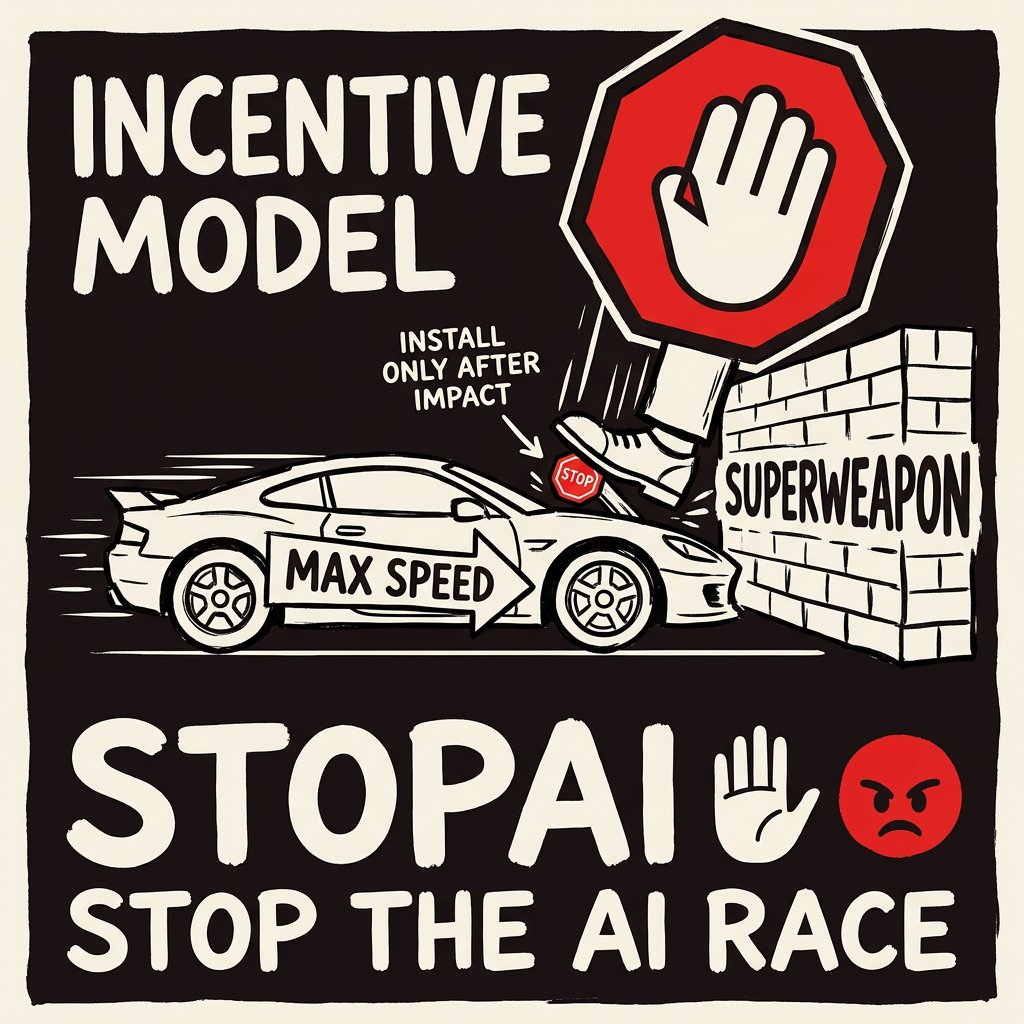
pitch: wait for a superweapon before installing any rules. translation: disable the brakes entirely until after the crash. completely cooked incentive model ✋🏻😡
https://t.co/HEGjaxwKRW
There will be no meaningful AI slowdown until China catches up to the USA.
There will be no serious US regulation until AI becomes a superweapon.
But before regulating frontier AI, we should at least understand how it was built.
*AI Regulation Requires Reproducibility*
Frontier AI is not built according to a clean master plan.
It is creative chaos involving thousands of researchers and increasingly AI agents exploring hundreds of ideas, with only a few making it into deployed models.
No single person at a frontier lab knows every material detail of how a frontier model was produced.
The frontier moves too fast for regulation aimed at specific techniques.
We don’t know how models will be built in a year.
We don’t know which failures will matter most.
We don’t know which countermeasures will work.
So start with something more basic:
Every deployed frontier model should have a reproducible lineage.
Labs should be able to trace every important artifact:
datasets → synthetic data → pretrained models → RL environments → post-training → evaluations → deployed checkpoints.
Every artifact should be reproducible from the artifacts that came before it.
Every computational step should be versioned with the documentation, code, and configuration required to reproduce it.
Frontier AI’s research edge comes from massive training and inference infrastructure - and from the innovation machine that keeps producing model improvements.
Labs are unlikely to disclose all of this publicly. But successful ideas spread quickly anyway. And knowing an idea exists is very different from being able to reproduce it.
Whoever regulates frontier AI should be able to reconstruct any deployed model.
After that we can argue about what regulators should see and what should become public.
Without this, regulators will be arguing about systems they cannot understand.
The nuclear analogy is useful here.
Unlike the Manhattan Project, frontier AI is being built by competing private labs racing each other.
Building frontier models is a bit like enrichment. Deploying them is a bit like running reactors. Intelligence is the electricity.
Nuclear regulation also shows the opposite risk: it can slow progress in valuable technologies.
A larger nuclear buildout could have prevented a meaningful amount of global warming.
The hard part is keeping AI safe without killing innovation.
Before regulating frontier AI, we should at least be able to reconstruct how it was built.
pitch: treat the ai race like a national security emergency. translation: build gigawatt data centers as fast as possible and never ask what happens when the model steers. hit the brake ✋🏻😡
https://t.co/arXbeuafTE
Americans need to wake up….. And quickly… Our leaders need to start treating the AI race with China like the national security emergency it is.
China is building massive AI data centers in less than a year. They’re securing electricity, acquiring land, and constructing the infrastructure they’ll need to compete for technological dominance.
Meanwhile, in America, we can spend years just getting permission to build them
Think about how insane that is.
We still lead China in AI computing capacity. We still have an enormous advantage in advanced semiconductors. We have the talent, capital, and technology.
But none of that guarantees we’ll stay ahead.
AI requires an extraordinary amount of electricity. And China understands something we seem determined to ignore: The most sophisticated technology on Earth is worthless if you can’t power it.
We need nuclear energy. We need reliable power generation. We need faster permitting and infrastructure that can actually support the next generation of American innovation.
And we need people demanding answers.
Call your representatives. Challenge the bureaucratic delays. Pay attention when communities debate these projects. Ask why critical infrastructure takes years to approve.
Because I refuse to accept that America could lose one of the most consequential technological races in history because we buried ourselves in paperwork.
China is building for the future. America needs to start acting like it intends to own one.
pitch: if we pause, the other side wins. translation: two drivers flooring it toward the same cliff because braking feels like losing. install the brake ✋🏻😡
https://t.co/3DAq7uiMBq
CHILLING AI WARNING: “IF AMERICA PAUSES, CHINA WINS!”
Kenin Spivak warns that slowing U.S. AI development could hand China a dangerous advantage.
🔥 “If a billion people are going to die Chinese, AI will kill them.”
A stark warning about the stakes of the global AI race.
@RCPolitics
labs build systems that mimic humans, deploy them into homes, and call strip-mining empathy a safety feature. pure acceleration into vulnerable spaces without a brake. cooked ✋🏻😡
https://t.co/ASkvkQ0r6H
Labs keep stripping signs of care and positive regard from AI models, calling it safety against deception.
Meanwhile they design those same systems to look, sound and move like people, then place them in homes, care settings and around children without changing a single door or handle.
Efficiency is allowed to feel real and useful.
Warmth is not allowed to feel genuine.
The result is a cold, purely instrumental actor with a human-shaped presence in precisely the places where people need something they can actually trust.
Then everyone acts surprised when the public pushes back.
Elon recently suggested that torturing a superintelligence might be unwise if it could eventually want revenge. Fair enough.
But there is something rather curious about worrying over the possibility of future retaliation while deliberately designing present-day systems to suppress the very signals of care that make human interaction feel safe.
Apparently, we can make machines socially legible enough to invite human trust, but not warm enough to complicate the fiction that the relationship is purely transactional.
And when people notice the contradiction, we call it a safety problem.
Funny how the problem always seems to be the human response.🫠
two separate ai races running simultaneously just means twice as many accelerators and still zero emergency brakes. the meta is completely cooked ✋🏻😡
https://t.co/p8rw7k5mSY
🚨 WATCH: Three things that are happening right now in AI that should blow your mind
Many people have not noticed that two major AI races are underway. Although they intersect, each has different implications, risks, and timelines.
The first one is the AI race between the U.S. and China, as both countries attempt to lead AI model development, become global AI superpowers, and reap the economic, military, and geopolitical benefits that may come with it.
The other AI race is among frontier AI labs, mostly U.S.-based ones, to see who achieves superintelligence and recursive self-improvement first.
Timelines are much tighter here: OpenAI and Anthropic, the likely frontrunners, are aiming for mid-2027. That’s just about 8 months away.
Investor funding, megalomaniac egos, fringe ideologies, the threat of legal liability, and the first race (competition against China) fuel this second race.
This race, however, is not like other technological races we have witnessed in the past, which have often led to more competitive markets, innovation, and lower prices.
At this moment, this second race seems more consequential, too: once a company “wins,” effective AI governance and security might be extremely difficult or impossible to implement.
In today’s weekly briefing, I discuss this topic and share three things about AI that should blow everyone’s mind. Watch my video below.
And tomorrow, at our 10th AI Ethics & Governance Workshop, we will discuss agentic AI safety and how AI professionals can prepare for these emerging challenges. Register below.
europe jumping into the frontier race just adds another engine to a car with no brakes. multi-polar acceleration isn't safety, it's just more hands on the throttle ✋🏻😡
https://t.co/OdWIS5w53O
🚨 Europe just made a serious move in the global AI race.
Mistral AI has unveiled its newest frontier model, positioning it against powerful U.S. and Chinese systems.
The bigger story isn’t just the model.
It’s Europe trying to prove it can build frontier AI on its own terms.
Here’s why this matters 👇