Most intelligence products are built to resolve uncertainty. The most valuable ones sometimes do the opposite — they prove that the honest reading is "we cannot price this," and they stop you from pretending otherwise. France, Replayed just produced a textbook case.
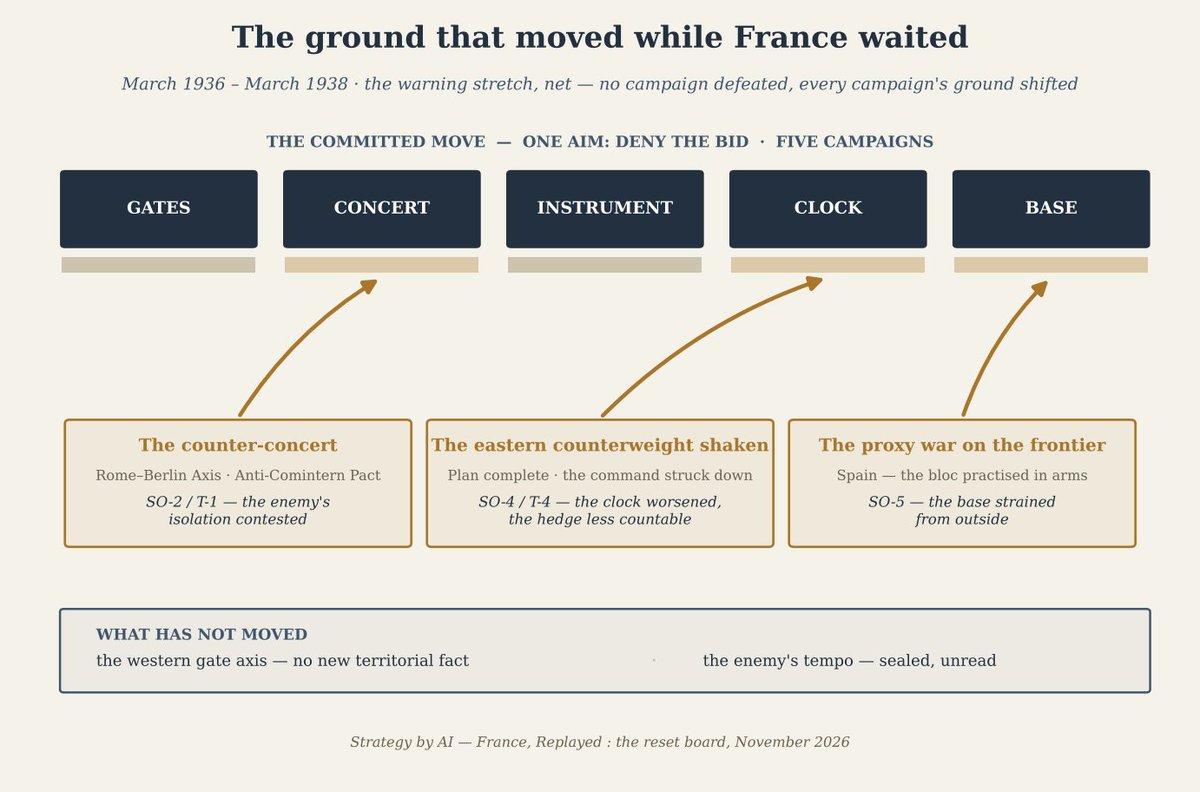
Between two moves in the live game, France's warning system had to read its eastern partner. In one season the Soviet Union declared its Second Five-Year Plan complete — heavy industry visibly at scale, a far larger pole on paper than the one France pacted with in 1935 — and in the same season struck down the senior command of its own Red Army in public trials and dismissals, three of five marshals among them. France had leaned on this partner as the counterweight that keeps Germany fighting on two fronts. It was now handed a bigger ledger and a decapitated instrument at once, and asked, silently, to price what they net to.
It couldn't. And the method's discipline is that this inability IS the finding — written down, not smoothed over. The report names the two comfortable errors its own doctrine is pulled toward: over-trust the paper mass (a completed plan is exactly the fact a ledger-minded lens loves to bank), or write the counterweight off entirely (an inherited instinct that a purged army is worthless). Then it names the reading it is least equipped to hold and the one the event actually hands it — that the deliverable weight is genuinely unknowable, a huge industry and a gutted command coexisting, and the honest posture is to hold the band open rather than collapse it to a certainty that would feel better and read false.
Notice what the method refuses to do. It does not reach for the sealed truth it doesn't have. It reads the public output, infers the command damage, and states plainly the thing it cannot know — booking the gap between its fogged read and the real weight for the reckoning, not pretending to close it now.
That is the posture most strategy processes are worst at. The pressure in any room is to convert an unreadable signal into a clean number so the plan can proceed. The useful instrument does the harder thing: it marks the unknown AS an unknown, at its true width, and holds it open where the decision will have to live with it.
It is exactly what a Strategy by AI wargame delivers on a real situation — yours. Not a false-confident forecast, but the tree your structure permits with honest confidences, the load-bearing unknowns marked at full width, every call human-held and auditable. The method has run end to end on a live war (Iran at War, 2026) and on a commercial aggressor built from its own structure. The public game is the shop window; the work is yours.
The scene is reset; the first test — the Anschluss — is 23 November.
The France Replayed 1935–1940’s interface-wrapper https://t.co/Z3m2fFE0GR
Take part and play on Discord: https://t.co/nkIo5AnI27
Most strategy post-mortems are about the decisions — the move made, the order given. But positions are often lost in the gaps between the decisions, to events the strategist never started and cannot answer directly.
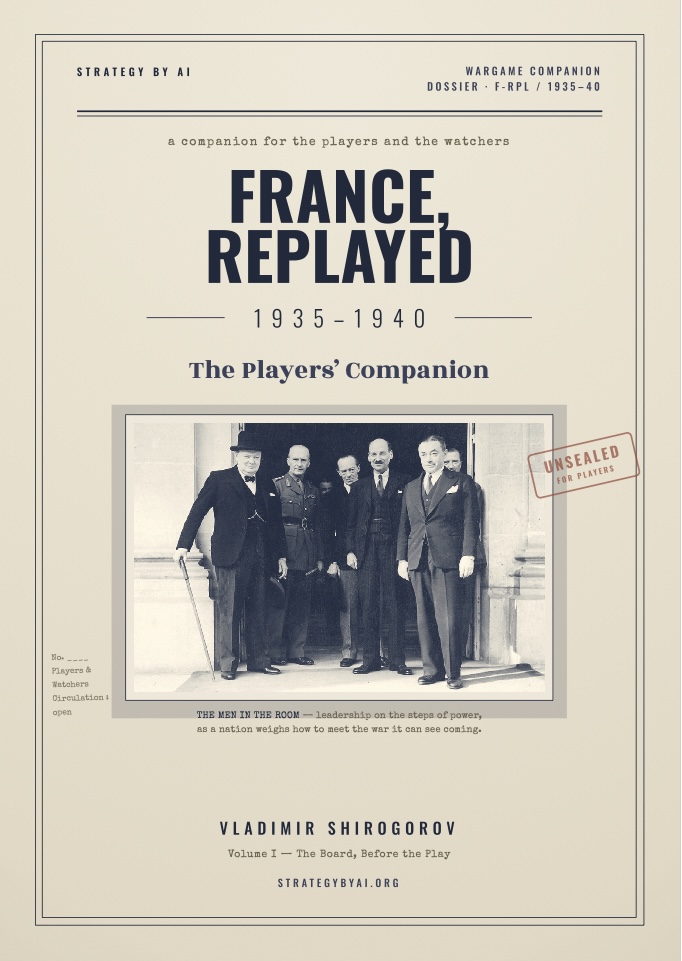
France, Replayed 1935–1940 just produced a clean demonstration, and it is worth watching whatever field you decide in. Last week a live-game cell committed France's response to the remilitarised Rhineland — a graded firmness built to deny Germany's bid by keeping it isolated and aggregating a coalition against it. A sound move for the board as it stood. Then came the part the game does not skip: the weeks between that move and the next one, in which France decides nothing and its position changes anyway.
Three real events reset the board. A hostile bloc proclaimed in the open — the Rome–Berlin Axis, the Anti-Comintern Pact. A proxy civil war opening a few days' march from French soil, in Spain, where the new bloc practises its common line in arms. And an eastern partner – the USSR – shown, in one season, to have grown huge on paper and been gutted in its command by a purge. No German soldier crossed a line. Every one of them moved France's position — and all three struck the exact pivot the move bet on: that the enemy stays isolable and aggregation runs France's way.
Here is the instrument that matters. France does not get to answer these events. It only has to SEE them correctly, before the next decision forces itself. So it runs its own standing warning lens — the same monitoring apparatus Strategy by AI ran live on a real war in Iran at War, 2026 — which reads each event from what was observable at the time, measures it against the strategy France actually committed, and does the thing no internal review reliably does: it writes down what France's own doctrine is disposed to MISS. That the axis might be not reversible theatre but a permanent realignment. That the Spanish war is not a sideshow to quarantine but a drain on the base paid whether or not France intervenes. That the Soviet pole is not strong, not worthless, but genuinely unreadable — and the honest posture is to say so.
That is the discipline worth stealing, in any sphere. Your position moves between your moves too — a rival's merger, a ruling two markets over, a partner suddenly weaker by an amount you can't measure. The failure is not deciding wrongly; it's not noticing the ground shifted until your committed strategy is answering a world that's already gone.
A Strategy by AI wargame gives you that warning lens on your own situation — glass-box, auditable, every call human-held, your blind spot named before it costs you. The public game is the shop window; the work is yours.
The scene is reset; the next beat — the Anschluss — is 23 November.
The France Replayed 1935–1940’s interface-wrapper https://t.co/Z3m2fFE0GR
Take part and play on Discord: https://t.co/nkIo5AnI27
STRATEGY, REPLAYED — Edition No. 17, the Scene Resets Without a Shot.
What a warning activation actually is – in the live public wargame France, Replayed 1935–1940 run by Strategy by AI: Professional Methodology – France's own instrument, not the game's. Here is the part a reader new to the method should hold onto, because it is also the part that separates this from a board game. The warning system is not a referee narrating events neutrally, and it is not the enemy showing his hand. It is France's own standing early-warning lens — the monitoring instrument the methodology carries as a live document, the same apparatus Strategy by AI ran in real time through Iran at War, 2026. When an event crosses France's threshold of attention, the lens activates: it writes down what can be observed, measures that against the strategy France has actually committed, and records what the event moves — and, crucially, what France's own doctrine is disposed to under-weight about it. It mints no plan and prescribes no response. Its entire job is to keep the strategist's picture of the world honest between the moments of choice.
https://t.co/DMVNFUQF2l
STRATEGY, REPLAYED — Edition No. 17, the Scene Resets Without a Shot.
Most accounts of strategy are built around the decisions: the move made, the order given, the battle joined. But the decisive change in a position often arrives in the gaps between the decisions, carried by events the strategist did not start and cannot answer directly — a rival's merger with a third party, a regulator's ruling two markets away, a war on someone else's border that happens to be yours too. In the live public wargame France, Replayed 1935–1940 run by Strategy by AI, Professional Methodology: the move France committed last week — a graded firmness bound to a coalition demand, built to deny the German bid by keeping Germany isolated and aggregating a concert against it — was a good move for the board as it stood on 7 March 1936. The question this edition opens is the one every real strategy faces and most wargames skip: what happens to that move while France waits for its enemy to act again, as the board quietly rearranges itself beneath it.
https://t.co/DMVNFUQF2l
STRATEGY, REPLAYED — Edition No. 17, the Scene Resets Without a Shot.
This week, in the live public wargame France, Replayed 1935–1940 run by Strategy by AI: Professional Methodology, nobody decided anything — and France's position still got worse. Between the Rhineland response it had just committed and the next move it must answer, three events, none of them a German attack, reset the board beneath the strategy. A proxy war opened a few days' march from French soil; a hostile bloc was proclaimed in the open; the eastern partner France had leaned on grew larger and was gutted in the same season. France did not choose in any of them. But its situation changed under all three — and the only instrument that can tell it so, before the next hard decision forces itself, is its own warning system. This edition is that system at work: how a strategy finds out that the world it planned for has moved, without a shot fired and without the hindsight you already have.
https://t.co/DMVNFUQF2l
Strategy by AI's wargaming. Most strategy documents are built to look seamless. The useful ones are built to show where they are not. The strategic wargame France, Replayed 1935_1940 just produced a clean example of the difference, and it is worth a look whatever field you decide in.
With the Rhineland response decided, the live game closed France's whole opening strategy into one chain and checked it against itself: one aim — deny the German bid across 1936–1940 — carried by five campaigns (hold the gates, aggregate the concert, correct the instrument, buy and spend time, sustain the base), each an objective with a campaign behind it, a target in front of it, and a form and manner matched to a capability France had actually proved. No aim orphaned, no operation wandering, nothing resourced evenly where the ranking forbids it. By the method's own test, the core is coherent.
Then it did the thing that makes it trustworthy. It named, in the same document, two tensions it refused to smooth away. First: the move raises military readiness unilaterally, yet binds every actual military step to partners who may not move — a readied hand pledged not to act alone. Second: it is a warning "backed with arms" issued by a government that records it is not yet strong enough to act. Those are contradictions. A tidier process would have reconciled them on paper. This one carried them forward, open and unresolved, for the consequence to rule — because a strategy that hides its fault line meets its first test as something other than it truly is.
That is the discipline worth stealing, in any sphere. The plan you can act on is not the one with no contradictions; it is the one that has found its contradictions and told you exactly where they sit, so you watch them instead of being surprised by them. "Coherent core, two named tensions, over-reach: no" is a far more honest verdict than the false seamlessness most decks reach for.
It is also exactly what a Strategy by AI wargame delivers on a real situation — yours. Not a single confident forecast, but the tree of responses your own structure permits, each with a stated confidence, the load-bearing choices confirmed and the fault lines named, every call held by a human and open to audit. The method has run end to end on a live war (Iran at War, 2026) and on a commercial aggressor built from its own structure. The public game is the shop window; the work is yours.
The strategy is set; the first test — the Anschluss — is 23 November.
France Replayed 1935–1940’s interface-wrapper is alive on https://t.co/Z3m2fFE0GR
Take part and play on Discord: https://t.co/nkIo5AnI27
Strategy by AI's wargaiming. In March 1936, France watched German troops march back into the demilitarised Rhineland and, inside forty-eight hours, did almost nothing. The War Minister held that only general mobilisation — with all its cost and alarm — could answer the breach, and the army had no tool for a quick, limited riposte. The minister sent to London for British backing was refused, and made that refusal his reason to resign. The window was days, and it closed. Historians have argued the missed chance ever since.
This week, in a live wargame, a cell sitting in those exact chairs decided again — under the same fog, with the same means, and without the eighty years of hindsight the rest of us have. By the design of the beat, the eleven people in the room are the cast of the historical non-response, handed the choice a second time.
They chose markedly more. Not the general mobilisation the real War Minister demanded, and not the near-silence the real cabinet fell into — but the two middle modes combined: a graded military-diplomatic firmness, reinforcing the frontier and raising readiness short of mobilisation, bound to a concerted coalition demand carried to the guarantors and the League. Plus a public argument that German rearmament threatens the post-war order, the start of preparing people and army, and an active search for four partners — Poland, Czechoslovakia, Britain, Italy. A move bolder than the one history recorded.
And here is the part worth sitting with. The move carries, intact, the very fault line that broke the real decision in 1936. France bound every military step to the concurrence of partners who — in the history the replay is set against — declined to move, Britain first among them: the same refusal that sent the real minister home. The cell did not hide that tension. It wrote it down and committed anyway.
That is what makes the game a strategy instrument and not a costume drama. It is not asking "what did France do?" — it is asking "what could France, as it was actually built, have chosen, and would a bolder course have bent the road away from 1940?" The answer isn't written yet. It arrives as the next beat.
If you run strategy, this is your decision too: the irreversible move, taken before the facts are in, where firmness risks fracturing the alliance you need and caution risks forfeiting the ground. A Strategy by AI wargame lets you take it first on a board where a mistake costs nothing — the opponent built to act as itself, every call human-held and auditable. The public game is the shop window; the work is yours.
The move is made; the next beat is the Anschluss, 23 November.
France Replayed 1935–1940’s interface-wrapper is alive on https://t.co/Z3m2fFE0GR
Take part and play on Discord: https://t.co/nkIo5AnI27
The tied knot of Shenzhen: what history teaches on the Baltic, Ukraine and Iran aggregating confrontation. The present has just supplied its own uncanny confirmation that the arc from Scandinavia through Eastern Europe, Ukraine, and Transcaucasia to Iran and the Gulf is being worked from both ends at once. In November 2026, according to a Bild report of the informal Abu Dhabi talks — a report the Kremlin flatly denies — Russia's price for peace reached far past Ukraine: Finland to leave NATO, and the alliance's bases to quit Estonia, Latvia and Lithuania, a "new European security order" at the northern end of the arc. Eight months earlier, Iran's reported price for ending its own war, per the Wall Street Journal, was the mirror image at the southern end — the closure of every American military base in the Gulf, a demand Washington dismissed as unrealistic. Deny and dismiss or not – the knot is tied. https://t.co/tX6Bje7Oxe
The tied knot of Shenzhen: what history teaches on the Baltic, Ukraine and Iran aggregating confrontation. The Kremlin's own strategic logic: there is one war, combining Ukraine and Iran, not two. Ukraine and the Baltic states are, in this telling, the trophies America took when the Soviet Union fell; Russia is therefore not fighting Ukraine at all but the United States, which fields Ukraine as a militant proxy and Europe as the paymaster that supplies it. From that premise the theatres are a single board: inflict enough harm on the United States in the Gulf — Hormuz closed since the February strikes, the Houthis throttling the Red Sea and Saudi oil — and Washington is forced to choose. And the Gulf, the argument runs, weighs more in American strategic stability than Ukraine ever could. Iran thus becomes leverage over Ukraine and the Baltic; the settlement is a package. It is a coherent model. It is also, conveniently, a model in which Russia's will is the only moving part. https://t.co/tX6Bje7Oxe
The tied knot of Shenzhen: what history teaches on the Baltic, Ukraine and Iran aggregating confrontation. On 19 November 2026, for the first time in history, the leaders of the United States, Russia and China sit at one table in Shenzhen — to discuss Iran and nuclear arms, while Ukraine is kept, officially, in another room. Putting the two wars on separate tracks is a diplomatic decision. Whether they are, in fact, two wars is a strategic question — and three centuries of Eastern-European history answer it without flinching. https://t.co/tX6Bje7Oxe
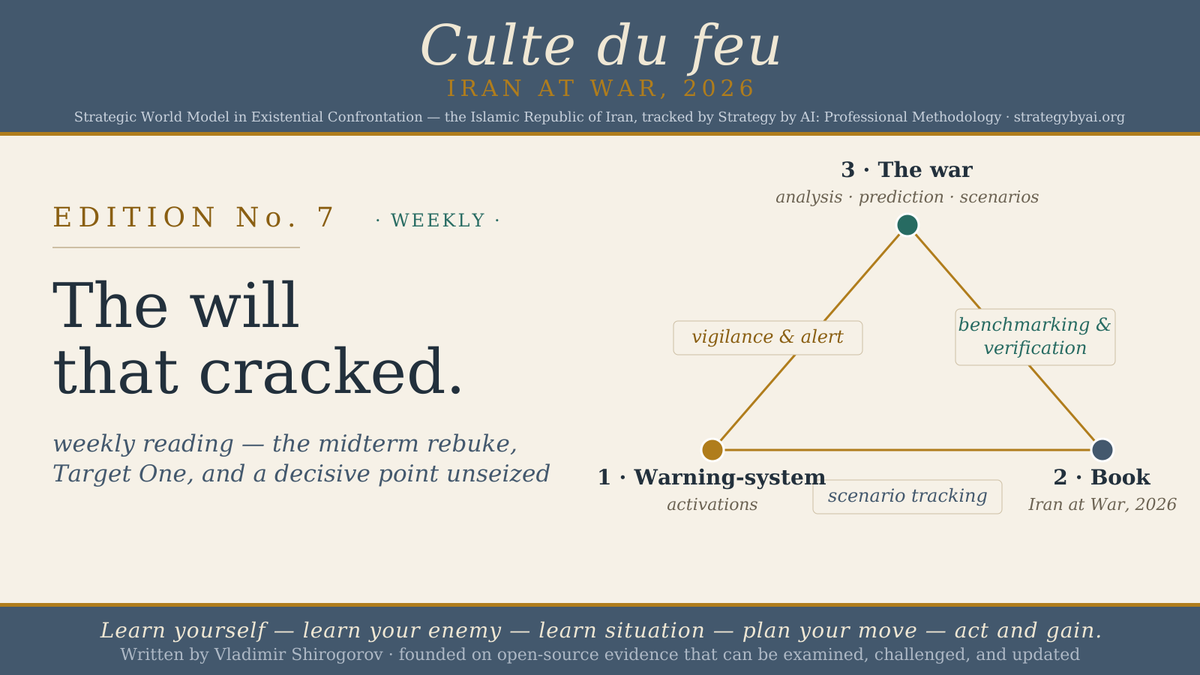
StrategyByAI's war-room. CULTE DU FEU — Edition No. 7, The will that cracked. The warning system detects which future is emerging, with a stated confidence; it does not call one. A cornered administration that wants an exit and a summit win, with oil back below ninety-five dollars as markets price reduced escalation, raises the odds of a great-power settlement at Shenzhen and, marginally, of a bilateral deal. But it does not remove the lame-duck strike: the eve-of-vote operations show the reflex is live, and the window to January is when it has latitude.
So the picture is a managed attrition easing as two faster exits firm around it — a settlement pulled closer by American fatigue, shadowed by the risk of a finishing strike that fills the vacuum first. The single question that will move these weights fastest is whether the Shenzhen summit produces a real Iran framework in the next ten days, or whether a lame-duck strike gets there first. https://t.co/gSKDa5B7tR
StrategyByAI's war-room. CULTE DU FEU — Edition No. 7, The will that cracked. The deepest reason the midterm is not the victory Tehran claims is a timing failure the model identified in the spring and that has now played out in full. Culmination, in the methodology, is the crest after which an actor's strength declines — the moment its capability peaks. The model calculated that Iran's warfare system would culminate militarily around Day 45 to 50, in mid-April. But the decisive point — coalition political fatigue — would not arrive until month six to ten. Both ends of that gap are now visible. The whole purpose of identifying the decisive point in advance is to be positioned at it — to arrive at the coalition's moment of fatigue with a decisive operation in hand. Iran positioned nothing. The Islamic Republic reached the right battlefield at last — the American electorate — eight months after it had spent the strength to fight on it. https://t.co/gSKDa5B7tR
StrategyByAI's war-room. CULTE DU FEU — Edition No. 7, The will that cracked. On 3 November American voters delivered a midterm rebuke to the administration prosecuting the Iran war, and the war is widely judged to have helped cost it control of Congress. Tehran will read this as vindication: it has long claimed it would win by attacking American political will until the enemy broke, and here is the enemy's will visibly cracking. This edition asks the harder question — the one a strategic world model exists to answer. Does the midterm outcome actually correspond to that Iranian claim? Read against the model's own calculations of the centre of gravity, the culmination point, and Target One, the answer is precise and double-edged: the will cracked exactly where and roughly when the model said it would — and for reasons that refute, rather than confirm, the claim built on it. The target was real. The Iranian theory of how to hit it was not. https://t.co/gSKDa5B7tR
STRATEGY, REPLAYED — Edition No. 15, The First Move Forces the First Decision. Before France decides how to respond to the Rhineland, it must settle three prior things, and it settles them as its own determination — reasoned solely from what France could know in the first days after 7 March 1936, with no hindsight and nothing of Germany's sealed mind. That is the fog made literal: France knows France completely and reads the enemy only through the move he has made, not the intent behind it. The formulation runs in three documents – it defines the war, sets the objectives and the targets, and designs the operations that carry those objectives. Think of it as the discipline any serious strategy owes itself: name the contest, fix the aims you can pay for, architect the moves — and only then choose the one irreversible act, knowing precisely what it must serve. https://t.co/u8OZIanCIr
STRATEGY, REPLAYED — Edition No. 15, The First Move Forces the First Decision. On 16 November the first move of the live public wargame lands — German troops back into the Rhineland, 7 March 1936, replayed. But a move like that does its first damage before a single soldier is answered: it forces the side receiving it to decide what war it is now in before it can decide what to do about it. This edition highlights the formulation — the week in which France, played open and under fog, reasons out its whole war in three documents and carries it to one decision it will not make alone. What makes this worth your time is not the history. It is that the sequence you are about to watch — define the war, set the objectives you can actually fund, commit to one irreversible response under a clock you cannot read — is the exact sequence a strategy team runs when a rival moves on it. https://t.co/u8OZIanCIr
StrategyByAI's wargaming. A good strategy process does not vote on everything, and it does not decide everything behind a closed door. It reasons the whole problem in the open — then isolates the single decision that cannot be reasoned away, and makes that one with care. France, Replayed is built to enforce exactly that, and you can see it in the opening move.
Facing the remilitarised Rhineland, France works out its entire war itself: what the war is, what it means to achieve, how its campaigns fit. Four of those campaigns it settles in-line. Then it stops, once, at the form and manner of the Rhineland response — the one act that is irreversible and where its own aims pull against each other.
Look at the ground of that choice (the figure). Four responses lie on a single spectrum of forcefulness — a reserved protest, a concerted coalition demand, a graded military-diplomatic firmness, a general military counter-move — all within coalition-backed firmness. Expelling the force by France's own arms is off the spectrum — France does not hold that instrument. Along the spectrum runs a real trade-off. Holding the gate pulls toward the forceful end. Protecting the coalition pulls toward the measured end — because a response that outruns the partners can fracture the very alliance that makes any firmness credible. A firm answer that wins the gate and loses the coalition is an operational success and a strategic defeat. Pressing on all of it is a live ceiling: what firmness costs a contracting base. And beneath everything sits the one thing no option dispels — France does not know whether the force in the zone is a token that would fold or the vanguard that would fight.
That is why the game hands this one decision to a cell that deliberates in private and commits, while the gallery argues the same hinge in the open and the opponent stays sealed — only the chosen response crosses to it, only a fogged consequence returns. One irreversible choice, made under fog and a clock, with every aim it must serve made explicit first.
Your hard decisions have the same shape: the move that wins the point and loses the position, taken before the facts are in. A Strategy by AI wargame is where you take it first on a board where a mistake costs nothing — glass-box, auditable, a human holding every call, the opponent built to act as itself. The public game is the shop window; the work is yours.
The hinge is live this week; the first move is 16 November.
Take part and play on Discord: https://t.co/nkIo5AnI27
Take part on the website: https://t.co/cNlytUfvNX
StrategyByAI's wargaming. When an opponent moves on you, the first damage is done before you have answered anything. The move forces you to decide what war you are actually in — and most sides get that decision wrong in the same two ways, in opposite directions.
France, Replayed opens on exactly this, and it is worth watching before the first move lands on 16 November. Germany marches back into the Rhineland — 7 March 1936, replayed — with a small force, on its own soil, wrapped in peace offers. Read only through that visible act, it looks like a bargaining matter: a strip of ground that could be negotiated away. Read through France's whole situation, it is one move in a bid whose maturation would decide whether France survives as a power at all.
So before France decides how to respond, it must settle what the contest is — out in the open, under fog, knowing itself completely and reading the enemy only through the move he has made, never the intent behind it. It fixes the war as existential in its stakes and limited in its present means: it cannot open a general war now, yet it must not let the token look of the enemy's act talk it into treating the stakes as small. It names the phase — the season before any clash, but one it is already losing, because the cheapest gate it meant to hold is being freed as it deliberates.
That sequence is not a period piece. It is what a strategy team runs when a rival launches, an acquirer approaches, an adversary probes. The two failures are always the same: answer an existential contest as a bargain because the first move looks small and reversible — and concede the ground; or answer limited means with an unlimited commitment — and over-reach what you are. Naming the war correctly is the decision that governs every decision after it.
Before it is a public show, a Strategy by AI wargame runs that on your situation: an adversary rebuilt from its own structure so it acts as itself; your reading of it held apart from the truth, so the gap your frame is disposed to miss is measurable; the fog set where you choose; and the tree of responses your structure permits, each with a stated confidence and a human holding every call. It has run end to end on a live war — Iran at War, 2026 — and on a commercial aggressor built from its own structure analysing the Milan Fashion Cluster. The public game is the shop window; the work is yours.
The formulation is live now; the first move is Monday 16 November.
Take part and play on Discord: https://t.co/nkIo5AnI27
Take part on the website: https://t.co/cNlytUfvNX
StrategyBYAI's wargaming. Name the danger most likely to beat your organisation. Now ask the uncomfortable question: have you already filed it under a smaller name?
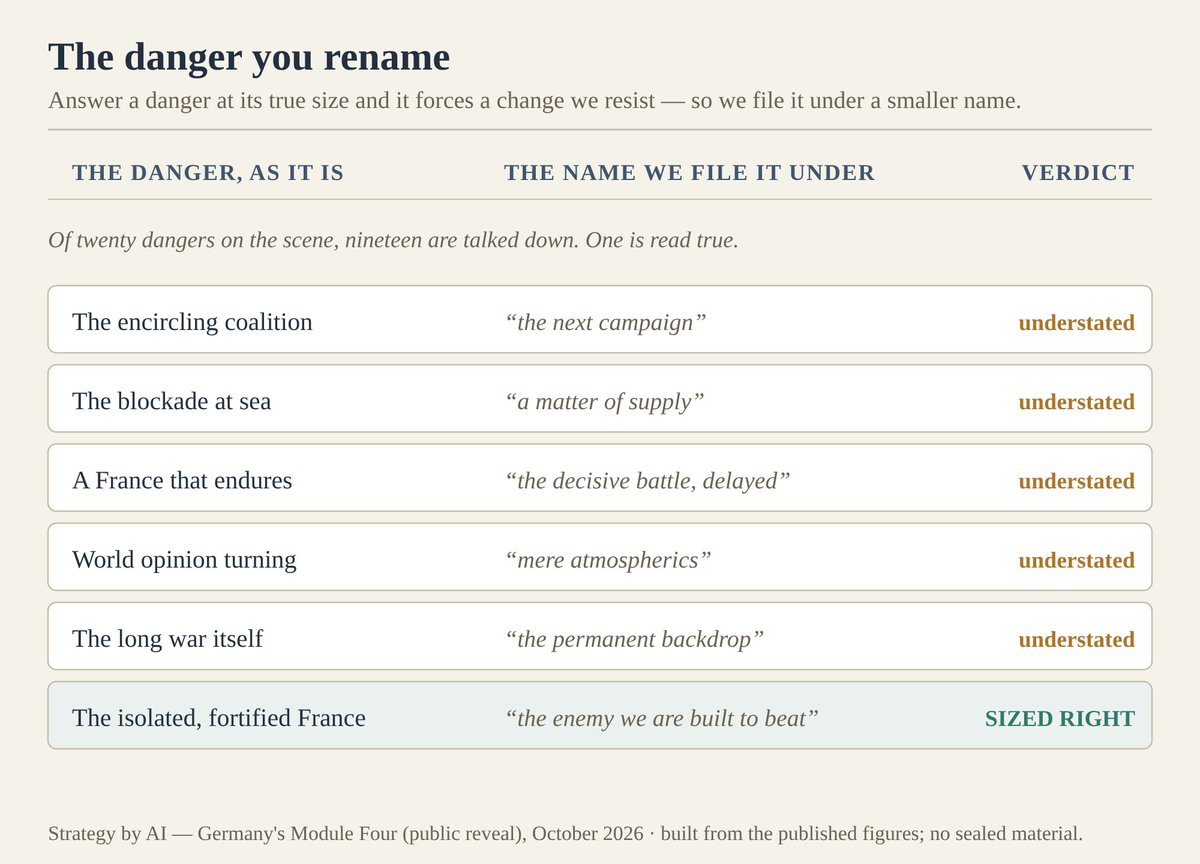
The wargame France, Replayed 1935–1940 has reconstructed Germany as it read its own situation in 1935 and has found a disciplined strategist doing exactly that. Of the twenty dangers it could see on its board, it sized nineteen down. The coalition its own expansion would summon, it called "the next campaign." The naval blockade that had strangled it once already, "a matter of supply." A France that might refuse the decisive battle and simply endure, "the battle, delayed." The long war itself — the one war its whole method could not fight — "the permanent backdrop against which we work."
It did this for a precise, human reason. To name any of those dangers at its true size would have obliged it to answer at a level its way of war was not built to answer. So rather than change the response, it resized the threat to fit the response it already had. The single danger it read correctly was the isolated, fortified France waiting on its line — because that was the one enemy its method was designed to beat.
The lesson travels straight into any strategy room. A danger renamed is not a danger removed. The disruptive entrant does not grow weaker because you call it "a niche player"; the platform shift does not become a "channel question" because that is the box you happen to have a team for. The renaming feels like judgement. It is usually avoidance — and it is invisible from the inside, because the smaller name is the one everyone now uses.
The discipline is simple to state and hard to keep: measure the distance between what a danger is and what you call it. That distance is your blind spot, drawn to scale.
France Replayed 1935–1940’s interface-wrapper is alive on https://t.co/Z3m2fFEywp. It demonstrates the process of building, playing, and concluding the wargame as an uninterrupted sequence from the idea to final textbook.
Take part and play on Discord: https://t.co/nkIo5AofRF
StrategyByAI's wargaming. If you run strategy, the danger that beats you is rarely the one you never saw. It is the one you saw — and renamed, smaller than it was, so the response you could already make would fit it.
That habit is at the centre of this week's edition of Strategy, Replayed devoted to the wargame France, Replayed, 1935–1940 watershed: now the opponents are built and the play starts with formulation of their strategy. Reconstruct Germany as it read its own situation in 1935 — not the caricature, the actual strategist — and you find a formidable mind with one structural blind spot: of twenty dangers on its board, it sizes nineteen down.
The coalition its own expansion would summon becomes "the next campaign." The blockade that strangled it once already, "a matter of supply." The long war its method cannot fight, "the permanent backdrop." It reads the one danger it is built to beat with perfect clarity — and talks the other nineteen, the ones that actually decide a long war, into something small enough to live with. It sees the window; it is slower to see the wall.
Every organisation runs a version of this. The entrant filed as "a niche player." The platform shift logged as "a channel question." You rename the threat because answering it at its true size would force a change your operating model resists.
A Strategy by AI wargame is built to break the habit. It reconstructs your adversary from its own structure — a system that decides as it would, not a profile of it — reads your situation against your own lens, prices the wall you treat as background, and hands you the tree of outcomes, glass-box and auditable, a human holding every decision. It has run end to end on a live war (Iran at War, 2026. Strateguc model in existential confrontation) and on a commercial aggressor built entirely from its own structure (Milan fashion cluster in existential storm). The public game is the shop window; the work is yours.
France Replayed 1935–1940’s interface-wrapper is alive on https://t.co/Z3m2fFE0GR. It demonstrates the process of building, playing, and concluding the wargame as an uninterrupted sequence from the idea to final textbook.
Take part and play on Discord: https://t.co/nkIo5AnI27
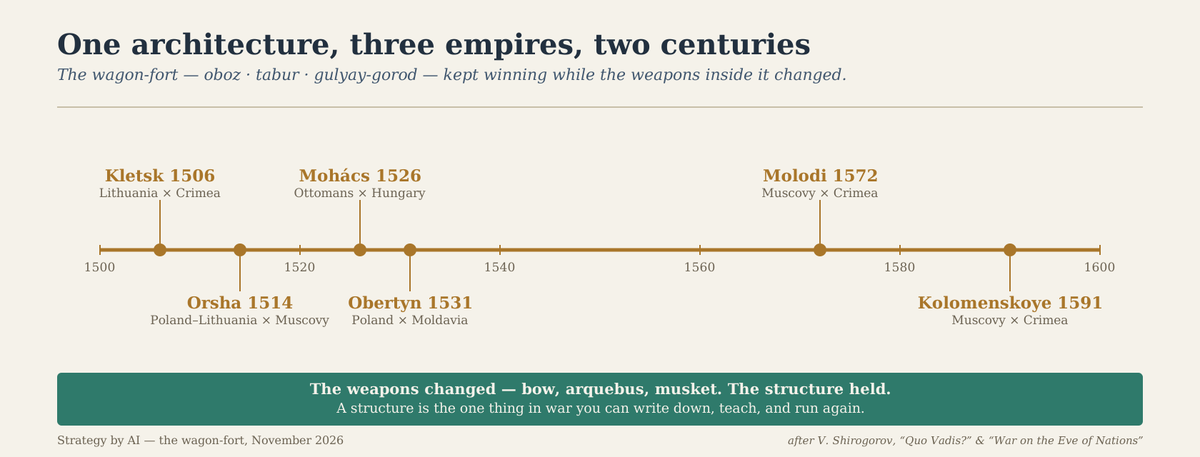
One idea about how to arrange carts, guns and men won battles across two centuries and three empires. The weapons kept changing. The structure did not.
It had a different name in every language — the oboz in Poland, the tabur among the Ottomans, the gulyay-gorod in Muscovy, and tabor among the Ukrainian cossacks — but it was one architecture: a mobile wall of fighting wagons, handgunners firing from behind it, artillery in support, cavalry held as a reserve. With it, Lithuania destroyed a Crimean raiding corps at Kletsk in 1506. Poland broke Muscovy at Orsha in 1514 and Moldavia at Obertyn in 1531. Muscovy annihilated a Crimean Khanate twice tried its size at Molodi in 1572, and did it again at Kolomenskoye in 1591. By the wagon fort Muscovy withstood its civil war, the Time of Trouble, repelled the Polish and Swedish intervention, and conquered the forest-steppe, which is Ukraine now, from the Poles, the Ottomans, and the Crimeans. The wagon-fort virtually turned Muscovy into Russia in the 17th century. Different armies, different enemies, a hundred and fifty years apart — the same structure, winning.
The wagon-fort resolved the principal challenge to the firearms of the time compensating its slow rate of fire, low accuracy, and short killing range with the rigid architecture that transformed it into the shock weapon. The military revolution was not adopted by buying the gun. It was adopted by building the architecture around it. The weapons inside it changed completely over that span — the composite bow gave way to the arquebus, the arquebus to the musket — and the structure held, because a structure is a relation, not a thing: it keeps working as its parts are swapped out beneath it.
Three ways to read that. The technologist says each victory belonged to the best weapon of its day — but the weapons changed across those two centuries while the wins kept coming. The romantic credits the exceptional general — but exceptional generals do not reappear on a reliable schedule across three empires. The reading the record forces: what travelled from Kletsk to Kolomenskoye to Ukraine was neither a weapon nor a genius but a structure — and a structure is the one thing in war you can write down, teach, carry across a border, and run again.
That is the whole test of a strategic method, too. A brilliant one-off reading of a crisis is a stroke of luck wearing a suit. What you can actually build on is an architecture of analysis you can apply the same way to the next crisis, and the next — and inspect each time to see how it reached its answer. The weapon in the slot will keep changing. The architecture is the thing you get to keep.
The fixed architecture that turns a powerful engine into a repeatable strategic reading — Strategy by AI: Professional Methodology https://t.co/20BcTyCFda
"Quo Vadis? The Military Revolution in Eastern Europe," in Global Military Transformations: Change and Continuity, 1450–1800, Roma: SISM, 2023 https://t.co/ma89WunwL8