Stratify is a two part innovative, intelligence-driven startup: a Think Tank, for thought leadership & communications & Capital Raise for Product R&D to market
The cost of energy impacts every single transaction.
It should be recognised as an essential, if not THE most essential part of governance is to MINIMISE the cost of energy to the consumer, both business and domestic.
Going to disagree here.
Do you think the home office bought new passports from France because “the best tender” probably 98% spite.
Do you think fisheries and farmers were screwed over because….. ahh yes, they dared to vote Brexit.
I do.
The entire big government arrogance department hated that they would actually have to fucking work and for the electorate.
This has exposed Burnham the bullshitter as the charlatan he is.
He did not need to burn political capital on this, especially after promising he wouldn’t.
Abysmal judgement and leadership.
38.7p of every £1 the UK spent on electricity in 2025 paid for climate policy.
No official body publishes what bill-payers pay through it, scheme by scheme, each year. So I've counted it:
https://t.co/myBg64v73m
'It's alright for you and your colleagues, but not for today's children?'
@NickFerrariLBC questions First Secretary of State Louise Haigh on the number of private schools that have closed since Labour introduced 20% VAT on fees.
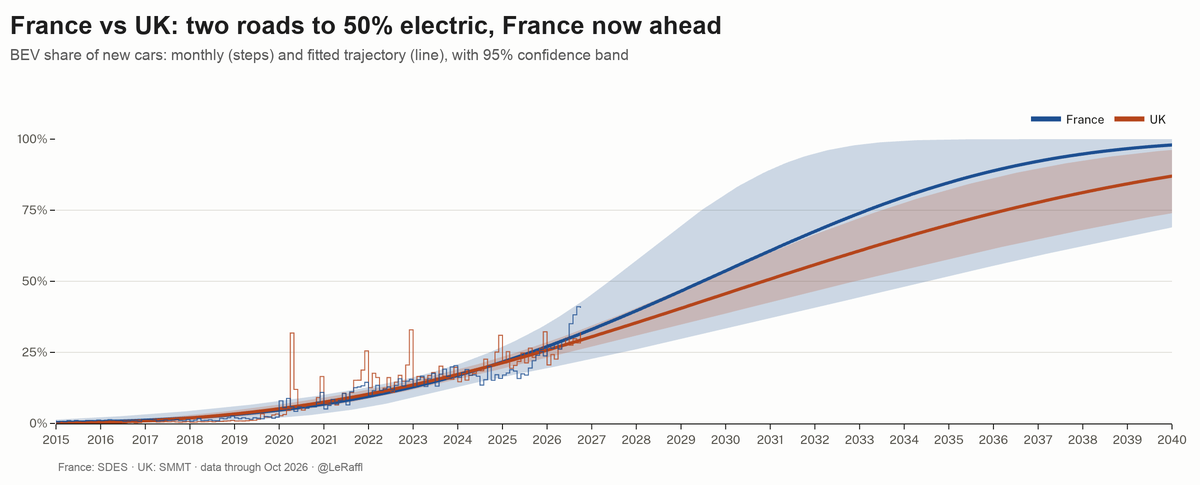
France 🇫🇷 and UK 🇬🇧. Two roads to 50% electric, and France just pulled ahead.
So the UK should be ahead. It isn't, not anymore. The reason is interesting, because the two are doing almost opposite things.
The UK is basically Tesla. The Model 3 and Model Y are the two best-selling electric cars in the country by a distance, 23,763 and 22,763 so far this year; the next car down is a Škoda at 14,373.
Tesla made this market. The Model 3 is the car that turned BEVs from a curiosity into a mass-market thing. The ZEV mandate nudges the whole field along, but Tesla is the market maker.
And yes, Tesla fell out of the UK top ten entirely in October and dropped to eighth in France, but that's just their registration/delivery cycle.
The Model 3 and Y still run absurdly well in the UK.
But France? No mandate for France. The old purchase subsidy is actually gone, scrapped in July 2025 when the budget ran out.
What's left is a purchase prime paid for by the energy suppliers (the CEE coup de pouce), or a social leasing scheme that puts some small electric cars at under 200 euros a month.
The leasing program comes with a catch though: an eco-score. They score the carbon it took to build the car and ship it to France, and China's coal-heavy grid plus the long boat ride fails basically every China-built car. European-built passes, any brand.
So France isn't subsidising electric cars so much as subsidising European-built ones, and in practice mostly French brands. More than two thirds of last year's social leases went to Renault, Peugeot and Citroën, the Renault 5 alone took a quarter.
This year Renault pulled its cars out of the scheme, it sells them faster than it can build them, and Stellantis took 64%.
That's the other thing. You look at what people actually buy and it's a completely different party in each country.
France's top ten has four Renaults in it, the 5, the Twingo, the Scénic, the Mégane, about a fifth of the whole electric market. There is not one Chinese car in the top ten. But that's not just the eco-score.
The EU also tariffs Chinese-built BEVs, an extra 35% on MG on top of the usual 10%, and Chinese brands are still new here, mostly selling hybrids, spread thin across a dozen models. The policy is part of it.
The UK's top ten is a much more mixed field: two Teslas, two Škodas, a Vauxhall, a Kia, a Ford, and BYD sixth and climbing, with Jaecoo and Leapmotor breaking into the monthly top ten.
The UK excludes China-built cars from its grant too, same carbon logic. It just doesn't have the tariff wall. So BYD discounts its way in and sells anyway. France picks a team and builds a wall around it.
The UK picks a team too, but leaves the gate open.
And France's bet is paying off right now. France went from 27.7% BEV in January to a record 41.1% in September and held 40.7% in October, sales up about 79% on the year.
The UK climbed too, just steadier and slower: 16.5% in 2023, 23.4% in 2025, 26.6% so far this year. France's expected time from 20 to 80% is down to about nine years and still falling. The UK's has been parked at about thirteen since spring.
So the country with the actual law is being overtaken by the country with no direct law, just cheap leases. I say "just" ... but we all know this is expensive as hell and that the tariffs work basically as the EU version of the law France doesn't have.
Also there are people in the UK parliament now recommending they copy France's social leasing apparently?
But both are heading to 50% soon. I can't say if France's tactic will end well. I don't know that.
What I do know? Having tariffs makes things more expensive for the consumer. If there were no tariffs, BEV share in France would end up more like in the UK. But instead of no tariffs and no leasing program, they do have them, essentially manually shifting demand to the local brands.
This locks in consumers to certain brands, in this case French brands. That's part of why I said I'm not sure if this will work out, because it depends entirely on how well European brands will build BEVs (Renault and Stellantis in this case).
@avandyc@ProudBrit19 I agree and same here.
The counter is, the asset price of the car is (typically) much higher.
Which is why I believe the greater overall benefits would be LTG or derivative where the vehicle battery is a “node on the grid”
What fresh hell do the government think they’re doing?
- Shall we deal with the problem?
- No, let’s manage the symptoms because we haven’t got the balls to attack the issue. Besides some will vote labour/left for more free stuff.
It’s like treating an aggressive cancer with ibuprofen and a milk chocolate bar.
“Diversity is Strength” is the darkest Orwellian propaganda so far this century.
Please read this for yet another stark reality check on the state of UK armed forces. Politicians and civil servants should be prosecuted under corporate negligence laws.
FYI @DrChrisParry as if you didn’t already know
Copied and passed on as requested. I did numerous R class bomber patrols between 1984 & 1996 and further T boats over 8 years.
“As a submariner for 35 years I saw this coming. In my opinion it will break good men and women but more importantly will break good marriages and family life. Read this and understand the life of today’s submariner. Every aspect of this is true. We used to work hard and play hard. Today there is no play…I rest my case.
A wiser man wrote this, but is needs to be seen and understood.
Robert Forsyth explains this issue very well and with exceptional accuracy.
"The fact that a Vanguard class Trident missile carrying submarine has broken the world record for longest submerged patrol deserves admiration for the stoicism of Captain & crew. But as a military matter it is an indication of the horrendous state of our submarine force; compounded by the relieving boat having to return to harbour with a technical problem. ‘Pity poor sailors on a day like this’ is a weather aphorism but all too apt on this occasion. Why has it happened? A post on X/Twitter by @StevenCrase explains……
When a Vanguard-class SSBN slips past the Gare Loch into the Clyde, the Ministry of Defence PR apparatus frames it as the relentless triumph of the Continuous At Sea Deterrent (CASD). The operational reality is far darker. This is a scene of institutional brinkmanship, played out in four distinct acts across the British state.
1. Within forty-eight hours, that 16,000-ton boat will vanish below the acoustic layer. Somewhere in the North Atlantic, another Vanguard is waiting. That returning crew has likely been submerged for upwards of 150 to 180 days—double the 90-day patrol limit the submarine was originally designed for. The handover is entirely cryptographic. Once Northwood Headquarters confirms the outbound boat has the watch, the exhausted inbound crew will turn her bow toward Scotland. They will be back in Faslane within a week. But the crew that just left? They are now entombed until late spring 2027.
2. Who actually makes the decision to lock 140 men and women in a steel tube for six months? The operational order comes from Commander Operations (COMOPS) deep inside the permanent joint headquarters at Northwood, specifically the node designated as CTF 345. But the admirals at CTF 345 are not making a strategic choice; they are playing a rigged hand dealt by Westminster. The doctrine of CASD dictates that one boat must always be on patrol. You need four submarines to maintain this mathematically: one on patrol, one training/working up, one in routine maintenance, and one in deep refit. But the math has collapsed. COMOPS is forced to order 200-day patrols because he simply doesn't have the hulls available in the rotation cycle.
3. Why doesn't the government intervene? Because successive governments are the exact architects of the crisis. To understand why that boat is being run into the ground, you have to look at the Treasury and the civil service managerial cartel. In the 2010s, chancellors like George Osborne and Philip Hammond engaged in "fiscal smoothing"—delaying the Dreadnought-class replacement submarines to save in-year accounting costs. Simultaneously, Whitehall utterly failed to manage the sovereign refit infrastructure at Devonport (Babcock’s Dock 9). They outsourced the deep maintenance (the Long Overhaul Period and Refueling, or LOP(R)) and let the dry docks decay. So, instead of a refit taking two years, it takes four to five.
You cannot rotate four boats if two are functionally trapped in a crumbling dockyard in Plymouth. The politicians did not intervene because intervention requires capital expenditure; they preferred to quietly force the Royal Navy to absorb the risk on the balance sheet.
4. Can it be proven that the Royal Navy is at a drastically elevated risk entirely due to government decisions? Unequivocally.
First, there is metallurgical and mechanical reality. The Vanguard class was commissioned in the 1990s with a 25-year lifespan. They are now being pushed past 30 years. Running ancient pressure hulls, aging reactor cooling systems, and legacy life-support scrubbers on 200-day continuous cycles creates exponential mechanical fatigue.
Second, there is the human capital destruction. You cannot repeatedly subject highly specialized, nuclear-qualified engineers to six-month underwater incarcerations without destroying their family lives. The retention death-spiral in the submarine service is not a mystery; it is the direct, predictable outcome of Treasury penny-pinching.
The politicians delayed the replacements. The civil service botched the dockyards. And as a direct result, the Vanguard crews are now operating at the absolute outer edge of physiological and mechanical safety just to keep the Whitehall illusion of seamless deterrence alive."
If you respect our Armed Forces then please share this as to be blunt most people have no idea of the true realities and pressuring the government can only happen if awareness is raised. The system is at best fragile..
It takes alot from a service person to leave home and have no idea at all when they are returning..The damage to the families is worse. People will say its easier than a Land deployment, I've done both.. Sea time on a submarine is drastically harder.. If for no other reason, you can't communicate with your loved ones, you just need to hope you get a "family gram" which looks like a till receipt that has been read and edited by at-least 3 different organisations before being passed to the recipient.”
#submarine #royalnavy #military #deployment
Not really, mould becomes a problem.
Thinner pane windows will become a source of condensation.
Have a short shower with the window only open a little/latch maybe.
Own a couple of house plants?
Another point worth mentioning is, drier air takes less energy to heat.
I’m not sure if this difference translates into a noticeable energy bill saving.
Wales always was a region to be administered - by the EU.
Blair marketed devolution as an important improvement on democracy when it was about breaking the U.K. voting block as per EU plans.
Scotland and NI were also, but England was too large to be a single block and would be too powerful.
As a response to criticism that England didn’t have its exclusive parliament the fat thug Prescott was the launcher of the English regions.
Of course, the plan was bollocks.