This is one of several reasons you shouldn't drop out of (or skip) college to start a startup at 18. Founders who do that tend to match the second paragraph rather than the first, because they haven't had time to have the "earned insight" he describes.
Here's YC's official advice about being truthful and precise about what is pilot, bookings, revenue and recurring revenue.
Founders, particularly first time founders, need to sear this into their brains. Don't mistake one tier for another. Be precise, and always be truthful.
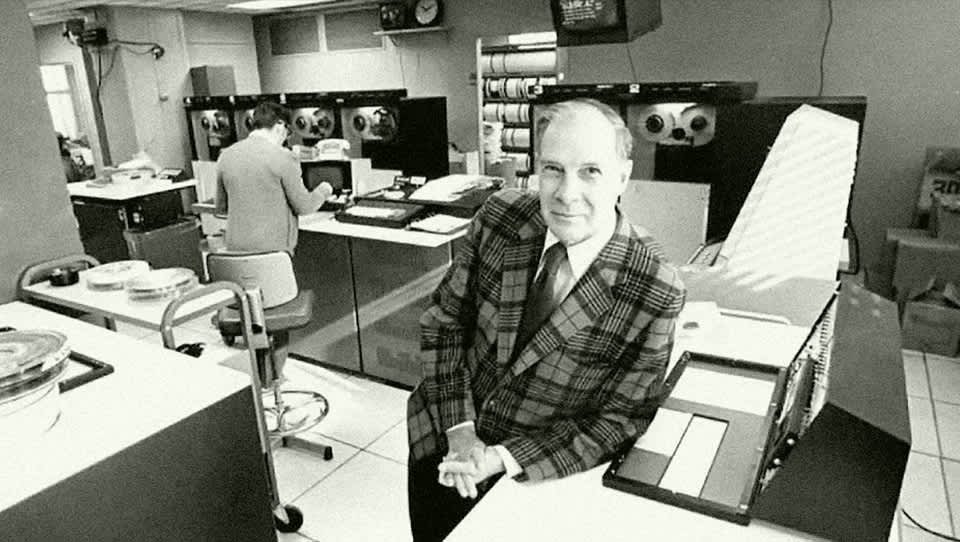
A mathematician who shared an office with Claude Shannon at Bell Labs gave one lecture in 1986 that explains why some people win Nobel Prizes and other equally smart people spend their whole lives doing forgettable work.
His name was Richard Hamming. He won the Turing Award. He invented error-correcting codes that made modern computing possible. And he spent 30 years at Bell Labs sitting in a cafeteria at lunch watching which scientists became legendary and which ones faded into nothing.
In March 1986, he walked into a Bellcore auditorium in front of 200 researchers and told them exactly what he had seen.
Here's the framework that has been quoted by every serious scientist for the last 40 years.
His opening line landed like a punch. He said most scientists he worked with at Bell Labs were just as smart as the Nobel Prize winners. Just as hardworking. Just as credentialed. And yet at the end of a 40-year career, one group had changed entire fields and the other group was forgotten by the time they retired.
He wanted to know what the difference actually was. And he said it wasn't luck. It wasn't IQ. It was a specific set of habits that almost nobody is willing to follow.
The first habit was the one that hurts the most to hear. He said most scientists deliberately avoid the most important problem in their field because the odds of failure are too high. They pick a safe adjacent problem, solve it cleanly, publish it, and move on. And because they never swing at the hard problem, they never hit it. He said if you do not work on an important problem, it is unlikely you will do important work. That is not a motivational line. That is a logical one.
The second habit was about doors. Literal doors. He noticed that the scientists at Bell Labs who kept their office doors closed got more done in the short term because they had no interruptions. But the scientists who kept their doors open got more done over a career. The open-door scientists were interrupted constantly. They also absorbed every new idea passing through the hallway. Ten years in, they were working on problems the closed-door scientists did not even know existed.
The third habit was inversion. When Bell Labs refused to give him the team of programmers he wanted, Hamming sat with the rejection for weeks. Then he flipped the question. Instead of asking for programmers to write the programs, he asked why machines could not write the programs themselves. That single inversion pushed him into the frontier of computer science. He said the pattern repeats everywhere. What looks like a defect, if you flip it correctly, becomes the exact thing that pushes you ahead of everyone else.
The fourth habit was the one that hit me the hardest. He said knowledge and productivity compound like interest. Someone who works 10 percent harder than you does not produce 10 percent more over a career. They produce twice as much. The gap doesn't add. It multiplies. And it compounds silently for years before anyone notices.
He finished the lecture with a line I have never been able to shake.
He said Pasteur's famous quote is right. Luck favors the prepared mind. But he meant it literally. You don't hope for luck. You engineer the conditions where luck can land on you. Open doors. Important problems. Inverted questions. Compounded hours. Those are not traits. Those are choices you make every single day.
The transcript has been sitting on the University of Virginia's computer science website for almost 30 years. The video is free on YouTube. Stripe Press reprinted the full lectures as a book in 2020 and Bret Victor wrote the foreword.
Hamming died in 1998. He gave his final lecture a few weeks before. He was 82.
The lecture that explains why some careers become legendary and others disappear is still free. Most people who could benefit from it will never open it.
>be Naval Ravikant
>spawn in New Delhi
>poor immigrant family
>father leaves shortly after they land in Queens, New York
>mother works menial jobs by day, night school after
>age 9, alone in a country you don't understand
>no friends
>no safety net
>no connections
>the library becomes your entire world
>get into Stuyvesant High School
>yes, that Stuyvesant
>the public school that produced four Nobel laureates
>one entrance exam changes the trajectory of your life
>go from blue collar to white collar in a single move
>graduate and land Dartmouth
>double major
>computer science and economics
>pay your way through by washing dishes, delivering newspapers, tutoring, fixing computers
>move to Silicon Valley with nothing but a degree and a bet on yourself
>join @Home Network
>watch a $20 billion company go to zero in the dot-com crash
>work on Intrinsic Graphics
>the thing that eventually becomes Google Earth
>co-found Epinions in 1999
>a consumer review site before Yelp and TripAdvisor existed
>raise $45 million in venture capital
>get screwed by your own co-founder and VCs
>they hide the company's real value during a merger
>the company IPOs at $750 million
>you walk away with $0
>not a typo
>zero
>sue Benchmark Capital and August Capital
>everyone in Silicon Valley calls you radioactive
>one VC tells the press you'll never work in the valley again
>settle the case
>learn the game from the inside out
>instead of quitting, you decide to rewrite the rules
>start Venture Hacks in 2007
>a blog that tears the veil off VC term sheets
>give founders the playbook that VCs never wanted them to have
>launch a $20 million fund called Hit Forge
>back Twitter before anyone cares
>back Uber before anyone believes
>back Stack Overflow, Notion, Postmates, Opendoor, Yammer
>turn Venture Hacks into AngelList in 2010
>50 angel investors
>$80 million committed in year one
>100 new startups signing up per day
>build the https://t.co/WLqfUQ0o7R for founders and investors
>do what LinkedIn tried and failed to do
>actually get people to transact
>realize US securities law is blocking everything
>fly to Washington DC
>spend six months lobbying Congress
>rally 5,000 investors and entrepreneurs for an online petition
>call in 100 favors
>get the JOBS Act signed into law by Barack Obama in 2012
>single-handedly open startup investing to ordinary Americans
>the entire equity crowdfunding industry exists because of this
>AngelList hits $4 billion valuation
>over $3.5 billion invested through the platform
>200+ unicorns funded
>spin off Product Hunt, Republic, CoinList
>companies like Neuralink and Rippling get backed through your Spearhead fund
>co-found MetaStable Capital in 2014
>a crypto hedge fund backed by Andreessen Horowitz and Sequoia
>bet on Bitcoin and Ethereum before it's fashionable
>earn a penny on every Uber ride taken on the planet
>invest in 200+ companies across your career
>drop a 40-tweet storm on May 31, 2018
>"How to Get Rich (without getting lucky)"
>it goes more viral than most product launches
>turns into a podcast series, then a global movement
>Eric Jorgenson compiles your tweets and interviews into The Almanack of Naval Ravikant
>it becomes a perennial bestseller
>you didn't even write the book
>your ideas were so good someone else did it for you
>go on Joe Rogan, Tim Ferriss, Shane Parrish, Chris Williamson
>every episode becomes a top-10 all-time listen
>millions of people re-read your tweets like scripture
>you become the most quoted man on the internet who isn't dead
>launch Airchat in 2023
>voice-first social media with AI transcription
>because you think text-only platforms made us forget humans can get along
>here is what Naval actually taught the world
>you're not going to get rich renting out your time
>own equity or stay a renter forever
>specific knowledge is the stuff that feels like play to you but looks like work to others
>leverage is a force multiplier for your judgment
>code and media are permissionless leverage
>you don't need anyone's approval
>10,000 iterations is not 10,000 repetitions
>one is mastery, the other is a treadmill
>if you can't decide, the answer is no
>when two choices look equal, pick the harder one short term
>stress is an inability to decide what's important
>desire is a contract you make with yourself to be unhappy until you get what you want
>inspiration is perishable
>act on it immediately
>the three big decisions: what you do, where you live, who you're with
>people spend years optimizing careers but pick partners and cities on autopilot
>not optimizing for wealth
>optimizing for sovereignty
>win the game fast enough that you get to stop playing
I still remember the first time I used a scientific calculator
As an engineering student, it felt like magic. Logarithms, trigonometry, exponentials—all at my fingertips. No more squinting at slide rule hash marks or flipping through dog-eared log tables.
That magic began exactly fifty-four years ago today, when Hewlett-Packard introduced the @HP-35, the world's first handheld scientific calculator.
Picture walking into a classroom in 1972 with a device that could out-calculate every student and teacher in the building all while fitting in your shirt pocket.
Before the HP-35, serious calculation meant real labor. Students spent grueling hours on equation mechanics just to reach a single result. Engineers were tethered to massive formula books and mechanical slide rules. Complex calculations? Wait for time on a bulky mainframe.
Then, suddenly, it was just... there. Instant. Accurate. In your hand.
Scientific calculators didn't make people "bad" at math. They fundamentally changed what math meant in daily practice. By offloading the grinding repetition, minds were freed to focus on logic and tackling actual problems. Engineering students like me could suddenly run dozens of iterations in an afternoon that would have taken our professors weeks.
But the revolution wasn't welcomed by everyone. By the 1980s, heated debates erupted over whether these "magic boxes" belonged in classrooms. Critics feared students would lose basic arithmetic skills, that technology was becoming a dangerous crutch.
In hindsight, those fears feel almost quaint. Math didn't disappear; it evolved. Fundamentals still mattered, but students used their new tools to go further and faster.
That history feels strikingly relevant right now.
We are having the same conversation about AI. The anxiety isn't really about the software it's about whether we're trading deep thinking for easy answers.
If calculators shifted learning from manual calculation to problem-solving, AI has the potential to shift it again: from producing answers to mastering high-level concepts and exploring territories we couldn't previously reach. Used thoughtfully, it's a superpower. Used carelessly, it's a shortcut to nowhere.
The HP-35 marked a turning point in how humans leverage technology to tackle the impossible. The calculator revolution didn't lower the bar it raised it. AI will likely do the same, provided we're brave enough to evolve alongside it.
I'm curious who here remembers when calculators first appeared in your world?
Roger Federer broke the internet with one statistic that will change how you see every setback in your life.
1,526 singles matches.
Won almost 80% of them.
20 Grand Slams. 103 titles.
Now answer honestly:
What percentage of total points do you think he won across his entire career?
70%? 65%? 60%?
Try … 54%.
He lost literally almost EVERY SECOND POINT he ever played for 24 years.
And still became one of the greatest of all time.
Watch him explain it himself (2:07 of pure life-changing wisdom):
“In tennis, perfection is impossible… When you lose every second point on average, you teach yourself to say:
‘Okay, I double-faulted — it’s only one point.’
‘Okay I got passed at the net — it’s only one point.’
Even a screaming overhead smash that ends up on SportsCenter Top 10… still just one point.
So when you’re playing your point, it has to be the most important thing in the world.
The moment it’s over — it’s behind you.
That mindset frees you to attack the next point, and the next, and the next with absolute intensity and clarity.”
Then he looked at the crowd and said the line that hit a billion people in the soul:
“The real sign of a champion is not that they win every point.
It’s that they lose again and again and again… and have learned how to deal with it.
Negative energy is wasted energy.
Cry it out if you have to. Then force a smile.
Move on. Be relentless. Adapt. Grow.
Work harder — and work smarter.”
Save this post.
The next time you lose a deal, bomb a presentation, get ghosted, miss a deadline, or just have “one of those days” — come back here and read it again.
You’re not falling behind.
You’re just in the 46%.
And the 46% is exactly where every single legend has spent most of their career.
Keep playing the next point.
(full 2:07 clip — sound on)
When our growth PM needs better analytics, he doesn't file a ticket with a data team. He builds a self-serve system that anyone can use.
High-agency generalists don't wait for permission.
There are no single points of failure because everyone can do everything.
Early career advice:
Be the person who's willing to do the shit that no one else wants to do at your company.
Then do it better than it's ever been done.
Practice this consistently for a year and there's zero chance you don't move up the ladder.
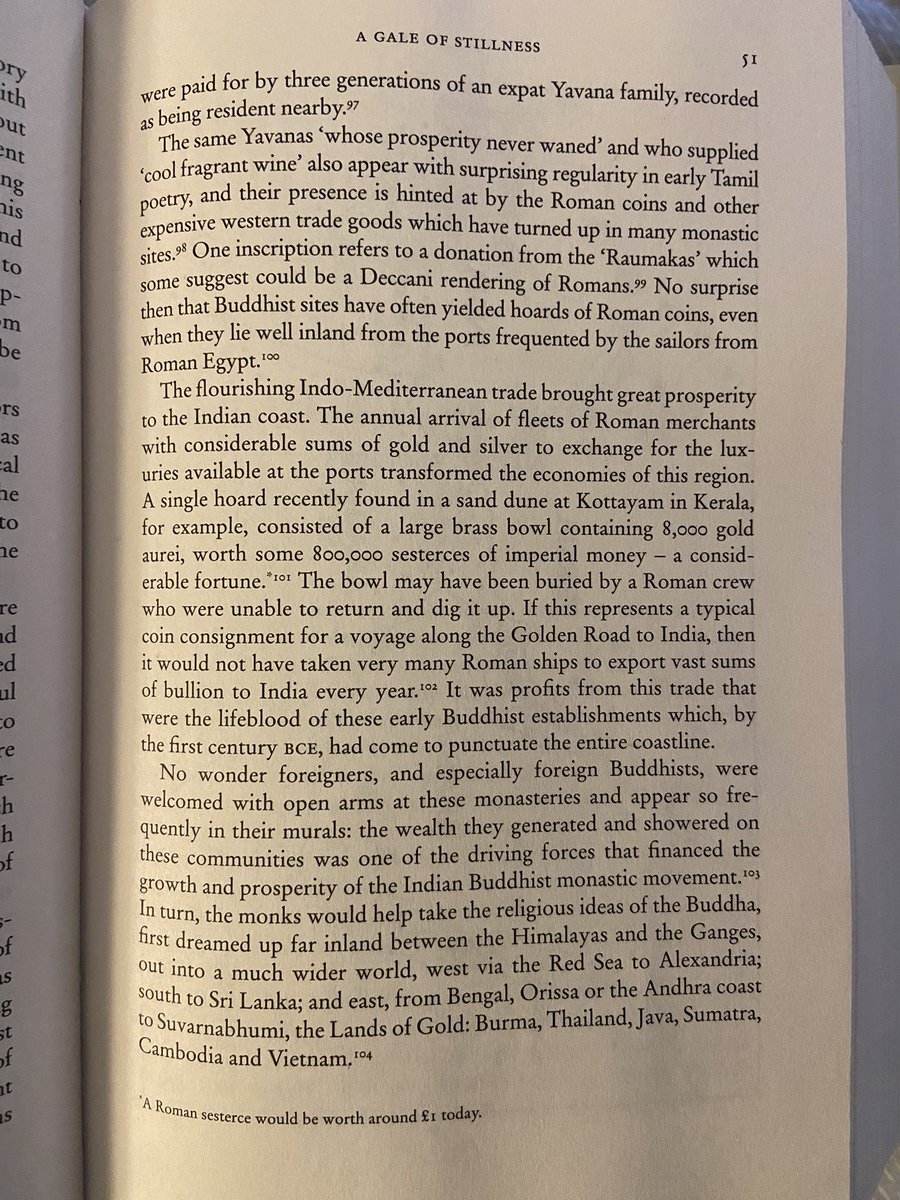
Per some calculations, almost a quarter of Roman Empires’ revenue could have come from these custom tax. And remember, this is the first time someone has quantified how much ancient India was worth - so far everyone was looking at China which he says was a wrong place to look at
What I like about #Darlymple is his way of quantifying the ‘riches’ of Ancient and Medieval India. In ‘Anarchy’, he calculated how much the British looted from the Indian palaces. In ‘The Golden Road’ he calculates how much India shipped to Roman Empire. Read these 3 pages
Flew AI191 BOM-EWR on Sept 27. Air India's Mumbai flights are top-notch unlike Delhi's. @airindia, the crew's excellent service, led by Anjali, was a highlight. Replicate this on all international flights to reclaim market share. #AirIndia#CustomerService
Bestie Q&A!: The One Question @Chamath Asks During Every Job Interview
If you want to know whether or not a candidate can contribute to your company, ask them this:
-- take a few minutes to think about something that you are an absolute expert in
-- it does not matter what it is (can be french horn, poker, chess, etc.)
-- explain it in ~2 minutes
Here's what this question shows:
Can the candidate think on their feet?
-- this forces them out of the coached answers people prepare for job interviews
Can they achieve mastery of a single thing?
-- this shows the ability to focus deeply on one goal
Can they simplify complex topics and communicate them clearly?
-- synthesizing complicated ideas or subjects in an easily understandable way is incredibly valuable
"That's a very powerful skill inside of a company."
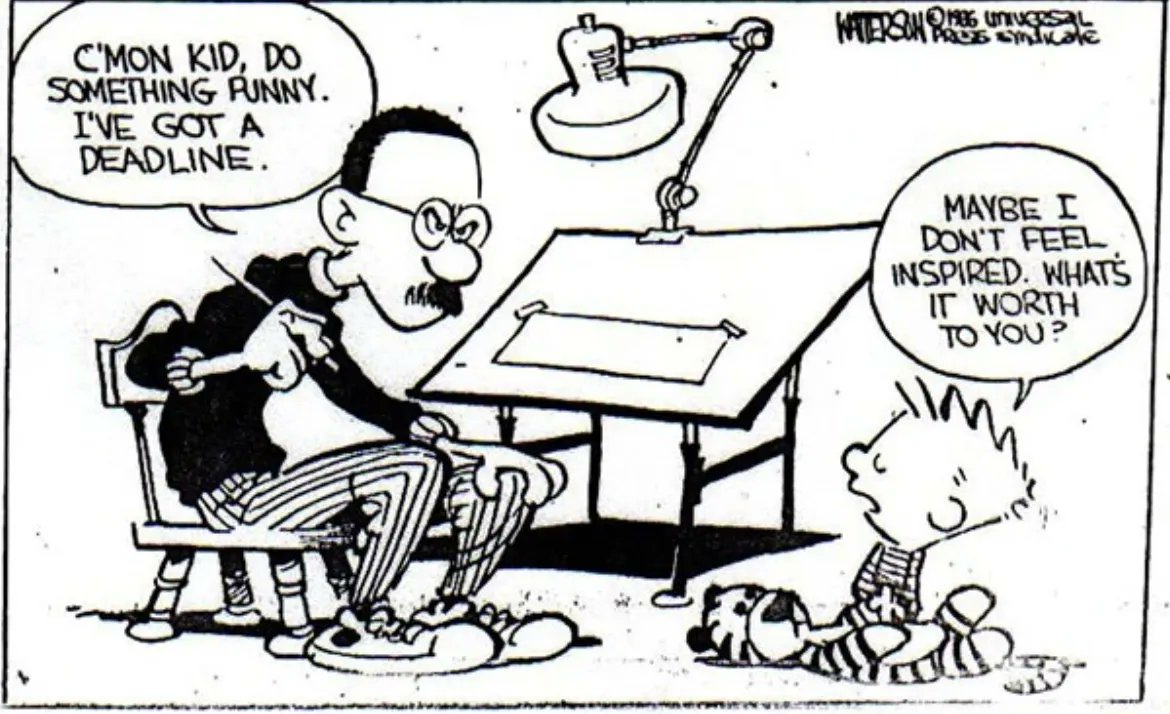
Today, we celebrate the extraordinary talent of Bill Watterson on his 65th birthday! The legacy of Calvin & Hobbes lives on, reminding us to embrace our inner child,explore our imaginations and find beauty in the simplest moments. Here’s to the magic you’ve shared with the world!