🔥BOA Forecasts Silver to Rise 61% Within Months!
🏦Bank of America sees a MASSIVE bull run in silver over the next few months in its just released forecast:
https://t.co/Lc5rxucT9A
[드러켄밀러의 경고: "연준은 인상 중이다, 지금은 돈 벌 때가 아니라 지킬 때"]
월가의 전설 스탠리 드러켄밀러가 TomorrowX 컨퍼런스에서 시장의 긴장감을 끌어올리는 묵직한 스탠스를 내놨다.
1. 드러켄밀러가 던진 4가지 시그널
- 구리 숏 & 연준 인상: "우리는 지금 구리 숏이다. 연준은 금리를 내리는 게 아니라 올리고 있다." (원자재 약세와 크레딧 스프레드 확대를 근거로 들었다.)
- 주식 중립: "주식은 롱도 숏도 아니다. 다만 감히 숏을 치진 못하겠다."
- 역대급 불확실성: "향후 12개월 뒤를 이렇게까지 가늠하기 어려웠던 때가 기억나지 않는다." (특히 2027년 하반기 경기 둔화 가능성을 경계했다.)
- 자본 보전 모드: "지금은 돈을 버는 게 아니라 잃지 않으려 애쓰는 '자본 보전' 구간이다. 며칠이 될지 6개월이 될지 모르지만 쉬고 있다."
- AI 전략 전환: "주식에서는 AI 인프라가 아니라 AI 활용 사례(Use cases)를 찾고 있다. AI 연구소들이 앞으로 토큰이 아니라 완수한 작업(Task)을 팔게 될 것이다."
2. 시장에 주는 3가지 함의
① 금융 환경의 역풍이 실물·원자재로 번지고 있다
AI 데이터센터와 전력망의 상징처럼 여겨지던 구리를 숏 쳤다는 건, 연준의 재긴축과 크레딧 스프레드 확대가 결국 2027년 하반기 실물 경기와 설비투자 속도를 누를 수 있다는 베팅이다. 지금 시장의 진짜 병목이 '반도체 업황'이 아니라 '금융 환경'이라는 걸 다시 확인해 준다.
② AI 투자의 눈높이가 '인프라'에서 '응용·���금흐름'으로 옮겨간다
"인프라가 아니라 유즈케이스를 찾는다"는 말은, GPU와 데이터센터를 깔아주는 1차 랠리를 지나 실제 업무를 해결하고 돈을 버는 소프트웨어·응용 기업으로 옥석 가리기가 시작됐다는 뜻이다.
③ "감히 숏은 못 친다"는 말 속의 실전 대응법
1월까지만 해도 자신감을 보였던 거장이 방망이를 내려놓고 현금을 쥐었다. 다만 섣부른 하락 베팅(주식 숏)은 경계했다. 즉, 방향성이 보일 때까지 무리한 레버리지나 공격적 추격 매수를 멈추고, 철저히 '잃지 않는 포지션'으로 버티는 게 이 구간의 정석이라는 메시지다.
출처: CoinDesk (2026-11-17)
https://t.co/bfz90hHaGE
#드러켄밀러 #매크로 #연준 #금리인상 #구리숏 #자본보전 #AI투자 #미국증시
Ten tanta calma que al final todo se solucione solo. A veces sólo necesitas rendirte y entrar en la fase de confianza para permitir que las cosas salgan bien para ti.
Si prestas atención a los patrones de tu vida, te darás cuenta de que todo siempre sale bien. Todo siempre te lleva a un destino mayor. Siempre creces y las cosas que crees que no puedes sobrevivir, de alguna manera divinamente las superas. Así es la vida. Siempre recuerda eso.
Banxico decidió bajar su tasa de interés en 0.25% para llevarla a 6.25%, en una decisión 3-2, con Borja y Heath votando por mantenerla.
Señala que la tasa se mantendrá en ese nivel por tiempo prolongado, es decir, señala una pausa.
On today's carnage
To me, this really "smells" of forced liquidation as an aftershock from 'blue tsunam' 🧢🌊
think of size of shock = combo of:
➡️tariff shock of 2025 --> blue tsunami "shock" 🧢🌊
➡️deepseek moment 2025 --> AI "super intelligence" bad
➡️situtational awareness of June 2026 --> ➡️several large hedge funds liquidating
Each of these prior shocks took time (only days) to "bottom"
- each of these prior shocks was a major buying opportunity
These shocks do not change the AI story:
➡️demand = strong due to major AI discoveries
➡️supply = there is no new "competitor" to AI or the bottleneck
➡️speed = there might be a 'speed bump' but a speed bump = oppty
This shock will soon pass
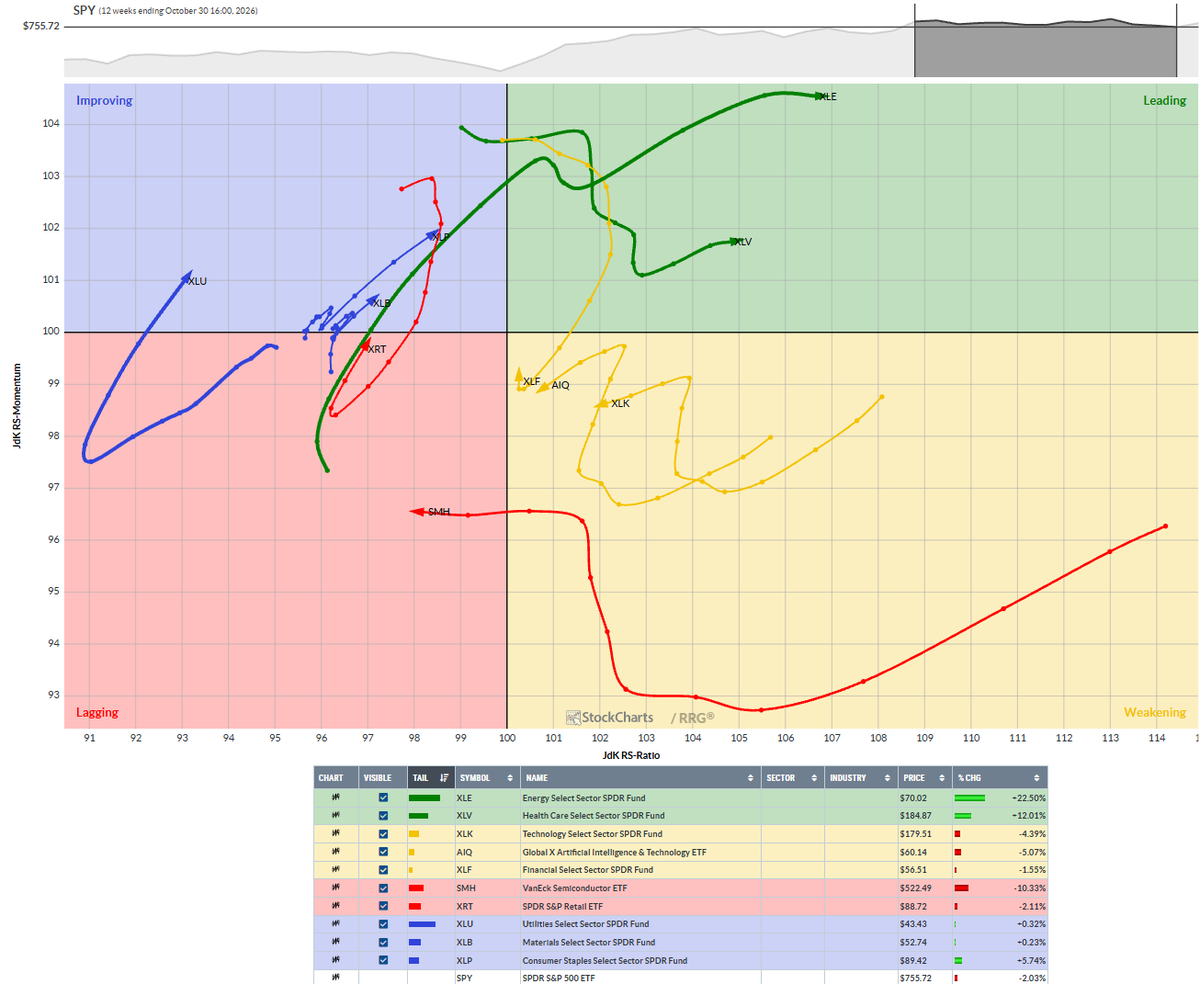
1ro Rotación de Semis $SMH a Software $IGV (Julio)
2do Rotación de IA $AIQ a $XRT $XLP (Consumos Básicos y retail)
Tal como explicabamos en los premarket APM en Youtube y X.
Cada punto es una semana... No mires la magnidtud sino la dirección.
Por eso $NKE $DUOL $SN $EAT $DLTR $STZ $BBWI $ETSY $VSXY $ULTA $WMT $WING $DNUT
Hoy hay FOMC: la Fed publica su decisión de tasas a las 2:00 p. m. (hora de Nueva York) y su presidente habla a las 2:30.
¿Cómo se prepara un día así sin adivinar? Esta es la estrategia que explica
Vamos paso a paso
Recuerda si eres un Trader Intradia Esta estrategia debes tenerla
Before you rush to buy a stock that's down 15-20% after earnings, understand one important rule: The 3-Day Rule!
What is the 3-Day Rule, and why does it matter? Let me explain.
When a stock gaps down sharply after earnings or bad news, wait at least 3 trading days before considering buying.
Why? Large institutions managing millions of shares may need several sessions to reduce their positions. The initial gap down might be just the beginning of the selling pressure.
Day 1: An initial bounce could be driven by short covering and aggressive dip buyers rather than sustained institutional demand.
Days 2 and 3: Selling pressure may continue, and the stock could make new lows as investors reassess the news.
After Day 3: Look for signs that selling pressure is fading and price is beginning to stabilize.
Before buying, check:
- Selling volume is shrinking
- Price is holding above the recent low
- You understand why the stock dropped
- The fundamental thesis remains intact
Remember, three days don't guarantee a bottom. Some stocks need several weeks or even months to build a proper base before beginning another sustained uptrend.
If the business is fundamentally broken, the stock isn't necessarily on sale. It may simply be getting repriced.
The market doesn't reward you for catching the exact bottom. Let the selling pressure fade, let the stock build a base, and let the trend confirm itself.
Missing the bottom is far better than getting caught in a downtrend
Elon Musk says “robot RAM needs will exceed everything else on Earth” and believes superintelligence will eventually drive even more demand through deep space compute.
To put that into perspective $TSLA producing 10M Optimus robots a year would require ~720 petabytes of memory at 72GB per robot.
Pretty wild for $MU and $SKHY as AI expands beyond data centers although robots use LPDDR rather than HBM so this could become a much bigger volume story.
$NVDA CEO Jensen Huang says a memory glut by 2029 is unlikely because "you can always use more of it" which is huge for $MU and $SKHY.
Even with China's CXMT ramping production I think the bigger threat remains standard DRAM rather than advanced HBM powering AI GPUs.
This is unprecedented.
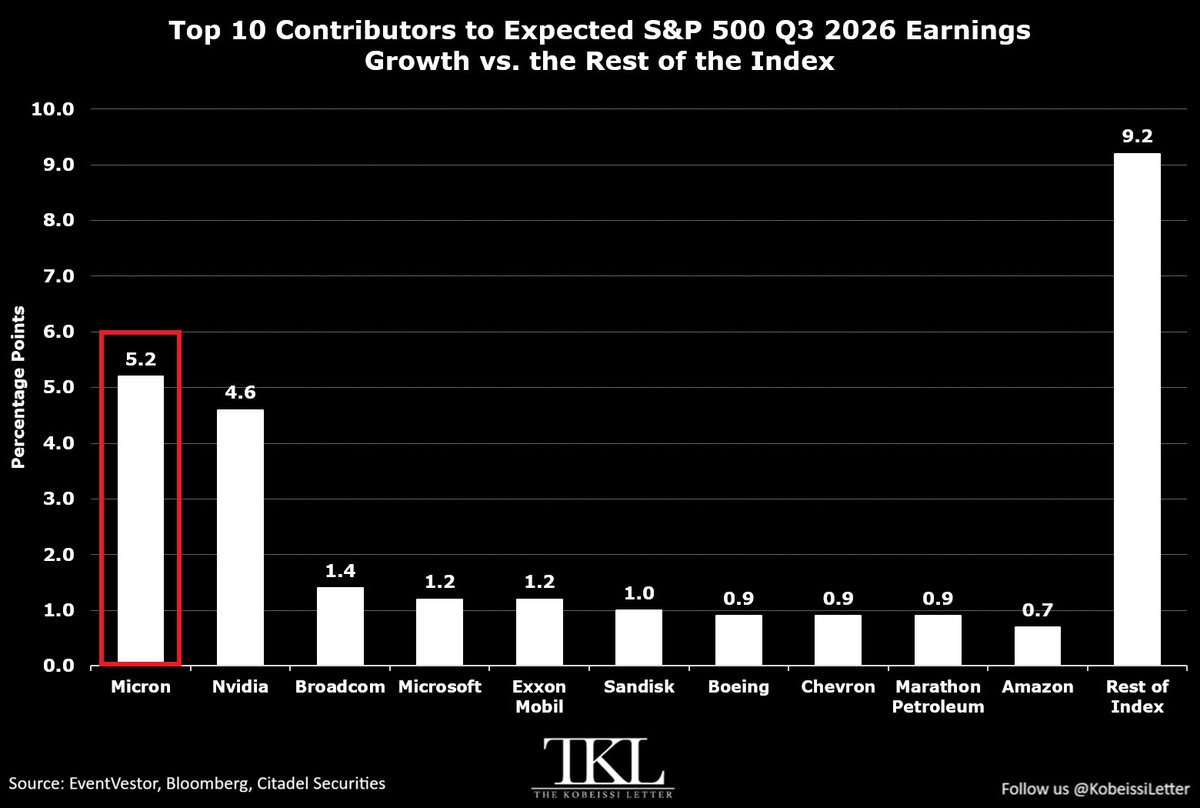
Micron, $MU, and Nvidia, $NVDA are expected to account for 36% of the S&P 500’s earnings growth in Q3 2026 earnings season.
This comes as $MU and $NVDA are expected to contribute +5.2 and +4.6 percentage points to the index’s +27% YoY earnings growth, respectively.
Meanwhile, the next 8 top contributors are projected to add +8.2 percentage points, accounting for ~30% of the estimated S&P 500’s net income growth.
Then, the remaining 490 stocks are set to contribute just +9.2 percentage points, representing 34% of the index’s projected earnings growth.
Excluding those top 10 contributors, earnings growth is estimated to decline -11% YoY in Q3.
Never in history have we witnessed market concentration like this.
BREAKING: The 3x leveraged long Semiconductor ETF, $SOXL, has attracted +$3.8 billion in inflows so far this week, putting it on track for its largest weekly intake on record.
This follows 3 consecutive weekly outflows, the longest streak since May.
By comparison, the previous record weekly inflow was +$3.1 billion posted in June this year.
This comes despite $SOXL falling -35% over the last 7 trading sessions.
Meanwhile, the Semiconductor ETF, $SMH, has posted +$430 million in inflows so far this week, on track for its biggest weekly inflow since the start of September.
At the same time, the Semiconductor ETF, $SOXX, has attracted +$574 million, on pace for its 2nd-largest weekly intake since August.
Investors are piling into leveraged semiconductor ETFs at a record pace.