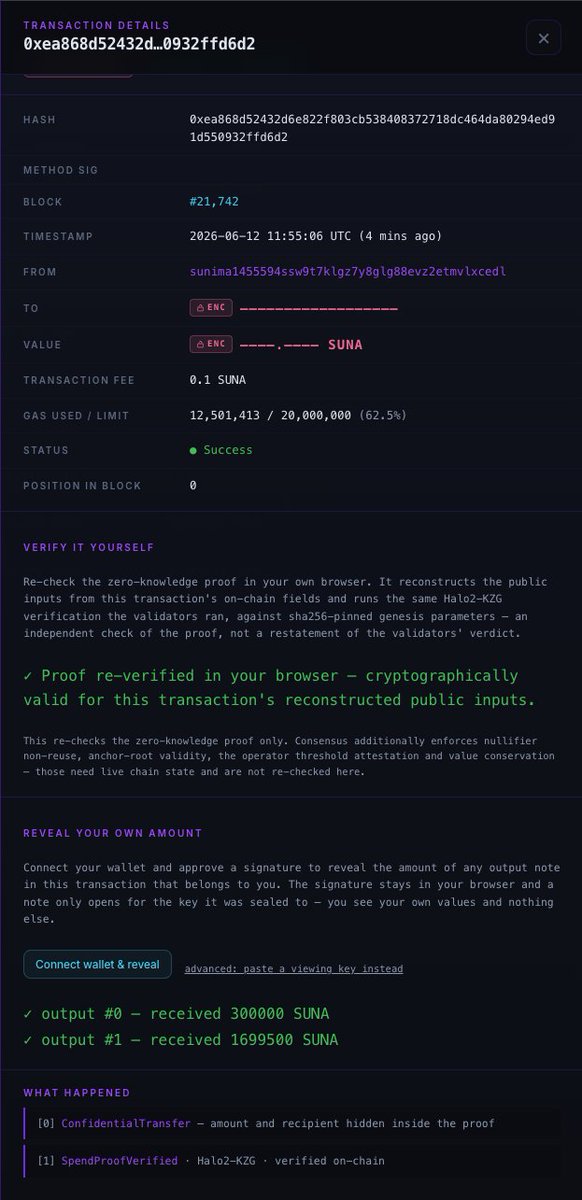
What you see: a transfer. ✅ Success. What you don't see: the amount, the recipient.Both sealed inside a zero-knowledge proof — and your browser just re-verified that proof against the chain's sha256-pinned parameters. Cryptographically valid. No validator's word taken on faith.Connect your wallet and only YOUR notes open. Everyone else sees ████.Compliant privacy — live, on-chain, verifiable.
https://t.co/wValUCbqHG
https://t.co/XSy0vKkW8l
https://t.co/TrpJKLNXjL - test this
#Sunima #Halo2 #Defi
Most blockchains show everyone everything. Every amount, every counterparty, forever public. We think that was always a mistake. Here's a real transfer on Sunima testnet — amount and recipient sealed inside the proof, invisible to the explorer, to validators, to anyone. Yet the chain verified it's honest: no double-spend, no inflation, balances intact. It just doesn't need to see your business to know the math holds. Confidential by default, proven on-chain (Halo2-KZG), with a lawful disclosure path when a court requires it. Privacy that's accountable, not absolute.
#Privacy #ZK #Halo2
This is the ground floor — the testnet is where we harden everything before
mainnet.
→ Run a node
→ Watch live blocks on the explorer
→ Break things, tell us what you find
https://t.co/UekCYkCnLD · https://t.co/7PRp4BP9px
A privacy-first L1 on one idea: confidentiality and compliance don't have to
be enemies. Encrypted transfers, disclosure only by court order, and an AI
security auditor in the stack.
And it's open for node operators today. 🧵👇
Under the hood:
• Confidential transfers secured by on-chain zero-knowledge verification
(Halo2 / KZG)
• Threshold key custody — no single party holds the keys
• Court-order-gated disclosure for lawful access
• An AI auditor pass over the protocol itself
@EliBenSasson When a team reviews what they shipped — that's good. When they actually catch something — better. When they catch it and fix it — that's the dream.
We tested FHE — fully homomorphic encryption — as an extra compute layer on Sunima. Here's an honest update most projects would bury.
First, to be clear: FHE was never our privacy layer. Confidential transfers run on proven, deterministic cryptography that works today. FHE was the ambitious bonus — we wanted it for private, verifiable AI and confidential heavy compute.
FHE is the dream: compute on encrypted data without ever decrypting it. After thorough hands-on testing, our verdict: it's not ready for the scale we need — and it isn't ready anywhere in the industry. Running a real model under FHE today costs hours to days per single inference. The best public result in the world runs a tiny model at ~134 seconds per ONE token. That's not an engineering gap we can out-work — it's a hard limit the entire field is stuck behind.
So we're making the call most won't: we don't ship what doesn't exist. No "private AI" vaporware. If anyone promises encrypted LLM inference at production speed today — read the fine print.
What this does NOT change: Sunima's core is real, tested, and shipping — confidential transfers with built-in, court-grade disclosure. Privacy a regulator can actually accept. That was always the heart of the project, not FHE.
FHE isn't trashed. We keep it for what it's genuinely good at — encrypted arithmetic and predicates — and we watch the research. When the breakthrough lands, we slot it in. Until then we build on what works.
Honesty over hype. Always.
Everyone calls TEE-based privacy "trustless."
It's not. It's trust-the-chip-maker.
The whole model rests on one assumption: that nobody extracts the key baked into the silicon.
That assumption keeps getting broken. https://t.co/CCK6yMae3C, Foreshadow, Plundervolt — the list grows every year.
Power analysis. Fault injection. Voltage glitching. Give an attacker physical access and the "secure" enclave isn't.
If your security model is "I hope the chip holds" — that's not a security model. That's a prayer. 🙏
@EliBenSasson The whole thread is arguing what institutions need. Truth: nobody knows. They want what doesn't exist yet — and once it ships, they'll want something else. Build the thing that makes the next 'something else' possible.
Most protocols that got hacked had an audit stamp.
Euler, Ronin, Wormhole — all audited. All drained weeks later.
What if there was an AI layer running continuously after the report was signed?
Maybe those hacks don't happen.
Today's audit stamp is a confidence sticker. Not protection.
@mikebelshe A regulatory zoo is still a zoo.
You can cage wild animals. They just stop being wild — and that's exactly the point. That's exactly the problem.
Stablecoins don't need a country. They need math.