Welcome to SunnyAIDock 🚀
AI is moving beyond models that generate answers towards systems that can reason, use tools and take action.
Here, I explore what's changing across:
🔹 AI Agents & Agentic Systems
🔹 RAG, LLMs & AI Solution / tools
🔹 Multimodal AI & Emerging Technologies
🔹 Hands-on Experiments & Practical Builds
I build, test, explore and share what I learn along the way.
No hype. Just insights, experiments and practical AI.
Follow @SunnyAIDock.
#AI #ArtificialIntelligence #AIEngineering
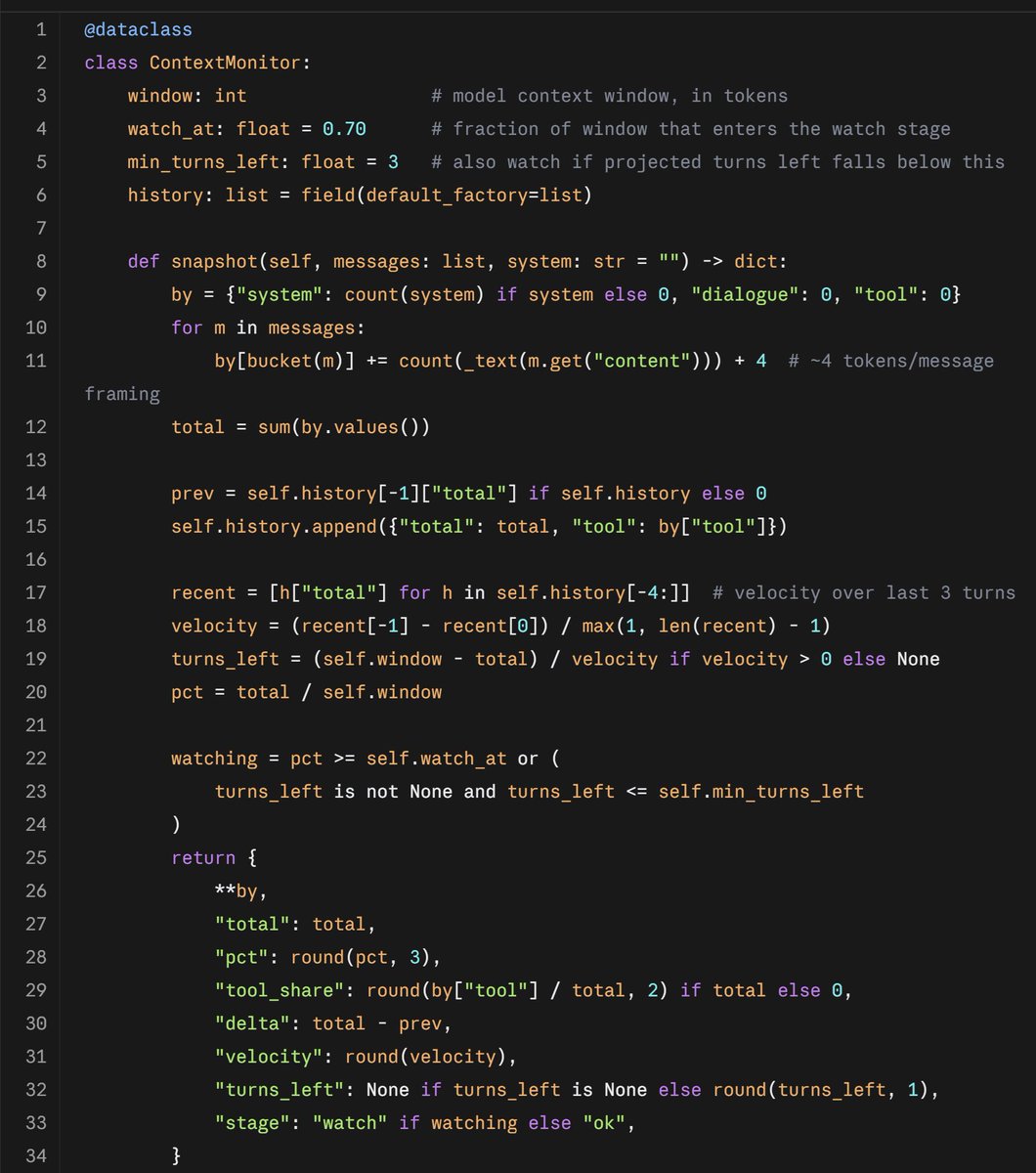
Don't let your agent's context overflow mid-generation. Monitor it every turn.
ContextMonitor.snapshot(): call it after each turn, before the next model call. It tracks:
📊 Token split: system / dialogue / tool output
📈 Growth velocity per turn
⏳ Projected turns left
🚦 "watch" at 70% full or ≤3 turns left
Why both? On a 200K window, 70% at 3K tokens/turn leaves room. At 25K/turn, you're ~2 turns from trouble.
tiktoken is accurate when its encoding matches the model's tokenizer. Otherwise, treat it as an estimate and prefer provider-reported usage.
Step 1: Watch. Step 2: Mask tool outputs.
Code 👇
#ContextManagement #AgenticAI #AIAgents #AIEngineering
Observation Masking vs. LLM Summarization for AI agents.
Tool outputs make up ~84% of tokens in a typical coding-agent turn (JetBrains Research).
Observation Masking
⚡ Sub-ms, zero extra LLM calls
💰 Cuts cost by more than half vs a raw agent
🎯 No generated text → nothing to distort
📈 Solve rates match or slightly beat summarization
LLM Summarization
🐢 Extra model call every trigger
💸 Also saves tokens, but adds a model call’s latency and cost
⚠️ Can distort parameters or decisions
Mask the tool output.
Summarize only the dialogue you can’t rebuild.
Why pay a model to compress what a string replace can drop?
#ContextManagement #AgenticAI #AIAgents #AIEngineering
AI models can return answers. Can they show where those answers came from?
Perplexity’s Decider v1.3 adds “locate”: it extracts text spans based on your instructions and returns their exact positions in the source.
That makes every extraction easy to check against the evidence.
Traceability is starting to become a model capability, not just an add-on.
The next step in trustworthy AI isn’t better answers. It’s verifiable ones.
#AgenticAI #TrustworthyAI #AISecurity
Did a quick test of Sarvam Dictate, and I'm impressed by how smoothly it works!
I was able to speak naturally in Hindi and English within a single audio recording and get the output in both Devanagari and English scripts.
No need to switch languages or record separately. The Codemix mode handles it beautifully.
Though it was a quick check, this seems like a very promising tool for India's multilingual developer ecosystem. Great work, Team Sarvam! 🇮🇳👏
#SarvamAI #VoiceAI
More than 40% of GitHub pull requests in September'26 began with an AI agent’s first draft.
Writing code is no longer the bottleneck.
Designing the system that writes, tests, and ships it is.
That system is a software factory of specialized agents. Someone has to:
→ define the flow
→ set explicit standards for what “good” looks like
→ treat every escaped defect as a process failure
→ put human judgment only where it’s still essential
Line-by-line review of every agent-generated change is becoming a craft-era habit.
The engineers who know good code, real tests, and safe rollouts from experience are the ones best placed to build the factory.
Where does human judgment still belong on your team?
#AIAgents #SoftwareEngineering #ProcessDesign
Indian IT once competed on headcount.
The next talent war is for engineers who can take AI from demo to production.
Anyone can build a prototype. Few can make it work with messy data and legacy systems, then prove business impact.
That's where Forward-Deployed Engineers (FDEs) come in.
Some of India's largest IT firms are already building this capability as they move towards AI-native delivery.
The shift from headcount to outcomes has begun.
#IndianIT #AgenticAI
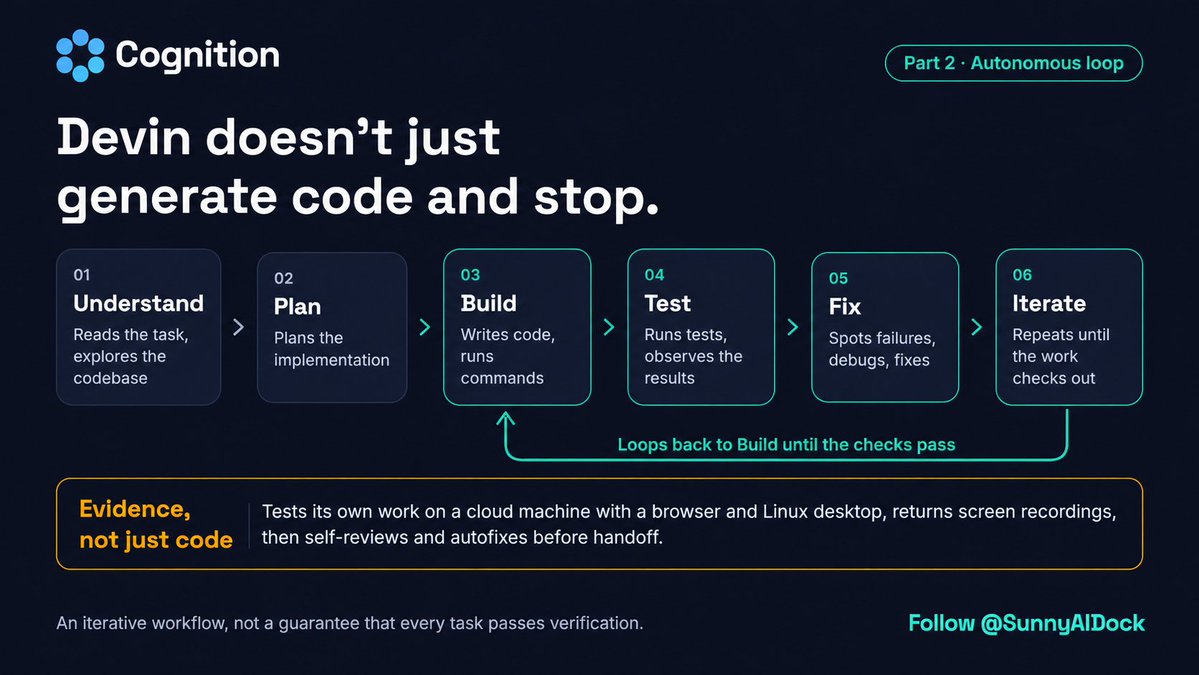
How does Devin actually work? It doesn’t just generate code and stop. 🤖
It runs an autonomous loop:
→ Understands the task and explores the codebase
→ Plans the implementation
→ Writes code and runs commands
→ Runs tests and observes the results
→ Spots failures, debugs and fixes them
→ Iterates until the work checks out
And here’s the interesting part: Devin can test its own work on a cloud machine, using a browser or a full Linux desktop, then send back screen recordings as evidence.
Add self-review and autofix, and verification stops being a handoff. It becomes part of the workflow.
The output isn’t just code. It’s code plus evidence you can review.
#Devin #AgenticAI #AIEngineering
Google just put an AI engineering team inside Antigravity. 🐝
Its new /swarm command (preview) turns one prompt into a coordinated team:
→ A coordinator breaks down the task
→ Specialised agents build in parallel, in isolated Git worktrees
→ Adversarial verifiers test the code and challenge diffs
→ Everyone coordinates on a shared, live message board
Different agents can even use different models, matching capability to role.
The catch? Every worker is its own agent, so swarms burn through quota fast.
Cognition’s Devin got here first with Managed Devins. The race is on.
The shift is clear: from AI that writes code to AI teams that engineer software.
#Google #Antigravity #AgenticAI
We’re building AI agents that think, decide and act.
When one makes the wrong call — a bad transaction, a rejected candidate, real-world harm — who answers?
The developer? The deployer? The human who trusted its output?
Autonomy without accountability isn’t innovation. It’s risk without an owner.
Before you ship autonomy, name the owner. Build in traceability and human oversight.
If you can’t say before you ship, don’t ship.
#AgenticAI #ResponsibleAI #AIGovernance
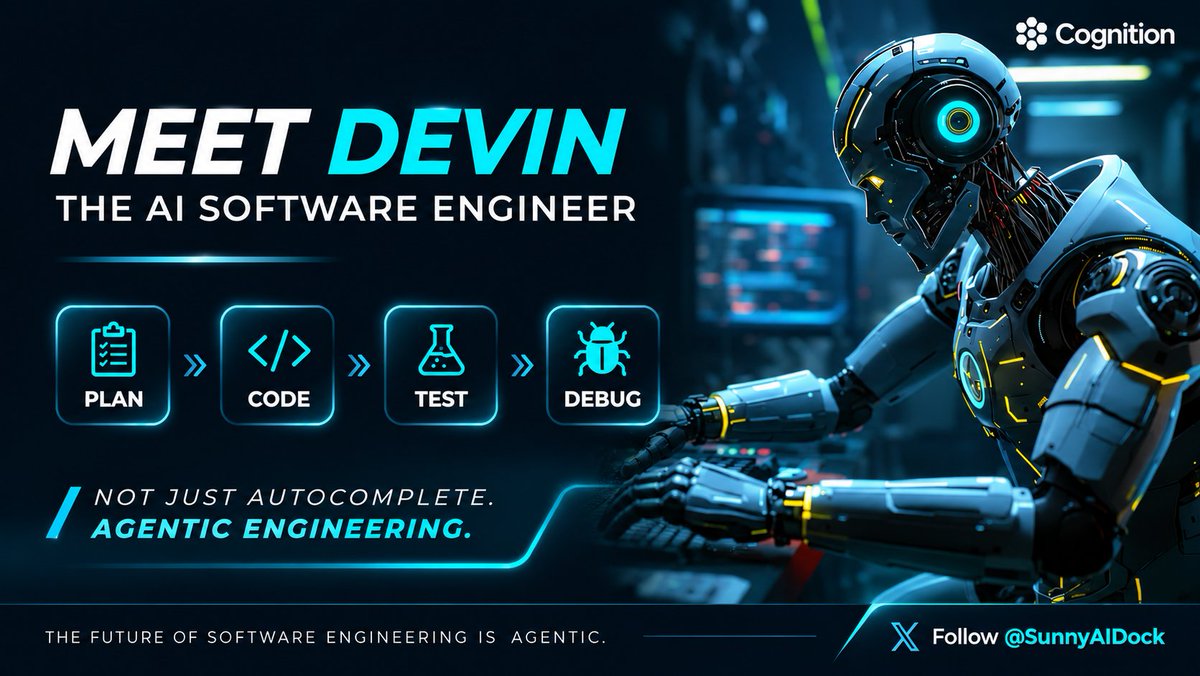
Most people still think of AI coding tools as autocomplete. Devin is a different idea. 🤖
Devin is an AI software engineer from Cognition. You don’t prompt it line by line. You give it a task, like a bug fix, a migration or a round of testing, and it can plan, write code, run tests, debug and open a pull request for review.
Think of it as a teammate working through your backlog, not an assistant sitting in your editor.
Since launching in March 2024, it has grown into teams of collaborating agents, multi-model pairing and scheduled autonomous workflows.
What does agentic software engineering actually look like in practice? Let’s break it down. 🧵
#Devin #AgenticAI #Cognition
Well said. The real challenge in the AI era isn't just keeping pace with technology, but making the right choices about where to invest, innovate, and build for the long term.
Would love to hear Mr. Vembu's own thoughts on this subject as well.
#GartnerSYM #AILeadership #LongTermThinking
Tested Paar for English-to-Hindi translation across everyday expressions, business communication and AI/technical terminology.
🔍 Key observations:
🟢 Basic translation: Reasonably good accuracy with straightforward sentences.
🟠 Contextual understanding: Struggles with idioms. For example, "Don't beat around the bush" was translated literally rather than contextually.
🟠 Business communication: Meaning is generally preserved, but some sentences lack natural Hindi construction.
🔴 Technical terminology: Needs improvement. "Retrieval-Augmented Generation" was translated awkwardly instead of retaining commonly used technical terminology.
🟠 Language naturalness: Some outputs convey the meaning but don't sound natural to a native Hindi speaker.
⚡ Overall: Impressive speed and on-device execution. However, contextual accuracy, idiomatic understanding and natural language generation need further refinement before production readiness.
#IndicAI #UdgamLabs #MachineTranslation
The ~600 ms TTFT (Time to First Token) is encouraging. Would be interesting to see the TPS (Tokens Per Second) benchmarks as well, once published, to get a better picture of the overall inference performance.
With India-hosted inference, competitive pricing, reliability and performance already in place, Token Factory has the potential to emerge as a very strong competitor to global inference providers. 🇮🇳
An agent completes a task. Can you explain exactly what happened along the way?
That’s where production architecture gets serious.
🔍 Observability
• LangGraph: execution traces + checkpoint inspection.
• AutoGen: OpenTelemetry traces across agent interactions.
• CrewAI: agent, task and tool execution visibility.
🔐 Control
• LangGraph: explicit transitions + approval gates.
• AutoGen: message-level and termination controls.
• CrewAI: role-based delegation, not permission isolation.
Log every tool call, approval, identity and outcome.
#AISecurity #AgenticAI #LLMOps
Orchestration isn’t security.
Is your agent stack audit-ready? 👇
Two Indian voice stacks. Two different bets on text normalization (TN).
🇮🇳 Sarvam Bulbul V4 Flash: Context-aware TN. ISRO spoken as a word; EMI letter by letter. Built around Indian speech patterns.
🌍 Sonex Pāṇini: 250+ languages, Hinglish code-switching, custom pronunciation dictionaries and 8 kHz telephony audio. Public docs don't detail its TN layer.
My take: Sarvam = Indian-context depth. Sonex = multilingual reach + pronunciation control.
Feature lists can't settle this.
Test five strings: ₹2.5 lakh, OTP 4920, EMI, IFSC and one Hinglish sentence.
Which would you test first? 👇
#VoiceAI #IndianAI #SpeechTechnology
Completely agree. I'd add one more dimension: mathematical foundations.
Linear algebra, vectors, probability, statistics and optimisation are equally important when working with embeddings, cosine similarity, RAG architectures and AI models.
AI can write the code, but understanding the mathematics helps us evaluate the logic behind it.
CS fundamentals + mathematical foundations will be the real differentiators for tomorrow's AI engineers.
Your voice agent just told a customer their OTP is "four thousand nine hundred twenty." 😬
That's a Text Normalization (TN) failure.
TN converts written text into contextually correct spoken words. In Indian voice AI, it's an often-overlooked bottleneck:
💰 ₹2.5 lakh → "two point five lakh rupees"
🔢 OTP 4920 → "four nine two zero"
🔤 UPI, EMI, IFSC → letter by letter
🗣️ "Aapka EMI due hai of ₹2,500" → natural Hinglish speech.
Great TTS isn't just about the model. It's about what you feed it.
What's the strangest TN bug you've encountered in production? 👇
#VoiceAI #TextNormalization #IndianAI