I got goosebumps studying my Bible today.
In Genesis 28, Jacob has his famous vision of a ladder stretching into heaven, with angels ascending and descending.
He wakes up trembling with awe. On his own initiative, he sets up the stone he slept on as a pillar, pours oil over it, renames the place Bethel ("House of God"), and vows to give God a tenth of everything if God protects him on the road.
Fast forward twenty years to Genesis 31.
Jacob has spent two decades being cheated, exhausted, and trapped in Laban's household.
When God finally appears to tell him it is time to return home, He does not introduce Himself with an intimidating, distant title. He does not announce Himself as the Almighty or the Creator of heaven and earth.
He looks at Jacob and says: "I am the God of Bethel, where you anointed a pillar and where you made a vow to me."
Do you realize what is happening here? God grounds His very identity in a runaway's memory.
For twenty long years, God remembered a desperate prayer spoken over a rock in the dark. He lets a flawed human encounter define holy ground, taking the name a frightened fugitive gave to a stone and adopting it as His own divine signature.
Now leap forward over a thousand years to John 1.
Philip brings his friend Nathanael to meet Jesus. When Jesus sees him coming, He says: "Here is a true Israelite, in whom there is no deceit."
Remember what the name Jacob actually means. Jacob was the deceiver, the supplanter. Jesus is deliberately invoking Jacob from the very first sentence.
Startled, Nathanael asks, "How do you know me?"
Jesus answers: "Before Philip called you, when you were under the fig tree, I saw you."
In Jewish life, sitting under a fig tree was the recognized place for solitary prayer, meditation, and wrestling with God in private.
Whatever Nathanael was carrying beneath that tree, whether an unspoken sorrow, a quiet wrestling match of the soul, or a prayer he thought had vanished into the silence, he believed he was entirely alone.
He had built no altar, poured no oil, and made no grand vows. He was simply sitting in the quiet with an ache he could not fix.
Yet that single sentence undoes him completely. Nathanael breaks: "Rabbi, you are the Son of God! You are the King of Israel!"
Then Jesus ties the entire story together:
"You believe because I told you I saw you under the fig tree? You will see heaven open, and the angels of God ascending and descending on the Son of Man."
Angels ascending and descending. That is word for word the scene from Genesis 28!
Jesus is telling him that the ladder his ancestors saw was never a stone staircase in the desert, and Bethel was never just a coordinate on a map. The ladder was always a person. The bridge between heaven and earth was standing right in front of him on a dirt road in Galilee.
The contrast between these two men is striking.
Jacob’s encounter was structured. He had oil, built a stone monument, named the place, and negotiated with a formal vow.
Nathanael’s encounter was raw. He was sitting in the shadow of a tree, empty-handed, carrying a weight he had no ceremony for.
Yet God claims both as holy ground.
He is the God of Bethel, the God who honors the altars you build when you have the strength to build them.
And He is the God of the Fig Tree, the God who sees you when you are too exhausted to promise anything at all.
Some people can’t handle the blessing on your life. Don’t let it bother you. It’s not you that’s offending them; it’s the blessing on your life. It’s what God put on you. You can’t stop that, and the good news is, they can’t stop it. You stay in peace and God will take care of the opposition.
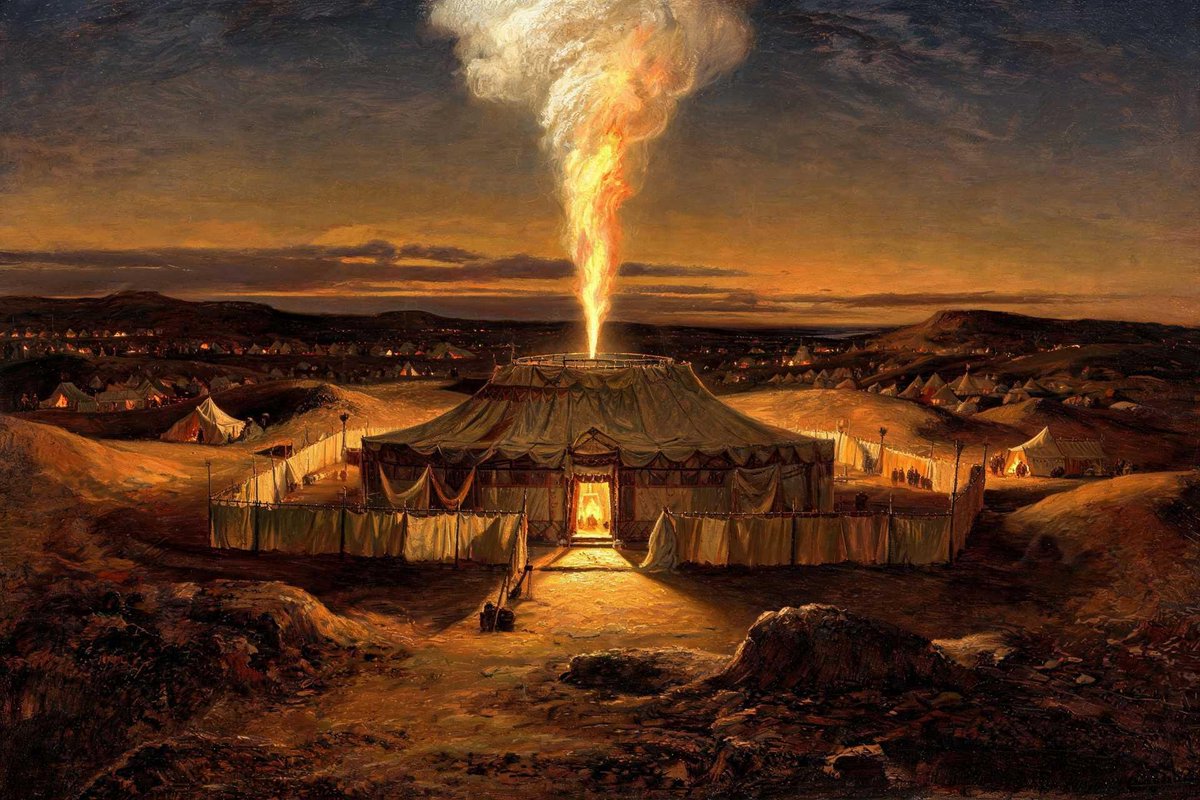
God gave Moses 50 chapters of instructions for a tent.
Fifty.
More space in the Bible is devoted to the design of the Tabernacle than to the creation of the universe.
That's not an accident.
Every measurement, material, and color was pointing to something, and once you see it, you can't unsee it.
A thread. 🧵
There was only one entrance to the entire courtyard.
One gate. One way in. (Exodus 27:16)
Not multiple paths. Not "find your own door."
Every Israelite who wanted to approach God came through the same single entrance.
Centuries later, Jesus would say: "I am the door. If anyone enters by me, he will be saved." (John 10:9)
The architecture itself was teaching a truth long before it was spoken aloud: access to God comes through one appointed way, not many.
@Joma1987900@imakun122 It's a distorted history (especially in our nationalistic history) to paint the whites as evil. Henry Doherty is a case in note.