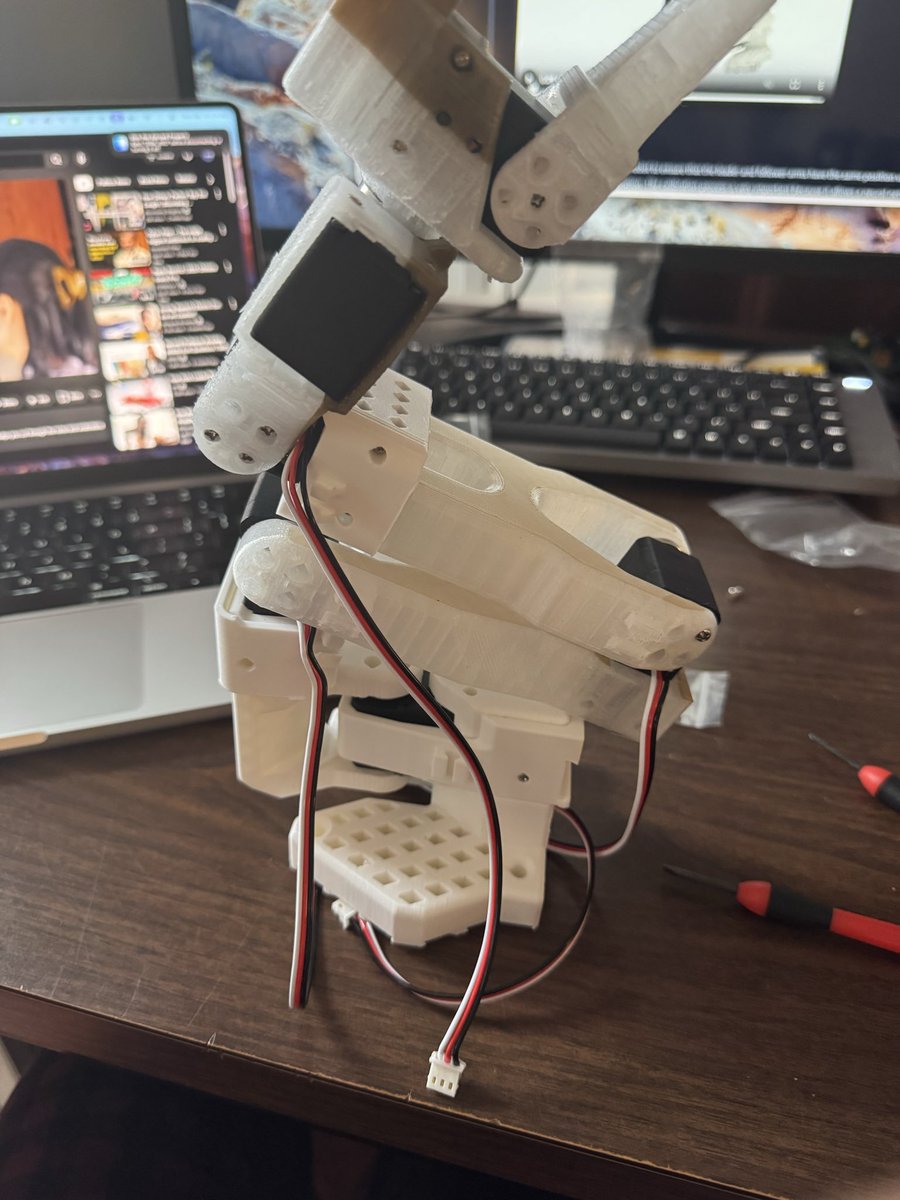
rip @kscalelabs :( learned a lot through their open source docs! Gonna have to put off the "building a humanoid in my dorm" for now. Might do some smaller robot arm projects with the actuators I have now and experimenting w/ VR and haptic gloves
What’s next for me? Right now, I’ve returned to Stanford and am trying very deliberately to not rush into the next thing. That being said, I am happy to use the code for the tech above for any interesting use cases, and have many ideas I’d love to explore. If you know any interesting people who care a lot about frontier things (particularly lab or manufacturing automation), are good at communicating + realizing their passions, and need an excuse to work on cool things — I’d love to meet them! Follow too, in case I actually decide to frequently use this app. Repost so I can find other cool robot people :)
In March, my cofounder and I raised $1M from @southparkcommons without an idea. Next thing, I left Stanford for SF to work on giving operators’ telepresence in humanoid robots.
I’m stepping away due to internal disagreements, but I wanted to share what I worked on so it doesn’t all fade into the abyss. Hence, I decided to cut together this “personal launch.” More on whole body control tech below. Hope you enjoy!
In March, my cofounder and I raised $1M from @southparkcommons without an idea. Next thing, I left Stanford for SF to work on giving operators’ telepresence in humanoid robots.
I’m stepping away due to internal disagreements, but I wanted to share what I worked on so it doesn’t all fade into the abyss. Hence, I decided to cut together this “personal launch.” More on whole body control tech below. Hope you enjoy!
📢 Introducing ServingBench, a research-to-production integration benchmark for ML serving engines
A little project I’ve been brewing:
In 12 months, traditional ML will feel antiquated—every “small” model will just be another LLM.
We’re on the cusp of a surge in hyper-minimized NVIDIA Blackwell B200s with FP4 support. To actually leverage them, you need to transform PyTorch prototypes into SRAM-/VRAM-savvy kernels
And this will be vital for ANY “AI-native” product, from JARVIS-style assistants to true on-edge companions.
Yet there’s always a sizable lag between paper and production in vLLM/TensorRT-LLM. Months are lost hand-crafting and tuning kernels for either individual productionizing or on the actual frameworks' end.
But researchers should stick to theory, not sweat over “magic” tile sizes for their tiled matmuls!
@arnavwad Real but I also wonder what would happen when devs lack enough context when something major breaks (that AI can’t fix) and they haven’t spent enough time in the weeds debugging/testing code