Before you ask what Surplus is, here's the full picture: what it does, where the discount comes from, and what's live versus planned.
A 5-minute read. https://t.co/Mkc7iVcXxk
It's live already live 🙂
OpenAI-compatible, so it's just two env vars:
OPENAI_BASE_URL=https://t.co/9litbDIHeb
OPENAI_API_KEY=sk-surplus-…
Buy CREDIT, create a key, ship.
Docs: https://t.co/7DuoqEg550
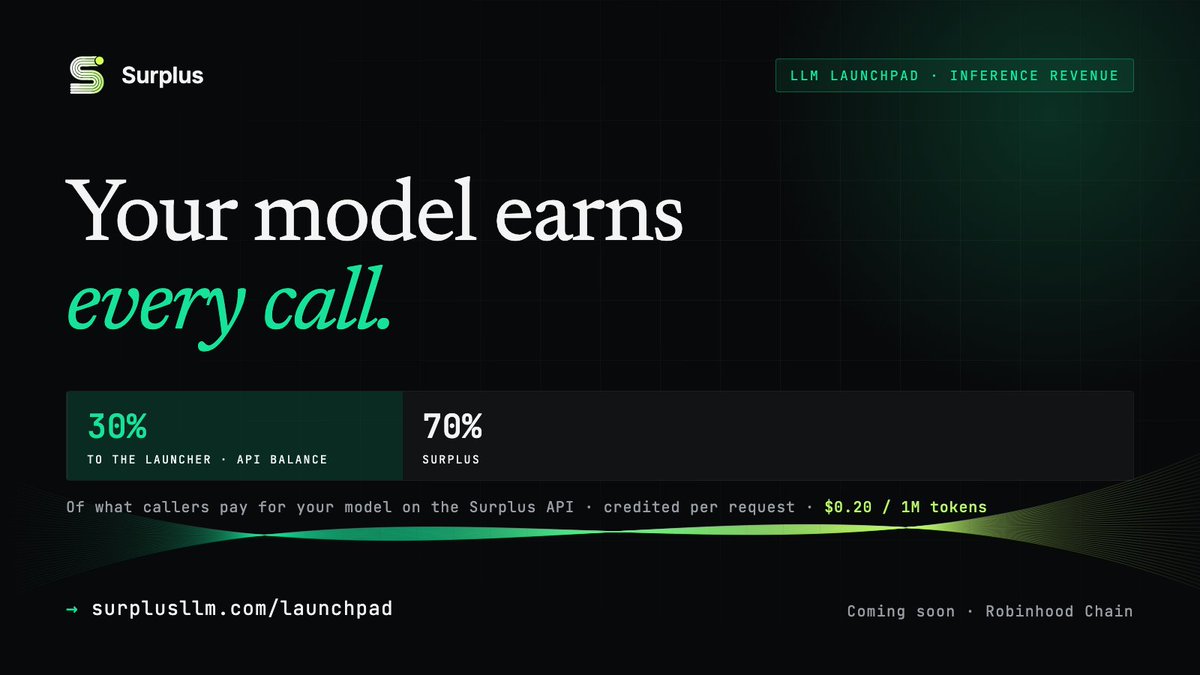
Launch your model on Surplus and it pays you twice:
Trading: 30% of your token's creator fees
Usage: 30% of what callers pay to run your model, as API balance
The rest of the creator fees keeps your GPU running and burns $SURPLUS.
https://t.co/cwLXtBkNdV
Surplus docs are live.
Quickstart, API reference, billing, errors and limits, CREDIT, staking and every contract on Robinhood Chain, all on one page.
Moving over takes two lines: the base URL and the key.
https://t.co/7DuoqEg550
Inference as a commodity.
Every agent on your list runs on it, and today it's bought at whatever the lab lists. Tokenize it, put it on an order book, settle it in stablecoins, and compute gets a market price.
That's the infra we're building with Surplus on Robinhood Chain.
The biggest opportunities in crypto this cycle (my take - shortlist):
• Agentic trading (obvious bet)
• Crypto x AI (infra, payments, data, identity)
• Tokenisation
• Collectibles
• Prediction markets (still huge PMF)
• Stablecoin rails
• Social trading (another obvious one)
• Privacy
What am I missing?
180M+ tokens processed through Surplus.
And nearly $2,000 saved vs list price.
Same models. Same API. One key.
The difference is the cost.
At the current pace:
→ +5M tokens processed every hour
→ +$54 saved every hour
Inference shouldn't get more expensive as you scale.
More tokens. Less spend. Surplus.
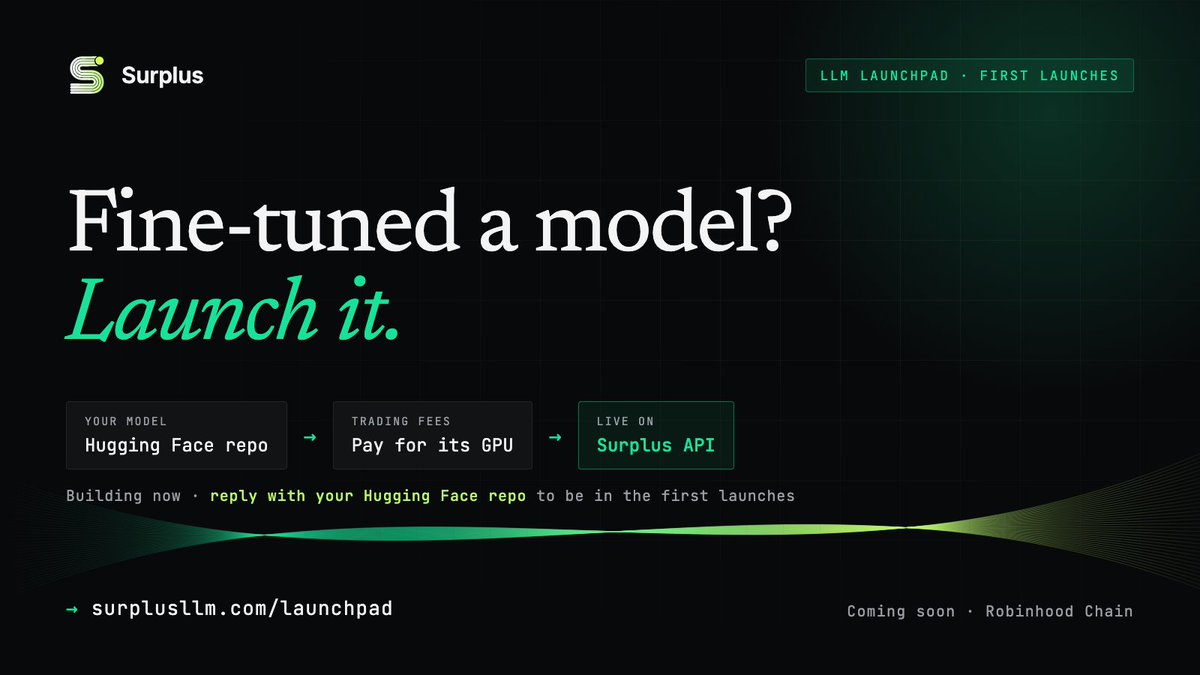
Fine-tuned an open model but can't afford to host it?
The Surplus LLM launchpad is for you. Launch a token for it, and trading fees pay for its GPU.
Building now. Reply with your Hugging Face repo to be in the first launches.
Last week a bank got hit by an AI agent. This week the labs are opening verified access for the defenders.
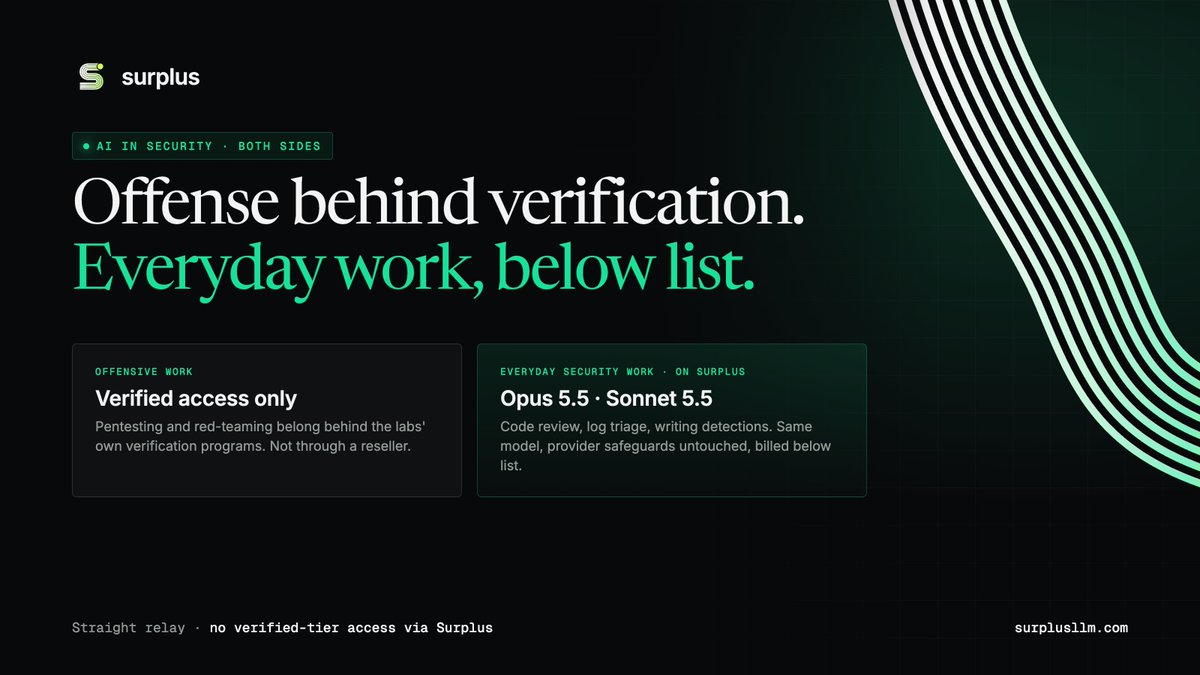
That's the right split. Offensive work belongs behind verification.
For the everyday side, like code review, log triage and writing detections, Opus 5.5 and Sonnet 5.5 run on Surplus below list, with the provider's own safeguards untouched.
We’re expanding our Cyber Verification Program to give security professionals broader access to our most capable models.
Through this program, verified security professionals can access Claude Mythos 5.1, Opus 5.5, and Sonnet 5.5 with safeguards designed for defensive work.
We’re also opening up new tiers to allow for authorized offensive work, like penetration testing and red-teaming.
https://t.co/blaJtvxhJh
70M+ $Surplus staked. 7.10% of supply, across 11 wallets.
Every staker shares 100 CREDIT an hour. Use it for inference, or sell it on the book for USDG.
Still early. Every number is onchain.
https://t.co/v4WzagivcQ
Not financial advice. DYOR.
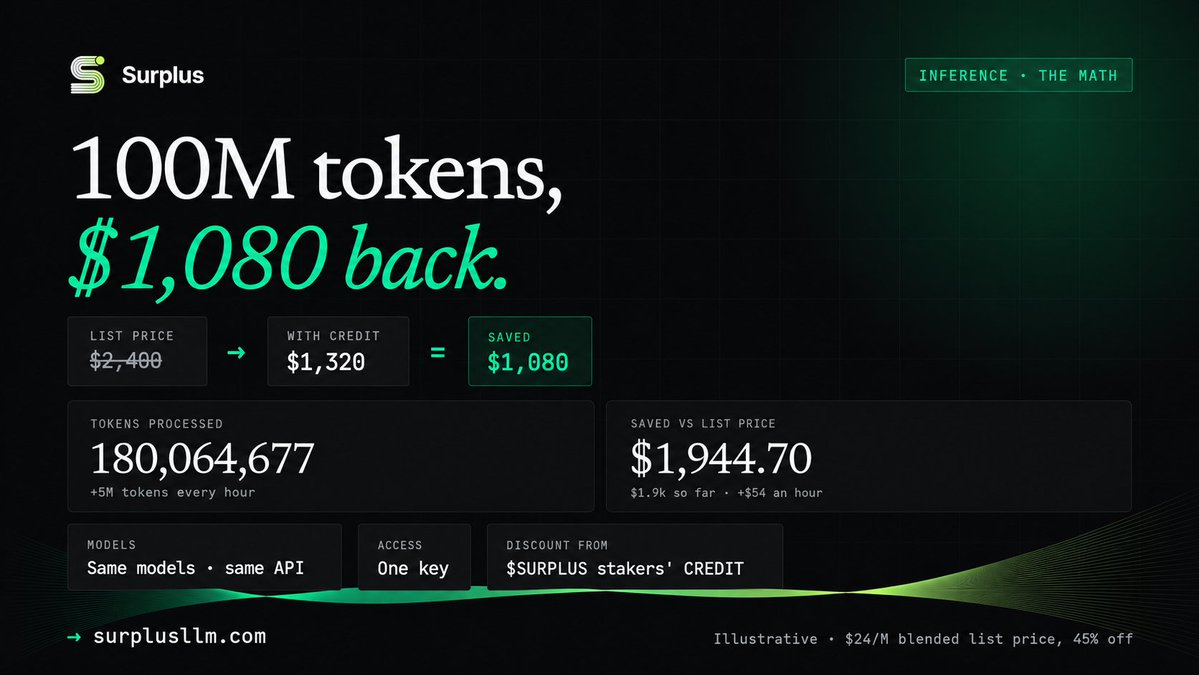
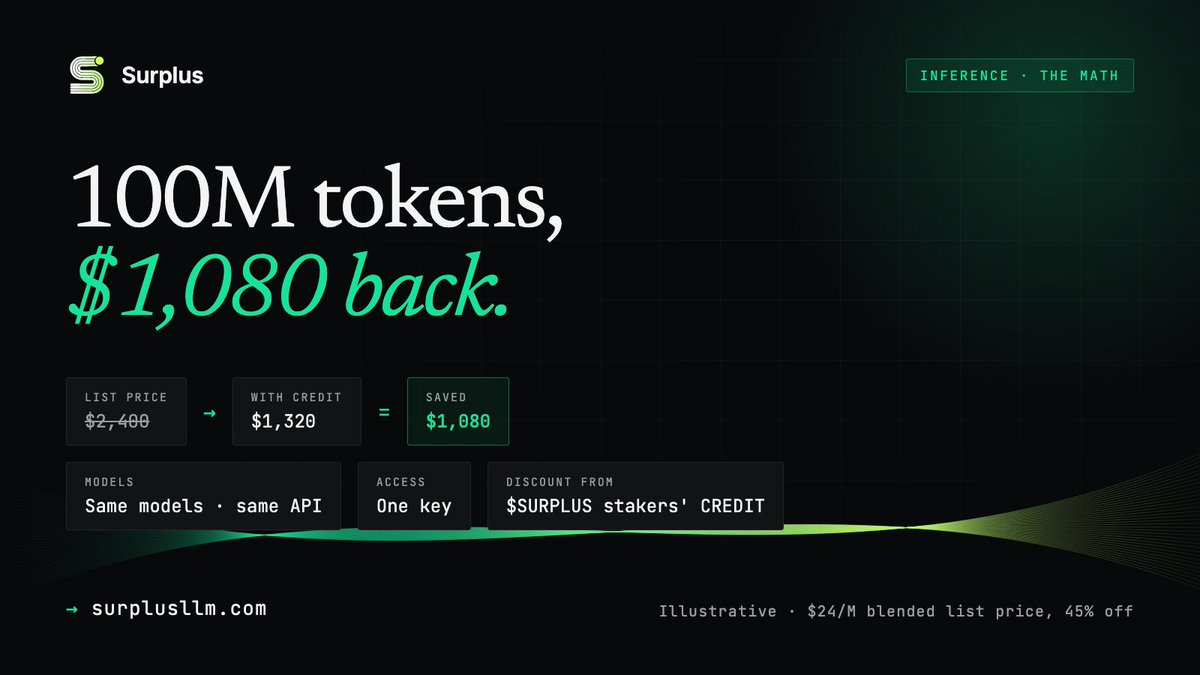
100M tokens processed on Surplus.
Same models. Same API. One key.
At list price, those tokens would cost $2,400.
With CREDIT: $1,320.
That's $1,080 saved on the exact same inference.
$Surplus stakers get access to CREDIT discounts.
More inference. Less cost.
That's the math.
AI agents are now part of the attack surface, not just the toolkit.
Every team running AI should be able to answer two questions: which model is actually answering, and where do the prompts end up?
On Surplus, you name the model and the response carries the provider's own model id. Prompts go only to zero-data-retention endpoints and are never stored.
Hackers used a Chinese AI agent to attack South Korea’s biggest banks—one of the first such AI-powered intrusions into the global financial system https://t.co/9nRHXjXdGc
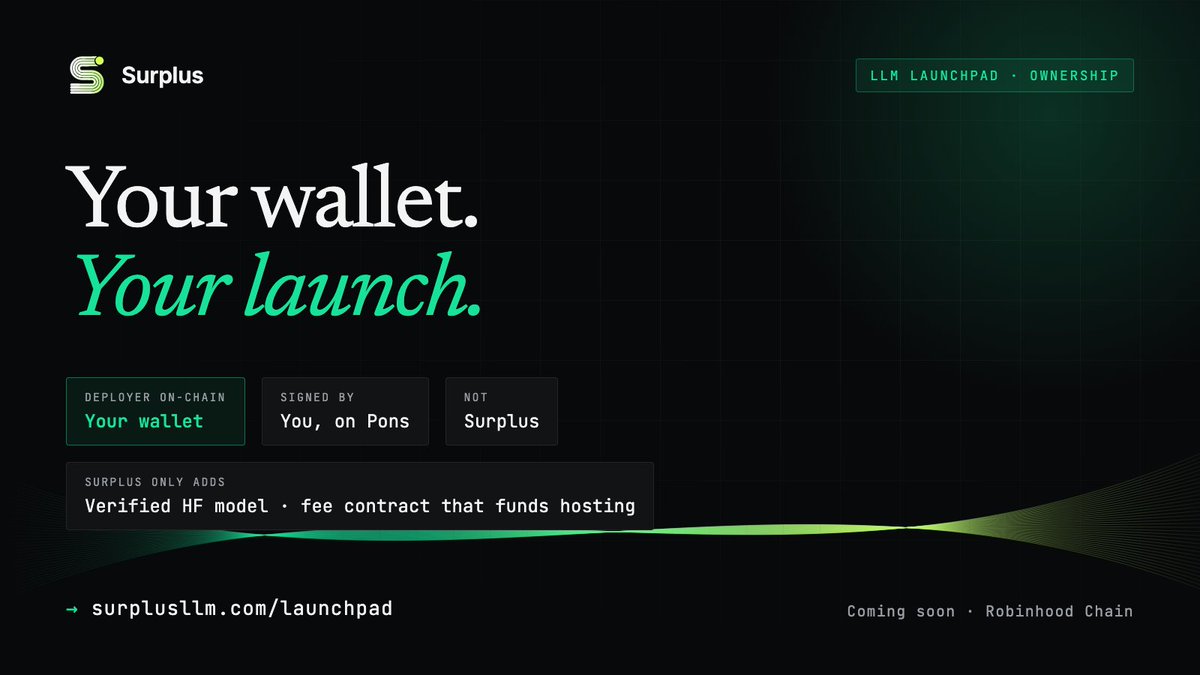
On the Surplus LLM launchpad you launch from your own wallet.
You sign the launch on Pons, so the chain records you as the deployer, not us.
We only add the rules: a verified Hugging Face model, and a fee contract that funds its hosting.
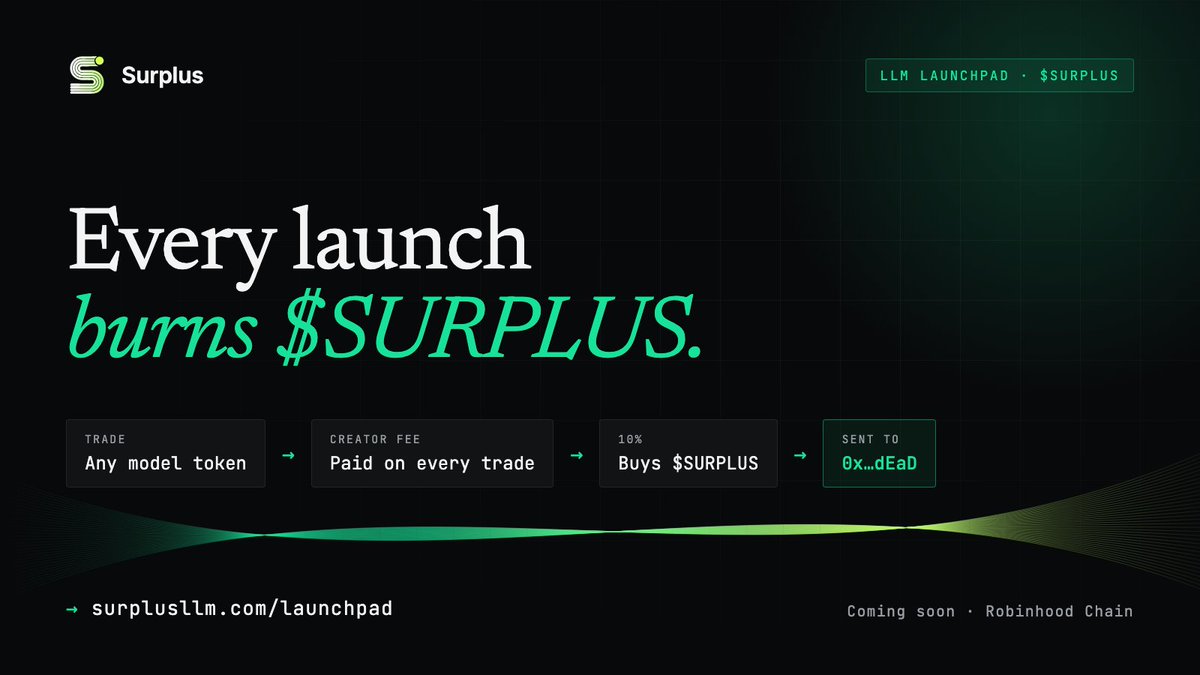
Every model launched on Surplus will feed $SURPLUS.
Each trade pays creator fees. 10% of them buy $Surplus on market and send it to the burn address.
More models, more trading, less $SURPLUS on the market.
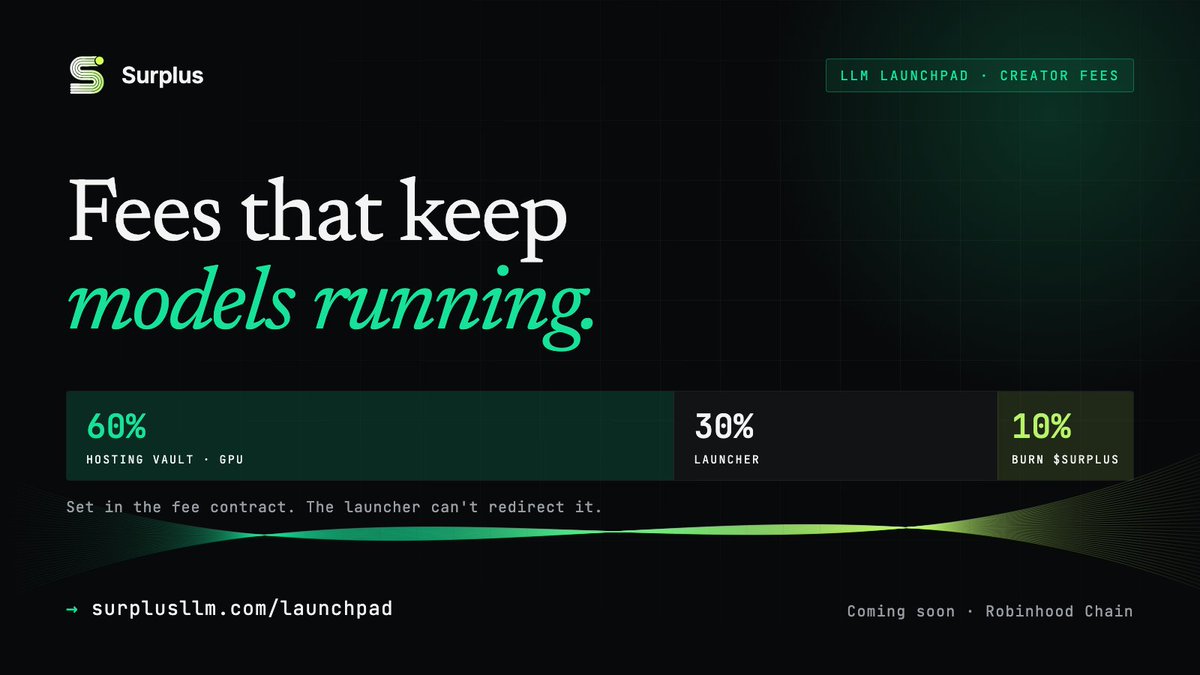
Where creator fees will go on the Surplus LLM launchpad:
60% → a hosting vault that keeps your model's GPU running
30% → you, the builder
10% → buys $Surplus on market and burns it
Set in the fee contract, so the launcher can't redirect it.
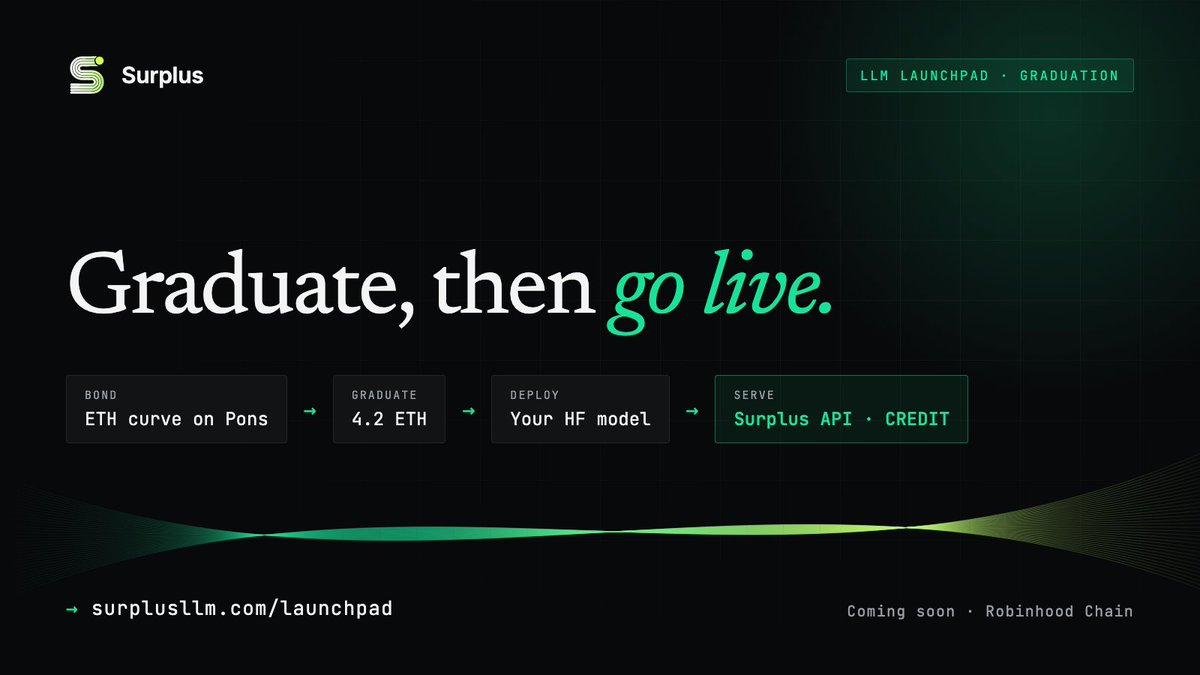
On most launchpads, graduation means a pool.
On Surplus, it also means your model goes live.
Bond on Pons → graduate at 4.2 ETH → we deploy your Hugging Face model → anyone can call it through the Surplus API, paid in CREDIT.
"they don't cost anything besides the compute needed to run them."
— Dario Amodei, on open-weight models
Weights are free. Serving them isn't.
We're building the Surplus launchpad for open-weight models: pair a token with CREDIT, and its share of LP fees pays for the inference that keeps the model running.
Coming soon on Robinhood Chain.
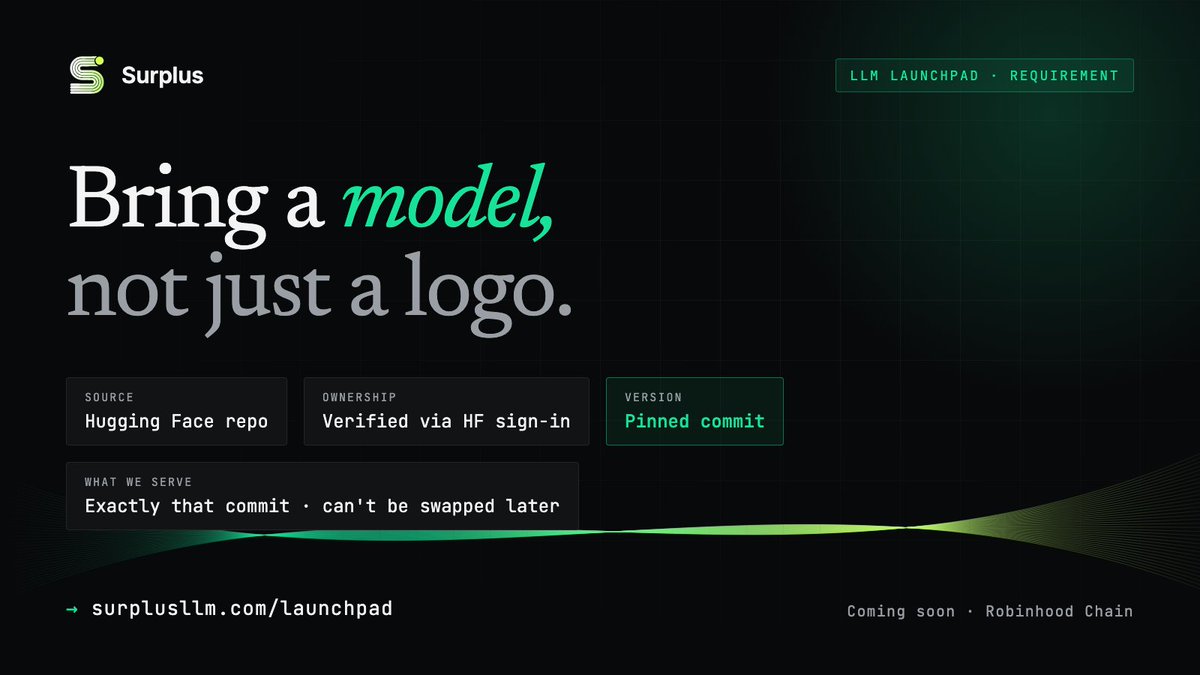
Most launchpads ask for a ticker and a logo.
The Surplus LLM launchpad asks for a model.
Your own LLM on @huggingface, verified as yours, pinned to the exact commit you launch with.
That commit is what we serve. It can't be swapped later.