3rd-gen peptide manufacturer out of China 🏭
Sharing what really goes on inside a GMP plant.
COA talk · Synthesis tech · Sourcing tips for buyews +852 5427 5934
We manufacture research peptides out of China.
What we make:
▸ Retatrutide
▸ BPC-157 / TB-500
▸ Semax / Epithalon
▸ Ghk-Cu / MOTS-c
Every batch ships with:
✓ COA + HPLC report
✓ GMP-grade facility
✓ Discreet worldwide shipping
MOQ starts at 10g.
DM "LIST" → wholesale price & catalog.
Research use only. Not for human consumption.
Metabolism, Repair, Mitochondria, and Anti-Aging: What Are These 13 Investigational Compounds Actually Exploring?
Health research truly worth noting goes beyond simple weight management; it delves into the complex interplay between metabolism, tissue repair, cellular energy, and healthy aging.
This collection of compounds spans five key areas:
1️⃣ Metabolic Regulation
Retatrutide: Investigates the relationship between multiple metabolic receptor pathways and the regulation of appetite, blood glucose, and body weight.
2️⃣ Growth Hormone and Body Composition
HGH, CJC-1295, Ipamorelin, and Tesamorelin: Focus on growth hormone signaling, visceral fat, and body composition—with careful consideration required regarding hormone-related risks.
3️⃣ Tissue Repair and Inflammation
BPC-157, TB-500, GHK-Cu, and KPV: Pertain to areas such as tissue repair, cell migration, collagen metabolism, inflammatory signaling, and intestinal barrier integrity.
4️⃣ Mitochondria and Cellular Energy
MOTS-c and SS-31: Target mitochondrial function, energy metabolism, oxidative stress, and overall cellular health.
5️⃣ Antioxidant Defense and Cellular Support
Glutathione and NAD+: Involved in antioxidant defense, redox balance, cellular energy metabolism, and processes related to DNA repair.
However, one crucial point must not be overlooked:
Research potential ≠ proven efficacy in humans.
These compounds vary significantly in terms of clinical evidence, regulatory status, and safety profiles. Some remain strictly in the research phase and cannot simply be combined into a validated regimen.
#Peptides #Retatrutide #BPC-157 #
@peptikamx Better not to add water to a vial you’ve already started (sterility risk). Just keep it as is and lower to 1mg for now, or start a fresh vial with 5mL next time.
🔬 Quick GHK‑Cu Reconstitution Guide
I get asked the same question ten times a day:
“How exactly do I prepare GHK‑Cu?”
One 50mg vial of GHK‑Cu + 5ml bacteriostatic water
→ Final concentration: 10 mg/ml
Using a U‑100 syringe:
• 10 units = 1 mg
• 20 units = 2 mg
Simple breakdown:
• 1 mg daily → one vial lasts 50 days
• 2 mg daily → one vial lasts 25 days
Save this guide for later ✅
Disclaimer: For research use only. Not medical advice.
@peptikamx Haha, that bottle is tiny! 😂 5mL is the absolute limit—any more and it just gives up. At 5mL, the concentration is exactly 20mg/mL, which means 2mg equals 10 units—precise and super easy!
For the 2mg daily dose (assuming 100mg vial with 5mL BAC water = 20mg/mL):
2mg = 10 units.
For NAD+ 100mg vial:
Add 2mL BAC water → 50mg/mL.
50mg dose = 100 units (1mL)
100mg dose = 200 units (2mL, or split into two injections)
You can also use 1mL for higher concentration if preferred. Let me know if you want other options!
The main issue is excessive muscle hypertrophy in the legs and glutes, which restricts joint movement and the range of motion when walking. On top of that, high-intensity training leaves the legs in a constant state of soreness. In some cases involving high dosages, there can even be tissue growth in sensitive areas, which causes discomfort due to friction. While these aren't necessarily permanent structural changes, the shift in physique naturally alters the way one walks.
@Jas7304478rf Yes, a lot of guys on TRT add low-dose HCG (usually 250–500 IU 2–3x/week) specifically to keep testicular size and some sperm production. It works for most, but fertility isn’t guaranteed—worth discussing with your doctor.
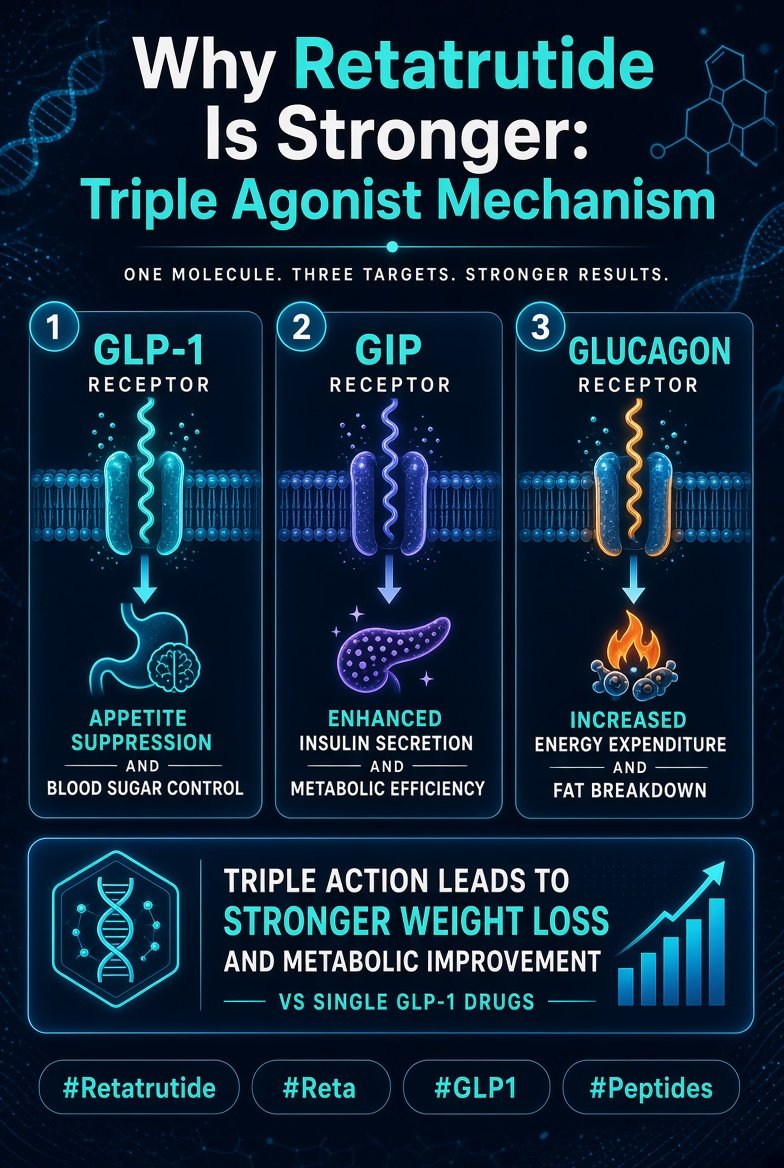
A deeper look at the GLP-1 receptor pathway and why Retatrutide is more potent. The classic GLP-1R pathway:
Gs → cAMP → PKA/Epac
→ Promotes insulin secretion, suppresses appetite, delays gastric emptying, and protects β-cells. Retatrutide (Reta) is a triple agonist:
It simultaneously activates:
• GLP-1 receptor: Suppresses appetite + improves blood glucose.
• GIP receptor: Further enhances insulin secretion and metabolic efficiency.
• Glucagon receptor: Increases energy expenditure and promotes lipolysis (fat breakdown). This triple-action synergy leads to more robust weight loss and metabolic improvements compared to single-target GLP-1 drugs. Which aspect of Reta interests you most—weight loss, fatty liver, or overall metabolic health?
#Retatrutide #Reta #GLP1 #Peptides #MetabolicHealth
@NCollectorz Same. Preserving muscle first makes more sense to me. Losing weight fast but ending up soft usually means you lost too much muscle along the way, and that hurts both how you look and how you feel long-term.
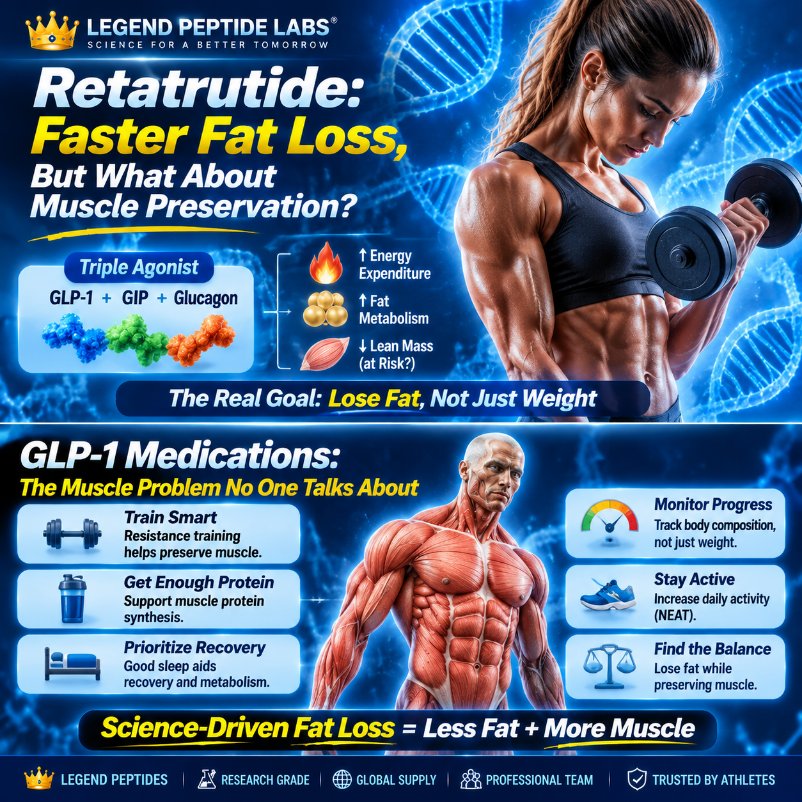
🧬 Retatrutide: What If You Lose the Weight, But Also Lose Muscle?
Imagine someone who has spent months trying to lose body fat.
The number on the scale finally starts dropping. At first, everything feels like progress.
But then comes a bigger question:
Are they losing only fat, or is some of that weight coming from lean mass too?
This is where the conversation around Retatrutide gets more interesting.
Retatrutide activates three receptors:
🔹 GLP-1
🔹 GIP
🔹 Glucagon
But weight loss is only part of the story.
💪 The Scale Doesn't Tell the Whole Story.
One important distinction: lean mass is not the same as skeletal muscle.
Changes in lean mass can also reflect body water and other non-fat tissues.
During significant weight loss, several factors deserve attention:
🥩 Adequate protein intake
🏋️ Consistent resistance training
😴 Quality sleep and recovery
📊 Monitoring body composition
⚖️ Avoiding unnecessarily aggressive calorie restriction
EAA supplementation is worth studying, but it isn't a proven standalone solution for preventing muscle loss.
🔬 And This Is Where Retatrutide Gets Interesting.
Its glucagon receptor activity adds another dimension to the discussion.
Glucagon signaling may influence energy expenditure and amino acid metabolism. But how these mechanisms translate into actual changes in skeletal muscle in humans still requires further investigation.
Retatrutide and Tirzepatide also have different receptor profiles and clinical evidence. They shouldn't be treated as interchangeable.
💡 The real goal isn't simply a lower number on the scale.
It's better body composition, preserved strength, and maintained physical function.
👇 If you had to choose, what would matter more to you: losing weight faster, or keeping more muscle while losing fat?
#Retatrutide #PeptideResearch #MusclePreservation
@MersedesMor01 With age, key brain signaling peptides (like BDNF and certain neuropeptides) decline while inflammatory signals rise, which can affect both memory and focus.
🧬 DOES YOUR BODY CHANGE THE WAY IT PRODUCES PEPTIDES AS YOU AGE?
Your 20s, 30s, 40s, 50s…
Your body doesn't stay the same. And neither does its biology.
Peptides are more than just a trending topic. They're involved in a wide range of biological processes, including:
🔬 Cell signaling
💪 Tissue repair and recovery
⚡ Metabolic regulation
🧠 Brain and nervous system functions
✨ Skin and collagen biology
But here's something worth remembering:
There is no single “peptide level” that tells the whole story.
Different peptides have different roles, and age-related changes vary depending on the molecule, tissue, and biological process.
That's why understanding the science matters more than chasing trends.
At LEGEND PEPTIDE LABS, we believe curiosity should lead to better questions — and better science.
👇 Let's talk:
What's your biggest focus as you get older?
1️⃣ Recovery & muscle health
2️⃣ Energy & metabolism
3️⃣ Skin & healthy aging
4️⃣ Cognitive health
Drop your answer below. 👇
🧬 Science for a better tomorrow.
#PeptideResearch #HealthyAging #Biotech
@EvanderGarcia1 Great focus! Collagen breakdown speeds up with age while production slows — a big driver of skin changes. Curious what angle interests you most: the science of the decline, or how peptides might help counteract it?