25,000 people now read my Ukraine in Focus newsletter! I'm grateful for your trust and will continue doing my best to provide in-depth analysis and insights on the war and more.
Sign up for free here: https://t.co/9u57m7OIOW
Putin will, of course, decline, but Zelensky’s continued efforts to end the war will be remembered, making it harder for some in the US to portray the Ukrainian president as an obstacle to peace.
In an open letter, Zelensky challenges Putin to meet face-to-face in a neutral country to negotiate an end to the war, after the Russian president claimed earlier today that he was ready to reach compromises.
In an open letter, Zelensky challenges Putin to meet face-to-face in a neutral country to negotiate an end to the war, after the Russian president claimed earlier today that he was ready to reach compromises.
Russia threatened to do this if Ukraine attacked the May 9 parade on the Red Square. After Trump’s intervention on Putin’s behalf, Ukraine agreed to a ceasefire so Russia could hold the parade. Two weeks later, Putin unleashed the ballistic missile barrage on central Kyiv anyway.
Congratulations to @magyarpeterMP and the TISZA party on their resounding victory. It is important when constructive approach prevails.
Ukraine has always sought good-neighbourly relations with everyone in Europe and we are ready to advance our cooperation with Hungary.
Europe and every European nation must get stronger, and millions of Europeans seek cooperation and stability.
We are ready for meetings and joint constructive work for the benefit of both nations, as well as peace, security, and stability in Europe.
Russia continues its mass attack on Ukraine in broad daylight. One drone struck St. Andrew's Church in central Lviv. Explosions are being reported across the country. Around 200 drones have already been shot down. Ukrainian authorities warn that missiles will follow at night.
THE NEW WORLD WAR by @Will___lloyd
As the fourth anniversary of the invasion of Ukraine approached last month, Zelensky inflated his rhetoric. He used the same formulation I had heard countless times from Ukrainians every time I visited. This was not a conflict between Ukraine and Russia any longer, if it had ever been that to begin with. These were, Zelensky told the BBC in February, the first years of the Third World War.
In the early weeks of the war, so many British citizens drove vans full of aid to the Polish border that Ben Wallace, then the defence secretary, had to ask with some tact that people send money instead. Clips of born-in-the-USSR Russian incompetence electrified social networks. No war ever seemed to cost so little. It generated a new, brief faith in ourselves, even in Boris Johnson. Our capabilities, our diplomacy, our technology, our sanctions packages, our intelligence services, our rules-based liberal order. We didn’t even have to fight. The Ukrainians would do that for us. Ukraine was a good war, a morally clean war, giving a precious gift to Europe’s leaders: meaning, valour, solemnity, glory.
That was not how it looked in Kyiv this winter, where the congealed violence of four years of war had transformed the country into something many in Europe no longer want to think about: a war of extermination fought between two militarised societies barely two days’ drive from Dover. The teams of men coldly eyeing their live feeds in bunkers, busily assassinating each other with drones, then posting the results online. The schools where children learned underground, as if they were surviving a nuclear winter. The old men and women who froze in their apartments and had to be cut out from them once their neighbours realised what had happened. The war had pulled the US and Europe apart, invented a whole new machinery of death, underlined our dependence on brutal petro-states, flooded this corner of Eastern Europe with several generations worth of weapons. A British official told me that Ukraine’s population, which had been estimated at just over 40 million in 2014, had shrunk to something like 20 million by 2025, significantly less than most estimates in the public domain.
I came to the war late, first visiting at the end of 2024. I witnessed Europe’s early hope and energy begin to curdle and move elsewhere: to Gaza and Greenland, Venezuela and now Iran. The world was a mess, expensive munitions for advanced air defence platforms were running low and needed everywhere from Kyiv to Tel Aviv to Abu Dhabi; Ukraine was not a front-page story anymore. The same image, the same blood, the same nation. Shrug. A terrible thing was happening somewhere far away.
A few days after I returned from Kyiv last month, Trump and Benjamin Netanyahu launched their war on Iran. Turkey, the keystone that sits directly between Ukraine and Iran, may yet be pulled into it. The vengeful Iranian Shaheds, so familiar to Ukrainians after four years of nightly terror, now rained down all over the Gulf. There were rumours that they were being mass-produced in China. Taken aback by the violent efficiency of the Iranian counterattack, Trump was demanding a Western armada enter the Gulf. War was spreading.
Let’s not forget that as Donald Trump passes judgement on the head of State of Iran there is another one, in the Kremlin, whose signature started the invasion of Ukraine and has left hundreds of thousands of people dead. If the US is not to be seen as hypocritical in its claim that it is re-asserting moral authority then the White House should take a much harder line on Russia.
It seems the first day of peace talks in Abu Dhabi didn’t go so well. Putin has launched another mass missile attack on Kyiv, trying to cut power supply routes linking the capital to nuclear power plants and make the city unlivable. Does he still believe he can force Zelensky to accept Russia’s terms to end the war? It appears so.
BREAKING: Volodymyr Zelensky says he is ready to hold elections within 60-90 days if the US and European partners can provide safe conditions for people to vote.
Volodymyr Zelensky shows Ukrainians they can still count on him to do the right thing. Andriy Yermak’s resignation is a major win for Ukraine’s civil society, which had demanded Zelensky fire his powerful and controversial chief of staff for months.
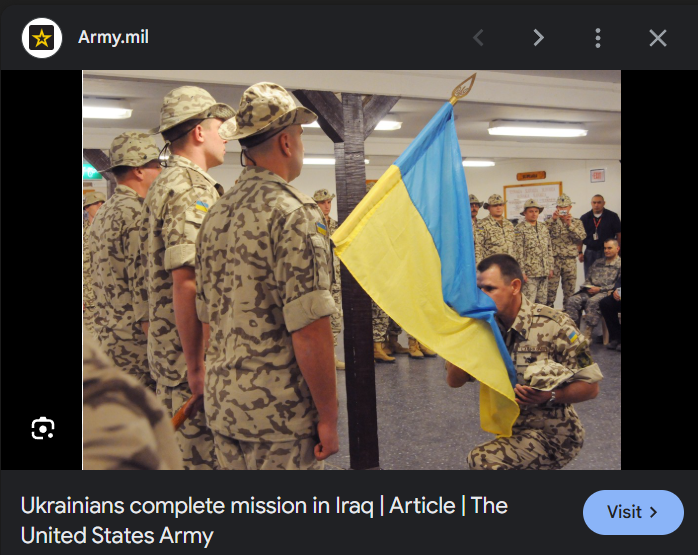
Real talk. I have trained Ukrainian troops for three years straight, and saying we “owe them nothing” is not just wrong, it is dangerous.
People forget very quickly. Ukraine stood with us in Iraq and Afghanistan. They sent troops, bled beside our soldiers, and never asked for anything in return. They did it because they believed in the West, in democracy, and in the idea that free nations stand together.
And now, for four years, Ukraine has been fighting the enemy that has openly wished death on the United States many times. The same enemy that still keeps nuclear weapons pointed at every major American city and every piece of critical infrastructure we depend on. How anyone can say that their fight has nothing to do with us is beyond me.
This kind of talk is exactly what Americans were saying before World War Two. We called it “not our war.” We insisted Europe’s problems were not our problems. Yet we still sent equipment. We still had volunteer pilots fighting for the United Kingdom. And it took Pearl Harbor to finally wake us up and show us that isolation and indifference were mistakes that cost countless lives.
When will we learn that in the world we live in today, everything is connected. There is no isolation. Not when dictators are reshaping borders by force. Not when war criminals hold nuclear stockpiles. Not when democracies fall one by one if no one helps. Appeasement does not stop tyrants. Appeasement encourages them.
I have trained thousands of Ukrainian soldiers. I have watched them fight for their land, their families, and frankly for the rest of us. To pretend that their struggle does not affect the United States is to ignore every lesson history has ever taught us. The red line where this “becomes our problem” was crossed a long time ago. Thinking otherwise only helps the people we should be standing against.
This kind of thinking is not realism. It is the beginning of another disaster we will regret later.
If America actually wants stability and peace, we cannot abandon a nation fighting the front line of that global struggle.
We either help now, or we will pay a heavier price later.
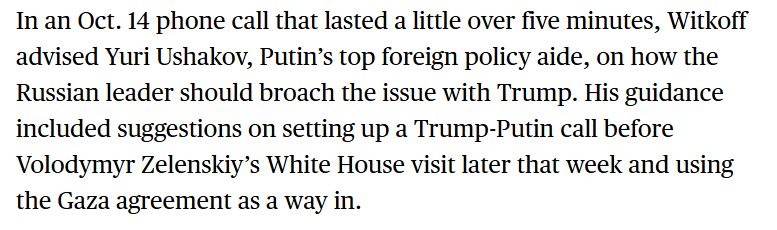
Steve Witkoff orchestrated the phone call that sabotaged Zelensky's White House visit last month, when Tomahawks for Ukraine were on the table. Absolutely unreal.