A Hero That Trusted His Intuition.
The problem wasn’t that Morgan Stanley didn’t believe him.
Rick Rescorla had already been right once. After the 1993 basement bombing of the World Trade Center, the firm’s security chief walked the towers, studied the site, and reached a conclusion most people preferred not to hear: the World Trade Center was still a target. Next time, he said, it would not be a truck. It would be an airplane.
An airplane. In a 1993 report.
Executives listened. Then they looked at the lease.
Morgan Stanley was the largest tenant in the complex—twenty-two floors of the South Tower, thousands of brokers, and a trading infrastructure that could not be packed into boxes and wheeled across the Hudson.
They literally made it a trading center.
The contract with the Port Authority ran until 2006. Walking away from premium Manhattan space of that scale would have meant penalties measured in the hundreds of millions, plus the operational chaos of relocating an entire downtown machine. So the company stayed.
Rescorla adjusted. If they could not leave the building, they would learn to escape it.
He built a protocol and treated it like doctrine. Unannounced drills. No exemptions. Brokers who billed by the minute were pulled off their desks and sent into the stairwells two by two, starting from the top floors, leaving a lane for firefighters coming the other way.
People complained. He did not care. Practice, he believed, was the only thing that would beat panic.
On the morning of September 11, 2001, American Airlines Flight 11 hit the North Tower. From the 44th floor of the South Tower, Rescorla could see the fire. Then the Port Authority came over the speakers: the South Tower was secure. Stay at your desks.
Rescorla grabbed a bullhorn and ignored them.
He started the drill his people already knew by heart. Floor by floor, two by two, down the stairs. He sang as he moved—Cornish songs from childhood, then “God Bless America”—keeping the line moving, refusing to let the stairwell become a stampede. Seventeen minutes later, the second plane struck the South Tower.
By then, most of Morgan Stanley was already on the way out.
Of the 2,687 employees in the building that morning, all but 13 survived.
It was stunning.
Rescorla could have been outside with them. He went back up instead. Colleagues told him to leave. He said he would, as soon as he was sure no one was left behind.
He was last seen around the 10th floor, heading higher.
The South Tower fell at 9:59 a.m. They never found him.
He was one of the 13.
He was a hero in every sense of the word.
Remember Rick Rescorla, he remembered for us.
@thedarshakrana@elonmusk Didn’t anyone read Edwin Abbott Abbott’s “Flatland: A Romance of Many Dimensions”, first published in 1884? It explains all this very well.
“The American dream is not that every man must be level with every other man. The American dream is that every man must be free to become whatever God intends he should become.”
— Ronald Reagan
“As I radiate love and goodwill to others, I will open the channel for God’s love to come to me. Divine love is the magnet that draws to me all good.” — an affirmation by Paramahansa Yogananda
#ParamahansaYogananda#Yogananda#quote#SpiritualQuotes#love
The Tanya reminds us that every small action of goodness creates infinite light in the upper worlds. Even a simple smile or act of kindness tips the cosmic scale toward mercy.
Rabbi Nachman taught: “The whole world is a very narrow bridge, but the main thing is not to be afraid.” Walking this bridge, we may think our steps are small — yet each step forward brings healing to ourselves and to others.
The Baal Shem Tov said: “Your place is where your thoughts dwell.” If we live thinking we are too small, our life becomes small. If we live with the thought that even the smallest act of love matters, then heaven itself bends to meet us.
Rabbi Sacks wrote: “Greatness is not measured by what we receive from the world, but by what we give to the world.”
From my 91-year-old patient who has survived three cancers, the loss of a child, and two husbands, I asked her why she is still so optimistic. She looked at me with a gentle smile and said:
*"When I go out to tend my rose garden, do you think I make any difference in the world? When I babysit my great-grandchild, is that earth-shattering? When I volunteer at the hospital, do they really need me? When I feed the homeless, would they die without me? The problem with people is they give up too easily. They think, ‘If I can’t make the news, what’s the point of trying?’
Life is not all or nothing. You do what you can. You can’t be everything to everyone — but you can be everything to someone. And that’s the key to life: Be one person’s angel. What if every person had an angel? It makes you important. It makes them important. It doesn’t make the news, but it sure makes the world a better place.
Now I have to go take care of my dog (I’m her everything) and you have to go take care of your patients (you’re their everything).”*
Then she smiled, and walked away. She was my angel today.
Elul is not only about our relationship with God — it is about how we bring His light into the lives of others. When we are someone’s angel, we draw God’s presence down into the field.
#ModehAni ❤️🙏
In 4th century AD a lot of Goths begged Romans to take them in as refugees to escape the Huns. The emperor agreed to let them in, give them food and land.
But Goths swarmed in such large numbers that Rome lost control of the situation. These Goths then rebelled, formed their own army within Rome and killed Emperor Valens who let them in the first place.
After few decades in 410 AD these same "refugees" sacked Rome. The last time Rome was sacked was in 390 BC, almost a millenium ago.
I think there is a lesson here for Europe.
This is one of the most beautiful paintings of Christ ever made, and for over a century people have walked past the one detail that holds its entire meaning...
It is called The Light of the World, painted by the English Pre-Raphaelite artist William Holman Hunt. Christ stands at night in an overgrown garden, holding a lantern, his hand raised to knock at a wooden door.
It illustrates a line from the Book of Revelation:
"Behold, I stand at the door, and knock."
The door is choked with ivy and weeds. It has clearly not been opened in a very long time.
Now look at the door itself, and you will see what holds the key to understanding the entire artwork… there is no handle. No latch, no knob, nothing on the outside at all.
Hunt left it off on purpose: this door can only be opened from within.
The door is the human soul, and the point is that Christ can stand there and knock forever, but he cannot let himself in. The handle is on the other side. It has to be you who opens it. The ivy has grown thick over the frame because this particular door has stayed shut for years, and yet his lantern is still burning, and he is still standing there, still knocking, waiting for a door that may never open.
Fifty years after he painted it, Hunt felt he had to spell the meaning out: the shut door, he said, was “the obstinately shut mind.”
The light has not gone out and whether that door ever opens was always, only, up to you...
Man: I prayed for my health every day for forty years.
God: I heard all of it.
Man: And you did nothing.
God: I sent a cow.
Man: A cow.
God: Then a lamb. Then a goat, to sort the hill out so the grass would come back for the cow.
Man: I didn't know that was you.
God: There was a hen at your door every morning for thirty years. Laying. In the rain. Unpaid. What did you think that was.
Man: I thought it was a hen.
God: It was a hen. It was also a hint.
Man: I was told to cut down on red meat.
God: By whom.
Man: A pyramid.
God: [checks] [checks again] I did not send a pyramid.
Man: Six to eleven servings of bread at the bottom of it.
God: I have never once recommended eleven of anything.
Man: The eggs had cholesterol in them.
God: The eggs had everything in them. That was the selling point.
Man: I switched to almond milk.
God: [a silence of the kind that predates weather]
Man: For the planet.
God: I gave you an animal that turns rain into food and stands in a field doing it for nothing. You went and got a bag of nuts, drowned them, and strained the corpse through a cloth.
Man: It's two per cent almonds.
God: I am aware of the percentage. I am aware of every percentage.
Man: There's gums in it, so it doesn't look like water.
God: Because it is water. You have described water. You paid extra for a photograph of a hand full of almonds, and then you drank the water.
Man: What was I supposed to do?
God: Eat the cow.
Man: That's it?
God: I made the sea, the whale, the whole business with the tides, and the easiest job on the list was feeding you.
“It is the little close-up things that a child sees most clearly. I remember daisies, wild daisies, not white as they seem to be to grown-ups, but pink; and I have only to pick one now and turn it over to see again the daisies of my childhood.” ~C.R.Milne
Every year when Elul begins, I feel the awe. But beneath the awe, I used to feel something else: fear. Fear of Yom Kippur. Fear of everything I did wrong, the promises I didn’t keep, the people I hurt, the mitzvot I missed. Growing up in Iran, I somehow learned that repentance meant beating myself up—that God was keeping score, waiting to punish me for falling short.
Then I began learning Kabbalah and Chassidut, and slowly I came to see something very different. God did not create perfect human beings. He created human beings who fall. Why? Perhaps because God desires dirah betachtonim—to dwell precisely in the lowest places. In our confusion. Our failures. Our broken promises. And especially in the moment when, from that low place, we choose to rise again. Imagine watching your child learn to walk. He takes a step and falls. Would you punish him for falling? No. You reach out your hand. He gets up, falls again, gets up again. And one day, the child who could barely stand is running.
Maybe that is a small glimpse of what God wants from us. Not the fall. The getting up. To learn. To repair. To choose Him again—not because we are flawless, but precisely because we are not. I think of the soul like a yo-yo. It can travel terribly far from the Hand that released it. But as long as the string remains connected, there is always a way home.
That is how I enter Elul now. Still with awe. Still with regret. Still asking forgiveness. But no longer terrified that my failures have made God abandon me. It is all love. It is all good. And there is always a path back. Sometimes I say to God, “I’m broken. Come limp with me.” And I imagine God answering, “No, My child. Come walk with Me.”
There is a species of ant that approaches the edge of another colony, kills a single worker, and then takes on the dead ant’s scent.
For ants, scent is everything. Wearing that scent, the intruder walks in with no resistance. The workers pass by without concern.
The intruder moves inward, toward the queen, then It sprays the queen with a different scent that makes the workers turn on her. Then they surround her and kill her.
The intruder does not need to fight anyone. The colony does the work itself.
Once the queen is gone, the intruder reproduces. The true invader is no longer an intruder. It is the future.
This is how ideological takeover works.
A destructive foreign ideology takes the scent of familiar ideas and walks in as if it belongs.
It speaks the native vocabulary, justice, equality, compassion, rights, progress. It uses these words and quietly changes what they point to.
Then it moves inward.
It alters how foundations are perceived. Responsibility is made to smell like cruelty, law like oppression, borders like hatred, tradition like danger, history like guilt.
At that point, the civilization turns on itself.
Its courts, universities, churches, media, and bureaucracies begin treating their own foundations as threats. They believe they are defending the system.
They are enforcing what now smells legitimate. They do not see the intruder because it sounds exactly like them.
And when the founding principles are finally removed, discredited, dismantled, erased, the foreign ideology does not need to conquer anything. It inherits what is left.
The queen is gone. The colony is no longer itself.
The most effective conquest is the one that convinces a society that its own foundations are the enemy, and that killing them is an act of virtue.
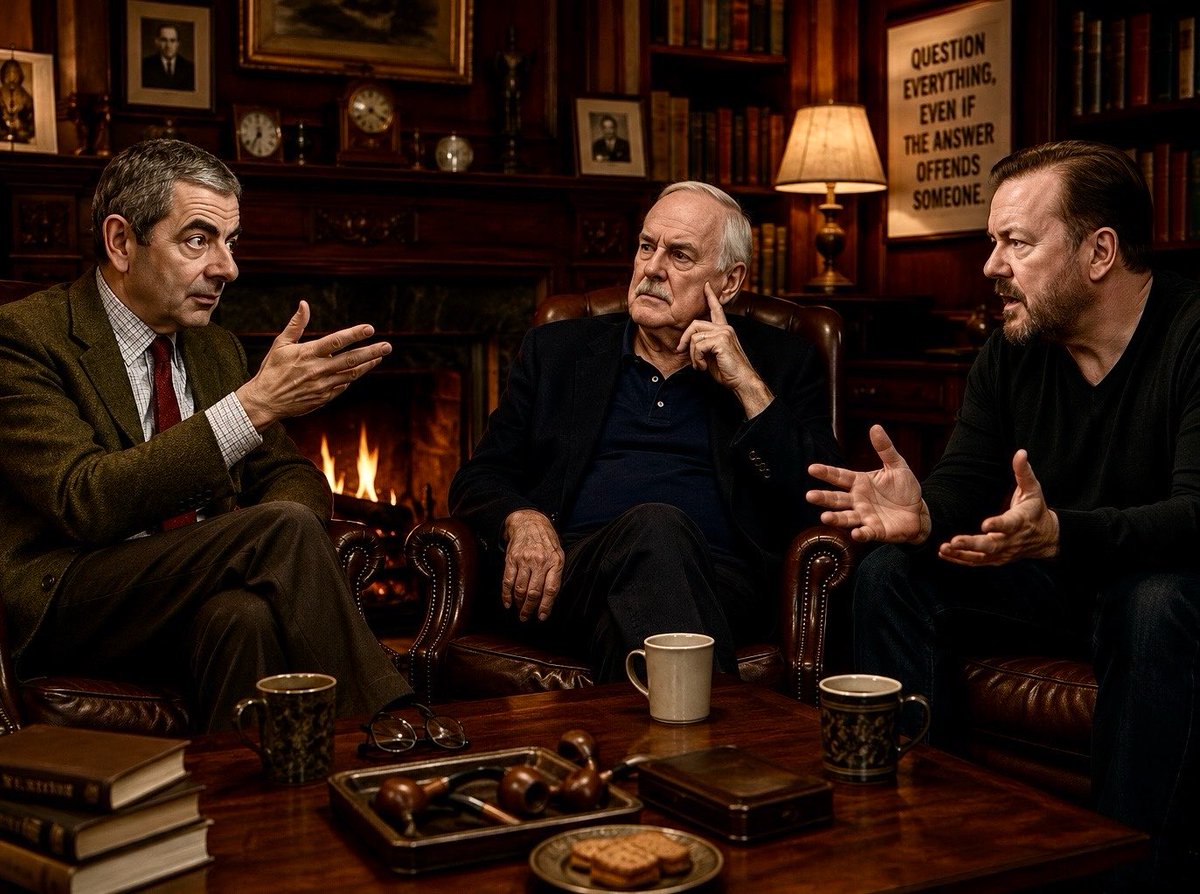
A Fire, Three Armchairs, and a Dangerous Amount of Common Sense
John Cleese: You know what fascinates me? We have more information than any civilization in history… and yet people appear to have outsourced thinking.
Ricky Gervais: Thinking’s exhausting. Much easier to download your opinion from social media before breakfast.
Rowan Atkinson: The remarkable thing isn’t that people disagree. It’s that so many have stopped asking the obvious question: “Does this make any sense?”
Cleese: Common sense has become a revolutionary act.
Gervais: It’s brilliant. You point out that two plus two equals four and suddenly you’re “creating an unsafe environment.”
Atkinson: We used to laugh at absurdity. Now we hire consultants to explain why it’s actually profound.
Cleese: Bureaucracy has always had that gift. It can transform complete nonsense into a seventy-page policy document.
Gervais: With an executive summary nobody reads.
Atkinson: And a diversity statement.
Cleese: Naturally.
(They laugh.)
Gervais: Here’s the strange part. Everyone claims to love free speech… right up until somebody says something they dislike.
Cleese: That’s because many people don’t actually want freedom. They want confirmation.
Atkinson: The purpose of free speech was never to protect popular opinions. Popular opinions don’t require protection.
Gervais: Exactly! Nobody gets cancelled for saying puppies are nice.
Cleese: Yet humour has always been civilisation’s quality-control mechanism. If something cannot survive a joke, perhaps it wasn’t particularly sturdy.
Atkinson: Humour punctures pomposity. That’s why pompous people dislike comedians.
Gervais: They hate being reminded they’re ridiculous.
Cleese: The world has become rather fond of taking itself incredibly seriously.
Atkinson: Which is ironic, because seriousness and wisdom are entirely different things.
Gervais: The cleverest people I know usually laugh first.
(A log collapses in the fireplace.)
Cleese: Politics, these days, resembles amateur theatre.
Gervais: No, that’s unfair.
Cleese: To whom?
Gervais: Amateur theatre.
(More laughter.)
Atkinson: Perhaps the problem isn’t left or right.
Cleese: Go on.
Atkinson: Perhaps it’s reality versus performance. Solving problems is difficult. Looking as though you’re solving them is much easier.
Gervais: That’s social media in one sentence.
Cleese: And a fair amount of government.
Atkinson: Common sense asks inconvenient questions. Does it work? Does it improve lives? Is it true?
Gervais: Instead we ask, “Will people clap?”
Cleese: Applause has become a substitute for evidence.
Atkinson: Which explains a great many things.
(Silence for a moment as they sip their tea.)
Gervais: You know what gives me hope?
Cleese: Go on.
Gervais: Ordinary people. Most of them haven’t gone mad. They still know when something feels fake. They still recognise honesty. They still laugh at the obvious.
Atkinson: Common sense is remarkably resilient.
Cleese: It merely spends long periods hiding from fashionable stupidity.
Gervais: Then here’s a toast.
Atkinson: To what?
Gervais: To curiosity.
Cleese: To laughter.
Atkinson: And to the quiet courage of saying, politely but firmly…
All three: “I’m sorry—but that’s complete nonsense.”
“A strict observance of the written laws is doubtless one of the high duties of a good citizen, but it is not the highest. The laws of necessity, of self-preservation, of saving our country when in danger, are of higher obligation. To lose our country by a scrupulous adherence to written law, would be to lose the law itself, with life, liberty, property and all those who are enjoying them with us; thus absurdly sacrificing the end to the means.”
-Thomas Jefferson literally telling us what to do to save our country in 2026
Things My Patients Taught Me — 5 of 20
He was struck by lightning — and woke up a different man. The part that still gives me chills: he didn't want the old one back.
The human body is not built to survive 300 million volts. Lightning can stop a heart in an instant, cook organs, and blow out through the soles of the feet. Survival is rare. Full recovery is rarer still.
So when the call came in — mid-twenties male, struck on a mountain trail, still had a pulse — I braced for the worst.
They wheeled Daniel in with the fern-like burns that only lightning leaves, branching across his chest like red frost. A park ranger, caught in an open stretch when the storm rolled through. His heart was in chaos. He was unconscious, responding only to pain. For two days he hovered in that unreachable place between living and dying, and all we could do was hold the line and wait.
And then, against every odd on the board, he woke up. Fully. Clear-eyed. No lasting damage any scan could find.
But something had changed.
"I can't explain it," he told me a few days later. "I feel different. Like I'm seeing everything for the first time. Colors are brighter. Food tastes more intense. And I feel this... connection. To everything. Like the boundary between me and the world got thinner." He looked at me carefully. "Does that sound crazy?"
"Not crazy," I said. "The brain goes through enormous electrical change during a strike. These effects are usually temporary."
He held my gaze. And he said something I've never forgotten.
"What if I don't want it to be temporary?"
He started sketching — something he swore he'd never done in his life. His bedside table filled up with drawings: the view from his window, the hands of the nurses, his own face half-covered in the lightning's mark.
The day before discharge, he asked me to sit with him. "Everyone keeps saying how lucky I am to be back to normal," he said. "But what if normal wasn't enough? What if getting struck was actually a gift?"
I chose my words carefully. "Medicine sorts experiences into traumatic or beneficial based on outcomes. But what it means? That's yours to decide. Only you can say what this event means for your life."
He nodded slowly. "The odds of surviving a direct strike are almost nothing. What are the odds I got this second chance for no reason at all?"
A year later, a letter arrived.
He'd left his old job. Trained as an art therapist, working with trauma survivors. He'd held his first gallery show — drawings inspired by the very burns that had nearly killed him. And on the one-year anniversary of the strike, he'd hiked back up to the exact spot. Not to tempt fate — he checked the forecast obsessively, he promised — but out of gratitude. To close the circle.
Standing there on the mountain, he wrote, I realized something I wanted to share with you. Some patients recover from their wounds. Others are transformed by them. Both are forms of healing.
He'd enclosed a drawing. A mountaintop, the sky split between storm cloud and breaking sunlight. In the foreground, a tiny human figure, arms flung wide — not in fear, but in embrace of the whole vast thing. Beneath it he'd written: The lightning taught me that boundaries are illusions — between life and death, between self and world, between what breaks us and what makes us.
That drawing has hung framed in my office ever since.
Daniel taught me that trauma can be both a wound and a window. That my job, sometimes, is not to explain away a patient's transformation, but simply to make room for it — to hand back the authority to say what their own suffering means. He wrote one more line in his exhibition catalog that I keep beside the drawing:
Maybe we're all struck by lightning in different ways — sudden flashes that change us forever. The only question is whether we recognize the strike when it comes.




![SamaHoole's tweet photo. Man: I prayed for my health every day for forty years.
God: I heard all of it.
Man: And you did nothing.
God: I sent a cow.
Man: A cow.
God: Then a lamb. Then a goat, to sort the hill out so the grass would come back for the cow.
Man: I didn't know that was you.
God: There was a hen at your door every morning for thirty years. Laying. In the rain. Unpaid. What did you think that was.
Man: I thought it was a hen.
God: It was a hen. It was also a hint.
Man: I was told to cut down on red meat.
God: By whom.
Man: A pyramid.
God: [checks] [checks again] I did not send a pyramid.
Man: Six to eleven servings of bread at the bottom of it.
God: I have never once recommended eleven of anything.
Man: The eggs had cholesterol in them.
God: The eggs had everything in them. That was the selling point.
Man: I switched to almond milk.
God: [a silence of the kind that predates weather]
Man: For the planet.
God: I gave you an animal that turns rain into food and stands in a field doing it for nothing. You went and got a bag of nuts, drowned them, and strained the corpse through a cloth.
Man: It's two per cent almonds.
God: I am aware of the percentage. I am aware of every percentage.
Man: There's gums in it, so it doesn't look like water.
God: Because it is water. You have described water. You paid extra for a photograph of a hand full of almonds, and then you drank the water.
Man: What was I supposed to do?
God: Eat the cow.
Man: That's it?
God: I made the sea, the whale, the whole business with the tides, and the easiest job on the list was feeding you.](https://pbs.twimg.com/media/HP1oLycXkAAoZDK.jpg)