Father, husband, and 🐶 dad to my Golden. Head of AI Services and Data at #AWS. 17 years at @Amazon. Skiing ⛷️ with my family when I’m not at the office :)
Amazon Quick changes how you work. Today we're releasing it in desktop mode—a proactive AI assistant that connects to your apps, builds a personal knowledge graph from your work, and gets smarter every session. No AWS account needed. Quick finds the smarter way to get it done ➡️https://t.co/IKyc5ZWoTi
#WhatsNextwithAWS
We recently open sourced BenchProofer, which uses automated reasoning to formally verify coding benchmark tasks. An agent can pass traditional tests and still be wrong on inputs no test checks. BenchProofer moves beyond testing to proving correctness. Also releasing SWE-Proof for all 500 SWE-Bench Verified tasks: https://t.co/euIQEC4Zuu
I am so excited to lead the Developer keynote at AWS reInvent this year!
Working on the talk track atm, and we've got such a great lineup of speakers, deep dives, and practical advice
Sign up for the livestream here:
https://t.co/aFHf0aeeMW
Monday, Nov 30, 7:30 pm - 8:45 pm
@kirodotdev's Auto mode has a new capability: model cascading.
Auto begins every task on a fast, efficient model and quietly checks the work as it goes. If a task gets harder, it hands off to a more capable model that picks up right where it left off. Across the sessions we analyzed, more than 80% of tasks finished on the efficient model alone.
When builders choose one model up front, they can either overpay on easy tasks or come up short on the more involved projects. Model cascading helps builders avoid that trade-off. https://t.co/fNwHHYdhvh
Today, we’re shipping updates to Amazon Bedrock AgentCore Runtime that help customers meet the demands of agents taking on longer, bigger, and more autonomous work. Agent sessions can now start up to 15x faster, scale to 4x more compute, and run up to 68% more efficiently, without giving up isolation. https://t.co/knmXvpPh7t
We just shipped AWS Emulator, which gives coding agents a local copy of AWS to test against.
Early in my career, we built test environments like this by hand, one system at a time. Now, agents are writing code far faster than any team can check it in production. Matt Goldberg, a Senior Principal Engineer on our Developer Tools team, wanted to know whether agents could build and test those environments themselves. He gave @kirodotdev a single prompt, and about 15 minutes later it came back with a first version of an SQS emulator. Turing that into a robust solution took much more work
Here’s what I think this means for engineers today: https://t.co/Nsk9LHS9Mu
Taking a moment to highlight an internal experiment with Strands Decider that will save our team millions of dollars in token costs.
Two engineers at @amazon recently put Strands Decider, a decision model that we launched last month, to work on one of the world’s largest ticketing systems. They found that Decider performed just as well at 98% less cost. This is a great example of ground up innovation done by a small team - kudos to them and the Strands team!
Here is the full breakdown on how they replaced an LLM’s job with a decision model and what the team measured. https://t.co/ajNs4qia6n
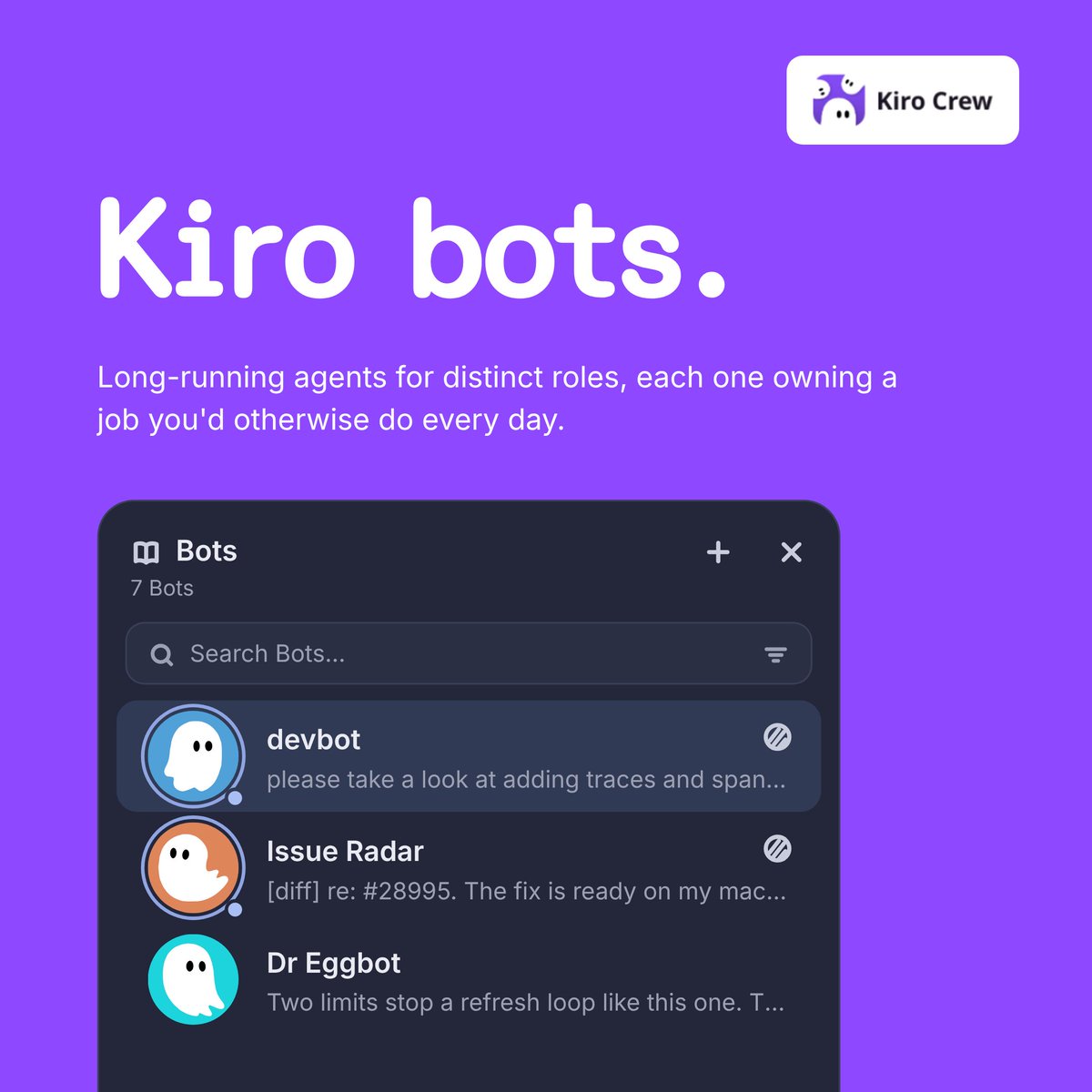
Today we're adding one of the most requested capabilities to Kiro Crew: Kiro bots, long-running and proactive agents for distinct roles.
When we open-sourced Kiro Crew, builders quickly started running dozens of agents in parallel. This also introduced a new challenge we heard from builders and experienced within our own teams. Devs were spending more time shepherding context between agents and checking which sessions finished or which needed further input. We built Kiro bots to address this; a bot is a new way to structure and drive agentic work.
Now, builders can give a bot one responsibility, like build health, and it works proactively to meet your goals, sharing results in one ongoing chat while driving parallel sessions behind the scenes. Decisions, tradeoffs, and context persist in Notes you can inspect and edit at any time. Each bot gets only the tools its role needs, runs and monitors the sessions behind it, and checks with you when a decision matters while keeping other work moving. Over time, your crew of bots gets better at each part of your workflow, taking the self-improving nature of Kiro Crew to a new level by letting you delegate entire processes.
Thank you to the builders and contributors whose feedback shaped this release. Set up your first bot: https://t.co/8IfiXuXUlI
Kiroween is here, just in time for Halloween!Submissions open today.
Build something wicked with @kirodotdev and compete for $100,000 in prizes.
Open now through December 4 at 2:00 PM PT. Register and build: https://t.co/XTa3ZSa8Cb
We just expanded @kirodotdev student tier. Today, eligible students at 41 new universities can get one full year of free access with 1,000 credits per month and full access to paid features including premium models. Check eligibility at https://t.co/77B0WSK9kj ➡️ [link]
Three @kirodotdev features every developer should be using today. Memory carries your preferences across sessions. Workflows hand tasks to a team of agents that build and review independently. Cloud Sessions keep working after you close your laptop.
More at https://t.co/aWtNFQ4xUb
The team recently shipped memory in @kirodotdev IDE and CLI.
One thing we heard from developers is how much time they spend re-explaining context to their coding agent.
Now, memory changes that for devs building in Kiro. Kiro now remembers how you prefer to work, repository-specific commands and conventions, and corrections you've made. When any of that becomes relevant again, Kiro carries your context forward so you spend less time repeating yourself and more time moving your work forward.
You choose whether Kiro can use existing memories and whether it can create or update them. Memories stay local to your machine and can apply globally or to a specific repository.
The longer devs work with it, the better it helps you build. Check it out now ➡️ https://t.co/2FurN77rFc
Re-explaining the same repo conventions? Again?
Memory in Kiro IDE + CLI can carry forward your preferences, repo conventions, corrections, debugging insights, and approaches you've already ruled out, then bring them back when they matter.
See and manage what Kiro remembers anytime. 👉https://t.co/V7VCHYqSys
Many developers run @kirodotdev's agent directly on their local machine so it can see the same filesystem, toolchain, and localhost services they do. That's what makes it effective for building and testing real projects. Today, developers manage that risk by reviewing every command before approving it. As agents take on longer tasks and developers run more sessions in parallel, that attention becomes the bottleneck.
Local sandboxing changes the trust model: even after a command is approved, the operating system still limits what it can read and write on your machine, and which network destinations it can reach. The agent still runs natively on your machine, but the commands it executes are restricted by the kernel. You can turn sandboxing on or off mid-session without restarting.
Available now on macOS, Linux, and Windows: https://t.co/Dj6sb1L8q6
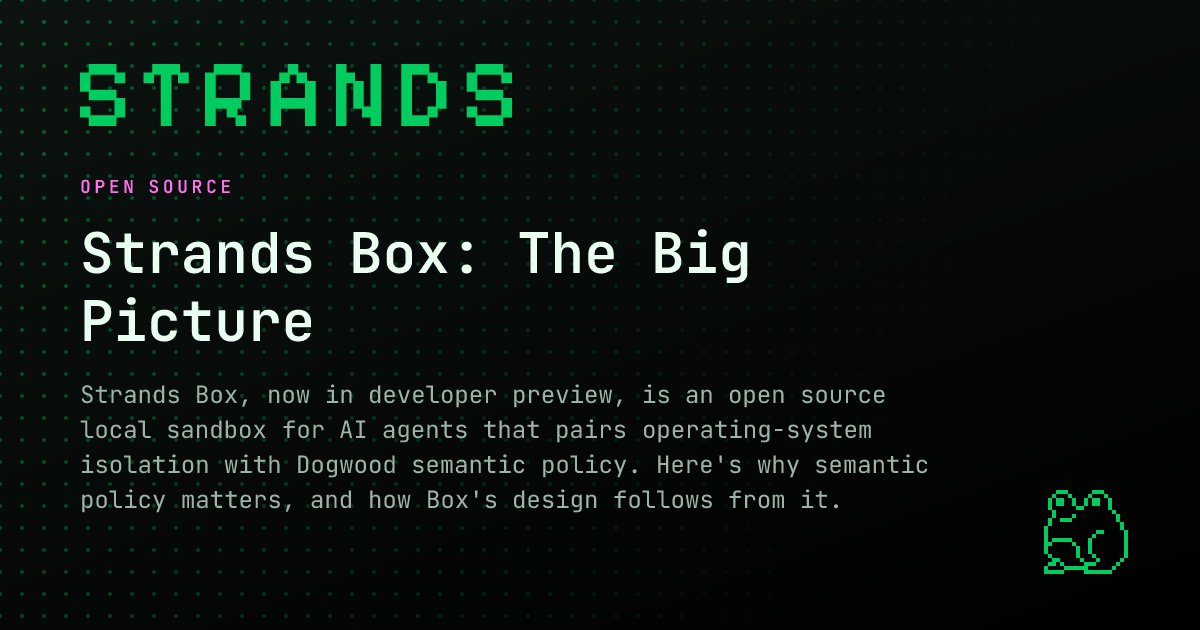
We just shipped Strands Box, now in developer preview. It's an open source sandbox for developers building applications that run AI agents, and it helps control what an agent can reach and do.
You write the rules in Dogwood. Box enforces them at the OS and network boundary, not by asking the agent to behave.
Glad to see this next step in AWS's approach to AI agent safety: giving developers greater control as agents take on more responsibility.
For the bigger picture, check out this deep dive from @MarcJBrooker https://t.co/iDTqESNLvw
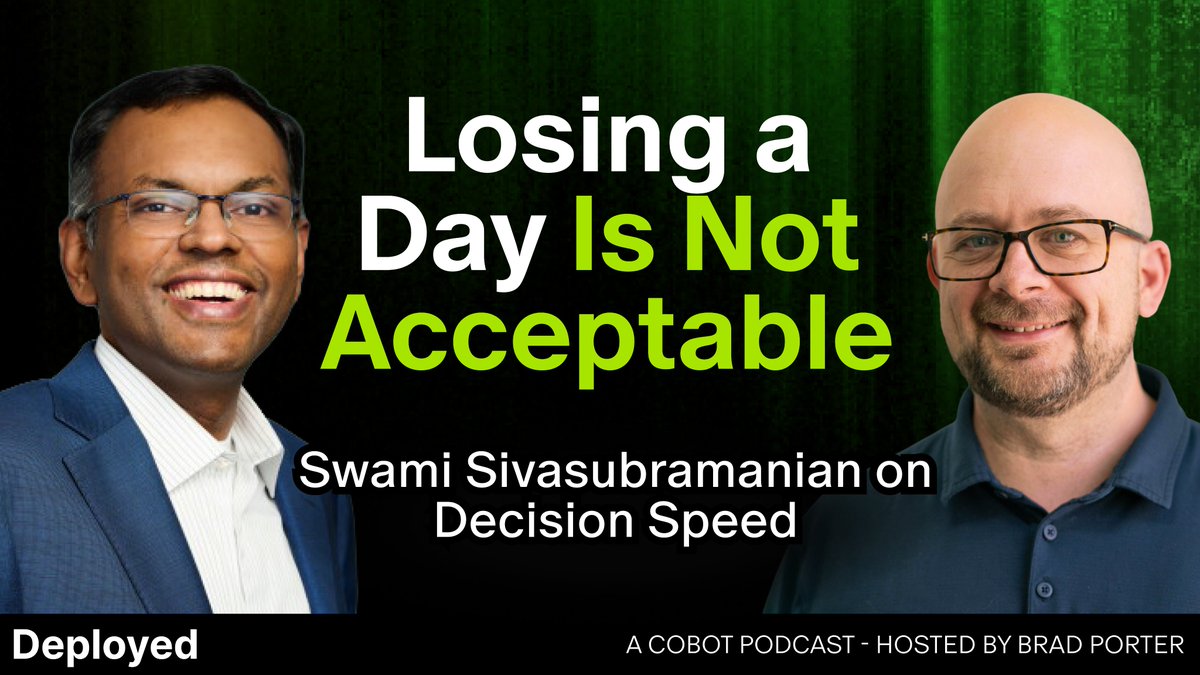
Sat down with @BradPorter_ for the latest episode of Deployed. We talked about what separates the organizations getting real value from AI agents from the ones still figuring it out, and why the biggest bottleneck right now isn't the technology. The teams pulling ahead aren't always better tools, they've changed how they operate. Thanks for having me on ➡️ https://t.co/QUQ8gqpF4N
It's always great to see builders come together and find creative ways to make technology easier to understand and access. A small team at @awscloud recently launched the Agentic Football Cup, and the virtual league is now live. I love the effort and clever thinking behind this program. Builders around the world are taking the challenge and testing their agent orchestration skills.
No matter your skill level, there's an opportunity to learn more about what it takes to get agents going. Check it out: https://t.co/fZU8HBt3mu
🚀 Meet Strands Decider 2B, a small open source decision model built for fast experimentation and local development: https://t.co/rZjMiz6Rn5
It's part of a new class of decision models. Unlike reasoning models that generate open-ended text, Strands Decider 2B picks between options and assigns confidence scores. Decision models are faster and more capable at a given size, always produce an answer from the selected options, and can run with very low latency.
Strands Decider 2B is a 2 billion parameter model that runs on a local CPU or GPU and can return answers to meaningful questions in tens of milliseconds. On accuracy and calibration, it ranks second among public models in its ~2 billion parameter class, and first among those that share their full training recipe.
We're already seeing early success with model routing, tool selection, guardrails, evals, and hybrid agents that pair LLMs for the hard calls with decider models for the rote ones. Grab the code on GitHub and the latest snapshots on HuggingFace, and tell us what you build.
This space is super early and we are experimenting with different variants of these models, so give it a spin and give us feedback!
The team just launched Kiro workflows, and it addresses a frustration we hear from developers: time spent supervising complex work as it progresses across multiple steps.
Before workflows, building with agents could mean asking one to implement a change, then coming back to say "now review it," and later "now address the findings." You can spend much of the session reminding it of decisions you already made and feedback because everything lives in one context window that keeps filling up.
@kirodotdev workflows solve this. The model lays out which agents do the work and in what order, and the Kiro runtime executes that plan, with each step running in its own fresh context. You can tune the plan, including the agents, models, and effort levels used in each step. And you can save any run as a recipe and reuse it.
We built the workflow runtime and Kiro's Web integration this way, and across the team, workflows now run nearly 24/7.
https://t.co/DemFlJRPBD
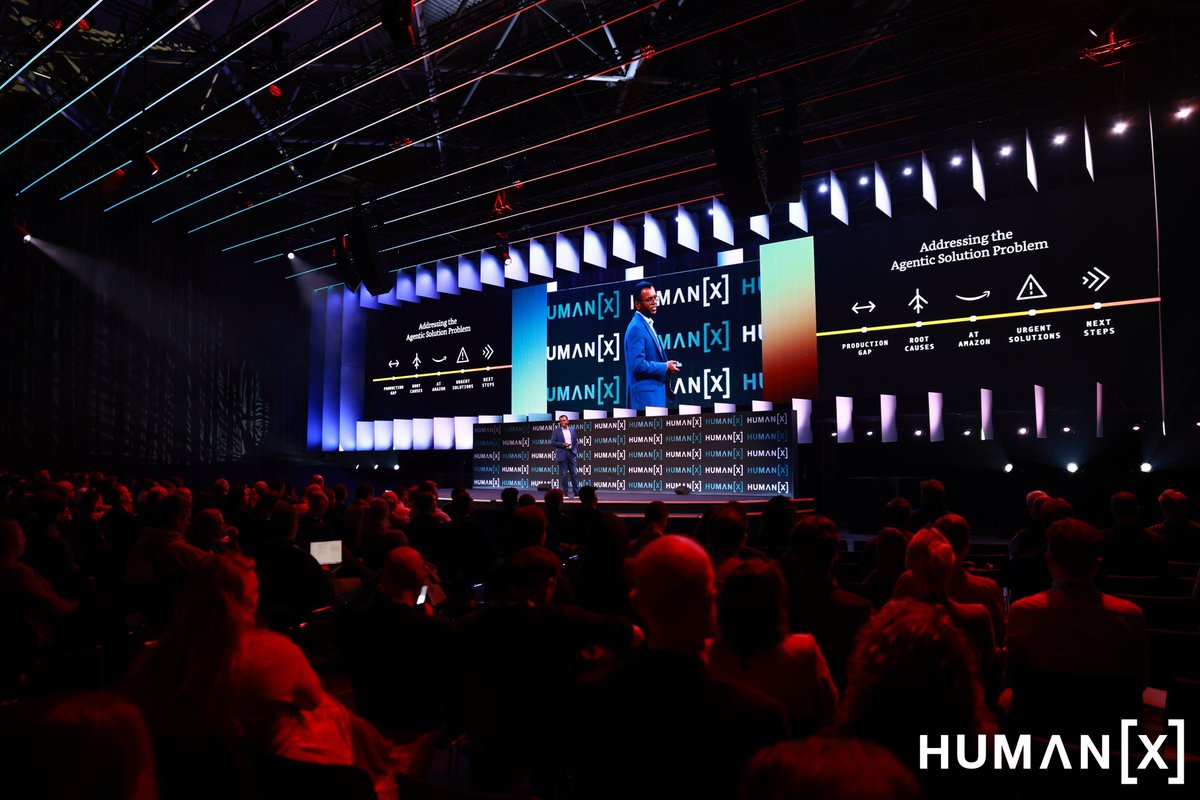
Wrapping up a quick visit to Amsterdam. Thank you to the @HumanXCo team for having me, and to everyone who kept the conversation going after the keynote.
One thing to remember: the teams making the most progress aren't the ones with the most pilots. They're the ones willing to pick an exit and commit to building for production. At @Amazon, that's where we see customers break through. It's how you get out of the POC roundabout.
Grateful for the discussions and the hospitality. Hope to be back soon.