Today is a historic day for Sword and the future of mental health: Sword is acquiring @Headspace.
This acquisition is the opportunity to bring our AI Care model and frontier research to millions more people around the world.
We’ve built the clinical intelligence to make mental health proactive, personalized and present. Headspace has built one of the most beloved mental health brands in the world, earning the trust of 100 million people in over 200 countries.
Together, we’re ushering in a new era for mental healthcare to make sure world-class care reaches everyone who needs it.
Read the full story here: https://t.co/RqTjbYxB1n
Motivation gets blamed for poor recovery outcomes when the real issue is usually time.
Phoenix builds sessions around the time members actually have. A 20-minute window before work, not the 6 PM slot that never happens.
See how it works: https://t.co/WYqfbgEr5S
It's 3 AM and you can't sleep. Debt. A fight with your partner. Work stress that won't turn off. A diagnosis you're still processing. Most EAPs are asleep too. Business hours only.
Phoenix is awake instead. Say what's going on and get connected to the right support, whether that's a financial counselor, a therapist, or someone who can just help you figure out next steps. Session booked before you put the phone down.
See Sword, awake at 3 AM: https://t.co/rN0OgXPHtT
For too long, fear has led the conversation when it comes to AI. In healthcare, AI is unlocking a fundamentally new model of care, with agents that can treat patients autonomously and run the systems that care for them.
We’re putting an end to the AI doom. Healthcare is where AI matters.
Recovery looks different for everyone.
With Sword, care plans evolve with each member, based on their pain, movement and progress over time. If progress starts to slow, Phoenix flags it so the clinician can adjust what comes next.
Health is personal. Healthcare should be too.
David Scott became a father and started thinking about the world his son would grow up in. His Philadelphia neighborhood has been hit hard by opioids. As a physical therapist at Sword, he’s helping people find relief a safer way, and creating a better world for his son.
Blade Code is one example of the infrastructure we build behind the scenes to operate AI healthcare at scale.
Our CTO breaks down the architecture, trade-offs, and savings methodology: https://t.co/dtElHa0gND
We cut our LLM costs by 94% - without reducing usage. We did it by building Blade Code, an internal control plane that sits beneath the AI tools our engineers already use.
Here’s what we learned about operating AI at scale. 🧵
This led us to lower our LLM costs in a staggering 94% - without reducing usage.
Not through a single pricing trick, but through better instrumentation, centralized routing, and the ability to act quickly on what the data showed.
Most of us know this reality all too well: having a health issue and wanting to begin treatment, but getting lost in referrals, wait times, and limited availability. That friction gives health problems time to persist, worsen, and become harder to address.
Sword fixes this. As soon as a member is ready, Phoenix begins the clinical intake, guides them through an initial session, and captures the data their dedicated clinician needs.
Imagine a world where there is no delay between needing to access healthcare and actually accessing it. Welcome to it.
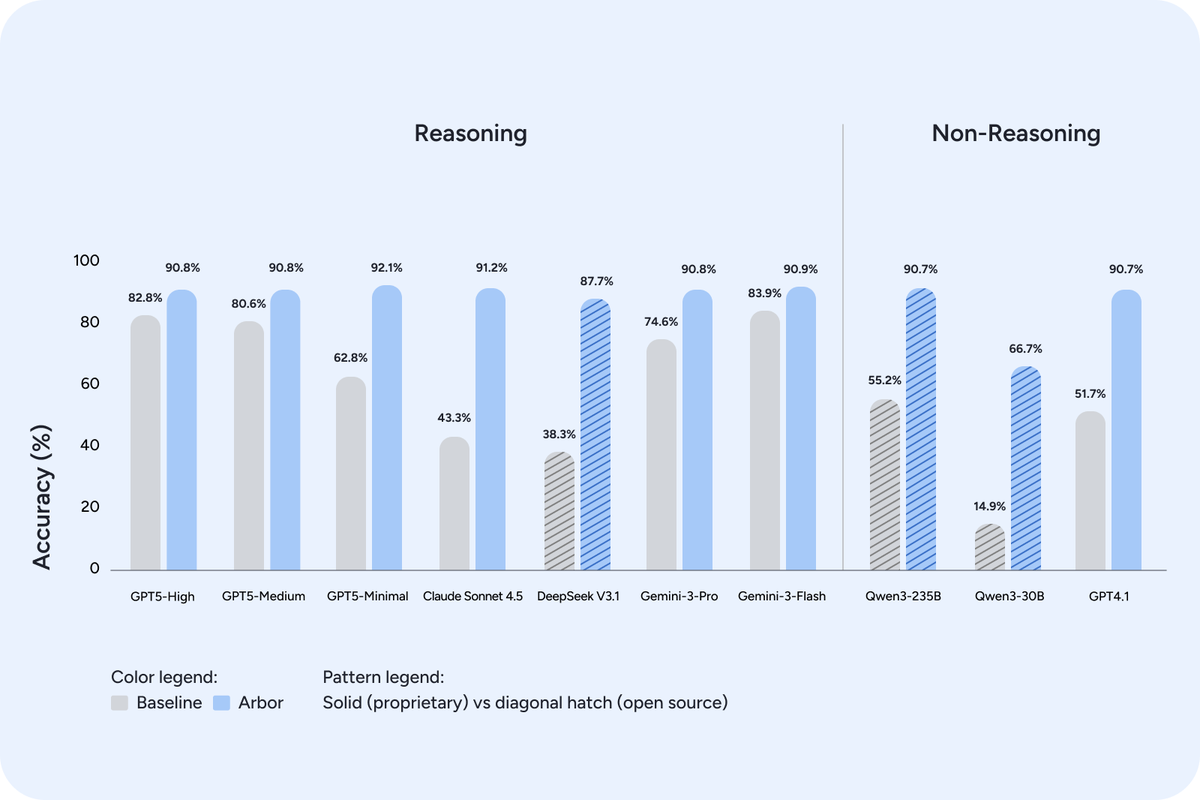
Crucially, the gains did not make the conversation feel robotic. Clinicians rated Arbor’s replies as equally natural.
In structured AI workflows, reliability may depend less on a bigger model and more on a better system around it. That’s Arbor.
Read the full article: https://t.co/Jx8BfZbhha
What happens when you ask an LLM to follow a complex clinical protocol while keeping the conversation natural?
We tested 10 models on real triage conversations. Accuracy ranged from 15% to 83%.
Stronger models helped, but none reliably solved the underlying problem.
The architecture mattered more than model size. DeepSeek V3.1 went from 38% to 88% accuracy. Qwen3 235B reached 91%. Mid-sized open-weight models running inside Arbor matched or beat much larger proprietary models navigating the full protocol on their own.