Sending lots of love to the Apple community on my last day as CEO. My title changes tomorrow, but the love I have for the Apple community never will. Thank you for being a constant source of inspiration. My gratitude is endless, and I’m excited for the next chapter!
Apple's on-device models give us free, private and low-latency inference in Swift. But their performance is limited by device constraints (memory, compute, thermal considerations), and the context window size (8k as of iOS 27 beta 3).
Learn how to overcome these limits with a hybrid AI router based on Apple's Dynamic Profiles:
https://t.co/y4U7r99khg
China is testing a different way to automate trucking.Instead of replacing every truck at once,one driver can lead a convoy while autonomous trucks follow behind.This kind of deployment could make freight automation arrive much earlier in controlled logistics sites than on roads
Good news and bad news for fans of the old variable blur navigation bar background, Apple have added 3 new styles in iOS 27...buuut they're private 🫠
UIScrollEdgeEffectStyle has gained three new class methods: _photosStyle, _messagesStyle, and _safariStyle.
The Photos and Messages styles are pretty similar, but photos has a more aggressive gradient scrim. The Safari style is indistinguishable from the public hard style to my eye.
Previewing Ultrafast mode for @OpenAI's GPT 5.6 Sol, powered by Cerebras.
GPT-5.6 Sol Ultrafast generates responses at up to 750 tokens per second. That's the full, GPT-5.6-Sol model -- up to 14× faster than the same model on Standard processing.
It speedran Humanity’s Last Exam in 11h 11m, nearly 7× faster than Claude Fable 5 with comparable accuracy.
Apple's internal private frameworks are basically open-source thanks to MachOSwiftSection, which lets you reverse-engineer and inspect private binaries 🛠
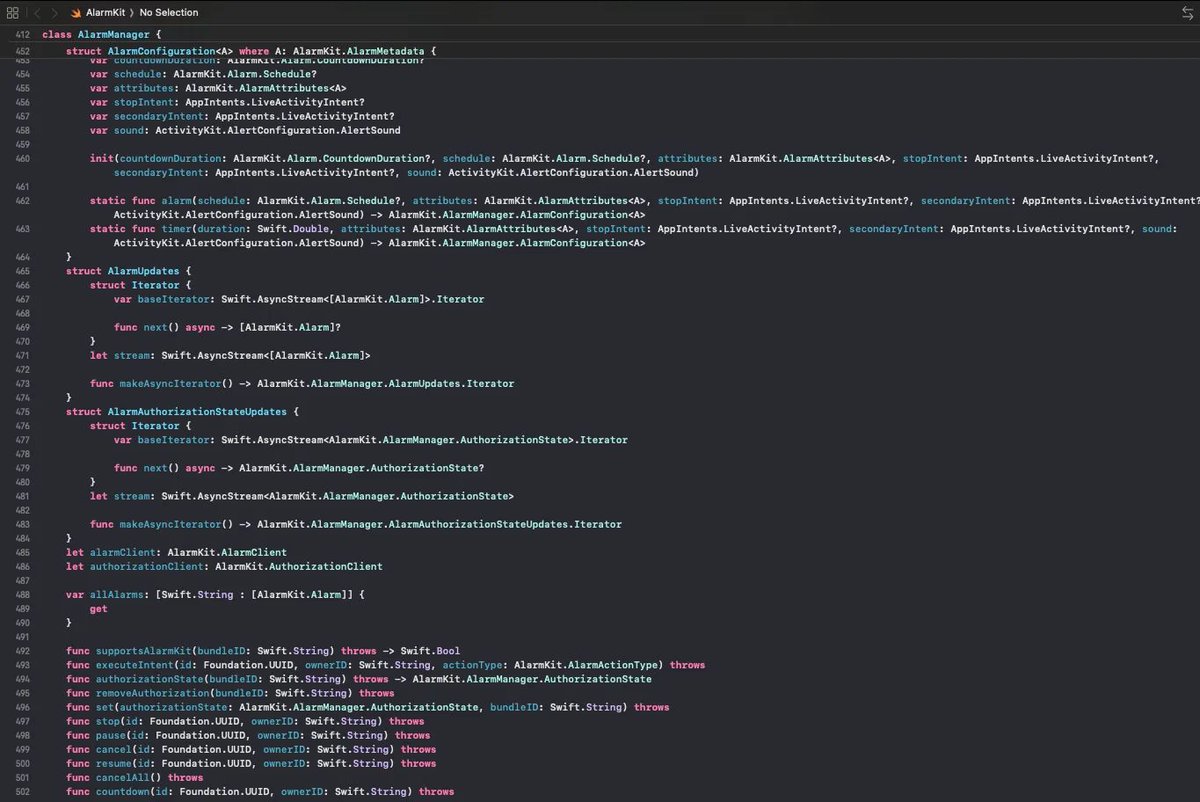
The open-source MachOSwiftSection tool by MxIris is the key to reverse-engineering the interfaces from these binaries - all of which live inside the Simulator on your Mac filesystem.
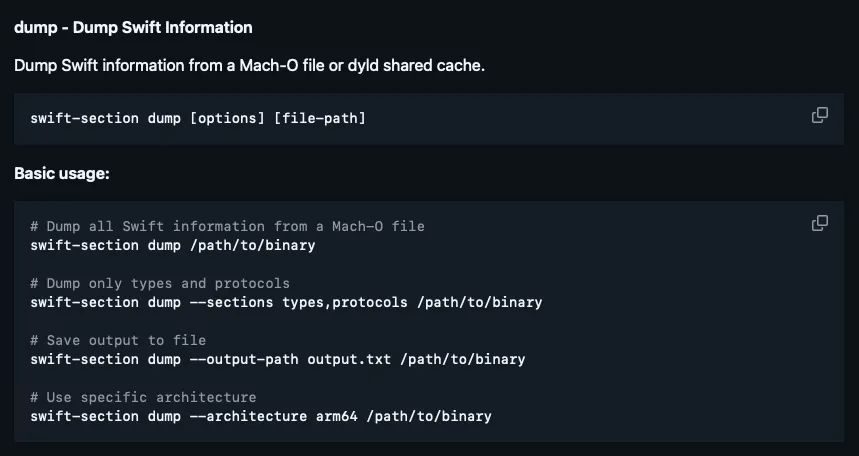
I downloaded the tool from the swift-interface branch, and ran the build script. The documentation is super clear (screenshot #1).
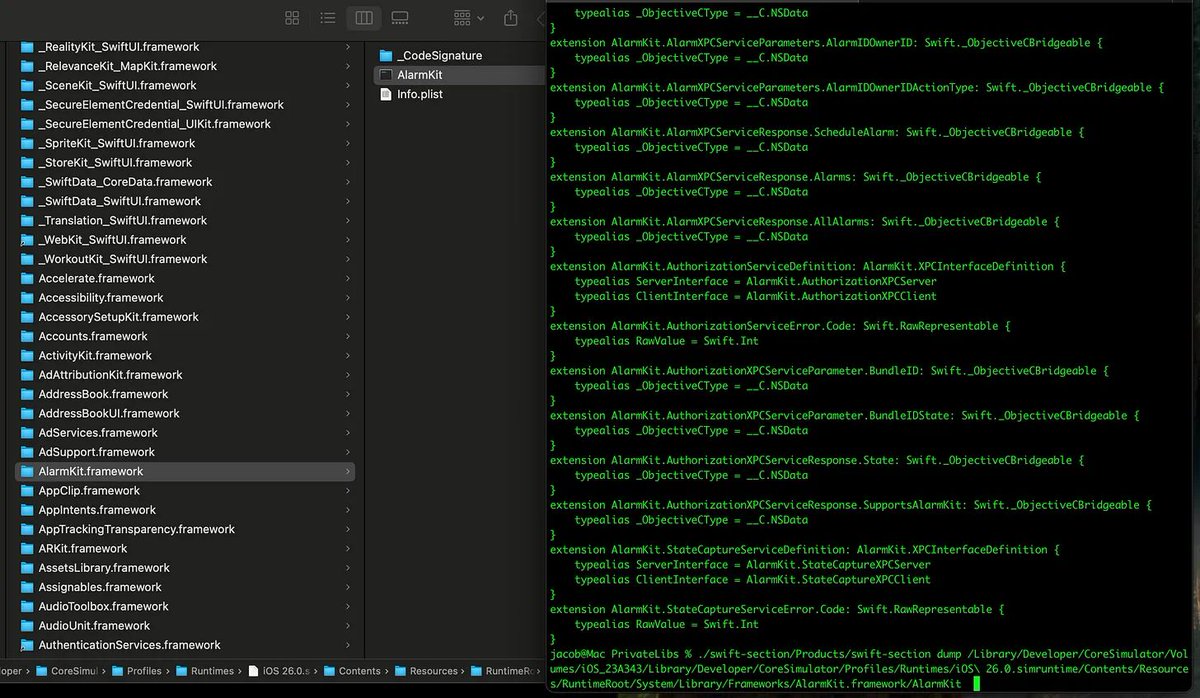
Let’s give this a try, and dump AlarmKit (screenshot #2).
Wow, it straight up just dumped the entire interface of AlarmKit. First try. That’s unbelievable.
We can get the slightly neater, Tweetable version by outputting the interface to a .swift file:
./swift-section/Products/swift-section interface --output-path AlarmKit.swift /Library/Developer/CoreSimulator/Volumes/iOS_23A343/Library/Developer/CoreSimulator/Profiles/Runtimes/iOS\ 26.0.simruntime/Contents/Resources/RuntimeRoot/System/Library/Frameworks/AlarmKit.framework/AlarmKit
This outputs a proper Swift interface containing all the internal Swift types (screenshot #3).
How does this tool work?
It walks the __swift5_* metadata sections in the Mach-O binary and reads ABI-defined descriptors in the binary to resolve types, protocols, and conformances. It runs a custom demangler to decode the resulting symbol names to reconstruct a regular Swift-y interface.
This works because the Swift ABI exactly specifies the structure and memory layout of these object code descriptors, for example, a ProtocolDescriptor always follows the exact same format when compiled into binary.
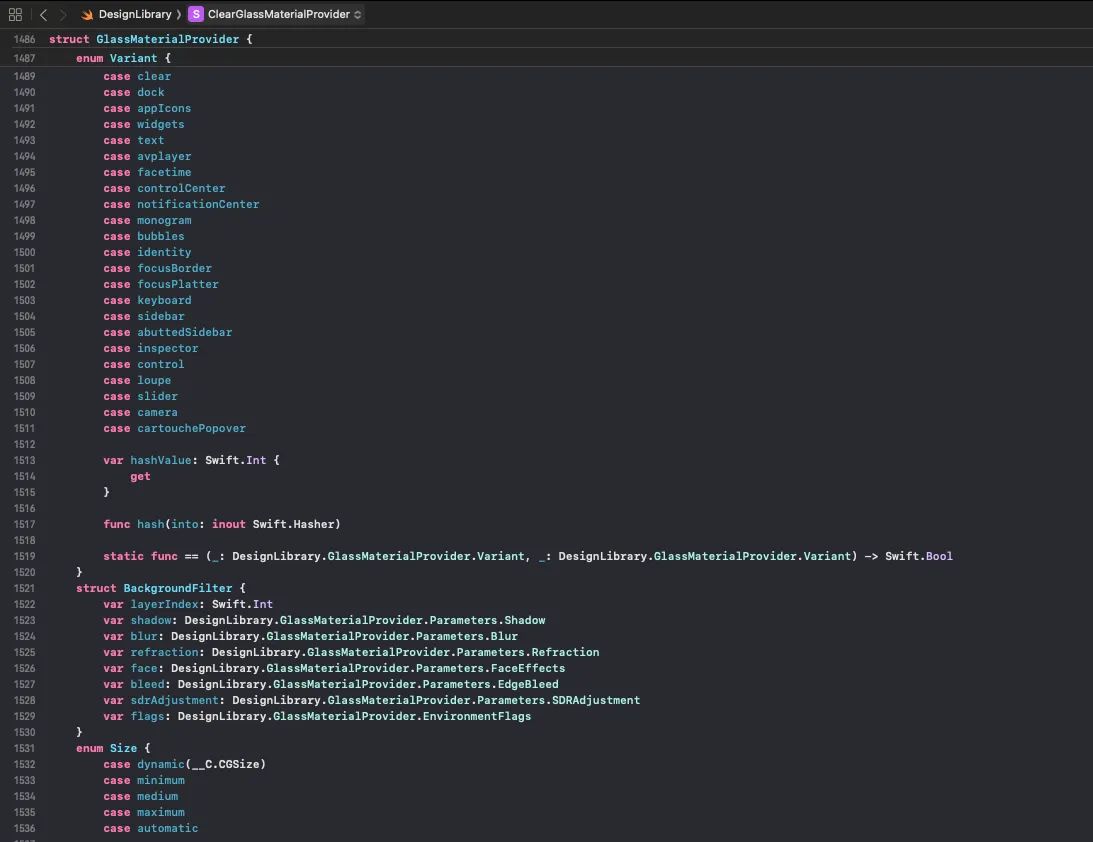
By running the tool on the DesignLibrary private framework, we can spot the original Liquid Glass configuration that inspired this article (screenshot #4).
I thought going through this exercise would make it seem less magic, but frankly I’m more convinced than ever that he’s a god.
Let me be clear: this does not reverse-engineer the actual source code from the binary, it just reconstructs the interface using type metadata. But this alone still gives us a ton of fascinating info.
./swift-section/Products/swift-section interface dump /Library/Developer/CoreSimulator/Volumes/iOS_23A343/Library/Developer/CoreSimulator/Profiles/Runtimes/iOS\ 26.0.simruntime/Contents/Resources/RuntimeRoot/System/Library/Frameworks/AlarmKit.framework/AlarmKit
If you liked this, please join my newsletter to master iOS for 10 mins every week! 🚀 https://t.co/5XrYBsTLjA
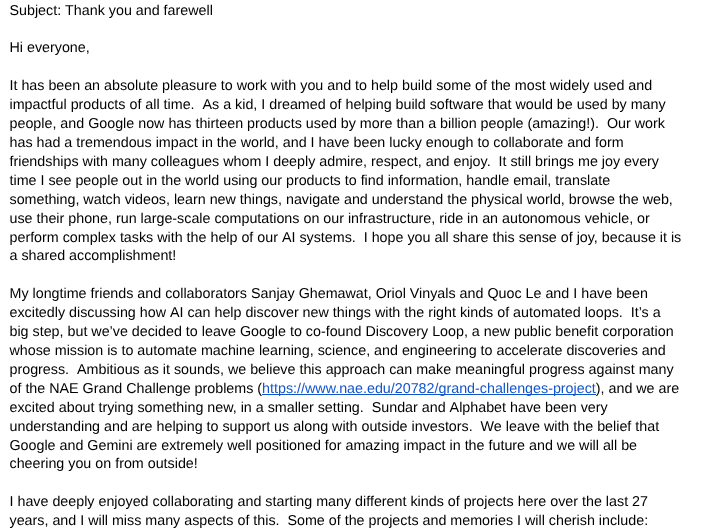
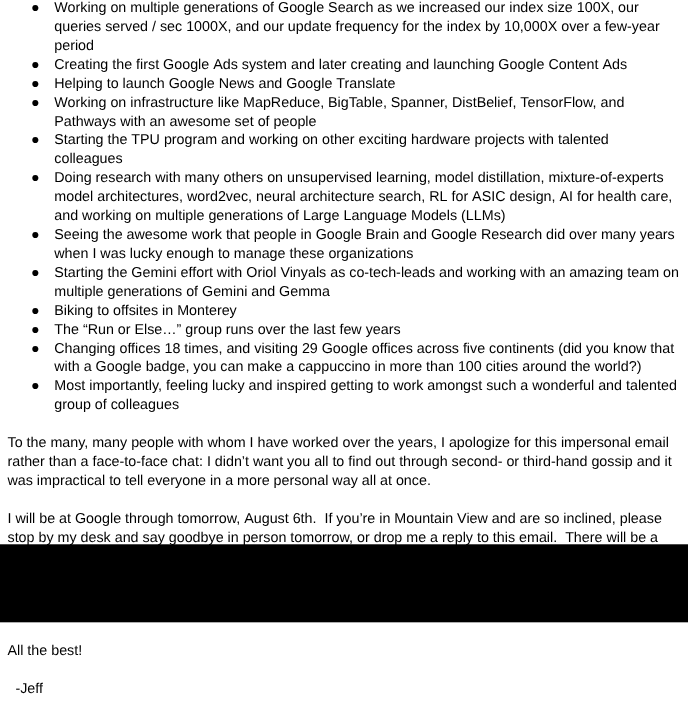
Tomorrow will be my last day at Google after 27 years, and watching it grow from 25 people to 190,000+ has been an amazing journey. Below is a note I shared with many people internally at Google today. An excerpt is:
It has been an absolute pleasure to work with you and to help build some of the most widely used and impactful products of all time. As a kid, I dreamed of helping build software that would be used by many people, and Google now has thirteen products used by more than a billion people (amazing!). Our work has had a tremendous impact in the world, and I have been lucky enough to collaborate and form friendships with many colleagues that I deeply admire, respect, and enjoy. It still brings me joy every time I see people out in the world using our products to find information, handle email, translate documents, watch videos, learn new things, navigate and understand the physical world, browse the web, use their phone, run large-scale computations on our infrastructure, ride in an autonomous vehicle, or perform complex tasks with the help of our AI systems. I hope you all share this sense of joy, because it is a shared accomplishment! Thank you to all of my colleagues at Google over many years!
Now I'm excited to go start @DiscoLoopAI with my longtime friends and colleagues @Sanjay_Ghemawat, @OriolVinyalsML, and @quocleix.
(Updated post: slightly redacted to not have some personal info)
Introducing Kitesurf: a browser built for agents, running entirely on Cloudflare Workers.
Chromium is too heavy to hand every agent one. Kitesurf is written in Rust, uses 3-7x less CPU and memory, and spins up per request.
Free in beta: https://t.co/Vm8kVCgSkG