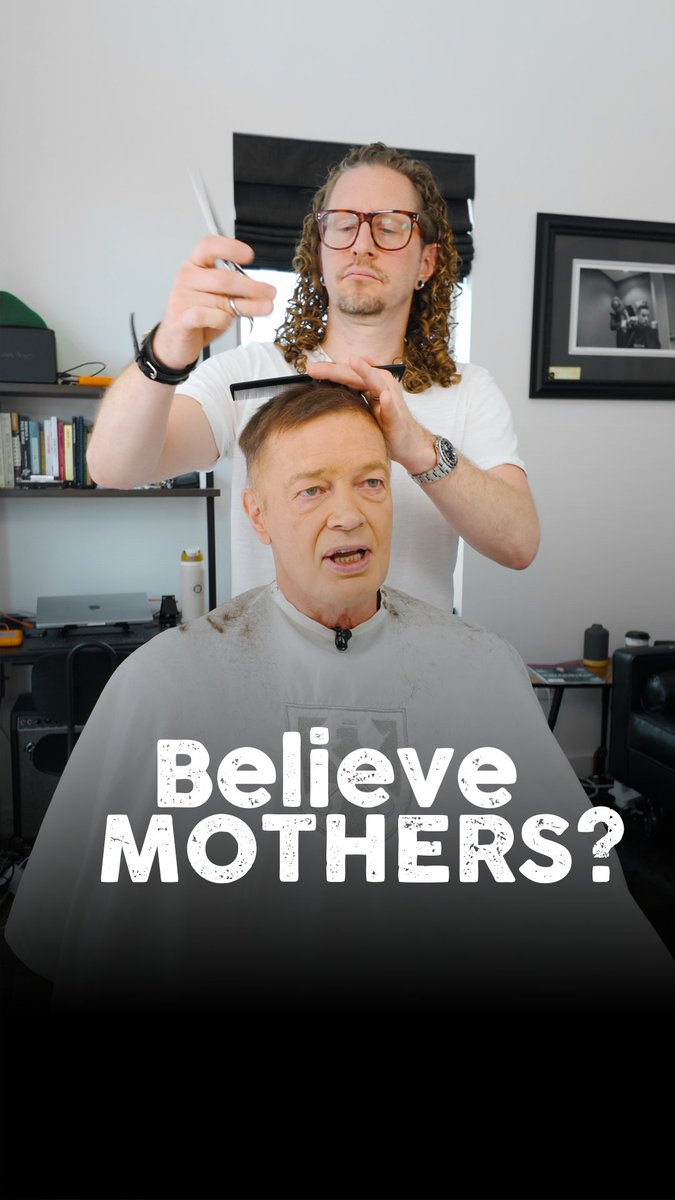
On this episode of Splitting Hairs Pod, Emmy Robbin (@emmyrobbindoula) explains why she believes oxytocin is one of the most important hormones during birth.
Known as the "love hormone," oxytocin is what helps the uterus contract during labor. It also crosses the placenta, exposing the baby to the same hormone. Emmy believes that's not an accident. In her view, we were designed to enter the world surrounded by love, not fear.
She also explains why creating a calm, safe environment matters so much. Fear, stress, and constant interruptions can interfere with the body's natural production of oxytocin, changing the experience for both mother and baby.
The conversation ends with one of Emmy's strongest beliefs: that how a baby is born may influence their nervous system for the rest of their life.
If love is the hormone that brings us into the world, what happens when fear takes its place?
66 | Emmy Robbin Gets a Haircut: Why Did We Stop Trusting Our Bodies?
Emmy Robbin is a doula, birth trauma coach, educator, and author of the #1 bestselling book Faithful Beginnings: A Doula's Guide to Eliminating Fear and Birthing with Confidence. Through years of supporting families, she has become a leading voice for physiological birth, nervous system health, informed consent, and helping parents approach birth with greater confidence rather than fear.
In this episode, Emmy shares why she believes modern culture has slowly disconnected us from our own bodies, how fear has become a defining part of the birth experience, and why rebuilding trust in ourselves may be one of the most important steps toward healthier pregnancies, births, and lives.
We discuss the nervous system, birth trauma, informed consent, the history of modern obstetrics, physiological birth, personal responsibility, and why so many women leave birth feeling unheard. We also discuss her #1 bestselling book Faithful Beginnings and the importance of approaching birth with confidence instead of fear.
Whether you're expecting a child, working in healthcare, raising a family, or simply interested in the relationship between fear, health, and personal responsibility, this conversation invites you to reconsider one simple question:
Why did we stop trusting our bodies?
https://t.co/jpTiZPfmMV
On this episode of @SplittingHairsPod, Dr. Andrew Wakefield (@DrAndyWakefield ) discusses his defamation lawsuit against the British Medical Journal and why he believes the case was dismissed despite having strong legal footing.
What stood out to me was the reasoning. According to Wakefield, the court argued there was no legal precedent that would allow the case to move forward.
The obvious question becomes: how does precedent ever get created if the first case is dismissed because no precedent exists?
Wakefield argues that his lawsuit had the opportunity to establish that precedent. Instead, he says, the case was stopped before it could move forward.
Whether you agree with Wakefield's conclusions or not, it raises a fascinating legal question about how new precedent is established and who gets the opportunity to establish it.
How can a case create precedent if it's dismissed for lacking precedent?
On this episode of @SplittingHairsPod, Dr. Andrew Wakefield (@DrAndyWakefield ) argues that the real crisis facing public health is not disagreement. It is trust.
He believes confidence in public institutions has been damaged by years of messaging that many people no longer believe. The result, he says, is that growing numbers of people are choosing to make decisions independently rather than relying on experts, pharmaceutical companies, government agencies, or public health officials to make those decisions for them.
Wakefield argues that trust, once lost, is incredibly difficult to rebuild. In his view, the growing reluctance of people to follow public health recommendations is not the cause of the problem. It is the consequence.
What happens when the people asking for trust are the same people who lost it?
Removing Greer from the convo -I had a client who was growing stem cells 98-99% pure to what they were design to help regrow. The lab was helping animals walk who has spinal cord injury. It was part of UCI with Dr Hans Keirstead. So as crazy as what Greer said it’s also not shocking that the tech could exist. Btw this what was about 15 years I was told this by Hans.
On this episode of @SplittingHairsPod, Dr. Andrew Wakefield (@DrAndyWakefield ) discusses the MTHFR gene and why he believes it should not automatically be viewed as a defect.
His argument is simple: nature does not tend to preserve genes over countless generations without a reason. Just because we do not fully understand the purpose of a gene does not mean it is broken.
The conversation explores the possibility that genes like MTHFR become problematic only when they encounter environmental exposures they were never meant to handle. In that framework, the question shifts from “What’s wrong with the gene?” to “What changed in the environment?”
What if we've spent decades blaming the gene instead of asking what changed around it?
On this episode of @SplittingHairsPod, Dr. Andrew Wakefield (@DrAndyWakefield ) shares the story that inspired his new novel, The Bequest.
Years ago, after speaking at a conference, a mother took him to dinner and made an unexpected request.
She wanted to have another child.
Not because she wanted a bigger family. Not because she was looking for a partner.
Her son had profound autism, and she was terrified of what would happen to him after she was gone. She wanted to give him a sibling. Someone who would understand him. Someone who would love him. Someone who could care for him when she no longer could.
That conversation stayed with Wakefield for years and eventually became the foundation for The Bequest.
Beneath all of the debates, research, and headlines is a question that remains deeply personal for millions of families affected by autism:
What happens to these children when their parents are gone?
On this episode of @SplittingHairsPod, Dr. Andrew Wakefield (@DrAndyWakefield ) reflects on a conversation that changed the course of his career.
While investigating questions surrounding vaccine safety, Wakefield says he was called into the office of the Dean of Medicine at the Royal Free Hospital School of Medicine and given a warning.
"If you continue with this vaccine safety research, it's not going to be good for your career. I suggest you stop."
Wakefield says the conversation didn't scare him as much as it angered him. In his view, medicine is supposed to follow the patient, ask difficult questions, and pursue answers wherever the evidence leads.
The irony, he says, is that the warning turned out to be true.
It wasn't good for his career.
Would you stop asking a question if the answer might cost you everything?
On this episode of @SplittingHairsPod, Dr. Andrew Wakefield (@DrAndyWakefield ) asks a simple question: what happens when the person who knows a child best says something is wrong?
Wakefield argues that many medical breakthroughs began because clinicians paid attention to what patients were telling them. When the patient is a child, that responsibility often starts with listening to the parent.
The conversation centers on mothers who watched their children change. Children who were speaking, learning, interacting, and developing normally until something shifted. Alongside those changes came symptoms many parents say were overlooked: pain, bloating, gastrointestinal distress, failure to thrive, and behavioral regression.
Wakefield's position is straightforward. Put the labels aside. Put the politics aside. If a parent tells you their child is suffering, the first responsibility is not to dismiss them. It is to investigate.
As he puts it, these symptoms are consistent with inflammatory bowel disease until proven otherwise. The key words being: until proven otherwise.
How many parents knew something was wrong long before anyone listened?
#AUTISM #VACCINE #BELIEVEMOTHERS
65 | Dr. Andrew Wakefield Gets a Haircut: What Happens When You Question the System
Few figures in modern medicine have generated as much controversy as Dr. Andrew Wakefield.
A former physician and researcher who published more than 150 scientific papers, #Wakefield lost his job, his career, his fellowships, and ultimately his medical license while pursuing questions surrounding childhood vaccines, intestinal inflammation, and neurological injury in children.
In this episode, we go far beyond the headlines.
Wakefield shares how parents first brought him stories of developmental regression following routine childhood vaccinations, why he believed those families deserved to be heard, and what happened when his research collided with governments, pharmaceutical companies, medical journals, and public health institutions.
What follows is less a conversation about #vaccines and more a conversation about scientific dissent, institutional power, media narratives, censorship, #whistleblowers, and the consequences of asking questions that powerful people would rather leave unanswered.
The discussion moves through autism, gastrointestinal disease, the gut-brain connection, the rise of chronic illness, pharmaceutical liability, #COVID-era public trust, and why so many people have lost faith in institutions that once commanded unquestioned authority.
One of the most fascinating parts of the conversation is Wakefield's transformation from physician to filmmaker and author. After years of legal battles, public attacks, and professional consequences, he turned to books, documentaries, and feature films as a way to tell stories he believed traditional media would never tell. We discuss VAXXED, Protocol 7, his upcoming novel The Bequest (releasing June 26, 2026), the power of storytelling to shape public opinion, and why narratives often outlive headlines.
Beneath all of it is a question that remains deeply personal for millions of families affected by #autism: What happens to these children when their parents are gone? That question became one of the inspirations behind The Bequest and leads to one of the most emotional discussions in the entire episode.
Whether you agree with him, disagree with him, or simply want to understand one of the most polarizing figures in modern medicine, this conversation offers a rare opportunity to hear the story directly from the man at the center of it. @DrAndyWakefield@RobertKennedyJr
https://t.co/VdFMdauVw8
On this episode of @SplittingHairsPod, Dr. Hilary Frisch talks about a growing problem inside airway and biological dentistry: a lot of people are using the language without truly understanding the depth of the work.
She explains that many dentists may take a few courses and begin marketing themselves as “airway focused,” but genuinely experienced airway dentists are extremely rare. Dr. Frisch estimates that the number is well below 1%, which creates a massive access problem for families trying to find real help.
That shortage is part of what led to the creation of Toothpillow, a platform designed to help connect families with trained airway dentists remotely through evaluations, photos, questionnaires, and customized appliances aimed at improving nasal breathing, tongue posture, facial growth, and bite development in children.
It’s amazing how many long-term issues start with something as simple as a child not breathing correctly.
How many kids are struggling because nobody checked their airway?
#airway #mouthbreathing
On this episode of @SplittingHairsPod, Dr. Hilary Frisch (@hilaryfrischdmd) explains why many of the dental problems people think are isolated issues may actually trace back to one root cause: airway dysfunction.
Clenching. Grinding. Worn down teeth. Crowns. Root canals. Gum disease. Narrow jaws. Recessed chins. These are often the body’s compensation patterns trying to protect the airway and keep people breathing.
She explains that the mouth is essentially the “garage” for the tongue. If the jaws do not develop wide and forward enough, the tongue no longer fits properly and begins collapsing back into the airway. The body then adapts however it can, often by grinding, clenching, or changing posture over time.
One of the wildest parts of the conversation is realizing how many common dental issues may actually be the body sending distress signals that are being treated individually instead of tracing them back to the source.
How many symptoms are actually your body trying to warn you?
#airway #breathe
On this episode of @SplittingHairsPod, Dr. Hilary Frisch explains why the tongue is one of the most important and overlooked drivers of facial development and airway health.
“The tongue is the architect of the face.”
That single idea changes how you look at crowded teeth, recessed jaws, chronic congestion, mouth breathing, and poor sleep. If the tongue does not have enough room to sit properly on the roof of the mouth, facial growth changes, airway space narrows, and the body adapts however it can just to keep breathing.
One of the more shocking parts of the conversation is when Dr. Frisch explains that airway, tongue posture, jaw growth, and nasal breathing were never discussed during dental school training. That gap in education is part of why airway-focused dentistry still sits outside mainstream conversations, despite how many adults are now struggling with sleep and breathing issues.
How many health problems start with the simple fact that people never learned how to breathe properly?
#airway #airwaydentist
On this episode of @SplittingHairsPod, Dr. Hilary Frisch explains why many of the soft processed foods marketed toward babies are doing far more harm than parents realize.
Her argument is not just about ingredients. It is about development. Babies are supposed to chew. Chewing develops the muscles of the face, which helps develop the jaws, palate, airway, and overall facial structure. When children are raised primarily on puréed foods and dissolvable snacks that melt in the mouth without resistance, those muscles are not being properly challenged to grow.
Dr. Frisch argues that generations of parents were taught to fear choking so intensely that babies stopped learning how to properly chew and develop their jaws. What many people now call “baby-led weaning” may actually be much closer to how children naturally developed for most of human history before everything became soft, processed, and pre-dissolved.
Did modern convenience accidentally create a generation of underdeveloped jaws?