Military victory is not enough if it turns into the enemy's victory image.
A Hezbollah victory image on the Ali al-Taher Ridge on "the day after" would be a mirror image of the weakness of Israel and the United States, and it could undermine every struggle against terrorism worldwide in general, and the struggle against the Shiite Axis's terrorism in particular.
If Hezbollah is able to return to the complex, restore the infrastructure, and present the survival of its operatives as proof of "victory," Israel could turn a significant operational achievement into a Hezbollah victory image and a highly significant cognitive achievement.
Israel must not allow Hezbollah to have this victory image. This is also in the clear interest of the State of Lebanon and the United States.
Any future arrangement in Lebanon must be measured not only by whether the IDF remains at a particular location, but by a far more important test: whether there is a reliable mechanism and capability that will prevent Hezbollah from returning to the assets that were taken from it, and that can also provide clear proof that this is indeed the case.
Read the full analysis in the attached opinion article.
https://t.co/DQ4gByxvCv
Syria: Secret Understandings to Remove Nuclear Material from “Site 99”
According to Axios, the U.S., Israel and Syria’s new government reached secret understandings for the IAEA to remove yellowcake and other nuclear materials reportedly left from Syria’s covert al-Kibar reactor project.
In August 2023, we reported on Project 99, whose site is located in the Tell Qartal area between Hama and Homs. According to the open-source materials available to us at the time, the site was linked to ballistic missile production under Institute 4000 of the Syrian Scientific Studies and Research Center (CERS), with Iranian and North Korean involvement.
At this stage, there is no information confirming that “Site 99,” referenced in the Axios report, is the same site identified by the Alma Center. However, in terms of storage requirements, “yellowcake” can be stored almost anywhere.
Removing the material under IAEA supervision could reduce a potentially clear and immediate security threat to Israel.
https://t.co/RqiZqgMvG0
Within just a few days, an ISIS cell was uncovered in Khan Arnabah, only about 5 km from the Israeli border, where it was reportedly involved in stockpiling weapons and preparing and transferring explosive devices. At the same time, several weapons shipments and caches were uncovered in Syria and along the Lebanese border, including Grad rockets and weapons reportedly destined for Lebanon.
These incidents highlight two persistent trends: ISIS continues to maintain operational infrastructure in southern Syria, while Syria remains a logistical corridor for weapons transfers to Lebanon, despite efforts by the new Syrian government to disrupt such activity.
Read the full analysis >>
https://t.co/VnKPdKhcG5
The Russian Presence in Syria: From Military Control to a Limited Partnership—Updated Situation Report as of August 10, 2026.
The new arrangement at Hmeimim and Tartus points to a shift from bases under independent Russian control to a limited and conditional presence: civilian infrastructure will be returned to Syrian administration, while the military facilities will be converted into joint training centers.
Moscow is losing military autonomy but retaining influence through military training, weapons maintenance, economic ties, and its international standing.
From Israel’s perspective, the change may slightly reduce the potential risk of direct friction with Russian forces—but it does not render the deconfliction mechanisms unnecessary.
Read the full article>> https://t.co/gJYa15EPNz
Hezbollah continues to consolidate its hold over the first pilot zone—Zawtar al-Gharbiyeh. De facto, Hezbollah operatives are present and active within the pilot zone under the auspices of the Lebanese Armed Forces, establishing a civilian foothold that will enable renewed military entrenchment at the next stage.
After identifying the entry of Hezbollah’s Islamic Health Organization into Zawtar al-Gharbiyeh under the auspices of the Lebanese Armed Forces, which deployed in the village (see our July 27 publication), in recent days we have also identified the entry into Zawtar al-Gharbiyeh of Hezbollah-affiliated “Cooperate with One Another” Association—“Wataawanou” Association Charity (جمعية "وتعاونوا" الخيرية). As with the Islamic Health Organization, the association’s entry into Zawtar al-Gharbiyeh is also taking place under the auspices of the Lebanese Armed Forces.
Full article: https://t.co/hls9GKDRLu
The Majdal Zoun Incident: An Old Explosive Device or an Indication of Hezbollah's Return?
The explosion that killed two IDF soldiers in the village of Majdal Zoun raises a broader question: Was this an explosive device left behind as part of Hezbollah's defensive network before or during the war, or does it indicate that the organization has already resumed operations within the Yellow Linearea?
The incident comes amid several developments in southern Lebanon: the return of residents to villages within the Yellow Line under the auspices of the Lebanese Armed Forces (LAF), large-scale funerals for Hezbollah operatives that provide an opportunity for the organization's members to return to the area under civilian cover, and the continued activity of Hezbollah's Islamic Health Organization in the pilot areas.
Are these merely remnants of a past threat, or signs that Hezbollah is exploiting the new reality in southern Lebanon to reestablish its presence?
Read the full analysis >>
https://t.co/HHcaYVpzvL
Who will disarm Hezbollah where the #IDF never operated? While attention is focused on “pilot zones” cleared by #Israel, #Hezbollah remains entrenched and is rebuilding in areas south of the Litani that the IDF did not enter.
If #Lebanon wants further Israeli withdrawals, the #LAF must prove it can dismantle Hezbollah’s infrastructure where it still controls the ground.
Read the full article: https://t.co/Tdo1kir3Dj
July 2026 was defined by multi-front escalation between Iran and the U.S, involving sustained low to mid-level kinetic clashes and calculated brinkmanship. Meanwhile, new information about Tehran’s covert efforts to rebuild nuclear capabilities at the “Pickaxe Mountain” facility emerged, alongside a resurgence of Houthi attacks on Saudi Arabia, all occurring amid Iran's severe economic crisis. This report examines all of the major developments and their significance.
As of August 5, the diplomatic focus has turned to the Strait of Hormuz. While U.S. officials remain hopeful for a reopening deal "today or tomorrow," Iran continues to deny direct negotiations with Washington. Until now, Iran has employed calculated brinkmanship, targeting commercial vessels and U.S. military assets in the region, while losing military and strategic assets to U.S. strikes, as part of an effort to establish dominance over Hormuz. Israel is keeping out of this attrition campaign for now.
https://t.co/Y8b4bl7Ama
Today marks six years since the explosion of the ammonium nitrate stockpile at Hangar 12 in the Port of Beirut on August 4, 2020. After a prolonged period of paralysis in the investigation into the explosion, there appears to have been progress in the investigation in recent months, led by Judge Tarek Bitar. Bitar completed the main phase of the investigation at the end of March 2026. The investigation file includes approximately 70 suspects, among them former senior officials from Lebanon's political and security establishment.
It is unclear whether indictments will be filed against all of them, when the indictments will be filed, and when the trial will begin. According to assessments in Lebanon, the trial is expected to begin before the end of 2026.
Throughout the past six years, Hezbollah has opposed the investigation itself, as well as the appointment and activities of Judge Bitar, has not recognized either of them, and has sought to delay and obstruct both the investigation and Bitar's work (it is interesting why...).
Will this case end with effective legal proceedings that bring the real perpetrators of the major disaster to justice?
The Beirut Port explosion is perceived not only as a civilian disaster, but also as a test of the Lebanese state's ability to effectively and genuinely investigate and conduct legal proceedings regarding a disaster in which a highly significant political and security power center such as Hezbollah was involved, confront it, and bring those responsible to justice.
Six years after the explosion, there is still no conviction, no active trial, and not even a single person imprisoned for responsibility for the disaster.
What does this mean for the Lebanese state's ability to deal with Hezbollah and its disarmament?
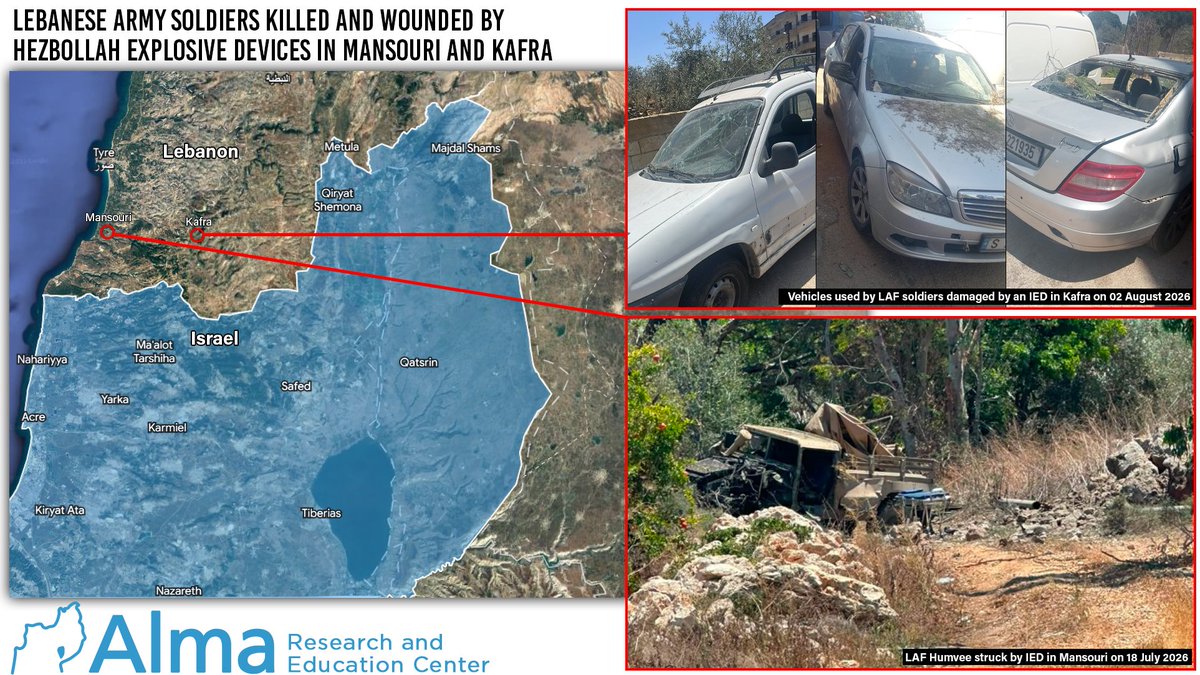
Two IED incidents targeting the Lebanese Armed Forces (LAF) within less than three weeks raise an important question: Is Hezbollah sending a message to the Lebanese state and its military?
In both incidents, LAF vehicles were struck. Against the backdrop of ongoing discussions in Lebanon over disarming Hezbollah, the question arises whether these were merely explosive devices left behind from the fighting, or a deliberate warning ahead of any attempt by the Lebanese state to move against the organization.
If preventing a new civil war is the Lebanese Army's overriding priority—as Commander-in-Chief Rodolphe Haykal stated this week—how will the army be able to implement the Lebanese government's decision to disarm Hezbollah?
Read the full analysis >> https://t.co/LUeCStXf8d
The Council for the South is a Lebanese government body responsible for the reconstruction of southern Lebanon. However, for decades it has been associated with the Amal Movement and operates in an environment where the Amal–Hezbollah alliance exercises extensive political and municipal influence.
This creates a system in which state funds and international assistance address genuine needs but may also strengthen Amal’s patronage networks, deepen residents’ dependence on Hezbollah, and help restore its civilian foothold and even its military capabilities.
The reconstruction of southern Lebanon is therefore not merely about rebuilding homes and infrastructure, it is also a struggle over sovereignty, influence, and legitimacy.
The main interest is not to prevent reconstruction, but to ensure that it is conducted transparently and under supervision, strengthens the Lebanese state, and does not lay the groundwork for Hezbollah’s renewed entrenchment and the next conflict.
Read the full article: https://t.co/DnbDDVFDfS
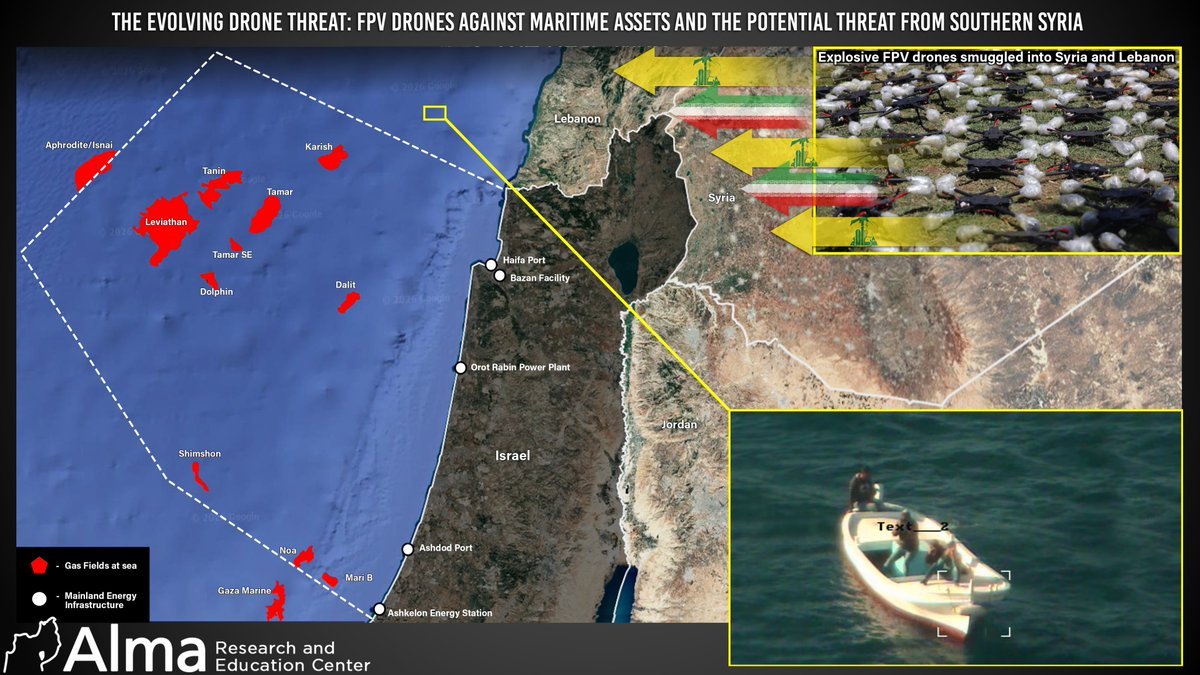
A Ukrainian recording of an attack on a Russian gas platform using FPV drones launched from boats reveals a new operational method—one with direct and highly relevant implications for the threat Hezbollah poses to Israel's offshore gas platforms.
At the same time, southern Syria could emerge as an additional drone front against Israel. The FPV drone threat has the potential to evolve from a tactical threat into a strategic threat to critical national infrastructure, and from a single-front threat into a simultaneous multi-front threat.
Read the full analysis. https://t.co/LDoPyQ3ECZ
Following the discussion on whether the Lebanese Armed Forces will be willing to conduct searches inside private civilian properties as part of Hezbollah's disarmament, the following case illustrates why this is a fundamental. not merely technical issue.
In the village of Haddatha in southern Lebanon, the IDF uncovered an underground Hezbollah command center constructed beneath a building materials factory, approximately 300 meters from a UNIFIL facility. The underground structure, approximately 55 meters long, consisted of three rooms. A nearby underground shaft containing dozens of weapons was also discovered.
This case joins a long series of Hezbollah military infrastructures identified since the beginning of the IDF's ground operations in Lebanon inside or beneath private civilian properties.
It further reinforces the understanding that the use of the civilian environment is not an operational necessity but rather an integral component of Hezbollah's method of operation and its systematic use of the human shield tactic.
If the Lebanese Armed Forces are unwilling to enter private civilian properties and conduct searches, a significant portion of Hezbollah's military infrastructure will remain beyond their reach.
In other words, when a substantial share of Hezbollah's military infrastructure is concealed inside or beneath private civilian properties, a policy of avoiding searches in these locations is not merely a legal or operational constraint- it fundamentally limits the ability to act against Hezbollah and to effectively implement its disarmament.
A reminder:
Exactly a decade ago, on July 28, 2016, Abu Muhammad al-Julani – now known as Ahmad al-Sharaa, President of Syria – appeared publicly and announced a new phase in the evolution of his organization: the dissolution of Jabhat al-Nusra and the establishment of Jabhat Fath al-Sham. The move marked the first major organizational and image-related transition on the path toward what would later become Hayat Tahrir al-Sham. In effect, it represented another step in a rebranding process rather than a substantive change in the organization’s positions or identity.
The move was presented externally as a break with al-Qaeda. In practice, however, it primarily reflected a structural rather than ideological change. In the announcement, al-Julani thanked Ayman al-Zawahiri and his deputy, praised al-Qaeda’s leadership, quoted Osama bin Laden, and made clear that the decision had been taken in coordination with and under the guidance of al-Qaeda – without compromising the organization’s “fundamental principles” and while maintaining its commitment to jihad in Syria.
This illustrates the organization’s trajectory: a gradual transition from a formal affiliate, through successive rebranding efforts, to a locally rooted entity with an ostensibly independent identity – yet marked by ideological and organizational continuity.
Al-Julani also explicitly explained the purpose of the move: to remove the pretext used by the United States and Russia to target the organization because of its formal affiliation with al-Qaeda. In other words, this was not a declaration abandoning the ideology, but a calculated effort to change the organization’s framework, name, and image.
Today, ten years later, as al-Julani has become Ahmad al-Sharaa, his own words must not be forgotten. A change of name, attire, and carefully calculated “political language” does not, in itself, constitute evidence of ideological change.
One of the main obstacles highlighted by the Lebanese media these days in the process of disarming Hezbollah is the Lebanese Army's refusal to conduct searches inside private homes and properties, out of concern that doing so could trigger internal escalation and direct confrontation with Hezbollah.
During the fighting, the IDF located weapons caches, tunnel shafts, and military infrastructure inside residential homes in southern Lebanon—including in bedrooms, children's rooms, living rooms, and beneath civilian houses in Shiite villages across southern Lebanon.
This was not an isolated phenomenon, but rather a manifestation of Hezbollah's human shield tactic—one of the organization's core military strategies, based on the deliberate and systematic embedding of military infrastructure and capabilities within civilian areas and private property.
Therefore, if the Lebanese Army is unwilling to enter private properties, a fundamental question arises: How can Hezbollah be disarmed when a significant portion of its military infrastructure is concealed precisely there?
The new oil route from Iraq to Syria was designed to bypass the Strait of Hormuz—but it could also become a new smuggling route for Iran.
Since April, hundreds of oil tanker trucks have passed daily through the al-Waleed–al-Tanf crossing on their way to the port of Baniyas. In June and July alone, approximately 1.42 million barrels of Iraqi fuel oil destined for the U.S. market were loaded at the port, a quantity that required an estimated 7,100 tanker trucks to transport.
Amid the growing volume of commercial traffic, an attempt to smuggle advanced weapons to Hezbollah concealed inside an oil tanker—including FPV drones, anti-tank missiles, and components for Iranian cruise missiles—has already been thwarted. According to local reports, previous smuggling attempts successfully reached their destination.
The U.S. withdrawal from al-Tanf, weak border oversight, and the pro-Iranian presence in Iraq are together creating an operational opportunity for Iran. Washington should not obstruct trade, but it should condition its support for expanding the corridor on transparency, technological scanning, and strict oversight.
Without appropriate safeguards, a route intended to reduce Iranian leverage in the Strait of Hormuz could become Hezbollah’s new reconstruction route.
Read the full article: https://t.co/cqPxQgCFSf
Several Lebanese media outlets have covered our analysis of Hezbollah's Islamic Health Organization returning to Zawtar al-Gharbiyah.
In Lebanon, the implications of this documentation- and the questions it raises about the implementation of the Israel-Lebanon understandings - are well understood. If one of Hezbollah's "civilian" mechanisms is already operating openly in one of the designated pilot areas, and neither the Lebanese state nor the Lebanese Armed Forces are preventing it, it is fair to ask how effectively the agreement is being enforced today and whether it will be enforced in practice going forward.
This is a question that deserves far greater attention beyond Lebanon.
@janoubia_news@almodononline@MTVLebanonNews
No international foreign force is relevant in southern Lebanon. Extending UNIFIL's mandate (as Lebanon seeks) or establishing a replacement force (as many Europeans propose) would only perpetuate the same failure. The only effective way to prevent Hezbollah's rearmament is to preserve Israel's freedom of action, alongside sustained diplomatic and economic pressure and genuine reforms in Lebanon and its armed forces.
No more UNIFIL. No replacement force. Only lessons learned from reality.
Read the full op-ed in the attached article: https://t.co/9MHK1eqyQT
#Lebanon #Hezbollah #UNIFIL #Israel
Why Is Hezbollah Waging a Campaign Against Beirut Airport's Security Chief?
In recent weeks, figures and media outlets affiliated with Hezbollah have launched a coordinated media campaign against Brigadier General Fadi Kfouri, a Christian officer serving as Head of Security at Beirut–Rafic Hariri International Airport.
The timing is no coincidence. Since early 2025, the Lebanese government has introduced a series of measures aimed at reducing Hezbollah's influence at the airport- one of the organization's most important strategic force-building assets.
The campaign against Fadi Kfouri may indicate that, from Hezbollah's perspective, Beirut-Rafic Hariri International Airport remains a strategic asset that continues to serve the organization's operational needs. Weakening Hezbollah's grip on the airport remains a significant threat, even if the methods used to counter it have changed.
Past experience suggests that information and influence campaigns are often only the first stage. The question is: Will Hezbollah stop there?
Read the full analysis >> https://t.co/Kn43r7euoB
The first pilot area is already providing a real test.
In Zawtar al-Gharbiyyeh, where the Lebanese Armed Forces are expected to prevent Hezbollah's return, Hezbollah's Islamic Health Organization is already operating openly—and publicly documenting its activities while accompanied by the Lebanese Army.
If one of Hezbollah's key civilian institutions has already resumed operations, the question is whether the arrangements are being enforced only against Hezbollah's military wing, or also against the civilian support networks that enable its recovery.
Read the full analysis >> https://t.co/p08wl3mxAQ