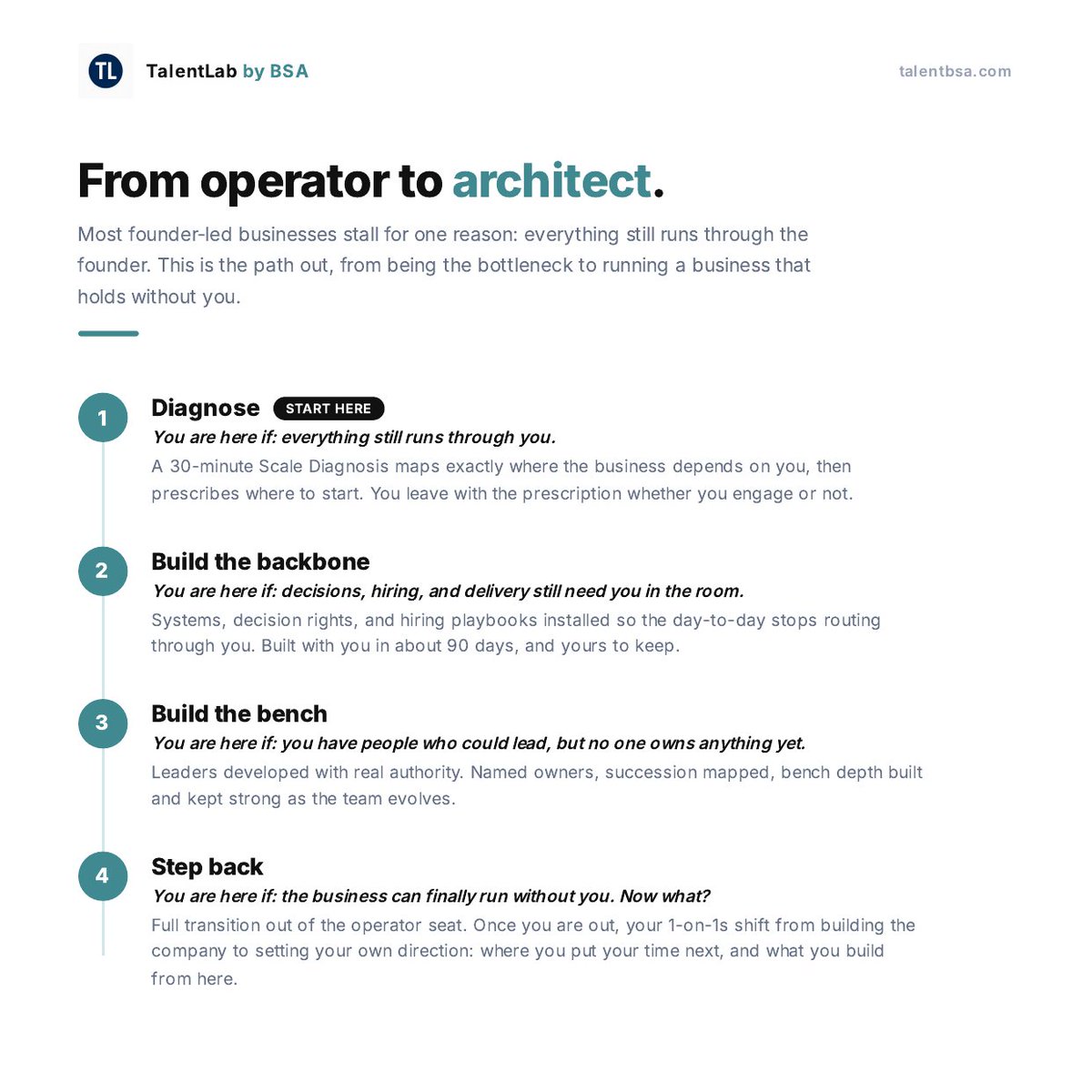
Most founder-led businesses stall for one simple reason: Everything still runs through the founder.
This is the path out- from being the bottleneck to running a business that holds without you.
Once a quarter, put one page in front of leadership: who is thriving, who is stuck, who is at risk.
Thirty minutes. Three lists.
You can't manage talent you never look at.
Great performer, first time managing people, no training, no framework.
Then everyone wonders why the team's output drops the month after the promotion.
Most new managers run 1:1s as status updates.
Give them three questions instead: what's blocking you, what's going well, what do you need from me.
A simple script beats good intentions.
Week one: access and introductions.
Week two: one real task with a clear finish.
Week three: feedback.
Week four: expectations for month two.
A plan that fits on a sticky note gets used.
When someone leaves, don't repost the same job description.
Ask what the role needs to do next year. Often it's a different job than the one you just lost.
Audit your recurring meetings.
If nobody can say what decision it produces, cancel it for two weeks and see who notices.
Process should save time, not spend it.
Promotion is a bet on the next role, not a reward for the last one.
Ask: have they shown the behaviors of the level above?
If not, give them the stretch first, then the title.
The conversation you're avoiding gets harder every week you wait.
Say it small and early. Name the behavior, the impact, and the ask.
Three sentences now beat a performance plan later.
If two interviewers can't score the same candidate within a point of each other, your scorecard is a wish list.
Write three outcomes. Score each one. Debrief on evidence, not vibes.
Ask your best people three questions this month: what keeps you here, what would make you leave, what would you change.
It takes 20 minutes and beats any exit interview.
If a new hire can't say what a great month looks like, nobody told them.
One page. Three outcomes. Reviewed every quarter.
Clarity is the cheapest retention tool you have.
The person who fixes everything is not a hero. They are a warning light.
If one person is covering for a missing role, you have a gap, not a star.
Name the gap before you burn them out.
An offer that is vague on scope, pay, and expectations starts the relationship on a guess.
Clear beats clever.
The first surprise a new hire gets should never be about the job itself.
You can't train a manager in one offsite.
Give them a weekly rhythm: one 1:1 cadence, one feedback habit, one team check.
Small repeated behavior builds a manager. A speech doesn't.
"Great job" costs nothing and changes nothing.
Name the behavior. Name the result. Say it in front of the team.
People repeat what they can see being valued.
Manager training does not need a three-day program.
Start with a checklist: how to run a 1:1, how to give feedback, how to say no.
A short habit used weekly beats a long course used once.