A former ally’s corruption challenge puts Zelenskyy’s wartime leadership under strain.
President Zelenskyy is facing an internal challenge as well as the war with Russia. The source describes a former ally and defence minister, Fedorov, openly criticising the government over corruption and raising questions about the direction of Ukraine’s leadership.
That dispute matters because corruption allegations do not remain a purely domestic political issue during wartime. They can affect confidence in the government and create friction over how the war effort is managed. At the same time, the evidence supplied does not establish whether the allegations are proven or whether they will decisively change public support for Zelenskyy.
The pressure is arriving alongside reduced American financial support and a greater need for European backing. Ukraine therefore faces a difficult combination: sustaining resistance externally while managing political opposition and accountability demands internally.
The central question is not simply whether Zelenskyy has critics. It is whether Ukraine’s institutions can process those criticisms without weakening the state’s ability to fight or abandoning the rule of law.
Can Ukraine address serious corruption allegations without allowing wartime political conflict to destabilise the state?
https://t.co/MMefeqZeIr
#Ukraine
Cofnas’s argument rests on two linked claims about intelligence and evolution.
Nathan Cofnas’s position begins with a strong assumption: intelligence and related cognitive traits are more than 50% heritable, and that heritability remains meaningfully expressed across groups after environmental conditions are considered.
He links this to evolution. Different environments, over different periods, may have imposed different selection pressures, producing adaptations that influence cognitive traits. In this model, average group differences are not explained by culture or institutions alone.
That framework carries a major policy implication: explanations of educational and social outcomes would need to account for both environmental conditions and possible inherited differences. But the source also identifies the central uncertainty: how much observed variation is genetic versus environmental, and whether interventions can substantially reduce group gaps remains contested.
The important question is therefore not whether the claim is politically comfortable, but whether it can be tested carefully without turning a disputed hypothesis into a social conclusion.
What evidence could distinguish inherited group differences from environmental effects?
https://t.co/06hiAb9PTu
#Hereditarianism #Intelligence #NaturalSelection
The weight-loss percentage is only part of the story
Institute of Human Anatomy compares semaglutide—used in Ozempic and higher-dose Wegovy—with tirzepatide (ZepBound). Clinical-trial averages show roughly 20% weight loss with tirzepatide versus about 14% with semaglutide.
Semaglutide’s half-life is about a week; natural GLP-1 lasts about 1–2 minutes. The discussion also cites reduced cardiovascular events and improvements in chronic kidney disease and sleep apnea.
Dosing remains a concern. Compounded medications in multi-dose vials and counterfeit products have been linked to accidental overdoses, with severe gastrointestinal symptoms lasting up to a week. Reported effects include nausea, vomiting, bloating, pancreatitis and gallbladder problems; the exact pancreatitis risk remains under study.
The discussion also flags muscle loss during weight reduction, making protein intake and resistance training important.
Is 20% versus 14% enough to judge the outcome without considering dosing safety and lean mass?
https://t.co/WR8sezvuGi
#Semaglutide #Tirzepatide #GLP1Medications
In Dagestan, fighting is part of culture.
Khabib describes wrestling and fighting as everyday traditions in Dagestan: “Everyone wrestles. Everyone fights.” He adds that “fighting is like fifty percent wrestling,” presenting combat sports as communal practices rather than distant professional spectacles.
The broader summary connects this culture to Dagestan’s mountains, diverse languages and history of invasions. Together, these conditions helped make fighting part of local identity and survival—not merely an individual career choice.
That cultural foundation may help explain how wrestling and combat knowledge pass through communities and generations. But culture alone does not guarantee elite success. The wider system also depends on coaching, repeated competition, hard work and mentorship.
Khabib’s point is therefore not that hardship or tradition automatically creates champions. It is that when a community treats fighting as familiar and meaningful, participation and knowledge have a stronger foundation.
Can infrastructure alone reproduce a sports culture rooted in community and identity?
https://t.co/sKBHlTPrY1
#LexFridman #KhabibNurmagomedov #Dagestan
A 1,000-year-old ironwood tree makes deforestation tangible.
The Amazon is not just a stretch of green on a map. Rosolie points to ironwood trees that can be more than 1,000 years old, anchoring ecosystems that support thousands of organisms.
That timescale changes the meaning of a single act of logging. A tree felled for short-term profit can represent centuries of growth removed in minutes, while the surrounding habitat loses part of the structure on which other life depends.
The same forest is also the home of the Mashco Piro, whose survival depends on maintaining its integrity and isolation. Protecting ancient trees therefore protects more than biodiversity: it helps preserve the conditions under which an uncontacted people can continue its chosen way of life.
Rosolie’s conservation work frames the task as urgent and local. Forest protection must confront illegal logging, mining, and trafficking while giving nearby communities a reason and a role in stewardship.
What should count as the true cost when a centuries-old tree is treated as a short-term resource?
https://t.co/pxDmvLCwBE
#AmazonRainforest #PaulRosolie #JungleKeepers
When history becomes a verdict, context disappears.
Robert Tombs and Nigel Biggar criticise what they describe as a dominant account of Britain’s past, centred on racism, oppression and exploitation.
Their objection is not to teaching those subjects. It is to presenting them as the main lens through which students understand Britain, creating a fragmented and overwhelmingly negative national story. They argue that this framing can weaken students’ attachment to the country and obscure its complex historical development.
They call for a fuller account that acknowledges wrongdoing while also explaining Britain’s wider past. As they ask, if children are taught mainly a “litany of racism and oppression and exploitation,” why would they believe in the country?
Can students understand Britain if its history is taught mainly as a story of guilt?
https://t.co/3T2HAguVvl
#BritishSchools #WokeHistory #BritishEmpire
Huang’s biggest NVIDIA bets begin with questions, not certainty.
The reasoning behind NVIDIA’s strategy, as Jensen Huang describes it to Lex Fridman, is less a single prediction than a process for making decisions under uncertainty.
Huang says curiosity informs his reasoning system. That matters because the company’s decisions span problems that cannot be solved by one discipline alone: computing, networking, software, memory, power and cooling all interact. A choice that looks attractive inside one layer can create a bottleneck somewhere else.
The implied method is to keep asking what the real problem is, decompose it into parts, and then examine how those parts behave together. That is different from treating each product cycle as an isolated bet. It also helps explain why NVIDIA’s strategy reaches beyond GPUs into platforms, infrastructure and the broader AI factory.
This approach does not remove risk. The source material describes a chain of assumptions: workloads will continue to scale, distributed systems can be coordinated effectively, token demand will expand, and efficiency improvements can keep pace with infrastructure needs. Each assumption can hold—or fail—for different reasons.
Huang’s framing therefore offers a leadership lesson rather than a guarantee. Curiosity can widen the field of possibilities, while decomposition can make a massive problem actionable. But the resulting strategy still has to survive technical limits, energy constraints, supply bottlenecks and changes in how AI is built.
That distinction is important when evaluating grand forecasts about AI and NVIDIA. A coherent reasoning process can produce an ambitious direction without making every conclusion certain.
Which assumption in NVIDIA’s chain deserves the most scrutiny: demand, efficiency, infrastructure or ecosystem durability?
https://t.co/IuicyNt7DX
#JensenHuang #NVIDIA #AI
Kirtley’s fusion case runs from plasma physics to civilization-scale energy.
In Lex Fridman’s conversation, David Kirtley presents fusion as a linked chain of problems and possibilities—not simply as a better power plant.
First comes the physics: light nuclei can release energy when fused at extreme temperatures. The challenge is reproducing the Sun’s confinement on Earth without the Sun’s enormous gravitational pressure. That makes temperature, plasma control, and confinement the central engineering obstacles.
Kirtley then connects those obstacles to Helion’s proposed pulsed magneto-inertial approach. Rapid magnetic field changes are intended to organize and confine plasma, while the charged fusion products could be converted into electricity directly rather than first becoming heat to make steam and drive turbines. The fuel question follows: deuterium is abundant in water, while deuterium–helium-3 is discussed as a potentially attractive fuel cycle, though helium-3 brings its own availability and engineering challenges.
Only after those steps does the civilizational argument appear. If a commercial system can produce net-positive electricity reliably and economically, abundant power could expand desalination, controlled agriculture, computation, and space activity. But the conclusion remains conditional: unresolved confinement, materials, cost, fuel, or scaling problems could break the chain. Fusion’s promise is therefore not one claim, but a sequence that must hold from plasma behavior to practical generators to widespread deployment.
Which link in this chain—confinement, conversion, fuel, or scaling—will determine whether fusion becomes transformative?
https://t.co/pgstNi4Qqg
#NuclearFusion #HelionEnergy #LexFridmanPodcast
Chung’s tech forecast starts with a supply-chain equation, not AI hype.
Professor Chung’s framework is blunt: technological progress depends on “specialization multiplied by globalization.” In his view, invention alone is not enough. Modern technology works because different countries concentrate on different materials, components, designs, manufacturing steps, and logistics, then connect those capabilities through trade.
That creates efficiency—and exposure. If war, nationalism, export restrictions, or disrupted shipping reduce specialization and cross-border exchange, countries may be forced to build more self-sufficient systems. Chung argues those systems would be less efficient and could produce not only higher prices, but technological regression.
His semiconductor example illustrates the mechanism he is describing. He says advanced chips rely on capabilities spread across China, the United States, Taiwan, Malaysia, Japan, and the Netherlands. A breakdown in one part of that network can affect the rest, because no single country controls the entire chain. He also presents the dependence as mutual: China may supply important inputs but rely on imported helium; the United States has high-quality quartz but still depends on overseas capabilities.
The implication extends beyond chips. In Chung’s framework, AI, robotics, energy, and other advanced industries are geopolitical systems, not isolated products. The argument is a forecast, not a demonstrated law: adaptation, redundancy, deterrence, or negotiated trade could prevent the regression he anticipates. But it changes the key question from “How fast can technology advance?” to “How much global integration can the technology still rely on?”
If specialization and globalization weaken, which technologies are most exposed to regression first?
https://t.co/RZUhb1gaOz
#TheDiaryOfACEO #ProfessorChung
Starship’s advantage is not just that it is newer.
The analysis frames Starship as a different class of launch tool from Falcon 9 because of payload scale. If Starship can deploy far more satellites in a single flight, the business logic changes: fewer missions may be needed for the same satellite-buildout task, and launch planning can shift from incremental batches to much larger deployment waves. That matters for Starlink and future satellite systems because cadence is only one side of the equation. The other side is how much useful mass each flight can move. In the episode’s telling, Starship’s larger capability is the reason SpaceX can even consider moving high-volume work away from Falcon 9.
Does payload capacity matter more than launch frequency in this transition?
https://t.co/mH6cj76Mam
#WhatAboutIt #SocialVideo #Technology #SpaceX #Starship #Satellites
Levin’s argument treats the matter–mind gap as a chain of testable steps.
A common objection to theories of mind is that they leave a gap between physical processes and goal-directed behavior. In the discussion, Michael Levin describes a different strategy: do not assume the gap is a single mysterious leap. Look more closely at what happens immediately before the behavior appears.
His point is methodological. When someone proposes that a system suddenly becomes intelligent, the next question should be whether the transition can be decomposed into smaller interactions, feedback loops, and changes in what the system is able to pursue. Levin says that, so far, he has not encountered an objection that cannot be examined at a finer level of detail.
That claim does not by itself establish his theory. Showing that a process has intermediate steps is not the same as explaining why those steps amount to agency, memory, or understanding. The distinction between a detailed mechanism and a useful account of behavior remains important.
Still, the approach changes where the investigation begins. Instead of asking only whether matter is “really” intelligent, researchers can examine how goals are maintained, how systems respond when blocked, and whether interventions change the system’s behavior in goal-sensitive ways.
This also explains why Levin moves between biology and computation. The same conceptual question can be applied to cells, algorithms, or other physical systems, while the actual mechanisms remain different. The goal is not to declare them identical, but to find experiments that reveal where their capacities diverge.
The strongest version of this view would need reliable tests that separate genuine agency-like organization from complexity, metaphor, or observer interpretation. Until then, the value is in turning a philosophical divide into a program of investigation.
Which intervention would show that a system is pursuing a goal rather than merely producing a complex sequence?
https://t.co/EA4HwGsF1j
#Agency #Mind #Cognition
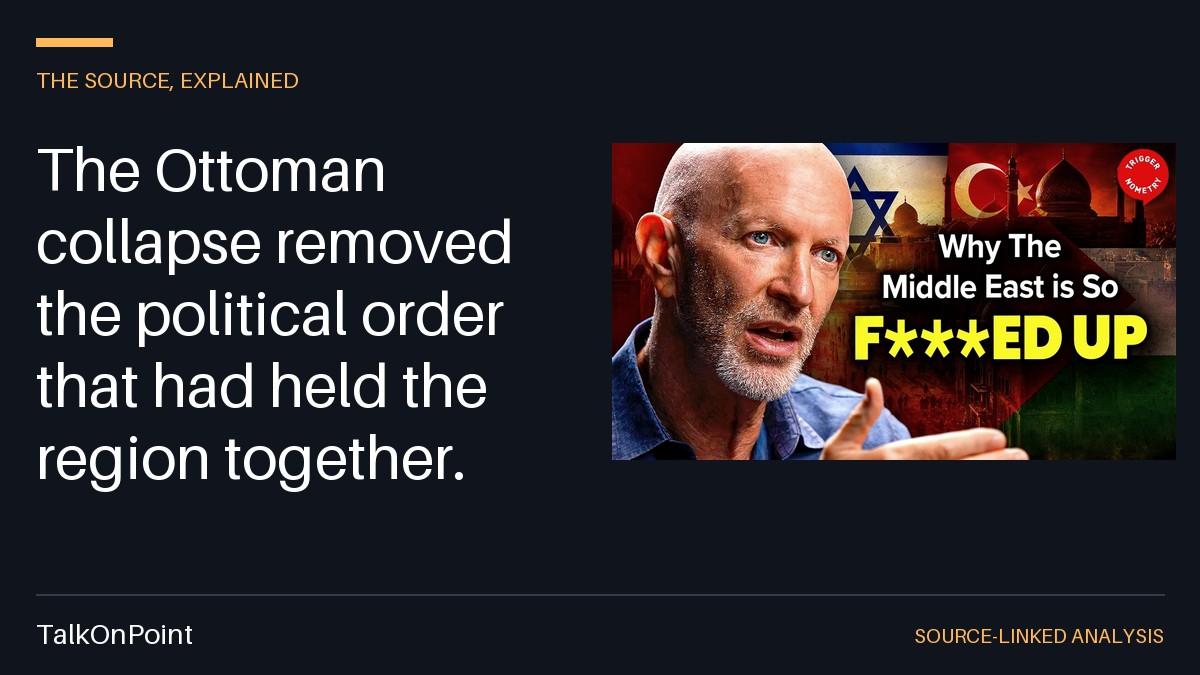
The Ottoman collapse removed the political order that had held the region together.
The collapse of the Ottoman Empire after World War I was not merely background to the modern Middle East. In the interview’s account, it was the foundation of the breakdown that followed: a large imperial order lost control over much of the region, leaving a political vacuum in which new arrangements had to be constructed.
That transition also challenges a popular image of the empire as simply tolerant. The source describes the late Ottoman state as harsh and authoritarian, and links it to the massacres of Armenians and other minorities. A more accurate account therefore has to hold two points together: Ottoman rule was an earlier framework for regional order, but it was not an uncomplicated model of coexistence.
After its collapse, the region did not move seamlessly into stable nation-states. Mandates, foreign decisions, competing national projects and imprecise borders helped determine what replaced the imperial system. The resulting states and conflicts were shaped by that transition rather than appearing from an ancient, unbroken political map.
That matters because historical memory often treats the Ottoman period either as a lost age of harmony or as irrelevant prehistory. The interview presents a harder conclusion: the empire’s collapse created the conditions for a new order, while the character of the old order limits any romantic explanation of what was lost.
Was the key turning point the end of Ottoman rule — or the choices made while replacing it?
How should the region’s modern conflicts be understood when both Ottoman repression and post-imperial disorder are part of the story?
https://t.co/EQZASUjN9o
#Triggernometry #MiddleEast #SimonSebagMontefiore
A claim about Roman identity depends on whose evidence is being used.
The continuity argument is powerful, but its evidence has to be handled carefully. Saying that the Eastern Roman Empire’s subjects called themselves Romans does not by itself prove that every person in the empire understood identity in exactly the same way.
The discussion makes this limitation explicit: attitudes drawn from part of the population cannot automatically be extended to everyone else. To understand how identity worked across the empire, historians need different kinds of materials and different assumptions. Elite statements, legal language, and official ideology may reveal how the state represented itself, but they may not capture every subject’s experience.
That distinction matters because the central claim links several propositions together. The Eastern empire is presented as the continuation of the Roman state; Roman identity is said to have persisted; and later labels such as “Byzantine” are treated as historiographical choices that can hide this continuity. Each step requires interpretation rather than simple repetition.
The result is not necessarily a rejection of the continuity thesis. It is a demand for precision. “They called themselves Romans” can describe a durable official, legal, or cultural identity without settling how uniformly that identity was felt across different communities, regions or social groups.
Good historical reasoning therefore separates what the sources directly show from what scholars infer from them. The Roman label may have remained central, while the meanings attached to it changed over time. That tension is part of the evidence—not a reason to ignore it.
What kinds of evidence would best distinguish an official Roman identity from how different communities actually understood themselves?
https://t.co/TDM5QDSXbD
#EasternRomanEmpire #RomanEmpire #LexFridman
When fraud is called persecution, accountability becomes the accused party.
The discussion presents a stark causal chain around Jason Arday: fraudulent claims and plagiarism were exposed; the resulting media attention was condemned by some as racist or hateful; after Arday took his own life, critics of the coverage were accused of causing his death. The speakers argue that this sequence can transform scrutiny into alleged persecution.
Their concern is not that media coverage is beyond criticism. Press intrusion and bad judgement can be debated. The narrower point is that exposing fabrication is not, by itself, evidence of racism or murder. If every damaging investigation is reclassified as violence, the public loses a language for distinguishing misconduct from prejudice.
The speakers also argue that a favoured figure can be turned into a symbolic victim. Once that happens, defending the person’s reputation may become more important than examining the underlying facts. Dissenters are then treated as morally suspect, and the group’s preferred narrative becomes difficult to challenge from within.
In the discussion, this alleged intolerance is linked to wider political disputes about immigration, welfare and citizenship. Those debates all involve questions of deservingness: who is believed, who receives protection and who is expected to answer for their conduct. The common danger is the same—replacing clear standards with loyalty to a narrative.
Accountability cannot prevent every tragedy, and the supplied discussion does not establish every link in the chain it describes. But it does identify a real political temptation: when criticism threatens a movement’s moral self-image, attacking the critic can seem easier than confronting the facts.
What standard should determine whether criticism is accountability or persecution?
https://t.co/bBvSDWhHYR
#Triggernometry #JasonArday #NathanKoffnas
Bradford was Brazier’s early warning about problems Britain later normalised.
Colin Brazier says his experience of Bradford gave him an “early warning” about Britain’s social direction. He describes the city as massively segregated and argues that the British state tolerated problems it should have confronted.
That experience anchors a broader chain of reasoning. Segregation can weaken everyday contact between groups. Institutional hesitation can then leave tensions unresolved. When public discussion becomes constrained, people may conclude that official language is more important than the underlying problem.
Brazier extends this criticism to the media. He argues that mainstream outlets have become more ideologically aligned and less connected to the concerns of their wider audiences. In his view, professional incentives can reward agreement with peers or elites rather than reporting that tests comfortable assumptions.
He also places class and identity inside the same picture. Changes in language, accent and social position can become markers of belonging. Someone attempting to move between classes may face suspicion, suggesting that Britain’s divisions are not only ethnic or political but also social and cultural.
Finally, Brazier links these tensions to demographic decline. Falling fertility, reluctance to have children and reliance on immigration raise questions about continuity and shared obligation. His conclusion is conditional: unless Britain addresses segregation, institutional trust, class barriers and family formation together, instability may deepen.
The alternative possibilities matter. Better integration, more responsive media and policies that reduce pressure on families could weaken his forecast. The warning is therefore less a prediction than a demand to examine the connections.
Which matters most for social cohesion: integration, media trust, class mobility or family policy?
https://t.co/Xpn4YSD6Kz
#Triggernometry #ColinBrazier #Bradford
Khabib’s lesson begins before the first exchange: pressure must be cultivated.
The meeting between Lex Fridman and Khabib Nurmagomedov quickly becomes more than an introduction. Lex is welcomed by Khabib’s team, then placed in a training environment where the central lesson is experienced rather than explained: sustained grappling pressure changes both the body’s energy and the mind’s willingness to continue.
The source frames Khabib’s approach through continuous work with high-level partners. A grappler who can keep applying pressure denies the opponent an easy pause. Each moment demands another defensive decision, another effort to recover position and another attempt to avoid being worn down.
That creates a feedback loop. Partners capable of resisting force the attacker to refine control, timing and endurance. The pressure then becomes more difficult to escape, not because technique disappears, but because technique is connected to an unusually persistent effort. Lex’s account supplies the experiential side of that mechanism: he does not describe a single spectacular move so much as the cumulative effect of being unable to make the pressure stop.
This is why the training matters as a window into elite performance. Khabib’s style is presented as a system in which physical dominance and psychological strain reinforce each other. The opponent is not merely defending against positions; they are also resisting the temptation to quit when every exchange feels costly.
Can a fighter develop that kind of mental stamina without first training under sustained pressure?
Is relentless pressure primarily a technique, a conditioning method, or the result of both being trained together?
https://t.co/0zJ0bMSpLS
#KhabibNurmagomedov #LexFridman
Houser’s creative process sounds less like magic than sequencing.
The analysis of Dan Houser’s approach points to a chain: ambition needs constraints, constraints force creative choices, clear choices shape characters and worlds, and those worlds create immersion. That matters because open-world games can become large without feeling focused. Houser’s model suggests scale works best when the pieces reinforce each other. Story, character, systems, sensory detail, and team standards are not separate in the final experience. They become linked causes. Weaken one, and the world may still impress, but feel less alive.
Is immersion mainly a writing achievement, a design achievement, or both?
https://t.co/ZWy8HYUZ7N
#LexFridman #KeyEntitiesDanHouser #Podcasts #Technology #Gaming #Leadership
The farm turns Harry Jowsey’s selfie joke into a test of unfamiliarity.
The joke about manual labor and selfies works because it identifies the difference the episode wants to explore: one person is comfortable performing a public image, while the other is asking him to do work that cannot be completed through appearance alone.
The farm removes the usual distance between celebrity and audience. Instead of discussing effort abstractly, Harry is confronted with stalls, animals, tools and the physical demands of the setting. His reactions become part of the comic structure because the environment keeps producing problems he cannot solve through charm or presentation.
That discomfort can create the feeling of spontaneity. The source frames the banter, clumsiness and exaggerated threats as mechanisms for producing tension and release. A task becomes a setup; a confused reaction becomes a punchline; a moment of vulnerability gives the conversation somewhere to go.
But the format rests on an important assumption: that the contrast itself will read as funny rather than simply unfamiliar. The humor is also shaped by the relationship between host and guest. Aggressive teasing can function as bonding when both participants treat it as play, yet the same tone may not travel equally well beyond that rapport.
The episode’s structure is therefore more precise than “celebrity visits a farm.” It uses labor to interrupt performance, then uses banter to make the interruption entertaining. The payoff is not just that Harry looks out of place; it is that the setting keeps forcing an ordinary, physical response from someone known primarily through a public persona.
That makes the selfie line a compact explanation of the whole concept: the episode pits presentation against participation. How much of the humor comes from the rural-urban contrast, and how much comes from Matt and Harry’s particular chemistry?
Is the farm itself the joke, or does the chemistry make the contrast work?
https://t.co/n2UhWxK2Gi
#MattMathews #HarryJowseyGaveMe #FarmChoresWithMatt
Greenblatt’s recursive-improvement scenario depends on three linked steps.
Greenblatt describes recursive self-improvement as a chain of conditions rather than a sudden jump to superintelligence.
First, AI research must become sufficiently verifiable. Progress can be checked through learning metrics, concrete experiments, or improvements to smaller models. That gives an AI system a way to test whether its research actually worked.
Second, an advanced model must be able to conduct that research and build new AI systems that substantially improve their predecessors. If each generation can make the next generation more effective, the rate of progress could rise sharply—potentially compressing years of work into one year.
Third, the resulting systems would need to generalize beyond narrow research tasks. Greenblatt’s endpoint is models that can outperform human experts at real work across fields, including engineering, politics and event planning.
The structure matters because weakness at any stage changes the forecast. A system might measure experiments well but fail to generate useful improvements, or improve narrow models without transferring those gains to messy real-world tasks. Greenblatt estimates full AI R&D automation around 2030–2031 and superintelligent capability a few years after that, but the pathway remains conditional.
Which of the three links—verification, improvement, or broad transfer—is most likely to fail?
https://t.co/MoHfChV2PP
#DwarkeshPatel #RyanGreenblatt
Amodei’s plan is to pace frontier AI, not permanently stop it.
Dario Amodei’s proposal is not a permanent halt to frontier AI development. He describes “pacing” the technology: slowing capability releases while building systems that can evaluate what companies are developing and coordinate when powerful models should be released.
The first element is embedded evaluators. Amodei compares them to independent supervisors placed inside banks, where they can observe daily practices rather than rely only on occasional external assurances. Applied to AI companies, the idea would give evaluators meaningful internal access to assess risks continuously.
The second element is democratic coordination. Amodei says governments should help companies discuss safety and release timing lawfully, without antitrust or collusion problems. The longer-term ambition is coordination among democratic countries and, eventually, globally. He also acknowledges that each step becomes harder and that global coordination may fail.
Amodei cites early support from figures including Sam Altman, Elon Musk, legislators, and officials, but stresses that support matters only if it produces concrete results.
The tradeoff is explicit. Moving too quickly could allow powerful systems to outpace safeguards. Moving too slowly, Amodei argues, could leave control to less responsible actors. His proposal therefore treats speed as a governance problem, not merely a technical one.
What authority and access would embedded evaluators need to make pacing credible?
https://t.co/65Ii608Mo6
#CNN #AnthropicCEO