An e-commerce company automated one question: "where's my order?"
That single question was 40% of their call volume.
AI handled it. Anything complicated got transferred to a human, with full context already attached.
That's the whole system.
The shocking part?
She never asked for "AI automation."
She asked: "Can you make my phone stop buzzing at 1 AM?"
Sell the sleep. Not the software.
Follow if you want more unfairly simple systems. 🎯
I made $3,200 last month from one Google Sheet and a ChatGPT tab I forgot to close.
No website. No team. No "agency."
Here's the illegal-feeling business model anyone can steal:
I found a local realtor getting 40+ DMs daily, replying manually at midnight like a zombie.
Built a 3-step auto-reply in 90 minutes:
→ Qualifies budget
→ Books her calendar
→ Sends summary to her phone
She sleeps now. I get paid monthly.
Someone who's deployed voice AI for 100+ companies says 90% of implementations fail.
Not because of the AI.
Because businesses try to automate the whole workflow instead of just the first, boring, repetitive step.
Automate the easy 40%. Hand the rest to a human.
An agency owner says AI cut brief creation from 4 hrs to 45 minutes.
6 hrs saved per client monthly. 40% more clients, no new hires. $180K added revenue.
Self-reported, not audited — but it's the most specific "AI ROI" claim I've found this week.
One freelancer's path from AI side gigs to a real business:
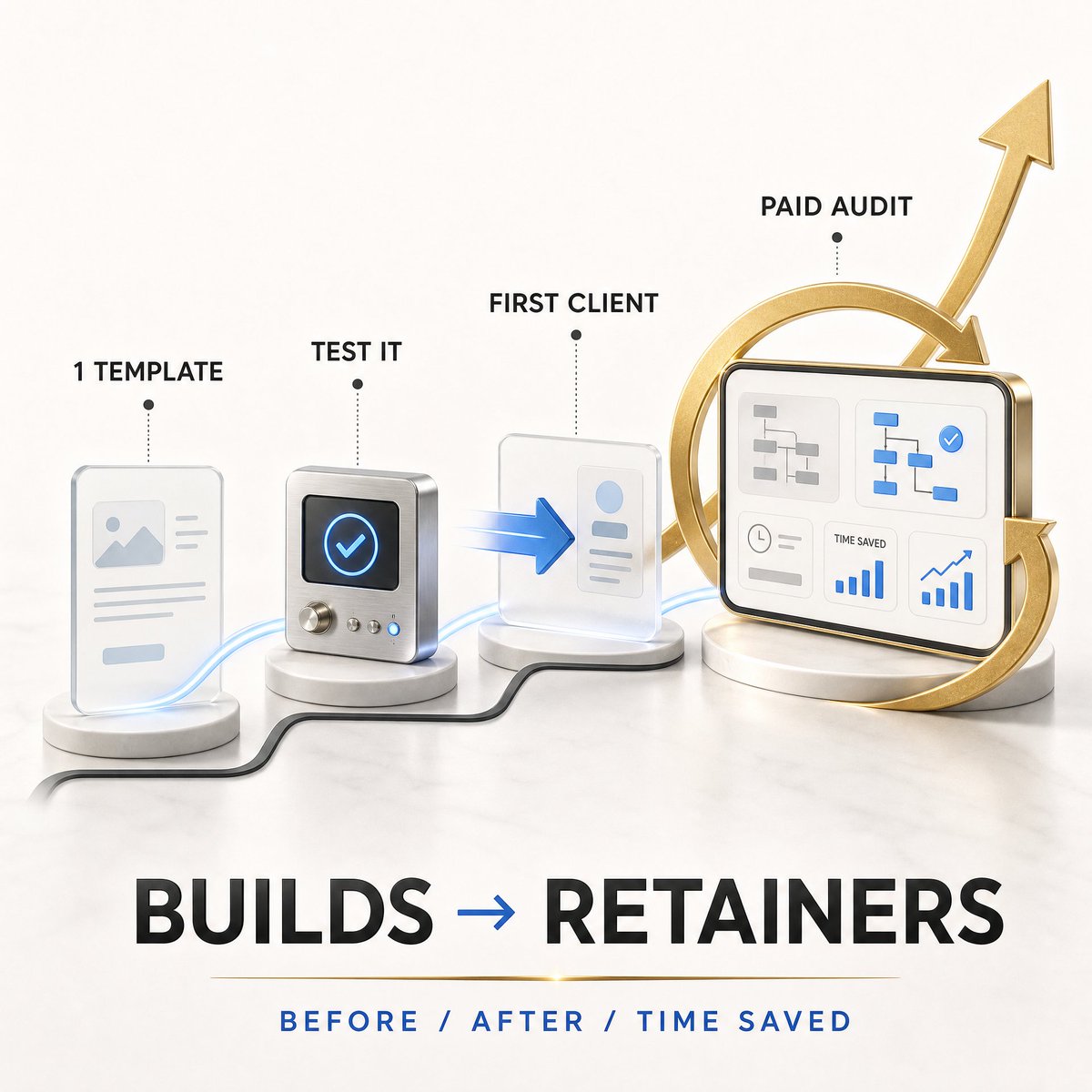
1 template → tested himself → cold outreach → first client.
The real shift: he added paid audits — map the workflow, measure time saved, show before/after.
That's what turned builds into retainers.
Three outcomes. One pattern.
The ones who lost money built a product first and looked for buyers after.
The ones who made money fixed something measurable that already existed.
Pick one business. Pick one workflow wasting their time. Measure it before and after.
A third person split the difference.
One automation template. Tested it, broke it, fixed it. Cold outreach. One small client.
Then he added a paid audit before every build: map the workflow, measure the time it actually takes, show before and after in numbers.
40% more client capacity. No new hires.
$180,000 in added revenue that year.
Self-reported, not audited — but it's one of the sharpest "AI actually worked" numbers I've found.
Notice the difference: this wasn't a product. It was a workflow fix.
Compare that to an agency owner in a completely different thread.
No startup. No 18 months. Just AI applied to existing client work.
Client brief creation: 4 hours down to 45 minutes.
6 hours saved per client, every month, on reporting alone.
His real conclusion: nobody wants "AI copywriting."
They want more sales.
A generic AI wrapper is impossible to differentiate from someone just opening ChatGPT themselves.
The opportunity was never the tool. It was a specific industry with an expensive problem.
His first mistake: he asked people if they'd pay for it.
Not asked them to pay.
14 months building. 4 months trying to sell it. $8,000 in marketing spend.
CAC: $650. Revenue per customer: $28.
The math never had a chance.
He spent $47,000 and 18 months building an AI copywriting startup.
Result: 73 users. 12 paying customers. $340 in revenue.
Not $340,000. $340.
Here's what went wrong — and what two other people did instead.
An agency owner says AI cut brief creation from 4 hrs to 45 minutes.
6 hrs saved per client monthly. 40% more clients, no new hires. $180K added revenue.
Self-reported, not audited — but it's the most specific "AI ROI" claim I've found this week.
He spent $47,000 and 18 months building an AI copywriting startup.
Result: 73 users. 12 paying customers. $340 in revenue.
His first mistake: he asked people if they'd pay. Not asked them to pay.
Nobody wants "AI copywriting." They want more sales.
Claude, ChatGPT, Gemini — they're all hammers.
Your job isn't to collect hammers. It's to find nails.
The nail is usually: "We're losing money because we don't have staff to handle X."
Find X. Charge to fix it.
The tool is the last 10% of the sale.
98% of businesses use AI in CX. Only 15% connect it across departments to solve problems end-to-end. That gap means paying for AI while still paying for unresolved tickets. Your opening: build one workflow that connects the handoffs.**