Gone are the days when Low Level System Design interviews were about writing a couple of classes and passing basic OOP checks.
If you could draw a few UML diagrams, apply Singleton or Factory pattern you passed.
Today LLD interviews expect you to design systems extensibility, correctness, and real-world constraints in mind, such as:
1. In-memory cache with eviction policies, and concurrency guarantees
2. Search autocomplete system with indexing, ranking, and updates
3. Ride-sharing system with driver matching, location updates, and concurrency
4. Bidding system with concurrent bids and ordering guarantees
5. Shopping cart with inventory consistency and idempotency
6. Splitwise-like expense system with settlement and concurrent updates
7. Rate limiter with sliding window, token bucket, and thread safety
8. Subscription billing system with plans and retries
9. Notification dispatcher with ordering
10. Message queue with producers, consumers.
LLD today is less about patterns on paper
and more about designing code that won’t break at scale and under change.
CANCEL your weekend plans.
You NEED to:
• Build a RAG system that cites sources with page numbers
• Implement hybrid search (dense + sparse) for better retrieval
• Add reranking with cross-encoders for top-10 accuracy
• Set up chunking strategies (500 tokens, 50 overlap minimum)
• Build query expansion for better recall
• Add metadata filtering for scoped retrieval
• Implement citation grounding to prevent hallucinations
• Create an eval harness with 50+ golden test cases
• Track retrieval metrics: hit rate, MRR, NDCG
• Add fallback to web search when confidence is low
• Build query rewriting for ambiguous questions
• Implement parent document retrieval for context
• Add embedding caching to reduce latency 80%
• Use colbert or late interaction for better accuracy
• Build a RAG dashboard showing retrieval quality
• Test with adversarial queries that should return nothing
• Document your chunking strategy and why it works
• Benchmark against naive RAG and show improvement
You have way too much to do.
Bookmark & Repost.
@tarak9999@AdiviSesh@mrunal0801@anuragkashyap72@AnnapurnaStdios chese movies anni elagu half baked ye kada Anna....atleast fast ga aina teesi maa mohana kottu....entha lazy endi anna.... movie poina perledu acting scope vunnai chei...Pan India pichi nundi bayataki raa Anna
Sliding Window looks simple... until you're in the interview.
It's one of the favourite topics of tech interviewers.
Why? Because it tests your ability to:
→ Identify the right pattern quickly
→ Know when to shrink the window
→ Understand where to update your answer
The confusion is real:
• Shrink while VALID or INVALID?
• Update INSIDE or AFTER the loop?
• Monotonic Increasing or Decreasing?
Let me simplify all 6 Patterns for you:
Pattern 1: Fixed Size Window
↳ Size K is given in the problem
↳ Build first window, then slide: +new, −old
↳ LC 239, 643, 1456
Pattern 2: Variable MAX (Longest)
↳ Find maximum length subarray
↳ Shrink while INVALID
↳ Update answer AFTER while loop
↳ LC 3, 424, 1004
Pattern 3: Variable MIN (Shortest)
↳ Find minimum length subarray
↳ Shrink while VALID
↳ Update answer INSIDE while loop
↳ LC 76, 209, 862
Pattern 4: HashMap (Anagram)
↳ Permutation / Anagram matching
↳ Track need & window maps
↳ valid++ when window[c] == need[c]
↳ LC 567, 438, 76
Pattern 5: Exactly K Trick
↳ exactly(K) = atMost(K) − atMost(K−1)
↳ Count subarrays: right − left + 1
↳ LC 992, 1248, 930
Pattern 6: Monotonic Deque / Stack
↳ Need MAX in window → Decreasing deque
↳ Need MIN in window → Increasing deque
↳ Always store indices, not values
↳ LC 239, 84, 42, 739
Quick Pattern Recognition:
"Window size K" → Fixed
"Find longest" → Variable MAX
"Find shortest" → Variable MIN
"Anagram / Permutation" → HashMap
"Exactly K distinct" → Subtraction Trick
"Max/Min in window" → Monotonic Deque
LeetCode is HARD until you learn these 20 patterns:
1.Two Pointers
2.Sliding Window
3.Dynamic Programming
4.Prefix Sum
5.Depth-First Search (DFS)
6.Breadth-First Search (BFS)
7.Binary Search
8.Backtracking
9.Monotonic Stack
10.Matrix Traversal
11. Fast & Slow Pointers
12. Top ‘K�� Elements (Heap)
13.Overlapping Intervals
14.Binary Tree Traversal
15.Union Find (Disjoint Set)
16.Greedy Algorithms
17.Linked List In-place Reversal
18.Modified Binary Search
19.Bit Manipulation
20.Trie (Prefix Tree)
Bookmark or repost it future use
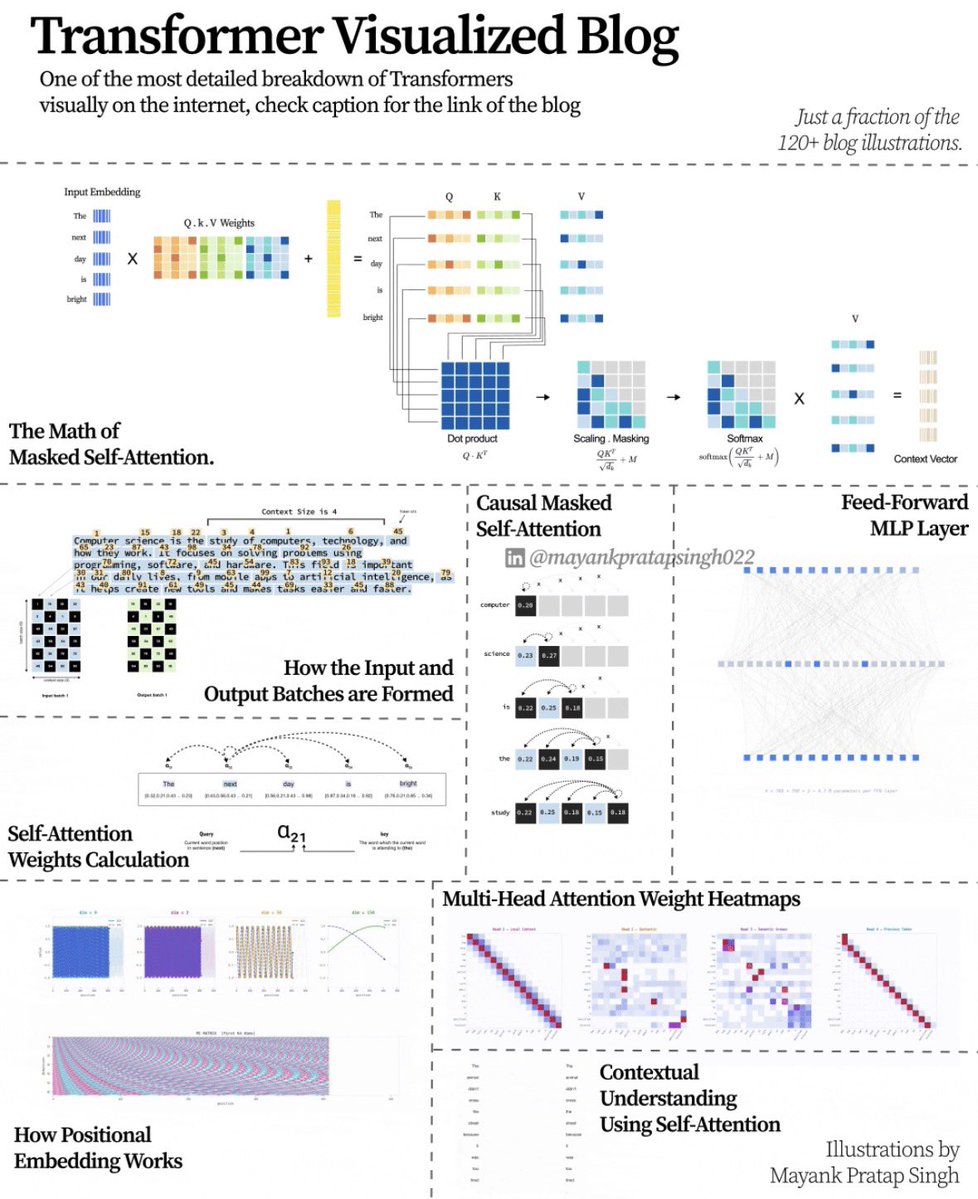
TRANSFORMER ARCHITECTURE IN LLMs
Large Language Models such as GPT, LLaMA, and PaLM are powered by a neural network design known as the Transformer Architecture.
WHAT IS A TRANSFORMER?
→ A Transformer is a deep learning architecture designed for sequence processing
→ It analyzes relationships between words in a sentence simultaneously
→ Unlike older models, it processes all tokens in parallel
This enables:
→ Faster training
→ Better contextual understanding
→ Scalability to billions of parameters
WHY TRANSFORMERS REVOLUTIONIZED AI
Before Transformers, models relied on:
→ Recurrent Neural Networks (RNNs)
→ Long Short-Term Memory networks (LSTMs)
These had limitations:
→ Slow sequential processing
→ Difficulty handling long-range dependencies
Transformers solved these issues using attention mechanisms.
CORE COMPONENTS OF TRANSFORMER ARCHITECTURE
1) TOKEN EMBEDDINGS
→ Text is first broken into tokens
→ Tokens are converted into numerical vectors called embeddings
→ These vectors capture semantic meaning
Example:
→ "cat" and "kitten" produce similar vectors
→ "car" and "engine" also have related embeddings
2) POSITIONAL ENCODING
Transformers process tokens in parallel, so they need positional information.
→ Positional encoding adds information about word order
→ Helps the model understand sentence structure
Example:
→ "Dog bites man"
→ "Man bites dog"
Word order changes meaning, and positional encoding helps capture this.
3) SELF-ATTENTION MECHANISM
Self-attention is the core innovation of the Transformer.
→ Each token looks at every other token
→ The model calculates how important each word is to another
Example sentence:
"The animal didn't cross the street because it was tired."
The model learns that "it" refers to "animal", not "street".
4) QUERY, KEY, AND VALUE MATRICES
Self-attention works using three vectors:
→ Query (Q) – What the word is asking about
→ Key (K) – What the word represents
→ Value (V) – The information carried by the word
Attention scores determine which words influence others.
5) MULTI-HEAD ATTENTION
Instead of one attention mechanism, Transformers use multiple attention heads.
This allows the model to capture different relationships simultaneously.
Example:
→ One head learns grammar
→ Another learns semantic meaning
→ Another captures long-distance relationships
6) FEED-FORWARD NEURAL NETWORK
After attention, each token passes through a feed-forward neural network.
This layer:
→ Applies nonlinear transformations
→ Learns deeper feature combinations
→ Refines token representations
7) LAYER NORMALIZATION AND RESIDUAL CONNECTIONS
These help stabilize deep networks.
→ Residual connections allow gradients to flow better
→ Layer normalization stabilizes training
Together they enable very deep Transformer models.
TRANSFORMER LAYER STACKING
LLMs stack dozens or even hundreds of Transformer layers.
Example:
→ GPT-3 has 96 Transformer layers
→ Each layer refines contextual understanding
Process flow:
→ Tokens → Embeddings → Attention → Feedforward → Next Layer → Output
OUTPUT GENERATION
At the final layer:
→ The model predicts the probability of the next token
→ The highest probability token is selected
→ The process repeats to generate text
This is how LLMs produce coherent responses.
WHY TRANSFORMERS ARE IDEAL FOR LLMs
Transformers enable:
→ Long-context understanding
→ Parallel computation
→ Massive scalability
→ High-quality text generation
They are now the backbone of:
→ ChatGPT-style assistants
→ AI coding tools
→ Document summarization systems
→ AI search engines
QUICK NOTE
Understanding Transformer architecture is essential for anyone building modern AI systems and LLM-powered applications.
Grab the LLM ENGINEERING HANDBOOK:
https://t.co/ljEMt0UNUI
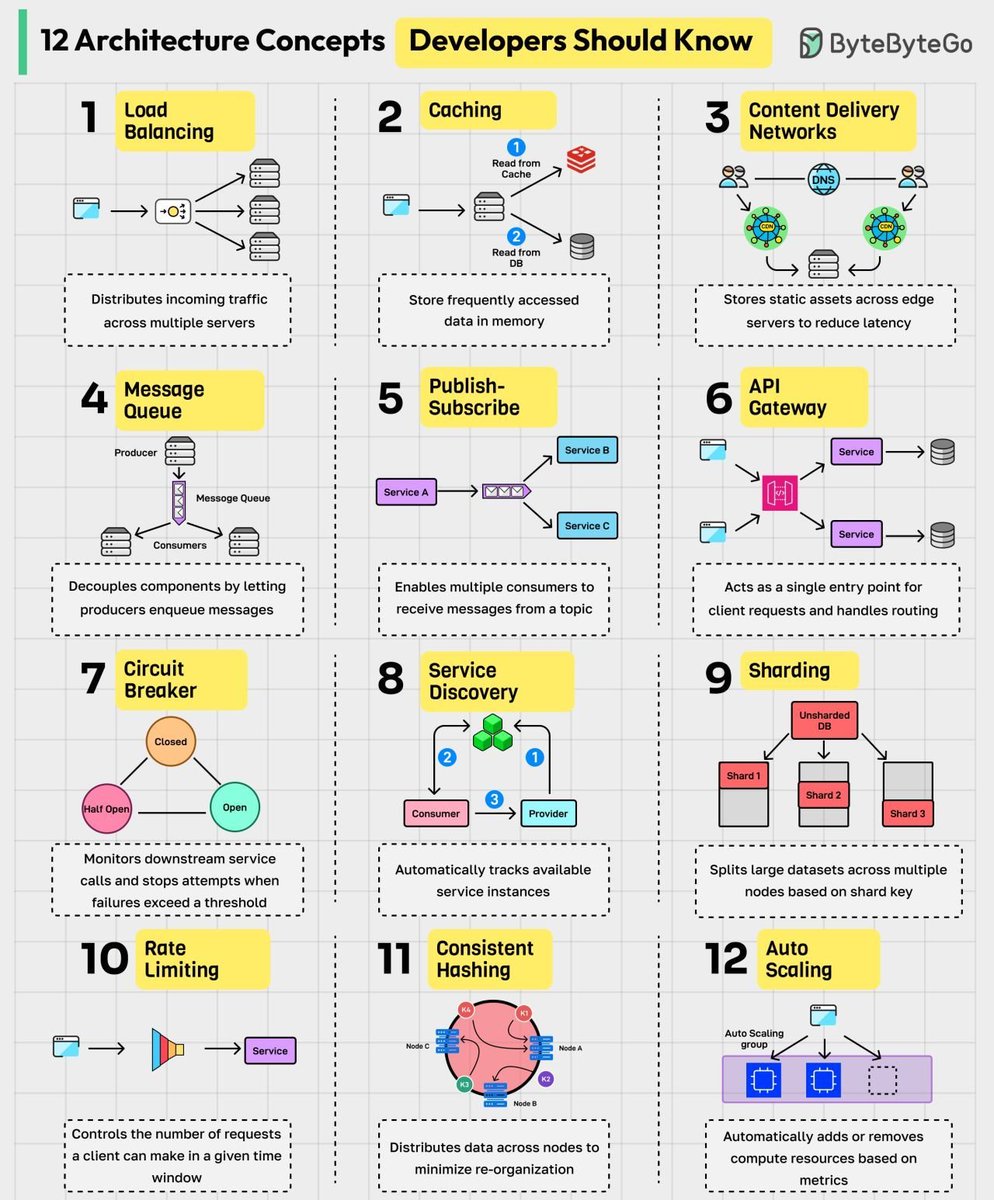
12 Architectural Concepts Every DevOps / Developer Should Know.
If you want to build scalable and reliable systems, these concepts are fundamental:
1. Load Balancing
- Distributes incoming traffic across multiple servers so no single node gets overloaded.
2. Caching
- Stores frequently accessed data in memory to reduce latency and database load.
3. CDN (Content Delivery Network)
- Serves static content from geographically distributed edge servers closer to users.
4. Message Queue
- Decouples services by letting producers send messages that consumers process asynchronously.
5. Publish–Subscribe
- Allows multiple consumers to receive messages from the same topic.
6. API Gateway
- A single entry point for client requests handling routing, authentication, and rate limiting.
7. Circuit Breaker
- Stops repeated calls to failing services to prevent cascading failures.
8. Service Discovery
- Automatically tracks service instances so components can find and communicate with each other.
9. Sharding
- Splits large datasets across multiple databases using a shard key.
10. Rate Limiting
- Controls how many requests a client can make in a given time window.
11. Consistent Hashing
- Distributes data across nodes while minimizing reshuffling when nodes change.
12. Auto Scaling
- Automatically adds or removes resources based on traffic or metrics.
Which architectural concept would you add to this list ? 👇
One of the most asked System Design Interview Question:
Design a Rate Limiter for a high-traffic API service (think Twitter/Netflix scale).
Requirements:
1. Limit requests per user (e.g., 100 requests/min).
2. Limit requests globally (e.g., 1M requests/sec across all users).
3. Should work in a distributed environment (multiple servers).
4. Must ensure fairness (no single user should starve others).
5. Handle burst traffic gracefully.
What Interviewers look for:
Which algorithm would you choose? (Token Bucket, Leaky Bucket, Fixed Window, Sliding Window) and why.
How will you store counters? (In-memory, Redis, DB) considering consistency vs performance.
How to ensure accuracy in sliding windows without degrading performance?
How to prevent race conditions when multiple servers check/update limits concurrently?
What will you do if the rate limiter itself becomes a bottleneck?
How do you gracefully degrade service when limit is reached (429, queue, drop)?
Follow-ups asked:
What if limits are dynamic (different tiers of users: free vs premium)?
How to handle multi-region deployments?
Can you design it as a reusable library/service used by multiple teams?
Python automation is one of the fastest ways to become hireable.
Why?
Because companies don’t pay for syntax.
They pay to save time.
That’s exactly what automation does.
Most beginners learn Python like this ❌
• loops
• functions
• random exercises
• tutorial projects
Useful? yes.
Hireable? not enough.
Python gets more valuable when it starts doing work for you.
Think automation like this 👇
• Rename hundreds of files in seconds
• Clean messy CSVs automatically
• Send reports without manual effort
• Scrape data from websites
• Process Excel sheets faster
• Organize folders and backups
• Schedule repetitive tasks
Now you’re not just “learning Python”
You’re solving business problems.
That’s what makes automation powerful for jobs.
Because it shows you can:
• reduce manual work
• improve workflows
• think in systems
• build practical tools
And that stands out way more than
another calculator project.
If I were building a Python portfolio today,
I’d make automation projects first.
Why?
Because they are:
• practical
• easy to explain
• useful to companies
• great for freelancing too
Python automation = real-world value.
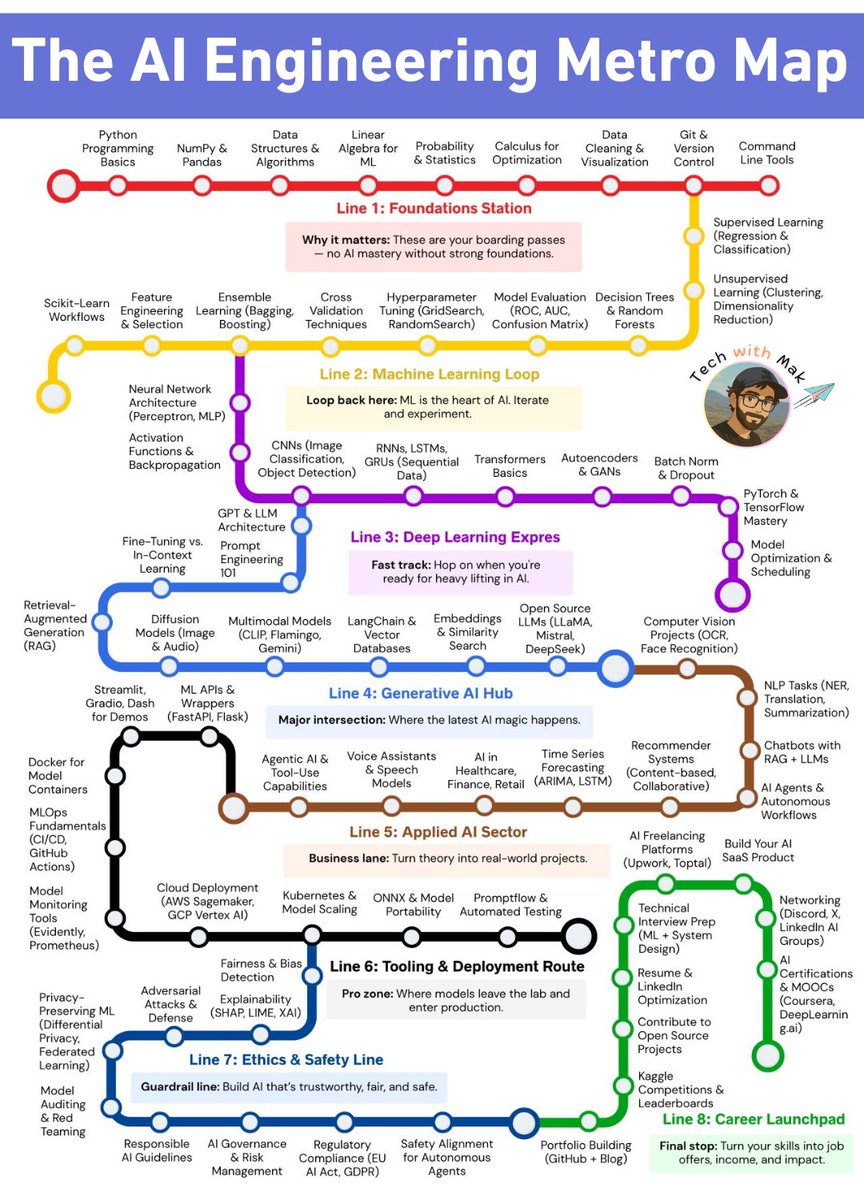
Most people try to learn AI randomly.
I mapped the entire AI engineering journey into a metro system.
The problem with most AI roadmaps:
They're linear. Step 1, Step 2, Step 3. As if everyone starts at the same place and wants the same destination.
But AI engineering isn't linear. It's a network.
→ A software engineer skips Python basics, jumps straight to LangChain
→ A data analyst already knows Pandas, needs Transformers next
→ A product manager wants RAG and Agentic AI, not CNNs
→ A researcher needs Ethics & Safety before deployment
A metro map captures this reality.
Generative AI Hub (Line 4) connects to:
→ Machine Learning Loop (you need Transformers first)
→ Applied AI Sector (where RAG becomes chatbots)
→ Tooling & Deployment (where demos become products)
Career Launchpad (Line 8) connects to:
→ Every other line (skills from any track convert to job offers)
Ethics & Safety (Line 7) connects to:
→ Deployment (you can't ship without guardrails)
→ Applied AI (real-world projects need fairness and privacy)
The 8 lines:
🟠 Foundations - Python, Math, Git (boarding passes)
🔵 Machine Learning - Neural Nets, CNNs, Transformers (the heart)
🟡 Deep Learning Express - LLMs, Fine-Tuning, PyTorch (fast track)
🟢 Generative AI Hub - RAG, Diffusion, LangChain (the magic)
🩷 Applied AI - Agentic AI, Healthcare, Chatbots (real projects)
🟣 Tooling & Deployment - Cloud, Kubernetes, MLOps (production)
🔴 Ethics & Safety - Bias, Privacy, Governance (guardrails)
🟢 Career Launchpad - Portfolio, Interviews, Networking (job offers)
You don't take every line. You don't visit every stop.
Find where you are. Pick your destination. Transfer as needed.
Bookmark this. Start today.
just read a reddit post and a youtube breakdown of the Anthropic SWE interview loop
never felt more dumb in my life.
apparently you need to casually:
- implement LRU cache with concurrency
- build a web crawler
- design LLM inference infra, KV cache management
- reconstruct profiler traces from sampling profiler
AI companies are interviewing like this now.