Our journey to track end-to-end data covering the entire supply chain – from chip fabrication to devices to the end consumer gets even more exciting as we acquire Display Supply Chain Consultants (DSCC), the leader in advanced display market research
We are thrilled to announce we have acquired Display Supply Chain Consultants (DSCC). They are now part of the Counterpoint Research family!
Very excited to work alongside @DisplaySupply's leaders @DSCCRoss, Yoshio Tamura, @DSCCBob, their seasoned analysts and the rest of the team that makes DSCC so special.
Many of you already know them as the leading provider of data, insights and analysis for the display industry. Their team of veteran analysts and supply chain data coupled with our end-to-end industry coverage will enhance the depth and breadth of our supply chain research.
Thank you to all our clients, industry colleagues and friends, and of course our families who have made this possible – and to everyone else who have been following us on this journey for the past decade.
Can’t wait to see what the next one holds!
@mobilekang@neiltwitz@MobilePeter
https://t.co/BtZiAUTxjM
#supplychain #displays #research #innovation #OLED #automotive #consumerelectronics #xr #ar #vr #insights
A lot is happening behind the scenes in the smartphone industry.
From the rise of AI to shifts in the global supply chain, the landscape is evolving faster than ever.
Sharing a few thoughts from our discussion on the trends shaping what's next.
Smartphone prices are rising. But what's really driving it?
From AI-driven memory demand and rising component costs to changing consumer behaviour, industry experts break down the forces reshaping the smartphone market and what it means for the future of pricing.
Featuring:
• @FrancisRealme: Head of Porduct Marketing, realme Global.
• @Tarunpathak: Reserach Director, Device & ecosystems, Counterpoint Research.
• @upasanaj_IDC: Senior Research Manager, IDC.
• Devinder Maheshwari: Founder, @beebomco.
• @fainalysis: Chief Analyst, Techarc.
• @DanishKh4n: Editor, Consumer tech & Telecom, @moneycontrolcom.
@CounterPointTR@IDC@techarcinsights
Watch the full conversation.
𝐀𝐩𝐩𝐥𝐞'𝐬 𝐍𝐞𝐰 𝐒𝐢𝐫𝐢 𝐄𝐱𝐩𝐞𝐫𝐢𝐞𝐧𝐜𝐞 𝐢𝐬 𝐭𝐡𝐞 𝐌𝐚𝐣𝐨𝐫 𝐇𝐢𝐠𝐡𝐥𝐢𝐠𝐡𝐭 𝐟𝐫𝐨𝐦 𝐖𝐖𝐃𝐂𝟐𝟔
For two years, Siri updates have been stagnant. This year, Siri gets a much-needed boost from a more responsive and integrated Apple Intelligence.
𝐊𝐞𝐲 𝐟𝐞𝐚𝐭𝐮𝐫𝐞𝐬:
• Siri can now draw on multimodal user data, i.e., searching through voicemails, texts, and emails for answers.
• Siri also works across devices more efficiently: users can begin on one @Apple device and finish on another.
• On-screen awareness is used to ask Siri about images and give immediate feedback on details.
𝐑𝐞𝐚𝐝 𝐭𝐡𝐞 𝐟𝐮𝐥𝐥 𝐧𝐨𝐭𝐞 𝐭𝐨 𝐥𝐞𝐚𝐫𝐧 𝐦𝐨𝐫𝐞:
https://t.co/gUbTS045yh
#Apple #WWDC26 #iOS27 #SiriAI #AppleIntelligence #AI
How important is India for Starlink's global expansion plans?
Neil Shah, Co-Founder & VP Research, Counterpoint Research shares insights with @VikramOza in The Bottom Line.
As you can see from the above, @Apple is leveraging the FFN expert in NAND FLash as well.
This hybrid approach optimizes Apple Intelligence for memory-constraint devices or might not need loads of DRAM in future.
If the query is too complex will be pushed to AFM server-based models for private cloud computations.
#WWDC #WWDC26
$SNDK $MU $TSM $AAPL $GOOG
The best part of @Apple vertical hybrid AI AFM strategy is to make sure these models leverage:
✅Personal Context
✅Privacy
✅Optimisations for on-device AI (Apple Silicon + smaller footprint Memory)
✅ World Knowledge (as much as possible on device)
Apple has achieved following On‑Device architectural breakthroughs
✨Breaks DRAM limits using sparse expert routing per prompt //This is huge//
✨ Mix of always‑active shared experts + routed experts
✨Elastic inference: activates 1–4B parameters depending on task
✨ Enables large‑model behavior on consumer hardware
#WWDC #WWDC26
$AAPL $TSM $GOOG
Great insights from my colleague @mobilekang on @nvidia Jensen and crew Korea tour.
👉🏻Jensen’s Korea Tour - Securing AI Coalition & Chips over 🐓Chicken and 🍻Beer (Chimaek)
Jensen Huang is traveling through Korea making much fanfare on his four day trip which started June 5th. He is holding back-to-back meetings with the heads of major conglomerates over chicken and beer, the pairing called Chi-maek in Korea. This is right after Computex, Taipei so this signals the significance of Korea to Nvidia’s future strategy alongside Taiwan.
This trip was both a trip to secure supply and accelerate demand for the next wave of AI.
🌩️Hyperscalers: Dinner with the heads of LG, SK and Naver.
🎮Gaming: PC café visit with Chairmen of NCsoft and Krafton, Korea’s top gaming companies.
🤖Industrial Robots & Automation: First pitch at baseball game with Doosan group chairman alongside individual sessions with Hyundai Motor Group.
✨Memory Supply & more: Separate meetings SK Hynix to Samsung Electronics
Most important priorities and drivers for this visit thus far:
🎯 Supply Side: Securing Memory (HBM) for Next Generation NVIDIA AI Factories Infrastructure:
✨The keys to memory lies with Korea to break the “memory wall”.
✅ During Computex 2026 Jensen wrote "PLEASE MAKE MORE" on a wafer in front of SK group Chairman Chey revealing his desire to source more. Nvidia is taking this opportunity to deepen its ties with Korea.

✅ With Vera Rubin ramping, HBM4 supply from @SKhynix and @Samsung alongside growing DRAM content for the Vera CPUs in Agentic Era is going to be the key choke points for NVIDIA's revenue.
✳️ According to @CounterPointTR Memory Tracker SK Hynix controls 57% of the global HBM market and Samsung aims to take some share away with HBM4 wins at NVIDIA.
✅ However, the bit and packaging remain the bottleneck. NVIDIA needs to guarantee priority allocation for upcoming HBM4 and HBM4E nodes, where design integration moves from traditional memory interfaces to advanced foundry base dies. This trip also gives Jensen, key insight into progress of Samsung’s HBM qualification status.
🎯 Demand Side: Physical AI & Sovereign AI are the key next markets with Korea a great case study for NVIDIA
✅ Physical AI is also an important reason for Jensen’s visit to Korea. Hyundai's robotics center, Doosan's humanoids, Boston Dynamics' Atlas hint that NVIDIA is considering Korea as a manufacturing-and-robotics proving ground. Korea's combination of heavy industry, automotive scale, and robotics gives it a unique angle that the US and Taiwan lack.
✅For NVIDIA, owning the software/simulation layer (Omniverse, foundation models) of the emerging humanoid industry is a strategic land-grab beyond GPUs for AI LLMs.
✅Jensen told media that “Robotics is going to be the next major sector here in Korea — this is a great opportunity for Korea to invest in AI.”
✅ @DoosanRobotics and NVIDIA have been expanding cooperation since declaring a strategic physical-AI partnership in October last year. Doosan is using NVIDIA's physical AI models on its construction, power, and robotics data.
✅ @Hyundai_Global and NVIDIA signed an MOU to advance domestic physical AI capabilities and agreed to invest $3 billion to establish an NVIDIA AI Technology Center and a Hyundai Motor Group Physical AI Application Center in Korea.
✅ Meetings with @NAVER_AI_Lab focus on securing localized LLMs optimized for East Asian enterprises. By supporting Naver, NVIDIA ensures high-margin infrastructure demand from regional enterprises that prefer domestic and sovereign cloud providers over US hyperscalers due to regulatory and data compliance mandates.
$NVDA $TSM
Key Takeaways - #WWDC26
✅️While WWDC 2025 was defined by Liquid Glass, 2026 is all about Apple Intelligence + Siri AI
✅️With the dedicated app for Siri and a commitment to visual intelligence, Apple could vastly elevate the entire user experience
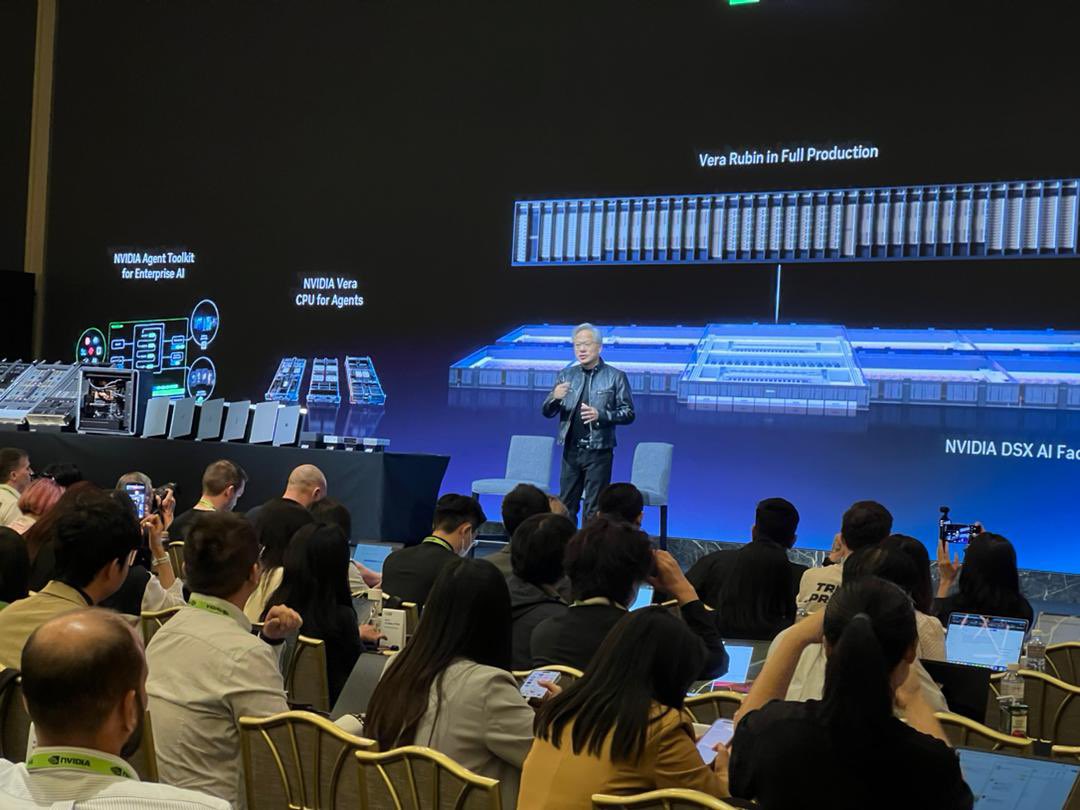
Got to ask Jensen his thoughts on how and when Physical AI will see an inflection point - during @nvidia Analyst Q&A this week -
Question:
“Physical AI has picking up in the factory, the autonomous vehicles.
But to cross the chasm into unstructured human spaces with humanoids like an average home or highly dynamic medical environments, what is the missing link, is it the dexterity, world models or lack of data to train the robots?
When shall we see the “Useful AI” moment for Physical AI like we are seeing with the Agentic AI?”
Jensen:
“We will see rapid integration of Agentic AI into Physical AI and the agentic framework he highlighted during the keynote will start applying to spatial or physical applications from autonomous vehicles to humanoids.”
He elaborated in detail on the importance of “reasoning” capabilities for autonomous cars and robots. The Agentic AI is the foundation along with the world models such as Alpameyo. He nicely tied the cloud, the PC, the car, and the humanoid to one agentic blueprint.
“Every edge device will become autonomous. We are not far away from inflection points for Physical AI.”
“In next two years be ready for Physical AI to reach an inflection point.”
$NVDA
Global DRAM revenue nearly reached the $100 billion mark in Q1 2026 as AI demand pushed memory prices sharply higher, according to Counterpoint Research
The biggest growth came from HBM (High Bandwidth Memory) used in AI GPUs and data centers, while traditional DRAM prices also surged due to tight supply
Samsung regained the top spot in the DRAM market, followed by SK Hynix and Micron, with all three benefiting from booming AI infrastructure spending
Moving things to Automotive, there are two platform series in Dimensity AX Cockpit - C Series and S Series.
C-X1 to feature @nvidia GPU and support for AAA Games
S1 Ultra to support omni-modal models and integrated cabin connectivity
The platforms will feature NR-NTN, 5G, Wi-Fi 8 and Dual Bluetooth connectivity options.