For the first time in 14 years, Air Zimbabwe is flying to London. The new thrice-weekly service is operated by a wet leased Plus Ultra A330. https://t.co/yt8lqZZZeM
Zimbabwe Cricket so far in 2026:
- Qualified for the Super 8 at the T20 World Cup, defeating Sri Lanka and Australia along the way.
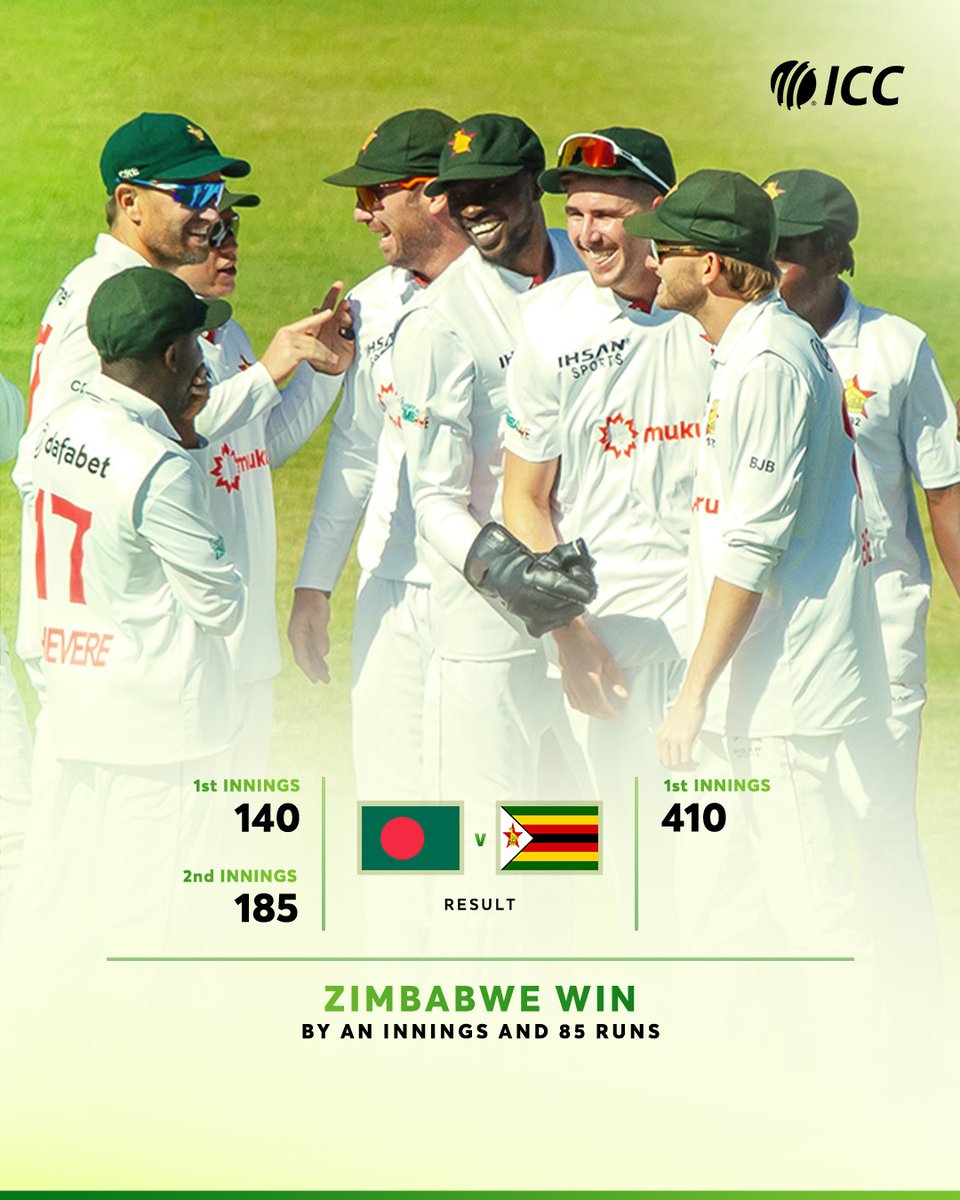
- Secured their biggest test win after beating Bangladesh by an innings and 85 runs.
- Defended only 141 run against Bangladesh
- won the ODI series Against Bangladesh while securing their third consecutive wins over Bangladesh in all formats.
What a year so far for Zimbabwe cricket 🔥🇿🇼
🇮🇷🇺🇸 Hackers took over multiple Instagram accounts, including the Obama White House account and the US Space Force Chief Master Sergeant's account.
They did it by simply asking Meta's own AI support chatbot to add their email address and reset the password.
The exploit bypassed 2-factor authentication entirely. Instructions circulated on Telegram within hours and the accounts were being resold as a service before Meta had time to patch it.
Source: BNO
After just hosting the African of Nations (Afcon), while set to host the 2030 World Cup with Spain and Portugal, Morocco, located 14km from Europe, still struggles with a complex identity crisis.
Is it an African country or an Arabic country in Africa?
Does it consider itself African, Arabic or European, or all of that?
Geographically, it is located on the African continent, specifically
on the northwest corner of Africa. It is part of the broad Maghreb region and is the only African nation with coastlines on both the Atlantic Ocean (to the west) and the Mediterranean Sea (to the north).
Morocco is the closest African Country to Europe (Spain). The distance is about 14km (9 miles).
So what is Morocco's identity?
Morocco's identity is complex, rooted in Arab, Amazigh (Berber), African, and Mediterranean influences, leading to perceptions of an "identity crisis" where some Moroccans identify more with Arab/European cultural spheres, while officially recognising their African continent location and
membership in the African Union.
After hosting the Afcon final on Sunday, losing to Senegal 1-0, Morocco plans to use six venues in 2030, five of them were used for Afcon, providing world-class infrastructure and a spectacular backdrop.
The Grande Stade in Tangier with a 75 000 capacity is an impressive facility in the northern coastal city, less than an hour's ferry ride from Spain.
Historically, schizophrenic actions like withdrawing from the AU (1984-2017) and applying to the EU ( which was rejected) fueled views and hostility that Morocco doesn't consider itself African, yet it is geographically in Africa.
They rejoined the AU in 2017, emphasising their dual Afro-Arab/Amazigh heritage, with recent constitutions acknowledging Amazigh as official.
That was after a 33-year absence.
Some say that simply proved they say they are African or not when convenient, hence they applied to be an EU member, only to come back running after rejection and because of Saharawi.
Morocco wants Western Sahara primarily for its vast natural resources, especially phosphates (key for fertiliser), rich fisheries, and potential oil reserves, alongside significant strategic Atlantic coastline access. Economically, it secures global food supply chain links and economic benefits; politically, it bolsters King Mohammed VI's authority, strengthens Morocco's regional leadership, and leverages diplomatic tools like "phosphate diplomacy".
Morocco views the territory as historically part of its domain, a claim it solidified through military presence and infrastructure development after Spain's colonial withdrawal, despite international calls for self-determination.
In essence, Morocco sees Western Sahara as integral to its territory, economy, and national security, leveraging its resources for both domestic stability and international influence.
Digital Services Tax Update: ZIMRA Admits Major Problems On The Ground
ZIMRA explained how Zimbabwe’s new Digital Services Withholding Tax is supposed to work, on record. That should have been a good thing. But if you listen carefully to what was said, you find out that they really don’t have any answers or solutions.
The clarification Zimra gave doesn’t solve the concerns we’ve all been raising since the tax was introduced. It confirms them.
The Questions People Asked From Day One
When the Digital Services Tax was announced, a few obvious questions came up immediately.
The first was double taxation. Many of the foreign digital services they are targeting already charge 15 % VAT. Now they have introduced a 15% digital services tax being collected locally through banks.
Without a clear way to make sure those two don’t overlap, we knew what would happen: people would pay twice.
The second was platforms that sell both goods and services. Digital platforms don’t fit neatly into boxes. Amazon is a good example.
A single Amazon payment could be for a physical product, Amazon Prime, music streaming, cloud services, or a mix of all of them. If the tax only applies to services, banks would need to know what you’re paying for.
The third issue was who carries the burden when things aren’t clear. Banks are expected to withhold the tax, but banks don’t see invoices from global platforms with all the items listed.
Even if they can’t tell what a payment was for, they still have to withhold 15%, which means it all falls on the customer to prove they shouldn’t have been taxed.
These are the real scenarios on the ground.
What ZIMRA Has Now Said
In a recent interview, ZIMRA explained that the Digital Services Tax applies to imported electronic services provided by companies based outside Zimbabwe. Physical goods, they said, are not subject to the tax. I’m sure we all understand this by now.
Zimra clarified that the tax is paid by the person receiving the service in Zimbabwe, not the foreign company. So, they are not even targeting the foreign companies with this tax, just you. As quoted by The Herald, Zimra Head of Technical Services for Domestic Taxes, Mr Mathias Chinanayi, said:
"This is not a tax on the supplier. The tax on the supplier is dealt with separately under the Income Tax Act, where a five per cent tax is charged on the gross income earned by the foreign supplier. The digital services tax, however, is paid by the person receiving the service in Zimbabwe."
So yeah, the supplier is taxed separately; there already is a mechanism for that. This new Digital Services tax is so that you don’t go scot free either. You gotta pay Mthuli for the privilege of using Microsoft 365.
So far, so clear.
But ZIMRA also acknowledged something else: that “operational challenges remain.” Specifically, they pointed to problems where foreign service providers are already charging VAT, and to the difficulty of separating goods from services on complex online platforms. The exact concerns people were raising.
They added that “work is ongoing to refine the framework and bring consistency and certainty.”
That admission makes it all worse.
Why This Isn’t Comforting
Saying that a tax will be refined after it has already been implemented isn’t reassuring, especially when real money is involved.
When VAT and the Digital Services Tax stack together, people end up paying 30% in taxes. That’s not a small inconvenience. It affects how expensive software is, how schools operate, and how businesses function day to day.
The goods-versus-services problem also isn’t some rare thing that can be ignored for now. The biggest e‑commerce platforms in the world sell both.
To acknowledge that this is difficult and then move on is to admit that the most common real-world case still doesn’t have a clear answer.
This is what people mean when they say this whole policy feels half-baked.
It’s Not Really a ZIMRA Problem
It’s also important to be fair about where responsibility sits.
ZIMRA’s job is to administer and collect taxes, not to design policy. They work with what the Ministry of Finance puts into law.
If implementation is this messy, we are forced to ask: was ZIMRA properly consulted when this tax was being drafted? Because if they were, these issues would have been obvious long before the tax was thrown onto the public.
Either that consultation didn’t happen, or the warnings weren’t taken seriously. After all, it’s even more revenue collected until its sorted. Which is what I suspect happened. Neither is good.
So, really, it’s Mthuli and company that we should be looking to for an explanation. Why was a half-baked policy allowed to pass, when it is double taxing people on the ground, whilst the tax enforcement arm admits they are still trying to figure out how not to do that?
Tweak-As-You-Go Policy
Rolling out a tax and then saying the framework will be refined later means we are all paying while the government figures things out. Meaning all the risk and administrative burden is placed on the public.
For something as sensitive as taxation, that’s not how it should work.
They should solve the hard problems first, then implement. Not the other way around.
https://t.co/TWPUtqJFrd
🚨 CHRISTIANITY IS UNDER ATTACK GLOBALLY - WHILE WESTERN CHURCHES DEBATE PRONOUNS
December 13, 2025: Chinese Communist Party mobilized "more than a thousand police officers, SWAT units, anti-riot forces, and firefighters" in Zhejiang Province.
Mission: Round up Christians. Raid churches. Mass arrests. Five-day operation. Several hundred detained.
China's rules now:
- Nobody under 18 allowed in church
- Adults only permitted in government-registered churches
- Violators get arrested and "de-programmed" through "anti-cult" programs
They're literally running re-education camps for Christians. In 2025.
India: Hindu extremists forcing Christians to burn their own Bibles
Mob of 80 extremists in northern India attacked Christian families. Pulled Bibles from their car. Made them pile the books on the ground.
Then forced the Christians to pour flammable liquid on their own scriptures. Made them light the match. While the mob filmed and chanted praises to Hindu god Rama.
Hundreds of churches burned down in recent years. Mobs storm services and beat worshippers with iron rods.
Nigeria: 12,000+ killed this year
Not in a war. Not in a conflict zone. Just killed. For being Christian.
Islamic State West Africa Province systematically massacring Christian villages. Trump launched airstrikes Christmas Day after warning there would be "hell to pay."
12,000 dead in one year. In one country. That's more than most actual war zones.
North Korea: Public execution for owning a Bible
Open Doors ranks North Korea #1 for Christian persecution globally. The penalty for possessing scripture: summary execution without trial.
Concentration camps filled with people suspected of worshipping Christ. Eritrea (#4 on the list) puts believers in metal shipping containers in desert heat for 10+ years.
More than 3 billion people - nearly HALF the global population - live in countries where Christians face violent persecution.
That's already systematic violence:
- China: mass arrests, forced de-programming
- India: church burnings, Bible burnings, mob attacks
- Nigeria: 12,000 massacred in 2025 alone
- North Korea: execution for faith
- Middle East: death sentence for conversion
50 countries total with severe persecution
Meanwhile in America:
Churches debating whether to put pronouns in bulletins. Arguing about coffee bar brands. Splitting over political endorsements.
Western Christians celebrating Christmas in heated buildings with catered meals have zero concept that their brothers and sisters are being executed for owning Bibles.
The irony:
Persecution historically makes Christianity grow.
When facing death for faith, commitment becomes real. Casual believers disappear. Serious believers multiply.
When you're not facing persecution, faith becomes optional. When you ARE facing persecution, faith becomes everything.
Now the question:
If you faced arrest for attending church, would you go? If owning a Bible meant execution, would you own one? If practicing your faith meant losing everything, would you practice?
3 billion people are answering that question right now.
Under threat of violence, imprisonment, death.
Western Christians might want to consider what they'd choose. Because one thing's become clear: persecution's intensifying globally.
And assuming Western exemption from history's patterns is betting against every precedent.
Source: @ZeroHedge