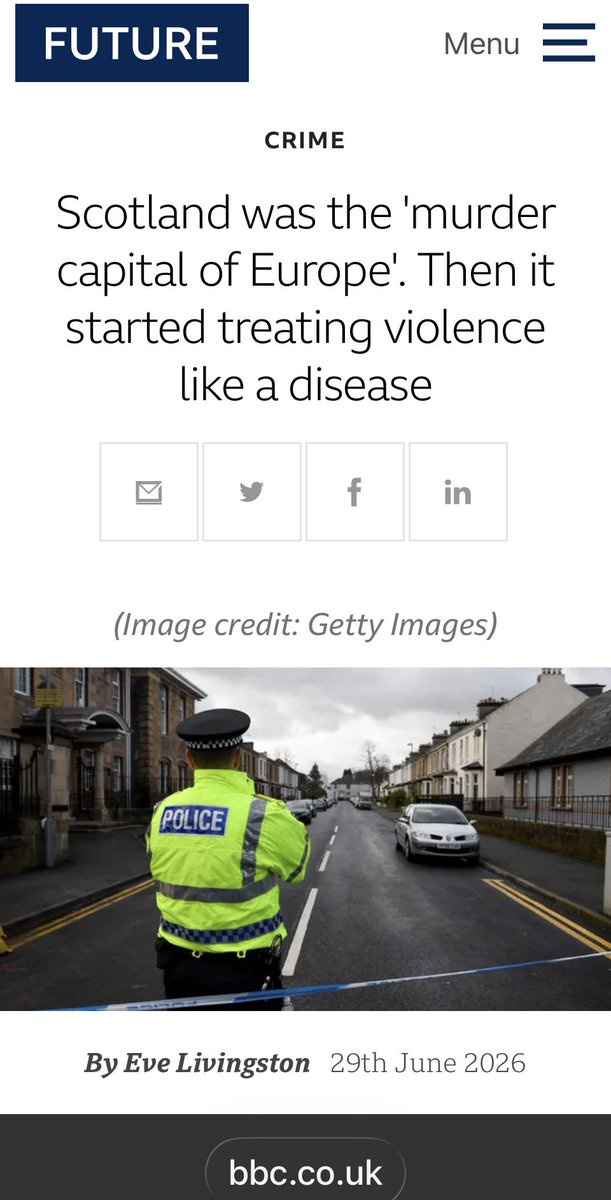
This article 👇 on Scotland’s success in reducing violent crime was published on @BBC_Future website in June.
Why has the rest of the BBC, including @BBCScotlandNews , ignored it?
https://t.co/F8KeFi1f3C
🏴 The Scottish Parliament has agreed that Scotland is a nation with the right to determine its own future.
‼️ It is now time for the PM to meet with the First Minister and agree a mechanism that allows the people of Scotland to choose that future through a referendum.
In Scotland I graduated from college with zero debt.
In Scotland my parents survived a heart attack and cancer without paying a penny.
The tax rate is about 12.5% for the average earner.
The systems aren’t perfect but I wouldn’t swap them for how America run them.
Ever…
Under Scottish Labour average homelessness applications were nearly 40% higher and in Glasgow, more than 50% higher, than in last five years https://t.co/XTmdaG3PG7
Michael Marra when asked if he's a Unionist "I don't really like the word if I'm honest."
Really? Now there's a question worth exploring. Why is Michael Marra ashamed of being called a Unionist?
WHAT’S THE MARRA? MARRA needs to ask AI!
Children in low-income families
England
roughly 27%*
Wales
26%
Northern Ireland
21%
Scotland
15%
UK overall
26%
How Scotland went from being the murder capital of Europe to one of the safest places in the world - On BBC Latin America but not BBC Scotland? - Por el amor de Dios, ¿por qué? https://t.co/nbjFEpQhKB
Good morning
@tom_watson
Your journey from MP who most understood the Cambridge Analytica scandal to paid-up Palantir apologist is really quite the journey.
Hope the 💰💰💰💰is worth it.
Here’s some background reading ahead of your first day 🧵👇
🥃 Andy Burnham has just given English whisky the same level of protection as Scotch whisky! 😱
MSP for Speyside Laura Mitchell explains why that isn’t a good idea. 👇
This drug has been available in Scotland for over three years , yet there's been zero calls in Westminster for Why aren't England following Scotlands lead" . We all know if it had been the other way around the press would have hounded FM Swinney for action
BBC Scotland is today pushing a narrative that delays in centralising neo-natal care units is putting the lives of vulnerable babies at risk. BBC Scotland ran an *attack* on the neo-natal centralisation plan last year. Two different narratives each side of the Holyrood election.
I’m sure Scots will enjoy this news
RP so we’d all in the loop thanks.
COVID Enquiry. Did you miss this?
"The benefit of domestic manufacturing to an economy has already been demonstrated. The Covid inquiry concluded that nearly £10bn of public money was wasted on the flawed way it went about buying personal protective equipment (PPE), much of it manufactured in China. By contrast, Scotland, which invested £102.7m in PPE and produced 88% of it domestically in 2021, generated £66.7m of additional economic value and 1,400 jobs." - The Guardian today.
Scotland's still an afterthought.
Scotch whisky is the UK's biggest food & drink export, and it has protected status.
Now the UK Labour Government have decided to water that down, by granting the same protection to English whisky/whiskey.
https://t.co/p17y8B2F7c
On the weekend before the 2014 Indyref the BBC broadcast a speech by Gordon Brown live across the UK. Brown used the platform to dupe Scottish voters into believing a No vote would lead to Scottish Home Rule. It was a lie. We have less power now than we had then.
There is a question at the heart of capitalism that we almost never ask.
Why should the owners of capital have the residual claim on the rewards generated by a business?
Capitalism assumes that a business employs people, buys goods and services, pays interest and meets its other costs. Wages are treated as one of those costs. What remains is profit, and that belongs to the owners of capital.
But there is nothing natural about this arrangement. It is not an economic law. It is a choice about power.
That matters when discussing the nature of capitalism and why it differs from neoliberalism.
Before about 1980, capitalism in countries such as the UK operated within much stronger democratic constraints. Trade unions had power. Finance was regulated. Taxes on high incomes and wealth were higher. Public ownership was commonplace. Full employment was an explicit policy objective.
Neoliberalism dismantled much of that settlement. It weakened labour, liberated capital, encouraged privatisation and promoted rent extraction. We should reverse much of that.
But I think we also need to ask a more fundamental question.
Why should capital get the residual return at all?
The usual answer is that shareholders provide risk capital. But workers take risks too. They can lose jobs, careers, pension expectations and future earnings when businesses fail. And most shareholders in large quoted companies did not provide capital to the company anyway. They bought existing shares from another investor. The company received nothing from that transaction.
So why does owning that share automatically confer a claim on the residual rewards created by the enterprise?
Accounting makes the answer look obvious because wages are deducted as a cost before profit is calculated. But accounting reflects the institutions we have chosen to create. Company law, limited liability, shareholder rights and accounting conventions were all designed. They are not laws of nature.
We could design things differently.
We could ask what return capital reasonably needs to attract the investment an enterprise requires, pay that return, and then give the residual claim primarily to those whose work created the remaining value.
That would turn one of capitalism’s most basic assumptions on its head.
Capital does not work, think, create, care or have needs. People do. Capital is a mechanism created by people to facilitate economic activity.
Labour should not simply be treated as a cost incurred to generate a return for capital.
Maybe it is time we asked whether capital should instead be treated as a cost incurred to enable people to work.
@BjCruickshank Blair McDougall explaining how he is going to spend billions saving a steel plant in England.
He wasn’t to be seen when Grangemouth and Mossmorran closed.
Half the domestic violence, one quarter of the children exposed and better police monitoring but only in Scotland does the BBC headline it https://t.co/AEfaMFimms