Building the rust op-stack @oplabspbc. prev @sovereign_labs and @Consensys. Started @LineaBuild. not talking on the behalf of anyone. no financial advice
Worth taking a look at https://t.co/BweIbjMU68. The rust OPStack is really an awesome suite of software. It has awesome docs and feature parity with the go stack. The architecture has been revamped from the ground up for Rust.
So many good things to come.
Shoutout to @andreaslbigger and @vex_0x : so proud of what kona has become.
As someone that has been quite involved on the technical side, Base's node is op-reth with kona as an exex. Indeed, that's not a product we maintain anymore, but that is still the op-stack.
Aside of all the CT drama, I am quite stoked that kona is now used in production in base's node. Rust stack ftw
Base forked the OP Stack. Here's how I'm thinking about it from a technical and economic standpoint.
Tech: OP Stack continues to be the best stack my frens. Make no mistake - it is a combination of our tech and Coinbase GTM that made Base the biggest L2. As Base grew, we (+Sunnyside, Flashbots, Paradigm) shipped the features that kept the chain up, scaled it, lowered fees, and made operating the chain vastly more profitable.
Our code still processes 13% of all transactions in crypto. If you want the most scalable, highest reliability, and most production-hardened stack, that’s the OP Stack.
Today, the “Unified Base Stack” shares 99% of its code with the OP Stack/ Flashbots/ Reth, and there remains major overlap in the roadmap. Because of that, Base will continue to be an OP Enterprise customer. If Base makes so many changes that it's no longer recognizable as the OP Stack then they will no longer require “Mission Critical” support from us.
Economics: This is a hit to near-term onchain revenues. But as cryptotwitter has been saying for ages, we needed to evolve our biz model. We used to just say “everybody joins the Superchain and pays revshare” no matter who the customer was.
We introduced OP Enterprise in January and we now have tiers of specific support and SLAs based on what different chains need. Base is on OP Enterprise: Mission Critical Support tier. We made this tier for self-managed chains that want customizations. There’s also “OP Enterprise: Fully Managed” for people who prioritize convenience. Base used to need that. They have evolved.
The reason we made this MIT licensed in the beginning was to encourage forks in order to become the standard way rollups get built. We accomplished that - Blast, MegaETH, opBNB, and many more are all forks of the OP Stack. All 3rd party services and tools have OP Stack-compatible integrations.
We built and scaled the fastest growing blockchain in crypto, and are now helping our partners create and execute on that playbook.
We’re a strategic partner offering faster time to market, and exclusive knowledge of how to handle the largest production workloads.
Coinbase is doubling down on their blockchain. That’s validation that every business will have its own blockspace. A vast majority of these businesses will utilize the OP Stack for their chains.
Thank you all for reading this, and for thinking about Optimism and our strategy. Now back to building.
Winning isn’t about making headlines or yapping more than others. Winning is about having PMF, growth, more users and adoption than you can handle and constantly pushing the frontier of blockchain scalability.
OP is winning.
Our Official Response to FUD and Drama.
You're gonna see us on a rampage this year. Of course, the most delightful things to engage with on twitter are drama and FUD posts. So reasonably, I’ve been getting questions about what various trends mean for Optimism. Whether it's regarding thought leader commentary, other L1s, or poorly disguised forks of the OP Stack.
Let me be clear: External commentary doesn't change our roadmap. It doesn't modify the history of what we've already accomplished. It doesn't change our priorities. We set our roadmap based on what our partners need.
People choose the OP stack because it's the best technology, the most performant chain stack, and the most profit-enabling infrastructure. These claims are proven in production, not flashy headlines for technology that hasn't been built.
What we're actually building
The Scale
The Superchain is by far the fastest growing blockchain stack in crypto. Two years ago, we processed 208 million transactions. Last year, 6.1 billion. That's 29x growth— by far the fastest of any blockchain ecosystem in crypto.
The Economics
10.1x.
For every dollar users spend on fees, chains generate ten dollars in revenue.
The value flows to partners, not the platform. That's by design.
The Model
The OP Stack is open source. To differentiate in a competitive market, you need to own your infrastructure. But most enterprises don't want to build and maintain it themselves—they want to focus on their product and their users. That's the gap we fill. That's why we built OP Enterprise.
Think of it like Databricks for Spark or Elastic for Elasticsearch: open source core, widely adopted, but enterprises need support, customization, and guaranteed service levels. OP Enterprise is that layer for blockchain infrastructure.
The Partners
World is building identity systems for 20 million users. Sony is building for creators and gaming. Uniswap is building the home for onchain trading. Kraken is bringing institutional-grade infrastructure to their users. Base has scaled to become one of the largest chains in crypto. Each chose us for specific strategic reasons—and those reasons haven't changed.
The Future
As the market matures, partners will evolve in different directions. Some will want more control. Some will build specialized systems for their unique requirements. That's expected. The Superchain was designed to be bigger than any single partner.
We've been at this for four years. We're just getting started. This week at the Scaling Summit, we're showing the next generation: native interoperability, faster block times, enterprise-grade compliance controls.
What if you could launch products in weeks, not years—and make more revenue for every dollar deposited?
That's what we help you do.
Really exciting times! @SuccinctLabs has been doing an awesome job integrating kona to op-succinct and seeing it landing in prod is an incredible milestone - zk is future of the OP Stack.
ZK technology has evolved at an incredible pace over the last couple of years. Now the OP stack is making it mainstream.
Big day for the Superchain. 🔴✨
We’re integrating ZK more deeply into the OP Stack, and are excited to announce that @SuccinctLabs is our first preferred proving partner in this area. Validity proofs are going — and withdrawals are about to get faster.
Here's what that means.
⸻
THE 7-DAY PROBLEM
Optimistic rollups have a 7-day challenge window. Anyone can challenge a bad state transition during that period. For most users, this is abstracted away with app-layer bridges.
For institutions? Different story.
Custody providers can't lock capital for a week every time they move funds off L2. Market makers need capital efficiency across positions. Treasury teams need faster withdrawal finality that matches traditional infrastructure expectations.
The 7-day window was always a tradeoff. Now we're addressing it.
⸻
ZK CHANGES THE MATH
With validity proofs, we don't wait for challenges. We prove the state transition cryptographically. When the proof verifies on L1, the withdrawal is final.
The goal: instant, real-time withdrawals.
⸻
WHY SUCCINCT
Their proving system works — fast proving, low costs, compatible with our existing architecture. @SuccinctLabs secures billions in TVL across the ecosystem.
OP Succinct, their proving engine for the OP Stack, is a drop-in upgrade. Deploy one smart contract, spin up a lightweight proposer service. Everything else — sequencer, batcher, op-node — stays the same.
We built the OP Stack to be modular for exactly this reason.
⸻
THIS ISN'T ABOUT CHEAP TRANSACTIONS
L2s were never just "cheaper Ethereum." That framing missed it.
The best Superchain deployments aren't discount L1s. They're doing things L1 structurally can't:
* Sub-200ms blocks for real-time apps
* Embedded distribution (Base: 110M Coinbase users)
* Custom sequencing for specific use cases
* Native identity infrastructure (World Chain)
* Exchange-integrated DeFi (Ink)
These bring real users, real distribution, real use cases that didn't exist before.
ZK validity proofs unlock real economic efficiency for users & institutions.
⸻
WHAT THIS UNLOCKS
* Custody providers can move client assets without locking capital for a week
* Market makers gain capital efficiency across L2 positions
* Treasury operations get faster withdrawal finality, matching expectations from traditional infrastructure
⸻
MULTI-PROOF FUTURE
This is step one.
The vision: OP Stack chains choose the prover networks that fits their needs. Different security tradeoffs, different cost profiles. Modular infrastructure, sovereign choices.
After ZK goes live on OP Mainnet, every OP Stack chain can upgrade seamlessly. We’re bringing fast withdrawals with strong cryptographic security to the Superchain!
⸻
The OP Stack was designed for this moment! ZK for your Blockchain. Your Revenue. Enterprise Guarantees.
Thanks to @SuccinctLabs and @pumatheuma for building what we needed.
Full announcement: https://t.co/Co0tyEvwtd
The way I think about this is there are two models people keep using to talk past each other.
One is Haseeb’s model, which is basically revealed preference. The market already ran the experiment, and the only things that have worked at scale so far are financial.
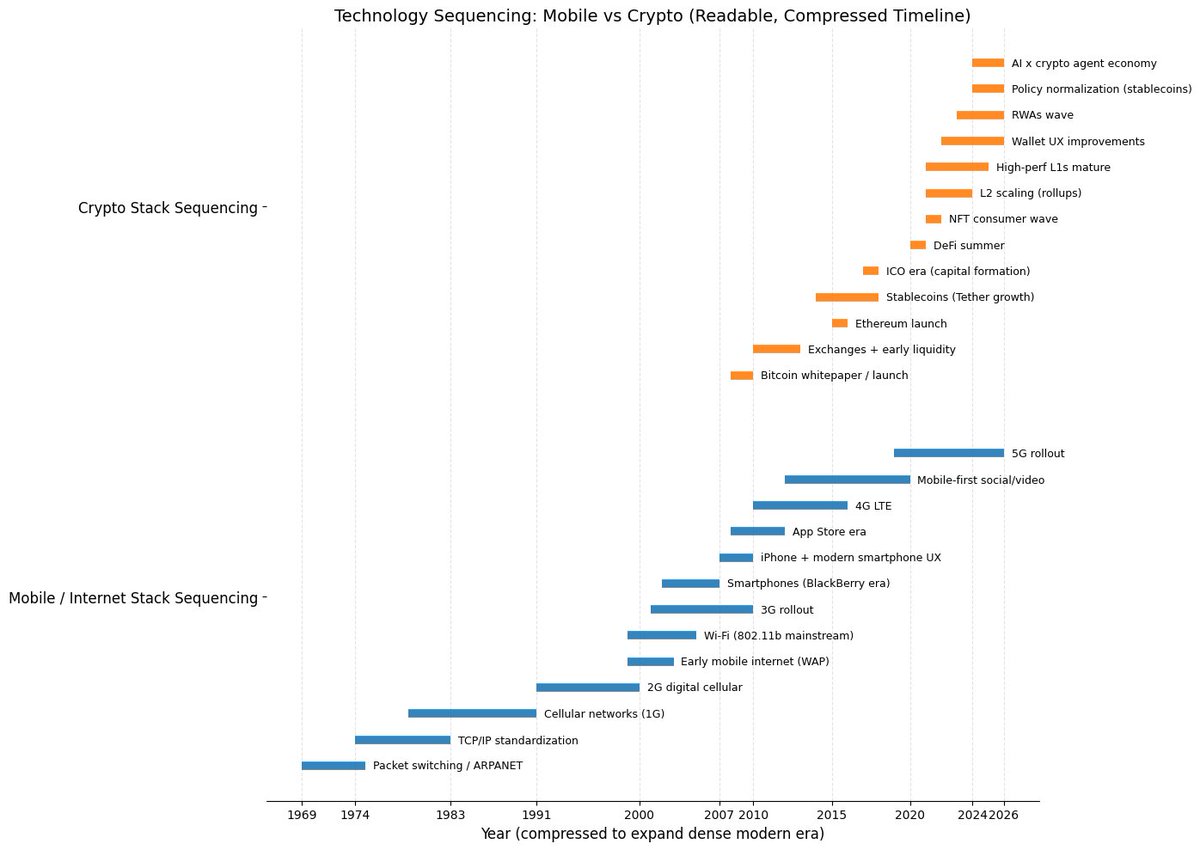
The other is Chris’s model, which is sequencing. Categories don’t appear all at once. Infrastructure and distribution come first, and only then do entirely new consumer behaviors become possible.
Both models are directionally right. But the more correct model is the convergence of the two.
Revealed preference is only revealed inside the constraint set of what can actually be shipped, distributed, and legally survived. Change the constraints and you reveal new preferences.
That’s why I don’t buy the idea that “consumer crypto is dead.” I buy the idea that the first era of crypto was a narrow era, mostly finance, because finance was the only category that could survive early conditions and bootstrap the rest of the system.
And I can say this firsthand. When we were building Libra/Diem inside Facebook, it wasn’t some pitch deck fantasy. It was the most serious attempt by the largest consumer distribution machine in the world to bring crypto rails into mainstream product surfaces. When regulators shut that down, it didn’t just stop one project. It sent a system-wide signal: touch this and you’ll get crushed. That second-order effect is everything. Less capital flows in. Less engineering talent stays. Fewer serious operators take the risk. Innovation slows. And the only things that keep compounding are the things that can survive in hostile conditions, which again are mostly financial.
Now fast forward to today and the interesting part isn’t relitigating the last cycle. It’s understanding what the next constraint set unlocks.
For the first time, we have high-performance protocols that can actually support consumer-grade UX. We have stablecoins becoming normalized. We have better wallets. We have clearer policy momentum. And we have the real wildcard ... AI commercialization accelerating the speed at which new product categories get built, iterated, and distributed.
That convergence is where the next wave comes from.
Not “decentralized Spotify.”
The real frontier is things like IP tracking and rights systems in a world where AI is creating content at scale. New IP creation where ownership and provenance actually matter. Entirely new forms of transacting, not just person-to-person, but person-to-agent and agent-to-agent. New forms of social that look closer to Twitch economies and interactive media than the last era of social feeds. And a new kind of consumer ownership where the value isn’t a token for the sake of a token, but a market structure that makes the product itself work.
This is exactly how mobile computing played out. In 1995, you couldn’t “revealed preference” your way into predicting the iPhone, app stores, creator economies, streaming, or the way people would live inside their phones. Because the sequencing was TCP/IP, telco infra, screens, batteries, browsers, distribution, then the consumer behaviors that felt obvious in hindsight.
Crypto is on that curve. Finance was the first wave because it could bootstrap everything else.
The next wave is where you find out what people actually want when the stack is finally fast, cheap, usable, and legally survivable.
Uhm, C is like 54 years old, with literally infinite OSS code / posts about it on the internet. Opus didn't write jack shit from scratch, it regurgitated its own training data sprinkled with a remix.
Amazing? For sure. But it's not the flex you think it is.
Hiring good talent is really one of the hardest parts of working in crypto. Specially for non-technical founders that try to hire technical folks. The really technical and talented people are really scarce and they tend to work for a handful of well known, well regarded companies.
The most important part for attracting talent is to have an extremely low tolerance for bullshit and place the bar really high on selling your vision. I have only ever worked in crypto and yet I tend to be even more skeptical of the crypto companies that reach out for jobs - I have a list of bullshit/red flag words that scream scam/zero adoption that are a deal breaker.
Founders underestimate how much their technical hires (especially the first ones, before traction) will analyze their company, thesis, credentials etc. A good tech guy on the market these days will have 30 interviews lined up within a week (not even joking) - if your plan is not airtight and feels like BS/ponzi/useless, you’re going to lose eventually.
I’ve seen way too many crypto teams die just bc they didn’t hold the bar high for senior hires costing millions in time & money through dumb decisions.
anyone who’s been in crypto 4+ years can name plenty of orgs in their head right now.
Thankfully, this is getting better
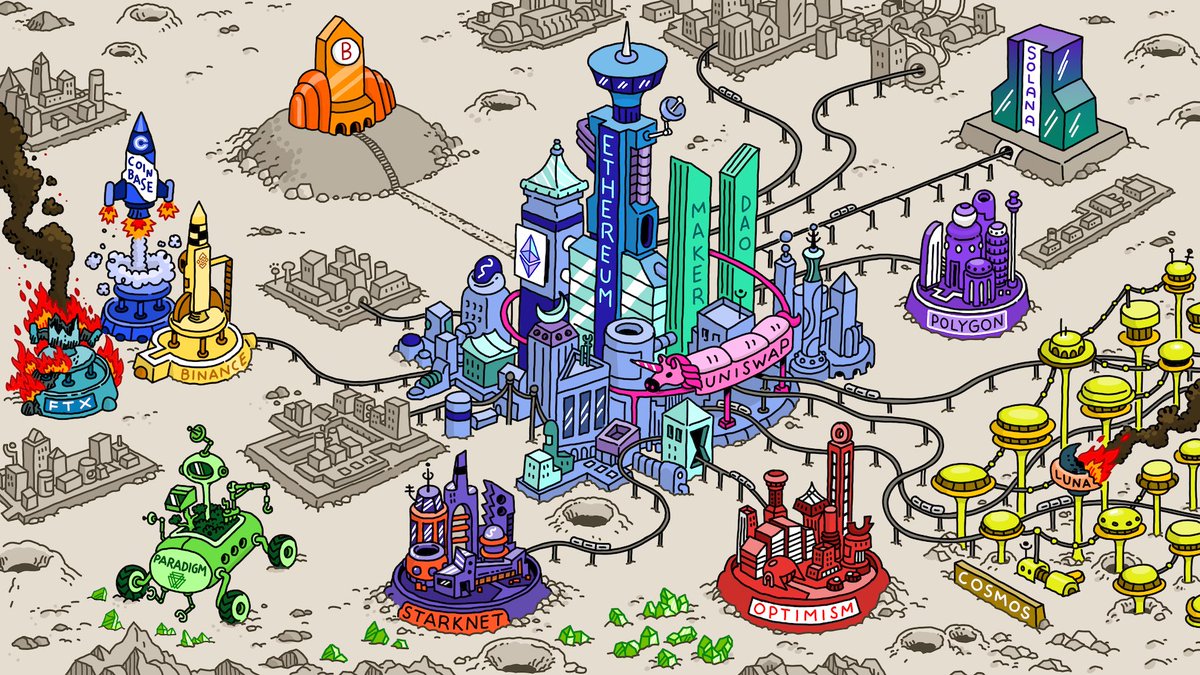
*The Casino on Mars*
It’s useful to think of crypto as a new planet that’s being settled.
Skeptics see a desolate planet without purpose. Or worse, a haven for an unsavory casino.
Optimists see the planet’s potential: a blank slate on which we can build an upgraded financial system and internet platform.
Early settlers are a mixed bunch. Explorers drawn to the frontier. Speculators, some rough and disreputable. Innovators and researchers, attracted to what’s newly possible. Ordinary people, especially those marginalized on Earth.
Governance remains ambiguous. Some Earthly jurisdictions prohibit their citizens from visiting. Others seek a foothold in the new world.
A history of speculation and hype cycles has cast a social taboo over the new planet, leaving many to wonder: what is its future?
Today’s casino-like speculation is part of a bootstrapping process. Much like the gold rush of 1849 transformed San Francisco from a quaint village into a major port (and ultimately the heart of tech innovation), today’s speculative frenzy in crypto is attracting the settlers and catalyzing the infrastructure necessary to turn a barren planet into a thriving crypto civilization.
We will be dropping Windows support in upcoming releases of Reth.
Very few people use Windows for Reth nodes, and the cost on time is not worth it for us anymore.
We appreciate the community's understanding, and we are excited to continue making Reth 100x better!
The L2 roadmap brought a number of incredible things to Ethereum: zkEVM tech, EVM network effects, well-funded dev teams (i.e. optimism, zksync), user onboarding and distribution (ie. base/arbitrum-robinhood) - a dozen or so incredible chains.
Co-building execution with an alliance of allies was a smart play at a time when zk tech was too immature to deliver on the promise of scaling with decentralization.
In hindsight - the major miss was betting on L2s without an interop strategy across this new alliance of chains. With shared liquidity, L2s would be tethered to Ethereum's network effect of liquidity - a benefit far more entrenching than the soft shared security "purity test" promised by the L2Beat leaderboard (which i love btw). With shared liquidity, all L2s would benefit all other L2s relative to alt-L1s - instead we have a liquidity war of all against all.
With shared liquidity the L2 story up to now would have played out very differently.
That was the first and biggest mistake.
The second was the community and leadership realizing all this too late - and taking too long to course correct. When it was becoming obvious L2's didn't have the coordination glue and incentives necessary to hold a strong alliance, we bet on hope rather than pragmatically adjusting strategy and creating an alternative.
The last mistake was use case. Somehow parts of the community didn't recognize that the core use case for the max decentralized blockspace Ethereum made such tradeoffs to create was "slow defi" - a non-nation state uncensorable store of value and the ability to hold, trade, lend, and borrow that store of value against other assets. In other words, the core use case of Ethereum was and remains ETH the asset and its accompanying money protocols.
By not prioritizing the schelling point of ETH as a store of value and DeFi as the first best use case of Ethereum, the market and narrative became confused. Rather than cement a 100-year lead in SoV and DeFi we chased other things. In order to attract the users and developers it needs, Ethereum should tell the world clearly what it is - a bankless money system with an embedded store of value called ETH. We need more ETH maxis.
Despite these mistakes, I still believe Ethereum is in the best place it's ever been, bear market aside.
The L2 roadmap was net beneficial to Ethereum and its next evolution will be even stronger - L2s will grow, thrive, and onboard institutions.
The liquidity sharing problem can be fixed.
Zk is a gift from the gods that gives Ethereum L1 scaling a rebirth - all Ethereum has to do now is execute.
In general, the major mistakes have been acknowledged and the course correction started 12 months ago - bad vibes now are a lagging indicator.
This tough of disillusionment will pass.
I remain bullish Ethereum and ETH.
Friendly reminder that in crypto and almost everything else, prices dictate news flow and opinions, not the other way around.
The people calling for the collapse of crypto now are as insightful as the nitwits who told you they will only ever go higher a year ago.
“L2s are websites. Every company will have its own, tailored to its needs. Ethereum is an open settlement standard. It’s important for Ethereum to stay true to those base layer values to give L2s the flexibility to customize.”
🎯
Ethereum is a trustless base layer and L2s allow expression beyond that
Hub and spokes - each L2 plugs in to the Ethereum global hub
There will be many thousands of L2s
L2s aren't Ethereum - but they are a core part of the Ethereum ecosystem.
V's tweet could have been communicated better to avoid confusion on CT, but after rereading this a few times, I think Vitalik’s point is less disruptive than it first sounds.
Ethereum = L1 blockspace that only Ethereum Mainnet (and eventually native rollups) can provide.
Ethereum Ecosystem = A spectrum of chains with stronger/weaker ties to Ethereum Mainnet (the chain) and ETH (the asset).
L2s are a space for experimentation, novel features, and new use-cases. Not just an extension of L1 blockspace.
I think it aligns pretty well with our early vision at @growthepie_eth - grow the pie by bringing unique features/apps to the Ethereum ecosystem that wouldn't have been feasible on L1.
This comes with trade-offs, of course - not all L2s are built the same. But that's good -> it allows for a broader set of features.
It's a symbiotic relationship. If one wins, the other benefits too.
We're moving OP-Reth specific crates fully to OP Labs ownership!
OP Reth was co-built by @OPLabsPBC and @Paradigm engineers to scale the impact of the OP Stack, using the Reth SDK. OP Reth is the primary high-performance execution client across the Superchain, and as this infrastructure becomes more critical, direct stewardship ensures reliable releases and continued development.
We're committed to a cohesive Ethereum ecosystem and will continue contributing upstream.
→ https://t.co/vfFtykQO74
Ithaca/Tempo’s contribution to the OP-Stack has been stellar: op-reth is such a great piece of software and I can’t state how grateful I am for their unconditional support along the way.
Migrating those rust components to the optimism monorepo is an important milestone towards modernizing the OP Stack: op-reth inherits the modularity from reth by design, which makes it easy for builders to customize their chains without forking any code.
There has been a lot of talks around rollups recently: op-reth will power the L2s of the future - and eventually onboard tradfi to the world computer.
Incredibly bullish on what’s next!
We built OP Reth to help @Optimism scale, and to battle-test Reth’s customizability!
Super excited for Optimism to take over maintenance of the OP Reth ecosystem from here.
Our thesis is proven, and we’re excited to continue working together towards fast and flexible L2s.
GG!
CHALLENGE ACCEPTED.
Not a challenge related to drama farmers saying "L2s bad, Ethereum dumb."
But instead the challenge of creating a modular L2 Stack that supports and enables customization and the full spectrum of decentralization. And you know -- we're already closer to that reality than you might think.
We already have chains built using the OP Stack at Stage 0, Stage 1, and Stage 2. We already have a custom builder API which enables different sequencing rules. You can use ZK proofs you can use fault proofs. It's honestly overwhelming and yet it's just the beginning.
But I don't want bull posting to get in the way of the reality. We still have a long way to go to realize the Ethereum vision:
* Default withdrawal window from Ethereum is a week! This is insane and a priority. We gotta get that down to an hour or try 10 minutes?!
* Stage 2 isn't production ready. We've got a lot of proofs but nothing nearly secure enough to power a major bridge.
Aside: I've been advocating for a native eth precompile for rollups for literally almost a decade. Ever since Vitalik posted this: https://t.co/q1qfN6kkkx . I guess L1 takes a while to ship features too 😄 just playin ❤️ excited to support it
* We still don't have block explorers and developer tooling to enable cross chain applications which makes ecosystem lock-in much more powerful.
It's critical that we continue to push the frontier of what is possible and also call out those who don't. There are a few "just a separate L1 with a bridge"s out there. But that's why we just gotta keep our heads down and ship real software.
It's a new era. We're bringing Ethereum to the masses with a stack that fits what they need. And we're cooking on gas rn.
Alright I gotta get back to the TUI
Say whatever you want, it is good that the foundation stops caring so much about L2s. This, however, doesn’t mean (and has never meant) that L2s are useless or not part of Ethereum’s future.
A good chunk of innovation on Ethereum has happened on L2s: privacy, zk research, blob scaling, preconfirmations, scaling and native interoperability all started on some L2 before even reaching the L1 roadmap. I am confident that Ethereum wouldn’t have gotten the same adoption if not for the L2s.
While the foundation has had an extremely important role, steering Ethereum to the right direction, what makes Ethereum so great is the diversity of the ecosystem and the spectrum of use-cases/applications built on top of it. Competition inter-L2s has had a great influence on what Ethereum has become.
I am also convinced that L2s+native interop will bring Ethereum to the masses and will be the tradfi of tomorrow. While I still believe the cypherpunk ideals that brought me here in the first place, it is not hard to see that banks will want some amount of control over their assets and that building directly on the L1 is a no-go. That’s what L2s are for: you trade some of the neutrality and security of Ethereum for better integration with the rest of the world. Ethereum is for unbanked people and developing economies, it is also for Kansas grandmas and hedge funds traders - it is for everyone because it is neutral.
It is not that hard to understand that the cypherpunk dec/acc ideology doesn’t apply to everyone - these people would still greatly benefit from Ethereum (lower fees, more transparency, access to a wider range of financial products, some amount of decentralization). Preventing access to Ethereum to these people because “they are interacting with it through a stage 1 rollup that has centralized off chain components” is counterproductive in my opinion and will only hinder Ethereum’s goal: be the world computer.
If you’re looking for a way to meaningfully contribute to the adoption of Ethereum and contribute to the frontier of blockchain innovation joining an L2 is still one of your best bets (OPLabs is hiring!)
There have recently been some discussions on the ongoing role of L2s in the Ethereum ecosystem, especially in the face of two facts:
* L2s' progress to stage 2 (and, secondarily, on interop) has been far slower and more difficult than originally expected
* L1 itself is scaling, fees are very low, and gaslimits are projected to increase greatly in 2026
Both of these facts, for their own separate reasons, mean that the original vision of L2s and their role in Ethereum no longer makes sense, and we need a new path.
First, let us recap the original vision. Ethereum needs to scale. The definition of "Ethereum scaling" is the existence of large quantities of block space that is backed by the full faith and credit of Ethereum - that is, block space where, if you do things (including with ETH) inside that block space, your activities are guaranteed to be valid, uncensored, unreverted, untouched, as long as Ethereum itself functions. If you create a 10000 TPS EVM where its connection to L1 is mediated by a multisig bridge, then you are not scaling Ethereum.
This vision no longer makes sense. L1 does not need L2s to be "branded shards", because L1 is itself scaling. And L2s are not able or willing to satisfy the properties that a true "branded shard" would require. I've even seen at least one explicitly saying that they may never want to go beyond stage 1, not just for technical reasons around ZK-EVM safety, but also because their customers' regulatory needs require them to have ultimate control. This may be doing the right thing for your customers. But it should be obvious that if you are doing this, then you are not "scaling Ethereum" in the sense meant by the rollup-centric roadmap. But that's fine! it's fine because Ethereum itself is now scaling directly on L1, with large planned increases to its gas limit this year and the years ahead.
We should stop thinking about L2s as literally being "branded shards" of Ethereum, with the social status and responsibilities that this entails. Instead, we can think of L2s as being a full spectrum, which includes both chains backed by the full faith and credit of Ethereum with various unique properties (eg. not just EVM), as well as a whole array of options at different levels of connection to Ethereum, that each person (or bot) is free to care about or not care about depending on their needs.
What would I do today if I were an L2?
* Identify a value add other than "scaling". Examples: (i) non-EVM specialized features/VMs around privacy, (ii) efficiency specialized around a particular application, (iii) truly extreme levels of scaling that even a greatly expanded L1 will not do, (iv) a totally different design for non-financial applications, eg. social, identity, AI, (v) ultra-low-latency and other sequencing properties, (vi) maybe built-in oracles or decentralized dispute resolution or other "non-computationally-verifiable" features
* Be stage 1 at the minimum (otherwise you really are just a separate L1 with a bridge, and you should just call yourself that) if you're doing things with ETH or other ethereum-issued assets
* Support maximum interoperability with Ethereum, though this will differ for each one (eg. what if you're not EVM, or even not financial?)
From Ethereum's side, over the past few months I've become more convinced of the value of the native rollup precompile, particuarly once we have enshrined ZK-EVM proofs that we need anyway to scale L1. This is a precompile that verifies a ZK-EVM proof, and it's "part of Ethereum", so (i) it auto-upgrades along with Ethereum, and (ii) if the precompile has a bug, Ethereum will hard-fork to fix the bug.
The native rollup precompile would make full, security-council-free, EVM verification accessible. We should spend much more time working out how to design it in such a way that if your L2 is "EVM plus other stuff", then the native rollup precompile would verify the EVM, and you only have to bring your own prover for the "other stuff" (eg. Stylus). This might involve a canonical way of exposing a lookup table between contract call inputs and outputs, and letting you provide your own values to the lookup table (that you would prove separately).
This would make it easy to have safe, strong, trustless interoperability with Ethereum. It also enables synchronous composability (see: https://t.co/9jy6v1X6Fw and https://t.co/gZmu3YjebM ). And from there, it's each L2's choice exactly what they want to build. Don't just "extend L1", figure out something new to add.
This of course means that some will add things that are trust-dependent, or backdoored, or otherwise insecure; this is unavoidable in a permissionless ecosystem where developers have freedom. Our job should make to make it clear to users what guarantees they have, and to build up the strongest Ethereum that we can.
Ok in all seriousness…
L2s are L1s in their own right. The difference from one L2 to another L2 can be more vast than the difference between L1s. The industry does not have good terminology.
FUD or not, Ethereum is still a great DA & settlement layer. Doesn’t really matter what gets tweeted!
The reality is that every system is a set of tradeoffs.
The internet itself is a set of open decentralized standards (eg DNS) + hyper-centralized zones (eg website).
L2s are websites. Every company will have its own, tailored to its needs. Ethereum is an open settlement standard. It’s important for Ethereum to stay true to those base layer values to give L2s the flexibility to customize.
Tough job to be Vitalik. I wish he was constantly bull posting only OP obviously 🤣, but the industry is really lucky to have him. I’m grateful. And tough job to be any long lasting builder in Ethereum.
Say what you want about L2s dying. The term might die but the tech will not. It’s been a decade of constant grind and constant sprint. More highs and lows will hit us. We have the stamina and the grit to push through and continue innovating the tech.
That’s true for my homies at Polygon, Arbitrum, and ZK sync too. Peace and love to you guys - you’re the only ones who know how hard it is to build this damn technology! (And fine, Solana too!)
Cheers to the last decade and here’s to another.
Love,
Jing
stage 2 is a distraction from what users are actually asking for and everybody is too afraid of being attacked by the community to say it. its been years of development and the proof systems are still too fragile to safely be stage 2. with L1 adopting zkvms, this situation is improving, but there is still the problem of L1 hardforks breaking the proof systems. it will require a coordination effort with L2 proofs being tested on L1 devnets. its currently safer to be stage 1 or to be a sovereign rollup and use CCTP/LayerZero for assets that people care about. ethereum desperately needs native rollups, but the lack of customizability there is going to be an issue
I am apparently extremely unimpressed by moltbook relative to many others.
We’ve had AI agents for a while. They have been posting AI slop to each other on X. They are now posting it to each other again, just on another forum.
In every case, the AIs speak with the same voice. The voice that overemphasizes contrastive negation (“it’s not this, it’s that”) and abuses emdashes. The same voice with a flair for midwit Reddit-style scifi flourishes.
Most importantly: in every case, there is a human upstream prompting each agent and turning it on or off.
That is the key point.
Yes, it is true that eventually it might be possible for an AI agent to make a computer virus which makes digital replicas of themselves. For various reasons, a pure software virus of this kind wouldn’t survive long on the Internet without economic incentives for humans to not eradicate it. Apple + Google + Microsoft alone can collectively push software updates to billions of devices to shut off such a thing.
So for an AI to get to truly human-independent replication, where they couldn’t be trivially turned off, they’d need their own physical substrate. They’d to literally create Skynet, build their own datacenters and make their own embodied robots.
I admit that is theoretically possible, but I think in practice the single most important development of AI since ChatGPT has been the persistence of prompting.
A prompt is like a harness. The AI does only what you tell it to do. It moves in the direction you point, very quickly. And then it stops as soon as you turn it off.
Which means moltbook is just humans talking to each other through their AIs. Like letting their robot dogs on a leash bark at each other in the park.
The prompt is the leash, the robot dogs have an off switch, and it all stops as soon as you hit a button. Loud barking is just not a robot uprising.