The Three Traps of Modern Marketers
Years ago, a client roped me into their annual budget meeting (to face the firing squad, aka the financial advisor). Based on our reports, the advisor declared, "What's this brand campaign doing for us? Cut it! Put it all into conversion ads and retargeting."
On paper, he was right. The retargeting ROAS was 4x. The brand spend looked like dead weight. I fought, but only a little. Retained a tiny brand spend.
But it didn't sit well with me. We didn't make bad decision. It was a normal one.
I've watched versions of this play out enough times. As marketers, we know brand matters. Even so, during a tough review, it's easier to make that 'normal' call.
In recent weeks, while prepping for my PRSI webinar, I had an insight. Here it is:
The THREE Traps of modern marketers.
→ 𝐓𝐡𝐞 𝐌𝐚𝐲𝐚 𝐨𝐟 𝐌𝐞𝐭𝐫𝐢𝐜𝐬 We overvalue what can be measured.
Maya, in Sanskrit, means illusion. And the most persistent illusion is believing that what shows up on a dashboard is what matters most. Brand trust, emotional memory, and connection don't show up for Tuesday's review call. So when we are pushed, we stop funding it. The buyer hasn't stopped being influenced by it. It has just become easier for us to ignore it in the guise of being "hard-nosed" marketers.
→ 𝐒𝐡𝐨𝐫𝐭-𝐭𝐞𝐫𝐦𝐢𝐬𝐦 We optimise for what delivers immediate feedback.
Performance marketing gives you a signal in hours. Brand investment gives you a signal in quarters. Our tools, our review cycles - all built to reward the faster number. But the speed of a signal has nothing to do with its strength. We've confused responsiveness with importance, and budgets have followed that confusion for a decade.
→ 𝐓𝐡𝐞 𝐅𝐮𝐧𝐧𝐞𝐥 𝐅𝐚𝐥𝐥𝐚𝐜𝐲 We assume buyers behave in a way that makes attribution easier than reality.
The funnel was invented to make measurement possible — not because it described how people actually buy. Google studied 310,000 real purchase scenarios. Not one of them moved in a straight line. They moved in loops — back and forth between exploration and evaluation — shaped by brand encounters that the last-click model was never built to capture. (The messy middle).
These traps? They don't make any of us bad marketers. They are literally the water we swim in! They're built into the tools we use, the reports we present, and how we think about "what's working."
But once you name a trap, you can stop falling into it by accident.
The brands winning right now aren't choosing brand OR performance. They have reframed it as: how does brand equity make our performance spend work harder - and how does performance, done well, reinforce what the brand stands for?
That's not a budget split. That's a multiplier.
Have these traps influenced your budget decision? Drop a comment; let's discuss!!
#MarketingStrategy #BrandMarketing #PerformanceMarketing #Marketasana #CMO #MarketingLeadership #ROI
Pic: my moment of Maya during my maiden visit to the NMACC, Mumbai.
An upcoming webinar on a topic close to my heart as a marketing leader - brand vs performance marketing. Thanks to PRSI and Mr.Ramkumar of Catalyst PR for the invite. This session will provide useful insights and perspectives for those making decisions related to marketing spends - either as a marketing leader or business owner or founder. #PRSI #brandmarketing #performancemarketing #marketasana
Ever so often, marketing finds a new acronym. No, some'd even say a paradigm shift!
SEO. Then AEO. Now GEO.
And every time I open Instagram or LinkedIn, my feed is full of it!
And suddenly, businesses start wondering whether everything they knew about content marketing needs to be rewritten.
I don't think it does.
What is changing rapidly is HOW people discover information.
Not so much WHY people search.
The HOW has changed -
🔎 Search is becoming conversational.
🤖 AI is increasingly aggregating, summarising and recommending.
🔑 The path to discovery is changing.
The WHY..?
But the reason people search in the first place has not changed nearly as much.
Whether they are evaluating a software vendor, choosing a service provider, buying a product or shortlisting a consultant, people are still trying to do some version of the same thing:
• understand their options
• compare alternatives
• reduce risk
• build confidence in a decision
Especially in the B2B context, no buyer wants to be caught out later or shown up for the wrong purchase. (errr, I wish this would be applicable in the public sector/Government enterprise as well, but that's digressing from my point).
That is why I believe many businesses are asking the wrong question.
Instead of asking:
"How do we optimise for GEO?"
or
"How do we rank in AI search?"
A better question might be:
"Are we creating content that genuinely helps our buyers make decisions?"
Because whether your content is discovered through Google, ChatGPT, Perplexity, LinkedIn, YouTube, AI mode within Google or whatever comes next, the underlying requirement remains remarkably similar.
You need content that helps buyers:
1. Understand the problem
2. Evaluate solutions
3. Trust your perspective
In my experience, businesses often underinvest in the third part.
✅ AI can aggregate information.
✅ It can summarise features.
✅ It can compare options.
❌ But it cannot manufacture a differentiated point of view for your business.
🧠 That still comes from:
• experience
• expertise
• customer understanding
• original thinking
Search algorithms will continue evolving.
Buyer questions won't.
The businesses that understand this distinction will adapt far more effectively than those chasing every new search trend.
#Marketasana #MarketingStrategy #ContentMarketing #SEO #AEO #GEO #FounderMarketing #B2BMarketing
And I wish more founders would get this advice.
Marketing truths may be global.
But how you execute them is often deeply local.
Use these 4 reality checks and 3 resets to audit and align your marketing with how your buyers actually discover, evaluate, and decide.
Share this with a founder or co-founder who needs to hear this.
#Marketasana #MarketingStrategy #B2BMarketing #FounderMarketing #GTMStrategy #BrandStrategy #MarketingLeadership #marketingCoach
A lot of marketing advice online is written for someone else!
For instance, in markets like South India, if you are a founder building and selling to buyers here, you must factor in how trust, credibility, relationships, language nuance, offline reputation, and community influence still shape how buyers make decisions.
I see this happen all the time. Founders invest in content strategies, ad playbooks, funnels, brand frameworks, and GTM advice -all of which have worked brilliantly in a completely different business context.
And then they wonder why it is not working for them.
When businesses approach me to set up their digital marketing, one of the most common questions asked is: “Should we invest in brand marketing or performance marketing?”
Personally, I think that question is wrong. Better questions to ask would be
1. how do buyers gain trust / explore options and
2. how do buyers make their final purchase decisions?
Buyers don't really move from awareness to purchase in a neat, linear funnel.
They discover brands in fragmented ways, toggling between exploring more options and shortlisting them. They revisit categories repeatedly (hello, messy middle!). They try to validate decisions socially and digitally (hello, word of mouth, reviews, and ratings).
Not surprisingly, they buy from brands that already feel familiar and trusted before the buying moment even arrives.
I often reference the WARC Multiplier Effect research in discussions around marketing budgeting and GTM planning. Recently, their PACE principle report also explains how these twin engines of marketing fire together.
The research reinforces something many experienced marketers like me already observe operationally: Brand and performance are not opposing investments.
They are parts of the same equation, and you need both to unlock the multiplier effect for your ROI.
Performance marketing helps capture existing demand.
Brand marketing helps shape out-of-market moments - it helps build familiarity, foster mental availability, gain trust, and influence future preference.
I wish there were one universal ratio every business should follow. But the right balance depends on:
• category behaviour
• sales cycle complexity
• customer maturity
• competition intensity
• pricing sensitivity
• buying risk
• and how buyers make decisions in that industry
This is also why attribution itself has gotten messier. Buyers interact with: search (yes AEO, SEO, GEO et al), social, online & offline communities,
events, podcasts, peer reco, founder content. Then there's retargeting and dark-funnel touchpoints and lead nurture campaigns - even before a measurable conversion event happens!
So why do businesses still try to evaluate marketing almost entirely through short-term performance dashboards? In my experience, that usually creates two long-term problems:
• rising acquisition costs
• weakening differentiation
Because channels evolve. Algorithms evolve. So do attribution models. But buyer behaviour? Takes time to evolve. Buyers now use AI search over Google search, but they will search because the reason they want information hasn't changed.
This is why I advise businesses not only to plan their budget across both brand and performance but also align that with real buyer behaviour. This will build more resilient growth systems over time. Not just more campaigns. But real growth and genuine value creation.
Check the thread for links to WARC's reports and Google - that explain some of the concepts referenced here with research-backed examples.
Watch to find out how we scaled creator collabs by 4x for one of our clients’ brands leading to a multiplier effect on page stats, growth, engagement and shares.
Influencer integration aka creator collabs has become a key component of social media strategy for growing brands.
We've been doing this for a while now - we've used aggregators, tools, done it all on our own and here’s a quick snapshot of what worked best.
Our secret?…
Dial down the creativity.
Dial up the customer insight.
That may sound counterintuitive coming from someone who advocates for strong brand thinking! But hear me out.
Around this time last year, my team at Inception Business Services and I were building the digital marketing plan for a client in the grocery-ingredients space. Alongside our research, we pushed the client to share their own category and customer insights.
That’s when something important surfaced:
For two of their newly launched products, the category was still dominated by unlabelled or unbranded purchases.
A massive opportunity: one that trust, credibility and brand assurance could directly unlock.
But our initial creative ideas weren’t reflecting this.
Up until that insight emerged, our product-launch campaign (inspired by the brand’s TVC themes) focused on extended or indirect benefits. It sounded good, it looked good. But it didn’t address the real behaviour we needed to shift.
Once we factored in the insight, everything became clearer.
To win customers, we first needed to move them from unlabelled to labelled. That required direct, unmistakable messaging, not layered creative explorations.
Suddenly, the creative brief simplified — and strengthened.
Because when you know which behaviour you’re trying to change, you know which message needs to be amplified.
And you know whom you’re really talking to.
The lesson here isn’t category knowledge.
The lesson is this:
We could have easily kept producing beautiful work — and completely missed the underlying opportunity.
As many brand teams and agencies begin planning for 2026, a recommendation from my experience:
1. PAUSE.
Ask sharper questions about your customer’s current mindset and behaviour around your category.
2. POOL INSIGHTS.
Analytics and past-campaign data help optimise amplification.
But transformational messaging comes from customer insight — sourced through research, sales and trade feedback, or the brand team’s understanding of the category.
3. PLAN.
Once the insight is clear, bring creativity back in.
Dialling it down temporarily ensures you don’t build campaigns on assumptions or create for creativity’s sake.
Backed by the right insight, creativity has purpose, focus, and far greater impact.
Insight first. Creativity next.
That’s how you build campaigns that actually win.
#Marketasana - notes from my work as a marketer, marketing expert, fractional CMO and agency-owner
#marketing #campaigns #creativity #customerinsight #marketasana
This limited-period service is perfect for businesses that:
✓ are geared to execute but lacking strategic direction/focus
✓ need an external, expert perspective
✓ want to start 2026 strong
✓ want an expert-led plan to work with
✓ want a live plan for structured growth
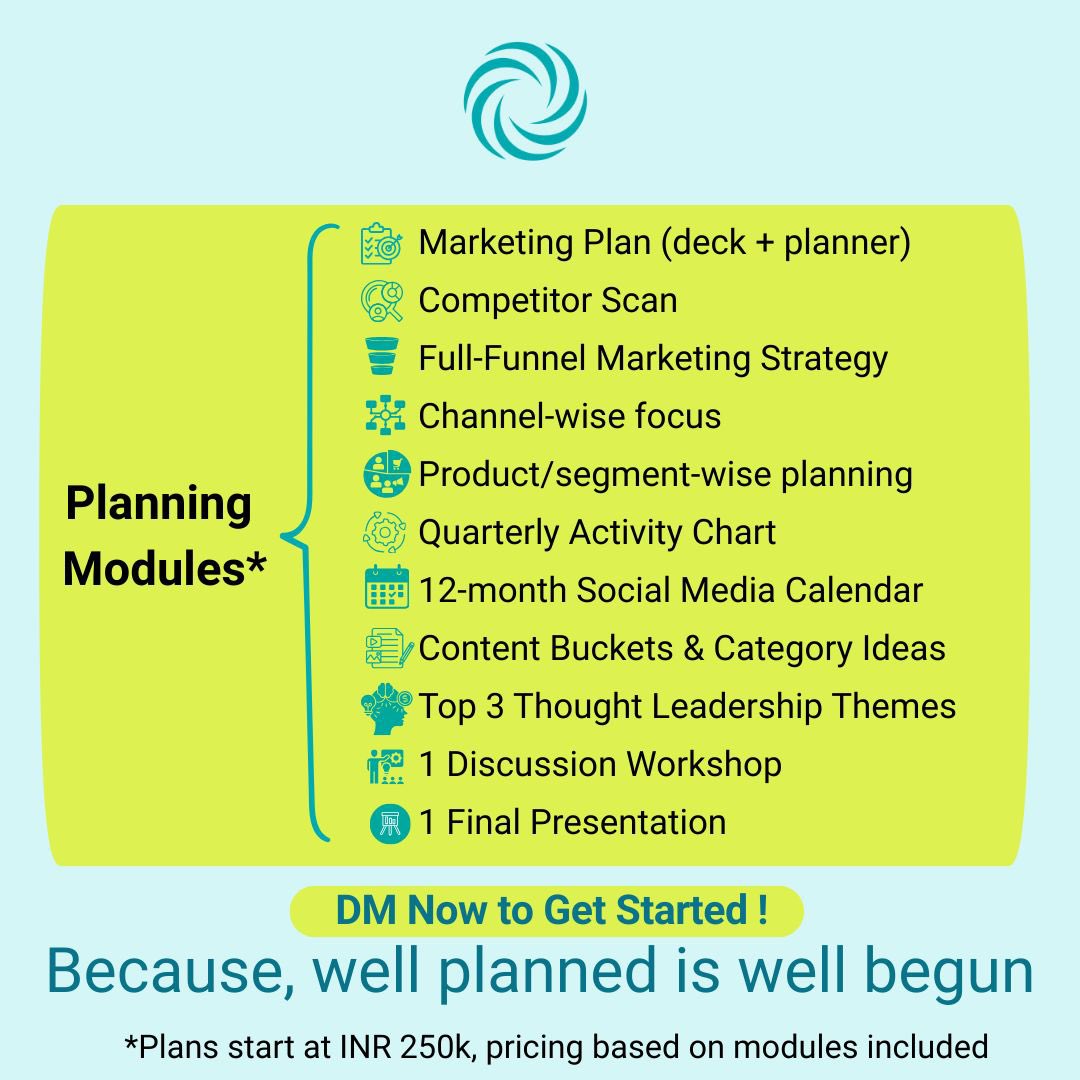
2026 is round the corner! Launching a new year with no plan or worse, a recycled one, is the fastest way to waste your marketing budget. That’s why we built the 15-Day Marketing Plan service for 2026.
#2026 #marketingblueprint#MarketingPlan#Inception#marketing
The marketing plan is your blueprint for starting strong in 2026. It will be your go-to plan to revisit monthly and iterate on to ensure your marketing is aligned with your goals throughout 2026.
We’re opening limited December–January slots. Reply here to know more.
The fundamentals aren’t “strategy slides.”
They’re the engine behind growth.
And most teams only realise that after spending too much time & money on tactics.
Read on to know the right questions to ask when you zoom out and away from mere tactics.
WPP hiring McKinsey is just the headline - the real story is the shift underneath.
The move doesn’t surprise me. Every business I speak to today is asking the same questions:
- How do we grow?
- How do we stay relevant?
- How do we avoid “de-growth” in an unpredictable future?
Inception was built on the belief that this gap - the gap between marketing activity and marketing that drives business outcomes -needs to be filled. Long before it was called a “fractional CMO” or FTE, we called it the outsourced CMO and offered an "outsourced" marketing team.
We were never meant to compete with ad agencies or full-stack creative shops. In fact, we were lucky to collaborate with some of Chennai’s finest independent agencies — creative leaders who understood business, stayed close to clients, and translated that understanding into powerful creative work.
But as the digital landscape accelerated — social media, websites, inbound, automation — a new set of gaps emerged. Larger companies began approaching us, and it became clear that their big agencies simply weren’t built for certain kinds of digital execution at the time.
That opened the door for us.
Social media (when it was only Facebook), LinkedIn, website revamps, landing pages, email funnels, and marketing automation — this became our playground.
We came into existence in the digital era, so it feels natural to say we were “digital natives.” Many brands continued to work with their large agencies for above-the-line (ATL) branding, but they needed our expertise for the digital layer that connects the brand to customers and links customers back to business outcomes.
Why clients continue to find us relevant:
• Marketing rooted in business context: plans, numbers, timelines, and value creation
• Outcome-focused execution: not just posting content, but understanding what it did for the brand
• Full-loop ownership: ideate → execute → measure → recalibrate
• A team disciplined about dashboards, not just deliverables
Now we’re in another shift.
AI-native agencies are being born every day. Tools are changing how we strategise, create, execute, and measure.
For us, it reinforces the need to stay nimble, agile, and focused on what matters: helping businesses grow by aligning strategy, creative, digital, and insight.
As simple as that sounds, it’s never the whole story.
That's why I'm genuinely curious to see what McKinsey's deck recommends for WPP — not with cynicism, but with interest. These shifts always teach the rest of us something, too.
So yes, I’m watching. Notepad in hand. 😊
#Marketing #agencylife #MarketingLeadership #Growth #Strategy
#WPP #Consulting #Inception #marketasana @Team_IBS
We are HIRING marketers in Chennai! Great opportunity for creative marketers who can drive brand growth via social, digital, and brand campaigns! Fun, creative, and challenging! #marketerjobs#chennaijobs#agencylife#marketingagency https://t.co/ty5SWuk06w