Research Associate @cissmunich | @PRIOresearch Research School Member | pol. violence & instability | analog player in a digital world | aggressively mediocre
1/ Happy to share that "Factorial Difference-in-Differences" (FDID), with Anqi Zhao and @pengding00, is out in JASA - ACS. https://t.co/XY39zo8sTw
It has been a truly thrilling experience working with Anqi and Peng.
Our paper “Difference-in-Differences Designs: A Practitioner’s Guide” is now published in the Journal of Economic Literature. It took us a while but we are happy!
We put together a lot of material to make the paper useful in practice: https://t.co/30TbAgihlz
Hope you like!
In political science and economics, a small set of instruments (e.g., rainfall, population, regional characteristics) has been used to identify many endogenous effects. This "collectively" invalidates the instruments. Our paper @ISQ_Jrnl provides a solution for causal identification using non-linearities in the first-stage estimation.
https://t.co/xeqUWEilXe
🧵1/ Our first meta-science paper (with 350+ coauthors) is published today in Nature. It presents one of the largest-ever reproducibility projects in economics & political science.
Here’s what we found 👇
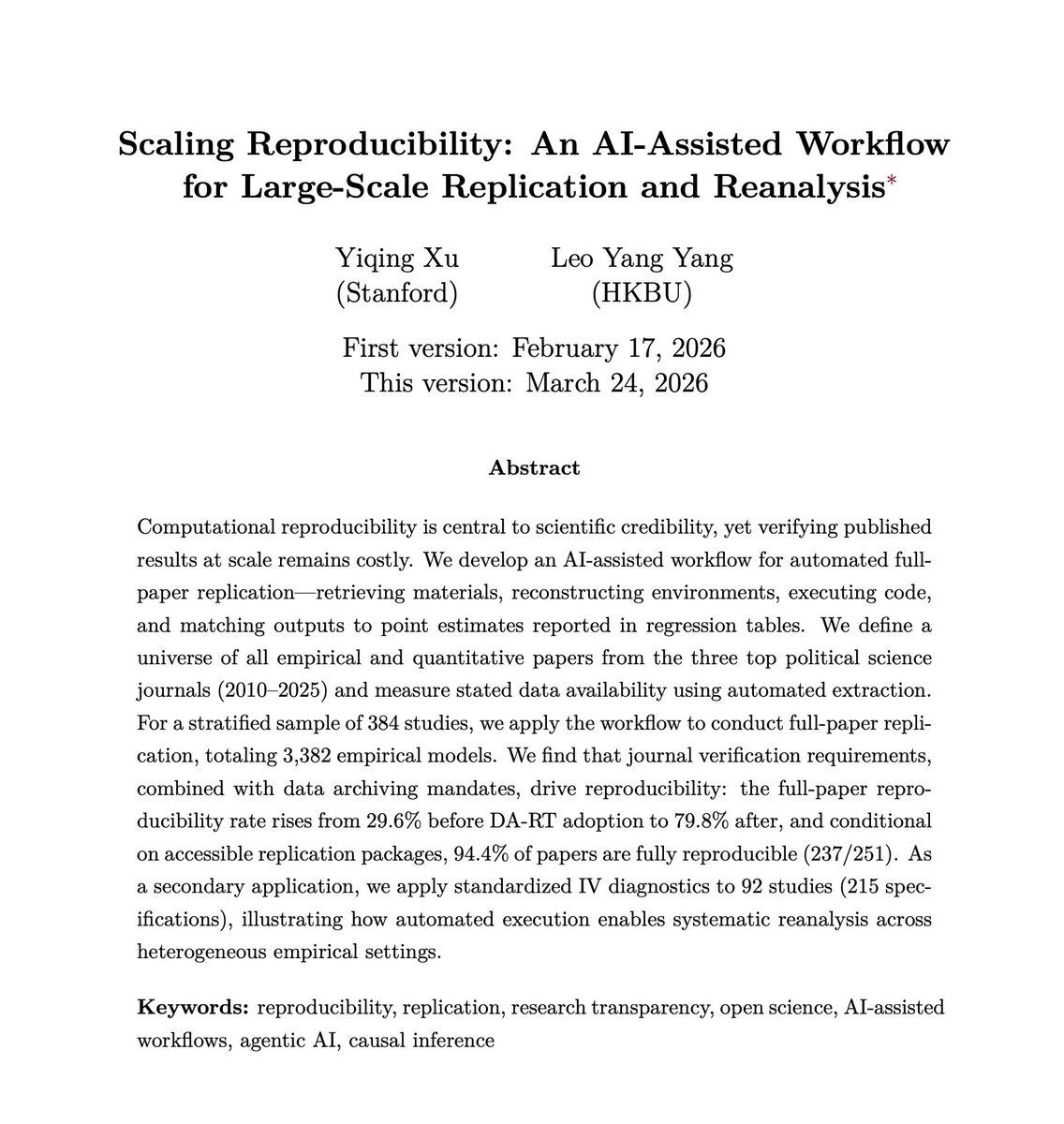
1/🧵 A major update to our paper: "Scaling Reproducibility" w/ @YangYang_Leo.
We move beyond reanalyzing a single design to (almost) full-paper replication!
Paper: https://t.co/fslLN0zTQO
4w ago I was a Claude Code skeptic. I'm not a coder. None of the use cases were relevant. I managed teams & projects, drowning in email & overdue reminders. So I tried creating tools that would help me and... holy crap.
Now I'm sharing the tools I built:
https://t.co/5z9nDcwVno
1/ 🐎 Our gift for the Year of the Horse:
An AI-assisted workflow that scales reproducibility in empirical research. w/ @YangYang_Leo
Paper: https://t.co/fslLN0zTQO
I have a new paper. We look at ~all stats articles in political science post-2010 & show that 94% have abstracts that claim to reject a null. Only 2% present only null results. This is hard to explain unless the research process has a filter that only lets rejections through.
Hi all, I've uploaded the 2025 update to my PhD Applied Econometrics slides:
➡️ More on regression & causality
➡️ Dynamic panel data models
➡️ Streamlined diff-in-diff extensions
➡️ More on spillover effects
➡️ Results from new papers on many topics
Link in the original tweet
This spring I'm GSI-ing graduate formal models. I struggled with proofs at first, and it's not part of math camp so I drafted a guide. I'm sharing it in the spirit of public goods / in case some are interested; I'd be grateful for comments/feedback! https://t.co/zzNn7uIcQO
A Critical Look at the Issue of Causal Inference
@DeatonAngus and Nancy Cartwright raise doubts about the view that randomized controlled trials (RCTs) should be assigned a special status. See https://t.co/YTdgsI8ER8
For a response by @guido_imbens, see: https://t.co/9oRJpGn9NW
Glad this paper with @guido_imbens is out in the JEP.
The LaLonde paper has had a big impact on my academic journey and continues to teach us about the challenges and possibilities of conducting credible inference using nonexperimental data. https://t.co/kfRlFXxULm
Many thanks to Tim for the tireless editing and suggestions. @TimothyTTaylor
New software: "Projoint: The One Stop Conjoint Stop" (with @aaronrkaufman & @YusakuHoriuchi), makes conjoint surveys easier & less biased, including everything from a drag-and-drop web survey design tool to specialized analysis software. Comments welcome. https://t.co/5cyTohjWBa
If you have been curious about which topics are increasing in popularity in econ, @paulgp has a new tool for you!
https://t.co/9pzDknEgHh
This lets you search over AER and AEJ's + 30k NBER WP!
Very neat!
How do promotion prospects drive patterns of repression in China? @baggottcarter, Jonghyuk Lee, and I find that the most promising officials hesitate to use repression for fear of backlash riots, except for in separatist regions https://t.co/qdb2o9TwJb
Latest from my colleagues at Forecasting Research Institute (FRI):
Superforecasters still outperform top LLMs.
But for how much longer?
Linear extrapolation from recent ForecastBench data suggests LLMs will surpass top humans in November 2026.
And linear extrapolation is itself a tough benchmark for both humans & LLMs to beat
Why do authoritarian states charge political opponents with non-political crimes? In our @The_JOP paper with @jenjpan & @xuyiqing, we examine how *Disguised Repression* undermines opponents’ moral authority and mobilization capacity. https://t.co/40R0wi7yiz🧵
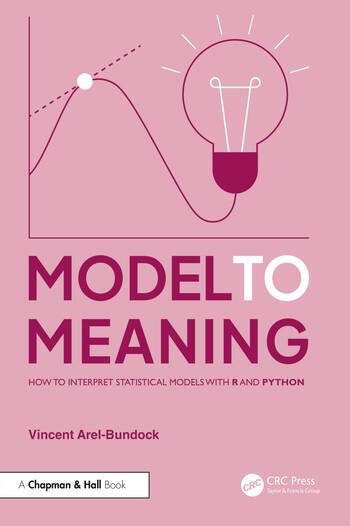
Whoa—my book is up for pre-order!
Model to meaning: How to interpret Statistical & ML Models in #RStats and #PyData
The book presents an ultra-simple and powerful workflow to make sense of ± any model you fit
Note: The web version stays free forever.
https://t.co/fpDmSdDWov
"Political violence in democracies: An Introduction" that I coauthored with Ursula Daxecker & Neeraj Prasad is now out & open access, @JPR_journal . We introduce 14 excellent articles and discuss the state of research on political violence in democracies. https://t.co/0q41C7OCVj