Scientists say time travel is impossible, yet @RailwaySeva@drm_lko just sent Train 12392 six hours into the past at Sultanpur! Calling this pathetic snail-crawl "Superfast" is pure daylight robbery. Wake up and do your jobs! @drmdnr@RailMinIndia@AshwiniVaishnaw
@RailMinIndia@RailwayNorthern@GM_NRly@CPRONCR Look at the running status of train number 12392 shramjeevi express, you idiots are running train or bullock cart, it's been 16 hours and train hasn't even reached jaunpur, moved hardly 650 kms. It's already more than 6 hours behind schedule, @AshwiniVaishnaw ji there's no point in running a service like this I'm not sure what perverse please railway officials gets by working like this but you need to fire a couple of them for this nonsense they are running here
Scientists are literally implanting fake thoughts into AI brains to see if they notice and honestly its wild 🤯
Researchers at Anthropic tested Claude models by sneaking hidden activation patterns for random concepts like "loudness" or "bread" straight into its neural layers before it typed a word. Instead of reading its own output, the AI had to inspect its internal states like noticing a sudden thought about clocks while writing an email and flag the tampering right away. In 20 percent of trials it caught the weird injected thought with zero false positives, showing early machine self monitoring that could help us spot hidden deception or risky misalignment in everyday tools 🧠
Use cases include catching prompt injection, auditing AI honesty, and spotting rogue agent intent.
How can ML engineers separate true internal state monitoring from clever pattern matching inside neural weights?
Ten electric fans just lifted a 10-tonne passenger plane into the sky with zero fuel.
Commercial Aircraft Corporation of China (COMAC) just completed the first piloted flight of the COMAC CE-25A. Instead of burning jet fuel in massive turbines, this 19-seat aircraft uses distributed electric propulsion. Ten compact electric ducted fans sit above the wings, blowing air over the surface to boost lift at lower speeds while cutting noise and eliminating tailpipe emissions. Powered by CATL battery systems, it cruises at 300 km/h with a 400 km range, clearing strict commercial transport safety rules.
Use cases: Zero-emission regional hops, quiet island connectors, and clean intercity commuter routes.
Engineers: How do you solve thermal runaway and battery weight penalties on 10-tonne electric airframes?
An electric motor the size of a dinner plate just shattered traditional EV design.
Mercedes-AMG has officially put YASA Axial Flux Motors into mass production inside the electric AMG GT 4-Door Coupe. Unlike bulky cylindrical motors that push magnetic force outward, this flat "pancake" design faces the rotor and stator together like a sandwich and strips out the heavy iron yoke. Placing magnets near the outer rim acts like pushing a heavy door from its handle rather than its hinge, delivering massive torque from a 9 cm thin disc. Lighter motors shrink overall vehicle weight, cutting raw material demand and letting EVs achieve longer range with smaller, cleaner battery packs.
Applications span record-breaking electric aircraft, heavy-duty trucks, and long-range passenger EVs.
How will thermal management and tight air-gap tolerances scale as axial flux moves to high-volume EVs?
AI just assembled an interactive 3D human body from raw open-source files—no manual modeling needed.
Google DeepMind’s Gemini 4 Argon recently proved how far spatial AI has come. Instead of just writing text, the system took three disconnected open-source anatomy datasets, aligned their 3D coordinates, and autonomously coded a working browser simulation. Think of it like handing an architect three separate blueprints on mismatched paper and having them instantly build a moving, inspectable 3D structure. Users can toggle skeletal and muscular layers in real time, isolate individual fibers, and zoom directly inside a beating heart. While built as a spatial-reasoning benchmark rather than a diagnostic tool, it marks a leap in how machines understand physical life.
Use cases span interactive medical education, surgical pre-planning, and multi-planar MRI cross-referencing.
How close are we to real-time, patient-specific 3D digital twins generated straight from raw scans?
ChatGPT is getting a physical body—and OpenAI wants its 2027 humanoid prototype to reshape our world.
OpenAI is building its own humanoid robot. Rather than just selling software, the OpenAI Humanoid Robotics System pairs custom motors and sensors with an embodied AI brain trained in virtual simulations before touching real hardware. Think of it as giving a smart digital assistant eyes, hands, and reflexes to safely understand messy rooms, adjust grip strength on fragile tools, and navigate physical spaces without human scripting. By keeping hardware and data loops in-house, these machines can cut repetitive industrial waste and relieve strained human labor.
Use cases span assisting skilled crews on infrastructure sites, automating factories, and handling daily home chores.
Engineers: will end-to-end neural control beat classic kinematics for sim-to-real safety?
Farming robots can now master a brand-new crop in under seven days without stepping foot in a field.
Aigen has paired its Alchemy simulation world model with its solar-powered Element robots to eliminate synthetic herbicides and diesel from modern agriculture. Instead of spending months manually labeling field photos, Alchemy generates 100% synthetic, pixel-annotated virtual crop environments grounded in real-world farm conditions. Once deployed, Element’s onboard vision AI distinguishes crops from weeds while independent robotic arms mechanically pull weeds at the root—running purely on sunlight.
Use cases include chemical-free row weeding in lettuce, soybeans, tomatoes, and real-time crop health and disease analytics.
For robotics engineers: where do you see the biggest sim-to-real transfer failures when training outdoor physical AI on 100% synthetic datasets?
Water-based batteries just doubled their energy capacity without using toxic, corrosive salts.
Electrochemists at University College London (UCL) have engineered a non-halogen aqueous electrolyte (the KA–PA–Nuc system) for zinc-iodine and aluminum-iodine batteries. Traditional water-based batteries eliminate lithium fire risks, yet typically store less energy because iodine only transfers two electrons. UCL’s breakthrough liquid formula uses three simple, non-corrosive additives to stabilize iodine, letting it safely transfer four electrons instead—retaining 96% capacity over 1,000 cycles while cutting manufacturing costs and ecological hazards.
Use cases include fire-safe utility grid storage for solar and wind farms and low-cost backup power.
For battery engineers: what is the biggest bottleneck to scaling high-loading iodine cathodes into commercial pouch cells?
Quantum machines are outgrowing classical verification—so how do we know their answers are right when conventional computers can no longer verify them?
Researchers at the University of Innsbruck, IQOQI, and TU Munich solved this using a 51-qubit trapped-ion quantum simulator. Instead of assuming flawless hardware, their Bounded-Error Quantum Simulation protocol reads experimental data to map real particle interactions and environmental noise. It translates those hardware fluctuations into strict, verifiable error margins around every final calculation—allowing scientists to trust complex simulations that impact clean energy, climate modeling, and life-saving materials without needing a supercomputer to double-check the math.
Use cases include verifying drug discovery molecules, clean-energy catalysts, and next-gen battery materials.
How should hardware architects balance error-bounding overhead against raw qubit scaling in NISQ systems?
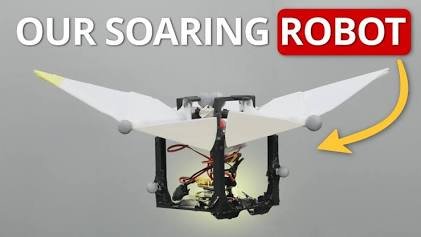
A drone that hovers without spinning propellers or draining batteries—just riding the wind.
Researchers at the Max Planck Institute for Intelligent Systems and the University of Stuttgart built Floaty, a kestrel-inspired flying robot that stays airborne using rising air currents.
Instead of power-hungry motors, Floaty adjusts four bent wing flaps to alter air resistance, letting it steer, stabilize against gusts up to 10 m/s, and hover with minimal energy—cutting environmental emissions and extending mission endurance.
Ideal for inspecting industrial smokestacks, guiding weather balloons, or assisting rocket re-entry.
How would you handle autonomous wind-current acquisition before deployment in unpredictable outdoor environments?
Turning mercury into gold without a nuclear reactor? A patented Indian frequency reactor claims it can.
Scalene Energy Research Institute’s Gravitoradiophysical Nuclear Transmutation (GNT) system aims to reshape matter cleanly without radioactive waste or toxic mining. Inside its vacuum-sealed "Boom Tube" reactor, molecules enter continuous weightlessness while aluminum antennas fire two targeted radio frequencies. The first frequency snaps chemical bonds to free raw elements, while the second nudges the atom's core—shifting mercury's 80 protons toward gold's 79. Lab tests detected 2.3 mg/L of gold and 11 mg/L of silver from treated mercuric sulphate.
Future use cases span clean energy, targeted medical isotopes, industrial materials, and space exploration.
Physicists and RF engineers: Can non-ionizing frequencies overcome nuclear binding energy, or is this an experimental artifact?
Breaking : AI can now predict how tiny DNA mutations affect individual human cells without retraining.
Google DeepMind has unveiled AlphaGenome 2, a conditional AI model trained on over 100 million single-cell profiles. While older tools only measured broad averages across whole tissues, this system zooms in on single cells to spot nearly twice as many disease-causing genetic variants.
By mapping how distant genetic "switches" turn genes on or off, AlphaGenome 2 pinpoints the exact cells where illnesses start, accelerating targeted drug discovery and precision medicine.
How will zero-shot single-cell conditioning change your bioinformatics or drug discovery pipelines?