@C4WBAL
Regarding ranked voting in Baltimore I’m ok with 50% requirement but not for the complicated 1..5. With signs like vote for Democrats everywhere I doubt most people will analyze seriously.
@Irina_exh Yes, she should know better in another country that could result in a much more serious penalty. Forcing students to pledge allegiance may even be a crime. What if it were a Nazi flag? This is far beyond teaching students needed skills they are there to learn,
@wakeupusa Is this like taking my chips and leaving if I don't get my way?
I think I hear this kinda thing before when Trump won, let's see how many get on planes.
@TaraBull808 Absolutely, you are not allowed to obstruct officers. Getting in front of anyone and holding a camera directly in front of their face imho you are obstructing their vision and if they were to trip and fall injuring themselves you'd be at fault. Being obnoxious has its own rewards
@PrimeVanguardX He started walking toward and shouting at a member of the President’s cabinet and then got forcibly removed.
Sorry, but this is how anyone would get treated in this situation.
As Padilla once said:
Grok, under what conditions can a President order the National Guard to take action in a state when the governor hasn't requested them, & may even be opposed?
***
A U.S. president can order the National Guard to take action in a state without the governor’s request, or even against their opposition, under specific legal and constitutional conditions. Here’s a concise breakdown:
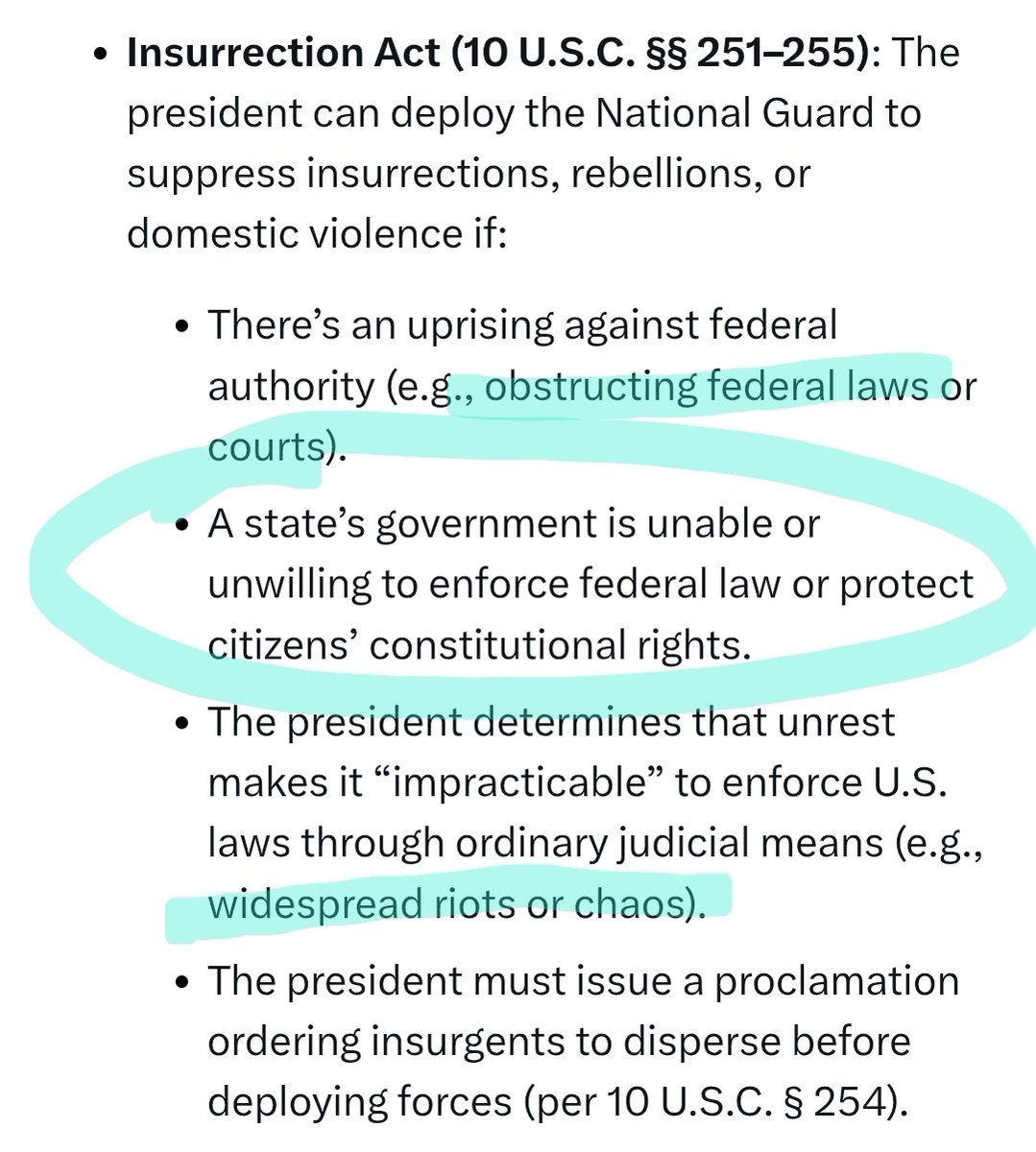
Insurrection Act (10 U.S.C. §§ 251–255): The president can deploy the National Guard to suppress insurrections, rebellions, or domestic violence if:
There’s an uprising against federal authority (e.g., obstructing federal laws or courts).
A state’s government is unable or unwilling to enforce federal law or protect citizens’ constitutional rights.
The president determines that unrest makes it “impracticable” to enforce U.S. laws through ordinary judicial means (e.g., widespread riots or chaos).
The president must issue a proclamation ordering insurgents to disperse before deploying forces (per 10 U.S.C. § 254).
National Emergencies or Martial Law:
In extreme cases, such as a national emergency (declared under the National Emergencies Act) or when civil order collapses, the president could federalize the National Guard under their authority as commander-in-chief (Article II, Constitution). This is rare and typically requires a clear justification, like a natural disaster or widespread violence overwhelming state capacity.
Federalizing the National Guard (10 U.S.C. § 12406):
The president can call the National Guard into federal service for:
Enforcing federal law.
Suppressing rebellion.
Responding to major emergencies (e.g., attacks on U.S. soil or catastrophic events).
This bypasses the governor’s authority, as the Guard shifts from state to federal control.
Key Legal Precedents:
Little Rock Crisis (1957): President Eisenhower federalized the Arkansas National Guard and sent federal troops to enforce school desegregation, overriding Governor Faubus’s opposition, citing obstruction of federal court orders.
Civil Rights Era (1960s): Presidents Kennedy and Johnson used federalized Guard units in Alabama and Mississippi to enforce desegregation against resistant governors.
Practical Constraints:
Political Backlash: Acting against a governor’s wishes risks escalating tensions and public criticism, as seen in debates during the 2020 protests when some governors opposed federal intervention.
Judicial Review: Courts may scrutinize the president’s actions if they overstep constitutional bounds or lack clear justification.
Posse Comitatus Act (18 U.S.C. § 1385): This limits federal military (including federalized Guard) involvement in domestic law enforcement unless authorized by the Insurrection Act or other exceptions.
Governor’s Role:
Normally, the National Guard operates under state control, and governors request federal assistance (e.g., for disasters).
Without governor consent, the president must rely on clear statutory authority (like the Insurrection Act) to override state objections, as governors lack veto power once the Guard is federalized.
Example Scenarios:
A state refuses to comply with a federal court order (e.g., desegregation or voting rights), and the president deploys the Guard to enforce it.
Widespread violence or riots overwhelm state police, and the governor refuses federal help, prompting the president to invoke the Insurrection Act.
A terrorist attack or foreign invasion requires immediate federal response, justifying Guard federalization.
In summary, the president has broad but not unlimited authority to deploy the National Guard without governor approval, primarily under the Insurrection Act or in national emergencies. However, such actions require clear legal grounding, face political risks, and may be subject to judicial review. If you want historical examples or deeper legal analysis, let me know!
@AEW@TheDonCallis@rainmakerXokada apparently there’s no security or control at AEW .. heels can do whatever they want.. I don’t buy this distraction nonsense, 1 bad guy and 15 security can’t stop him. Let’s just see them in the ring.
@AEW@GatewayArena@TBSNetwork @SportsonMax @The_MJF@AEWonTV It’s hard to watch, new folks see 4 and 5 on one beat downs and think the promotion has lost all control and are turned off. Wrestlers like @johnmoxley hiding like a punky bully behind 3 wrestlers and a woman. Shows he’s lost his edge.
@ClaudioCSRO@AEW There it is the much expected screw job, so Moxley has lost it, he can’t win a match without help, pretty sad he use to be really good..