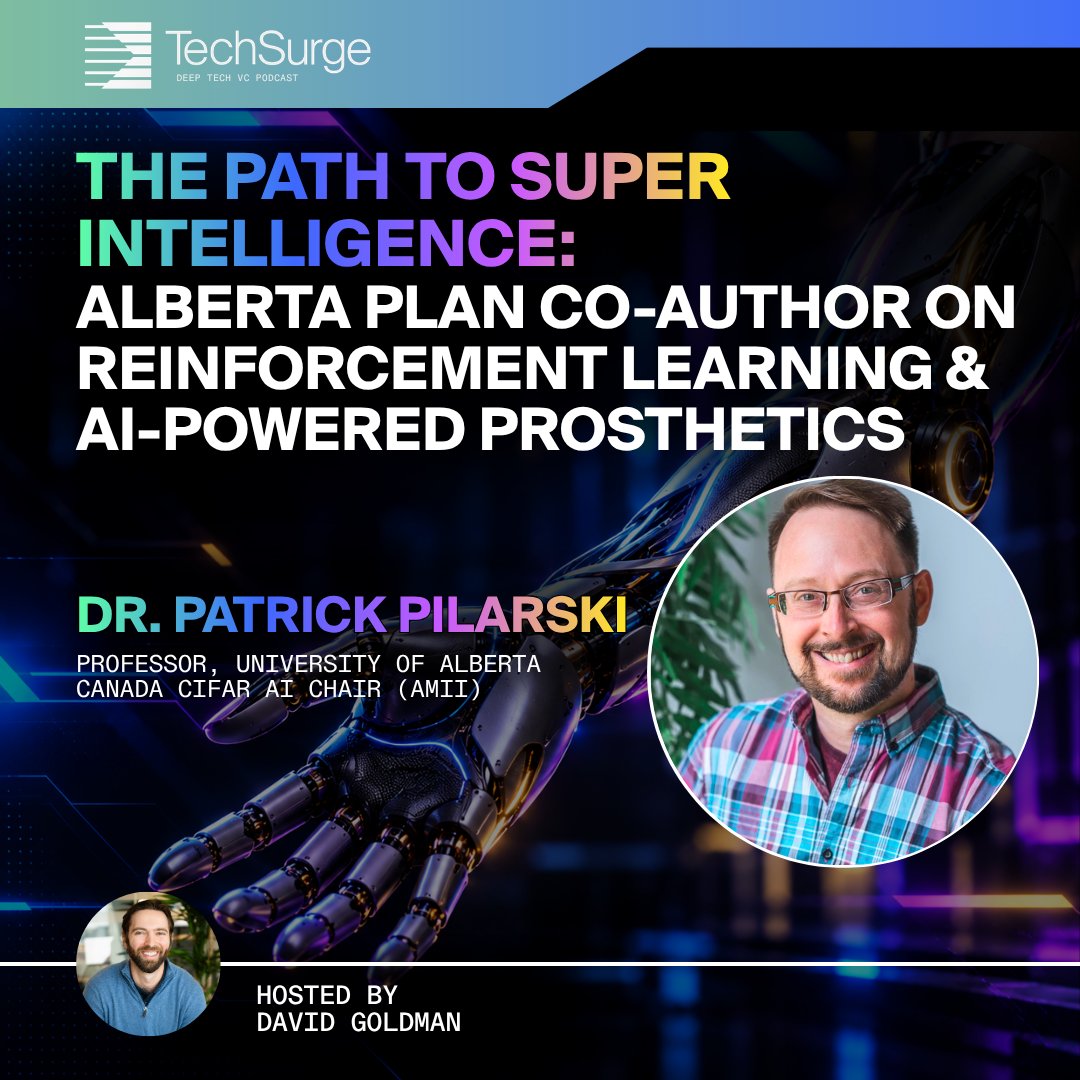
"Your co-author has argued that LLMs are a dead end."
@PatrickPilarski , Canada @CIFAR_News AI Chair (Amii) and co-author of the Alberta Plan, on an agent that never stops learning, and the AI-powered prosthetics his lab builds.
Trailer for the new TechSurge episode, link below
The “Alberta Plan” lays out a path to superintelligence through reinforcement learning. Its co-author, @PatrickPilarski, also builds AI-powered prosthetics.
New TechSurge episode with Host @dgoldman627, coming soon.
"Customers today don't care about a chip. They don't care about the package. They don't care about the board."
@RajaXg on why AI infrastructure buyers just want electricity in and tokens out.
New Episode of Techsurge with Host @dgoldman627 on YouTube 🎙️
"The competition is not between Nvidia, Google, or Broadcom. It's between China Inc. and the rest of the world."
@RajaXg is on the real AI hardware race everyone's missing with Host @dgoldman627
New Techsurge Episode live on YouTube 🎙️
"That's a lot of capital. I don't think we have that capital."
@RajaXg Koduri on the math behind AI infrastructure's price tag: 400GW of new computers needed by 2030, at $50-60B per gigawatt. That's $24 trillion.
Full Episode of Techsurge with Host @dgoldman627 on YouTube
"You need to render the entire world in 16 milliseconds."
@RajaXg on why decades of gaming's brutal performance constraints are what still make Nvidia formidable today.
Full Episode link given below 👇
Thanks @dgoldman627 for a fun conversation. Topics: the $24T capital math behind AI compute, why inference is a whole memory hierarchy problem, why the spec is now 90% of chip design, a Steve Jobs decision story, and token mills. Worth a listen.
"That's a lot of capital – I don't think we have that."
@RajaXg (2x head of graphics at @AMD ) on the real cost of AI infrastructure, and why China's 5-6x cost advantage is the bigger threat than @nvidia vs. @Google vs. @Broadcom .
New TechSurge episode, now on YouTube.
Every gigawatt of AI infrastructure costs $50–60 billion in the West. China's target? Under $10 billion. New episode of TechSurge: gaming chip legend @RajaXg (Founder & CEO,@realoxmiqlabs) joins host @dgoldman627
The top 3 AI neocloud players are worth ~$125B in public markets. We talk endlessly about chip startups.
We barely talk about them. @austinsemis on AI infrastructure's most under-discussed layer.
Frontier models command a premium. Older, smaller models don't. Senior AI Chip Analyst @austinsemis on why landing a frontier anchor might be a prerequisite for the next breakout chip company.
Nvidia invests in neoclouds → neoclouds buy GPUs → GPUs become collateral for debt → revenue flows back to Nvidia → Nvidia invests in more neoclouds.
@austinsemis on the circular financing question everyone's asking.
"We had GPUs, and they kind of morphed to fit the shape of what we're doing... no one has really brought a chip to market designed specifically for LLMs."
@austinsemis on AI hardware's next evolution.
I joined David Goldman on @CelestaCapital's TechSurge podcast to talk about the race to build the next trillion-dollar AI chip company.
The main idea we dig into is that no one has yet brought a chip to market designed specifically for LLMs. Blackwell is a GPU that morphed toward the workload. Nobody has yet stood up a gigawatt of clean-sheet LLM silicon, and that gap is where the next trillion-dollar chip company comes from.
We cover:
• Why AI infrastructure now sells as full systems, and how Nvidia got to rack scale first
• Prefill vs. decode, and why the SRAM bets Groq and Cerebras made years ago suddenly paid off
• How neoclouds built $125B+ of public-market value while most investors missed them
• Circular financing, and why I land on the demand being real
• My four conditions for the next trillion-dollar chip company
• Clean-sheet architectures: @OpenAI's Jalapeno, @TensordyneInc's log math, @Etched's low-voltage inference
• Why enterprise and on-prem inference could end up bigger than the cloud
Full episode: https://t.co/3J52KIygMo
100 qubits is easy. A million is the problem.
Nobel laureate John Martinis says quantum computing's real bottleneck isn't physics anymore, it's manufacturing.
Trailer for the new TechSurge episode, out now:
Link given below⬇️
Training used to be where all the AI money went. Not anymore.
For the first time, inference spend has overtaken training spend.
Semiconductor analyst Austin Lyons on where the next trillion-dollar chip company emerges.
Trailer for the new Tech Surge episode:
Link given below⬇️