I've been in this industry long enough to know that when CT is promising money around the corner, it's much farther away. Market will be stagnant for the rest of the year.
America has 7.6 million job openings.
So why does finding a job feel harder than ever?
Because the labor market is starting to lose price discovery.
In a healthy market, prices tell you where demand is.
Labor works the same way.
Open positions signal where workers are needed. Wages signal how scarce those workers are. Hiring closes the loop.
But that loop is breaking.
Companies leave job postings online for months.
Some are collecting resumes for future hiring.
Others are "ghost jobs" meant to reassure investors, employees, or customers that the company is growing.
At the same time, applicants are firing off hundreds of AI-generated resumes through one-click applications.
Recruiters respond with AI filters.
Humans increasingly never meet.
The result?
Millions of job postings.
Millions of applicants.
And both sides think the other doesn't exist.
This is what economists call a loss of price discovery.
The market still has signals.
They're just becoming too noisy to coordinate people efficiently.
It's a strange paradox:
The labor market can look healthy on paper while feeling completely broken to the people living inside it.
The internet made applying for jobs nearly free.
Now we're discovering that when signaling becomes free, signals stop meaning much.
The “lone genius” story is wrong.
But so is the idea that genius is a myth.
No one invented the modern world alone.
The plow, fire, language, agriculture, writing, markets, science, software — these were not gifts handed down by one heroic caveman staring into the sunset.
Human progress is cumulative.
People copy.
Tweak.
Teach.
Forget.
Rediscover.
Improve.
Across generations, knowledge compounds.
That is the real miracle of civilization.
But then people take that truth and run too far with it.
They go from:
“No one creates from nothing.”
to:
“Therefore individuals don’t really matter.”
That’s where the argument breaks.
Because history is not just collective knowledge slowly drifting forward.
It is also moments where one person, or one small group, sees a possibility buried inside the noise and forces it into reality.
Bezos did not invent the internet.
He did not invent warehouses, credit cards, databases, package delivery, cloud computing, or capitalism.
Obviously.
But Amazon also did not “just happen” because society had accumulated enough knowledge.
Specific people made specific bets.
Books first.
Customer obsession.
Reinvest everything.
Build fulfillment.
Expand to everything.
Turn internal infrastructure into AWS.
Accept brutal low-margin scale for years.
Those choices mattered.
The internet existed.
Amazon was not inevitable.
Same with Apple.
A pile of semiconductors, Xerox PARC research, designers, engineers, factories, and consumers does not automatically become the iPhone.
Someone still has to compress the chaos into a product.
Same with SpaceX.
Rocket science existed.
NASA existed.
Physics existed.
Government contracts existed.
Engineers existed.
But reusable rockets did not simply emerge from “the collective.”
Someone still had to make the insane bet, recruit the people, survive the failures, and keep pushing.
So the better model is not:
“Great individuals create everything.”
And it is not:
“Individuals are just myths; only the collective matters.”
The better model is:
Collective knowledge creates the possibility space.
Exceptional individuals choose, combine, coordinate, and scale inside that space.
The collective is the soil.
The individual is the catalyst.
Without the soil, nothing grows.
Without the catalyst, most things never happen.
This is also why the billionaire debate gets so sloppy.
The strongest critique of billionaires is not “genius is fake.”
That’s weak.
Genius can be real.
Leadership can be real.
Taste, judgment, risk, timing, obsession, and execution can be rare and valuable.
The stronger critique is:
Modern wealth is created through networks.
Workers.
Customers.
Infrastructure.
Law.
Public research.
Suppliers.
Culture.
Financial rails.
State enforcement.
Generations of accumulated knowledge.
So when one person captures an extreme share of that value, it needs justification.
But the strongest pro-founder argument is also real:
Networks are often inert.
They contain possibility, but not direction.
The difference between “the internet exists” and “Amazon exists” is not automatic.
It is agency.
Civilization is collective accumulation.
But history often turns on unusually high-agency individuals.
The annoying online version forces you to pick one god:
The genius.
Or the collective.
Reality is more interesting.
Geniuses are not separate from the collective.
They are the collective becoming sharply focused through one person.
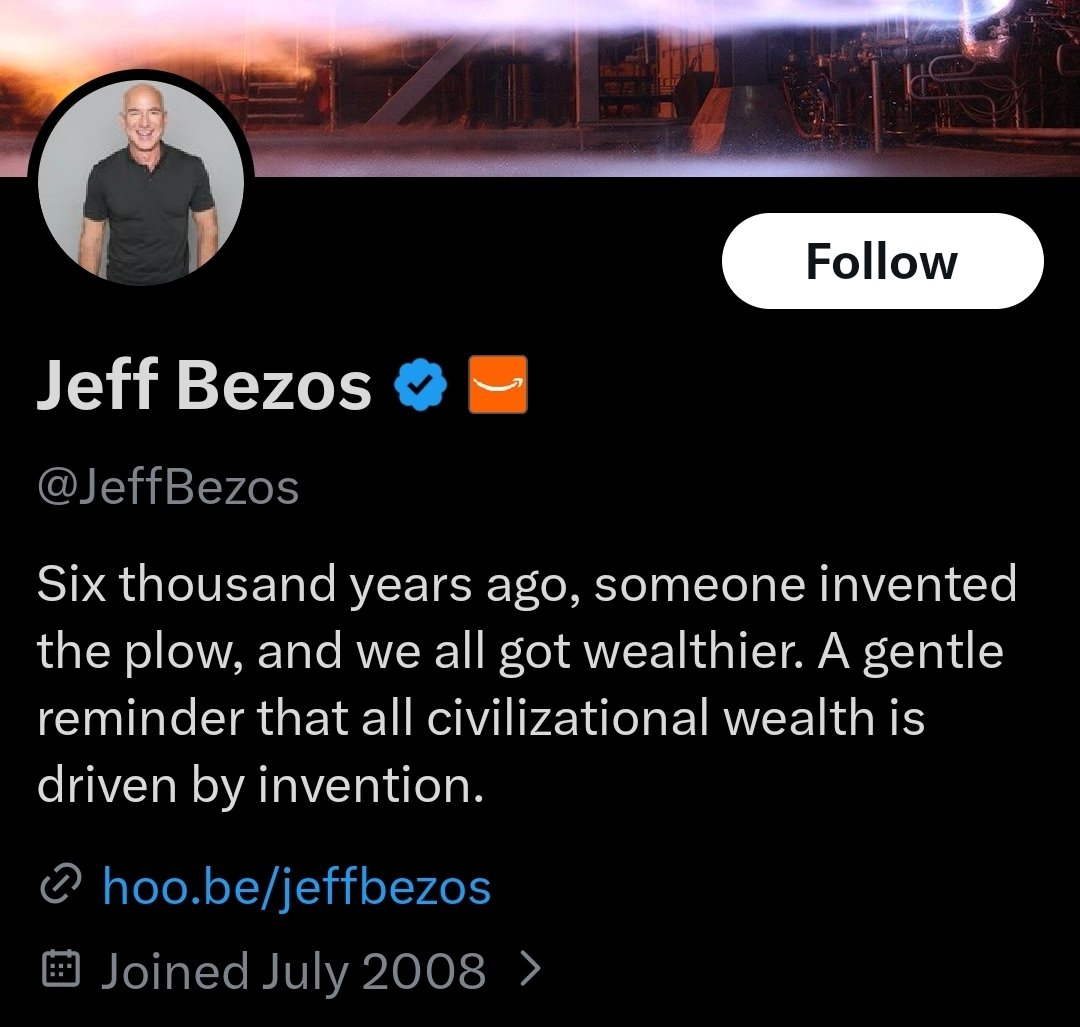
The problem with Jeff Bezos' ideology is that it's based on a false premise. The idea that "six thousand years ago someone invented the plow" is based on a faulty belief that ancient humans functioned as individuals. They did not.
Ancient humans were collectivist. The likelihood that one individual invented anything is slim to none.
This is the myth of the genius.
Archeological evidence demonstrates that for hundreds of thousands of years, early humans congregated around communal gathering places, like the fire, and engaged in problem solving and passing on of shared learning down through generations.
Additionally, the plow (and tools like it) were developed by humans in Mesopotamia, Europe, Egypt, East Asia, sub-Saharan Africa as well as other places - not in one place by one person. This is known as parallel development.
Believing that the plow was invented by one genius is like believing language was invented by one person. It is a silly myth and represents the projection of current moral standards onto past events.
This is called 'presentism' and it is both an uncritical and ignorant way to view history.
Social learning was the main driver of human evolution. Collectivism is how we both survived and progressed as a species.
The myth of the genius is an example of uncritical analysis and a flawed lens used to justify the grotesque hoarding of wealth and obscene inequality that is currently tearing at the social fabric our species.
It needs to be thrown on the trash heap of history.
⚡️Civilization is a system for conquering distance.
Roads conquer physical distance.
Money conquers exchange distance.
Law conquers trust distance. Archives conquer memory distance. Schools conquer generational distance. The postal system conquers coordination distance.
When the postman becomes unreliable, the empire is losing its ability to keep people inside the same world.
That is what collapse really is: the return of distance.
Rome at its height compressed geography. A decision in the center could move outward through roads, letters, tax offices, military posts, legal channels, and administrative memory. The empire made faraway places feel connected to the same operating system. A merchant, governor, soldier, bishop, landlord, or official could act as if messages would arrive, contracts would matter, taxes would be collected, orders would propagate, and law would have reach.
Once that reliability decays, the map does not change immediately. The psychology changes first.
People stop assuming the center will answer.
Then they stop asking.
Then they make local arrangements.
Then local arrangements become the real state.
That is the collapse.
The postman disappearing means the empire’s nervous system stopped firing. The limbs still exist. The cities still exist. The roads still exist. The titles still exist. But the signal no longer travels with enough speed, trust, and repetition to hold the body together.
That is why service decline is more important than spectacle. The state can still speak while losing the ability to execute. It can still issue rules while losing the ability to enforce. It can still collect symbols while losing operational reach. It can still perform authority after authority has become hollow.
The real death of an institution happens when people route around it without drama.
They stop expecting the court to resolve the dispute.
They stop expecting the school to educate the child.
They stop expecting the police to arrive.
They stop expecting the road to be repaired.
They stop expecting the permit office to answer.
They stop expecting the currency to hold value.
They stop expecting the capital to understand local reality.
Then private substitutes emerge: patrons, clans, churches, militias, landlords, guilds, warlords, local bosses, private security, informal credit, barter, family networks. Civilization does not simply vanish. It fragments into smaller protection systems.
That is the real truth. Collapse is the privatization of reliability.
The state fails, and people buy or build miniature states around themselves.
⚡️Human life is bounded.
You appear for a brief moment, inherit a world you did not create, carry a body you did not choose, meet suffering you cannot fully avoid, love things you cannot keep, and then disappear.
That makes life tragic.
It also makes it sacred.
Because the task is not to live forever.
The task is to make the temporary opening matter.
You are not merely an animal chasing reward.
You are not merely a social identity collecting achievements.
You are not merely a consumer optimizing comfort.
You are a temporary aperture through which reality becomes aware, and the clock is running.
So the question becomes brutally simple:
While consciousness is awake in this body, what will it serve?
This sounds profound until you realize it treats money like a magic wand.
Most billionaire wealth is not cash sitting in a vault.
It is ownership in companies.
Stock.
Equity.
Paper value tied to businesses, employees, customers, supply chains, investors, regulations, and markets.
Could billionaires do more good? Obviously.
But “why don’t they just solve world poverty?” misunderstands the problem.
You cannot permanently solve food insecurity by wiring money once.
You need logistics, agriculture, energy, roads, storage, governance, trade, anti-corruption systems, local capacity, and functioning institutions.
The same is true for housing, healthcare, education, and infrastructure.
Money helps.
But money alone does not build competence.
A billionaire can fund malaria nets, vaccines, schools, research, or emergency food relief.
That can be hugely valuable.
But turning broken systems into functioning systems is not the same as buying a yacht.
The real question is not “why doesn’t one rich person save the world?”
The real question is why so many governments spend trillions and still fail to build systems that work.
Billionaires are easy to blame because they are visible.
Institutions are harder to blame because failure is spread across bureaucracy, incentives, politics, corruption, and time.
The world’s biggest problems are not unsolved because no one has enough money.
They are unsolved because coordination is hard, incentives are broken, and systems matter.
SERIOUS QUESTION: You don’t find it weird that not a single billionaire wants to end world poverty ?? Doesn’t it strike you as bizarre that no one with that kind of wealth wants to be the hero who actually solves the world’s biggest problems when they literally could ?? Isn’t that suspicious ??
@DarkFootstep@omgsidewalks Not only that, if you gave all those people those stimulus checks, the prices in those economies would just rise to match the increase of money supply.
The Ponzi scheme has finally come to bear. His billionaire friends who invested before IPO are quietly cashing out. The top of pyramid is cashing out, that’s what’s happening. Of course they all know Space X is never going to deliver on its impossible promises. Before the new deadline of 2028, the fabricated trillionaire will make more impossible promises to hustle more money off his gullible fans.
This sounds moral until you think about it for five seconds.
A billionaire founder usually gets there by owning part of a company that scaled to serve millions of people.
Saying “everything after $1B should be taxed at 100%” is basically saying:
please stop creating value once the scoreboard gets too high.
Honestly, billionaires should be illegal. Anything over a billion should be taxed 100% and go to public services. There's no reason for any single person to have that much money.
Canada may be making housing “more affordable” by giving up on making homes cheaper to buy.
That is the quiet shift underneath the latest housing policy.
The official goal is reasonable:
keep construction moving,
turn unused units into affordable rentals,
and prevent the housing pipeline from freezing.
But the mechanics are harder to ignore.
Ottawa and B.C. are backing a $3.2B plan to reduce development costs and convert thousands of unsold condos into affordable homes.
CMHC’s MLI Select can give rental developers financing terms ordinary buyers could never dream of: up to 95% loan-to-cost and amortizations up to 50 years.
Meanwhile, Canada’s population just fell by 55,025 in one quarter, with non-permanent residents down 117,879.
That weakens rental demand at the exact moment government-backed rental supply is being pushed harder.
So yes, this may create more rental housing.
That matters.
But it also softens the market correction for developers who built units people are not buying, banks exposed to those projects, and owners who would rather not see prices reset.
In a cleaner market, bad bets get repriced.
Prices fall.
Losses get absorbed.
New buyers get a shot.
Instead, public policy is stepping in to stabilize the system.
The result is a strange version of affordability:
rents are pushed down,
ownership is protected,
developers get relief,
banks get breathing room,
and younger Canadians are told the solution is more access to renting.
That may be practical policy.
But it is not the same thing as making home ownership affordable.
It is protecting the asset class while expanding the rental class.
Canada may be making housing “more affordable” by giving up on making homes cheaper to buy.
That is the quiet shift underneath the latest housing policy.
The official goal is reasonable:
keep construction moving,
turn unused units into affordable rentals,
and prevent the housing pipeline from freezing.
But the mechanics are harder to ignore.
Ottawa and B.C. are backing a $3.2B plan to reduce development costs and convert thousands of unsold condos into affordable homes.
CMHC’s MLI Select can give rental developers financing terms ordinary buyers could never dream of: up to 95% loan-to-cost and amortizations up to 50 years.
Meanwhile, Canada’s population just fell by 55,025 in one quarter, with non-permanent residents down 117,879.
That weakens rental demand at the exact moment government-backed rental supply is being pushed harder.
So yes, this may create more rental housing.
That matters.
But it also softens the market correction for developers who built units people are not buying, banks exposed to those projects, and owners who would rather not see prices reset.
In a cleaner market, bad bets get repriced.
Prices fall.
Losses get absorbed.
New buyers get a shot.
Instead, public policy is stepping in to stabilize the system.
The result is a strange version of affordability:
rents are pushed down,
ownership is protected,
developers get relief,
banks get breathing room,
and younger Canadians are told the solution is more access to renting.
That may be practical policy.
But it is not the same thing as making home ownership affordable.
It is protecting the asset class while expanding the rental class.
We keep hearing that no one is buying condos these days. But you just did. And by "you" we mean taxpayers, since the B.C. and federal governments are spending $3.2 billion to buy 2,200 unsold condos in Vancouver and resell them as affordable housing https://t.co/uNKxO6KOXR
The scary part of AI warfare is not killer robots.
It is speed.
War used to move at human tempo.
A drone spots something.
An analyst reviews it.
A commander weighs the risk.
A strike is approved.
AI compresses that chain.
It can scan satellite feeds, drone footage, radar, signals, maps, troop movement, and prior intelligence at a scale no human team can match.
Then it ranks what matters.
This is the new battlefield:
not just tanks against tanks,
but sensors against sensors,
models against models,
supply chains against supply chains,
and decision speed against decision speed.
The side that can find, classify, prioritize, and act faster gains an enormous advantage.
That is why the Pentagon has been pushing systems like Project Maven.
That is why militaries are racing toward autonomous drones.
That is why software companies are becoming defense contractors.
And that is why the phrase “human in the loop” is going to become one of the most important questions of the next decade.
Because if an AI system filters the battlefield,
decides what looks suspicious,
ranks the target list,
and tells commanders what to hit first,
then the final human approval may still exist.
But the shape of the decision has already been built by the machine.
The future of war may not look like Terminator.
It may look like a dashboard.
A map.
A target queue.
A recommendation engine.
And a human forced to make life-or-death decisions at machine speed.
Ukraine does not need to destroy Russia’s army to hurt Russia.
It can make the gas station run dry.
That is the new shape of modern war.
Ukrainian drone strikes on Russian refineries have helped push Russia into a spreading fuel crisis. Reuters reports gasoline output is down roughly 25% from mid-2025 levels, while seaborne oil product exports have fallen 15% because of refinery outages.
Now Russia is discussing fuel imports.
Crimea is restricting public life.
Some regions are rationing gasoline and diesel to stop panic buying.
This is the part of drone warfare people miss.
A cheap drone does not need to match the cost of the thing it destroys.
It only needs to hit the system that expensive things depend on.
Fuel is not just fuel.
It moves tanks.
It powers logistics.
It keeps farms running.
It keeps civilians calm.
It keeps the war economy breathing.
Ukraine is turning Russia’s energy infrastructure into a pressure point.
Modern war is no longer just fought on the front line.
It is fought in refineries, ports, rail lines, insurance markets, export bans, fuel queues, and household prices.
The battlefield is becoming the supply chain.
Water usage has been a hot topic in the AI data center world, but the numbers may surprise you.
According to the Manhattan Institute, data centers use 0.2 percent of daily water usage in the U.S. and that number has dramatically decreased in the past few years due to a new method: liquid cooling.
By moving to 45°C liquid cooling, AI factories in favorable climates can use dry coolers instead of conventional cooling-tower-based systems, cutting facility cooling water use from roughly 2.6M gallons per MW per year to near zero.
Liquid cooling enables AI factories to be both water and energy efficient, while creating opportunities for heat reuse and dispersal to local communities, allowing these factories to become energy grid assets.
Learn more below ⬇️
https://t.co/7WanoPNKTR
SpaceX did not fall because people stopped believing in rockets.
It fell because scarcity finally met a market.
Before the IPO, SpaceX was one of the hardest companies in the world to buy.
Employees, funds, private-market platforms, tender offers, SPVs — access was limited, messy, and expensive.
That scarcity created its own price.
MSCI data showed that in May 2026, SpaceX/xAI secondary-market asks reached $12.8 billion.
Bid volume was only $1.3 billion.
Ten dollars trying to sell for every one dollar trying to buy.
Then SpaceX went public.
The IPO priced at $135.
The stock ripped.
Retail traders piled in.
SpaceX briefly crossed a $2 trillion valuation.
For a moment, the market treated it like the perfect story: reusable rockets, Starlink, defense, Mars, AI, Elon, scarcity, all wrapped into one ticker.
Then the public market started doing what public markets do.
It asked what the story costs.
SpaceX generated $18.7 billion of revenue in 2025.
It also lost $4.9 billion.
Its AI segment alone lost $6.4 billion from operations and spent $12.7 billion on capex.
In Q1 2026, AI capex was already $7.7 billion.
So investors are not just valuing a rocket company.
They are valuing a launch business, a satellite internet business, a defense contractor, an AI lab, a data center buildout, and an Elon premium.
All at once.
That is the real reason the stock is volatile.
Private markets price dreams slowly.
Public markets reprice them every second.
SpaceX may still become one of the most important companies in the world.
But the stock falling from its highs is not random noise.
It is the market discovering that even the greatest story on Earth still has to become a financial statement.
Everyone thinks the AI bottleneck is Nvidia chips.
But the real bottleneck may be the thing those chips plug into.
Electricity.
A data center is not “the cloud.” It is a warehouse full of servers, cooling systems, backup generators, batteries, substations, fiber, land, water, and power contracts.
And AI is turning those warehouses into industrial-scale power consumers.
The International Energy Agency estimates data centers used about 415 terawatt-hours of electricity in 2024.
That was already around 1.5% of global electricity demand.
By 2030, the IEA expects that number to nearly double to 945 terawatt-hours.
For context, that is not a software upgrade.
That is an energy system being rebuilt around computation.
The mismatch is brutal.
A data center can be built in 2 to 3 years.
But the power system underneath it — generation, transmission, substations, interconnection approvals — often takes much longer.
That is where the AI race gets physical.
Not who has the best chatbot.
Who can get firm power.
Who can get grid access.
Who can get gas turbines.
Who can get transmission capacity.
Who can get a substation built before the GPUs arrive.
You can already see the system bending.
In the U.S., Berkeley Lab estimated data centers consumed 176 TWh in 2023, or 4.4% of total U.S. electricity.
By 2028, that could rise to 325–580 TWh, or roughly 6.7% to 12% of U.S. power consumption.
EPRI’s newer scenarios go even higher: data centers could consume 9% to 17% of U.S. electricity by 2030.
That is not marginal demand.
That is a new industrial load class.
Texas is the clearest warning sign.
ERCOT is tracking roughly 410 gigawatts of large-load interconnection requests.
About 87% of them are data centers.
Most of those projects will not get built.
But the fact that they are even asking tells you what changed.
The AI boom has become large enough that grid operators now need new processes just to decide which data centers are real.
Then Microsoft and Chevron made the quiet part obvious.
Chevron signed a 20-year power deal tied to a Microsoft data center campus in West Texas.
The project is expected to start at 2 GW and eventually scale toward 2.67 GW.
That is not “cloud infrastructure” in the old sense.
That is an oil major, a hyperscaler, gas turbines, power generation, and AI compute merging into one industrial machine.
Microsoft is also tied to the restart of Three Mile Island.
Google signed a deal for nuclear power from small modular reactors.
Amazon is backing nuclear projects too.
The AI trade is moving down the stack.
First it was models.
Then it was GPUs.
Then it was data centers.
Now it is electricity.
Gas.
Nuclear.
Transmission.
Cooling.
Switchgear.
Substations.
Turbines.
Land.
Water.
China sees the same thing.
It wants 80% of AI data center power to come from green electricity by 2030, up from 11% in 2023.
But Chinese data center power demand could rise by 300 to 500 billion kilowatt-hours between 2026 and 2030.
That is the contradiction of the AI era:
The world wants intelligence to scale like software.
But intelligence now requires infrastructure that scales like heavy industry.
Every prompt has a supply chain.
Every model has a power bill.
Every breakthrough needs a grid connection.
AI did not escape the physical world.
It just hid the physical world behind the word “cloud.”
The next phase of the AI race may not be won by the company with the best demo.
It may be won by whoever secures the most reliable electricity before everyone else realizes electricity became the moat.
Noteworthy paintings are worth more than photographs, sure — but that doesn’t mean photography was irrelevant. Photos became far more accessible, abundant, and useful to everyday people. Same thing with AI: handmade work may keep prestige, but machine-made output can still dominate by making creation cheap and scalable.