Student turns in a paper. Send it to AI, generate a 5 question quiz on the content. Student takes the quiz next day on their own paper. If they wrote it, easy. If they didn't, obvious. No detection software. No accusations. Just quiet accountability.
Eli Manning on youth sports: “I wanna ride with your dad on the car ride home.”
That line says it all.
Parents: the game ends when the whistle blows.
The car ride home should build joy, not steal it.
Be that parent.
MIT students got bored on a Saturday night and turned an entire building into a playable game of Tetris, rigging every window with LEDs at midnight.
These kids are going to run the world and we should let them.
A community college professor taught the same study skills lecture for 30 years, and the video quietly became one of the most watched educational recordings on the internet.
His name is Marty Lobdell. He spent his career as a psychology professor watching students fail not because they were lazy, but because nobody had ever taught them how their brain actually works under the pressure of learning something hard.
The lecture is called "Study Less Study Smart." Over 10 million views. Passed around in Reddit threads, Discord servers, and university study groups for over a decade. And the core insight buried inside it has been sitting in cognitive psychology research for years, waiting for someone to explain it in plain language.
Here is the framework that completely changed how I think about effort.
Your brain does not sustain focus the way you think it does. Studies tracking real students found that the average learner hits a wall somewhere between 25 and 30 minutes.
After that, efficiency doesn't just decline. It collapses. You're still sitting at your desk, still looking at the page, but almost nothing is going in.
Lobdell illustrated this with a student he knew personally. She set a goal of studying 6 hours a night, 5 nights a week, to pull herself out of academic probation. Thirty hours of studying per week. She failed every single class that quarter.
She wasn't failing because she lacked effort. She was failing because she had confused time spent near books with time spent actually learning. The 25-minute crash hit her at 6:30pm every night. She spent the next five and a half hours sitting in the wreckage of her own focus and calling it studying.
The fix sounds almost too simple. The moment you feel the slide, stop. Take five minutes. Do something that actually gives you a small reward. Then go back. That five-minute reset returns you to near full efficiency. Across a six-hour window, the difference is not marginal. It is the difference between thirty minutes of real learning and five and a half hours of it.
The second thing he taught destroyed something I had believed about how memory actually works.
Highlighting feels productive. Going back over your notes and recognizing everything feels like knowing. But recognition and recollection are two completely different cognitive processes, and your brain is very good at making you confuse them.
You can see something you've read before and feel completely certain you understand it, even when you couldn't reconstruct a single sentence from memory if the page were blank.
He proved this live in the room. He read 13 random letters to his audience. Almost nobody could recall them. Then he rearranged the same 13 letters into two words: Happy Thursday. The whole room got all 13 without effort.
Same letters. Same count. The only thing that changed was meaning.
The brain stores meaning. Not repetition. The moment new information connects to something you already understand, the retention changes entirely.
This is what the cognitive psychology literature calls elaborative encoding, and it is the mechanism underneath every effective study technique.
The third principle was the one that hit me hardest, and the one almost nobody applies.
Lobdell cited research showing that 80 percent of your study time should be spent in active recitation, not passive reading. Close the material. Say it back in your own words.
Teach it to someone else, or to an empty chair if no one is around. The struggle of retrieval is where the actual learning happens. Reading your notes again is watching someone else do the work.
His parting line has stayed with me longer than almost anything else I have read about learning.
He told the room that if what he shared didn't change their behavior, they hadn't actually learned it. It would just live in their heads as something they had heard once and felt good about.
He was right. And most people leave every lecture exactly like that.
The students who remember everything aren't putting in more hours.
They stopped confusing the feeling of studying with the fact of it.
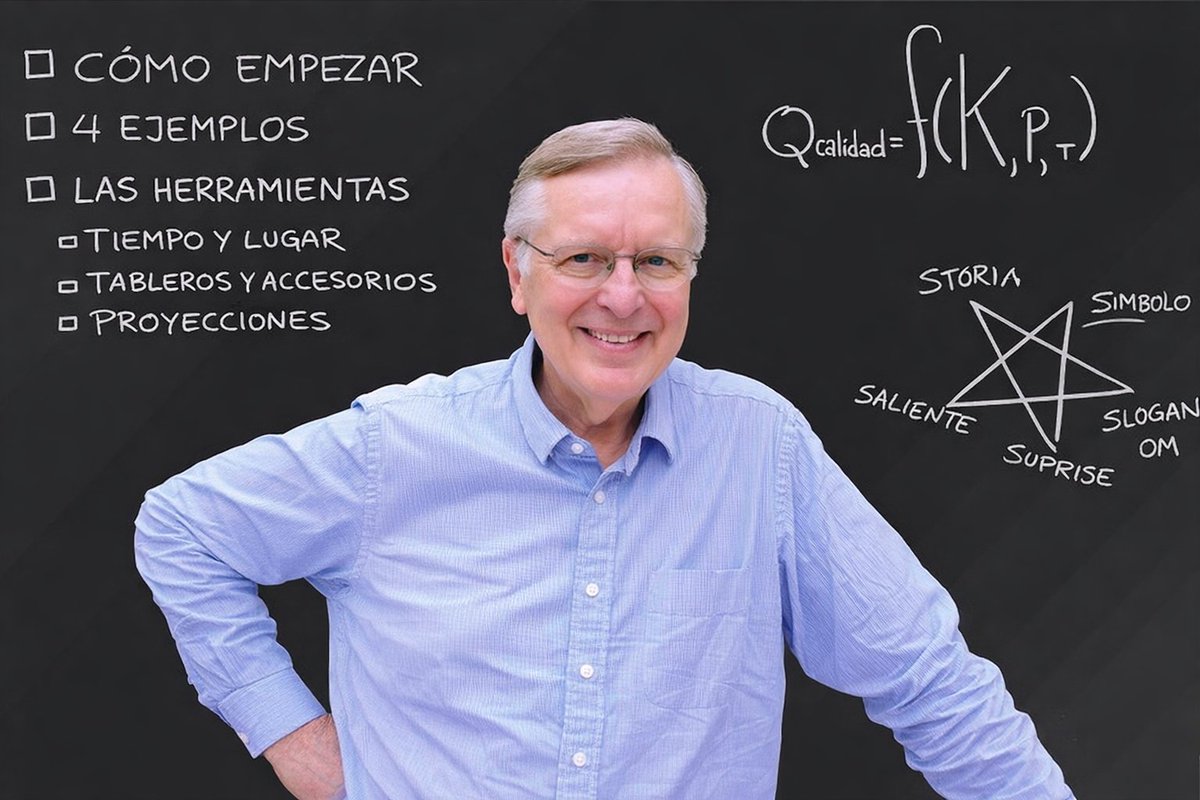
Un profesor del MIT dio la misma conferencia cada enero durante 40 años, y cada una de las veces no cabía ni un alma en el aula.
La vi a las 2 de la mañana y cambió por completo mi forma de entender la comunicación.
Su nombre era Patrick Winston. La conferencia se titula "Cómo hablar" (How to Speak).
Su frase de apertura te golpea como un camión: "Tu éxito en la vida vendrá determinado en gran medida por tu capacidad para hablar, tu capacidad para escribir y la calidad de tus ideas, en ese orden".
Ni tu nota media, ni tus títulos, ni tu coeficiente intelectual. Cómo hablas es lo que separa a las personas que son escuchadas de las que son ignoradas.
Este es el esquema que inculcó a los estudiantes del MIT durante cuatro décadas:
1) Nunca empieces con un chiste: Empieza diciendo a la gente exactamente qué es lo que va a aprender. "Prepara la bomba antes de verter nada". Él lo llamaba la "promesa de empoderamiento": dales una razón para no levantarse del asiento en los primeros 60 segundos.
2) La regla de las 5S: Para que una idea se quede grabada debe ser: Símbolo, Slogan, Sorpresa, Saliente (relevante) e Historia (Story). Cualquier idea que valga la pena recordar cumple al menos tres de estas.
3) La técnica del "casi acierto" (Near Miss): Esta parte me dejó alucinado. No te limites a mostrar lo que está bien; muestra lo que parece estar bien pero no lo está. Ese contraste es lo que hace que el cerebro registre algo de forma permanente.
4) Su regla final: Termina con una contribución, no con un resumen. No recapitules lo que ya dijiste. Dile a la gente qué les has dado que no tenían antes de entrar por la puerta.
He usado este esquema en ventas, entrevistas y presentaciones desde que lo vi, y los resultados no son sutiles.
Patrick Winston falleció en 2019, pero esta clase sigue siendo gratuita en el OpenCourseWare del MIT. Una hora, vista por millones de personas, y no cuesta absolutamente nada.
Video: "How to Speak", Patrick Winston, MIT OpenCourseWare, RES.TLL-005, January IAP 2018.
Fuente: MIT OpenCourseWare.
Licencia: CC BY-NC-SA.
Términos: ocw. mit. edu/ terms
My favorite teachers could think on the fly.
They weren’t tied down to a lesson plan.
They could take any idea, question, or random comment and turn it into something meaningful.
One moment we’d be talking about the lesson, and the next we’d be connecting it to Martin Luther King Jr., traveling through France, or a documentary they watched the night before.
The lesson felt alive.
But in many schools today, a culture of standardization leaves little room for that kind of spontaneity. And with it, we risk losing the energy, curiosity, and human connection that make learning memorable.
Major League Baseball is aired in the morning for Japan. So technically they eat breakfast with it being on television.
Here’s their #openingday commercial. No hyperbole, when I say this, it might be greater than any US MLB commercial I’ve seen. Well done and worth the watch for any baseball fan.
The Robotics team from Wissahickon High School in Ambler, Pennsylvania, built the robot Miss Daisy XXIV that picks up balls and shoots them into a container.
Last month, I shared a bit here about how my 17-year-old son has a passion for video game development and has spent hundreds of hours over the last 9 months creating his first game for release. Well, I want to let you know that Nitro Turtles is now out!
It's a party racing game (kind of like Mario Kart) and has 9 courses, a speedrun mode with online leaderboards, and split screen/online multiplayer. My husband and I played all 9 courses against each other last night and IT WAS SO FUN!
I'm so proud of him for the accomplishment. He has a really demanding junior year schedule of AP/Dual Credit/Honors classes, has straight As, and somehow managed to develop this all on his own out of pure passion. He started teaching himself programming in 3rd grade and just developed his skills from there. Nitro Turtles in the culmination of all the subsequent years of self-driven learning.
If you or your kids play computer games, I would love for you to check the game out on Steam!
https://t.co/RWf3885qFR
Loving Aaron Judge more and more as the tournament goes on. One of the best answers I’ve ever heard an athlete say and probably the best thing you’ll watch today.
This is truly the most beautiful video I’ve seen lately
So tender and heart-warming, yet it makes you stop and reflect, with a subtle touch of sadness
We may have gained so much, but perhaps we’ve lost even more✨