This afternoon, I had a productive phone call with Secretary of Homeland Security Markwayne Mullin and FEMA Administrator Cameron Hamilton, making them aware of the dire situation on the ground in my district and the Governor’s urgent request for FEMA and the SBA to immediately begin joint preliminary damage assessments across Ohio. I am urging action, without delay.
This recovery will not happen overnight, but I will continue advocating for our communities as long as it takes.
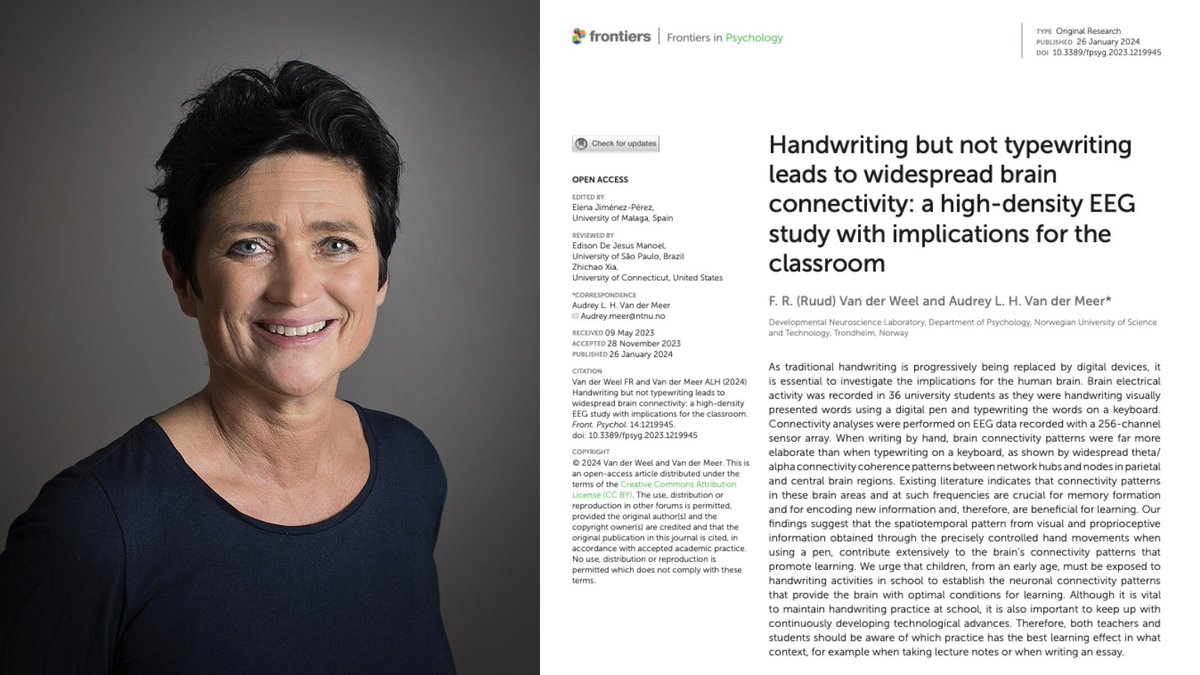
A Norwegian neuroscientist spent 20 years proving that the act of writing by hand changes the human brain in ways typing physically cannot, and almost nobody outside her field has read the paper.
Her name is Audrey van der Meer.
She runs a brain research lab in Trondheim, and the paper that closed the argument was published in 2024 in a journal called Frontiers in Psychology. The finding is brutal enough that it should have changed every classroom on Earth.
The experiment was simple. She recruited 36 university students and put each one in a cap with 256 sensors pressed against their scalp to record brain activity. Words flashed on a screen one at a time.
Sometimes the students wrote the word by hand on a touchscreen using a digital pen, and sometimes they typed the same word on a keyboard. Every neural response was recorded for the full five seconds the word stayed on screen.
Then her team looked at the part of the data most researchers had ignored for years, which is how different parts of the brain were communicating with each other during the task.
When the students wrote by hand, the brain lit up everywhere at once.
The regions responsible for memory, sensory integration, and the encoding of new information were all firing together in a coordinated pattern that spread across the entire cortex. The whole network was awake and connected.
When the same students typed the same word, that pattern collapsed almost completely.
Most of the brain went quiet, and the connections between regions that had been alive seconds earlier were nowhere to be found on the EEG.
Same word, same brain, same person, and two completely different neurological events.
The reason turned out to be something nobody had really paid attention to before her work. Writing by hand is not one motion but a sequence of thousands of tiny micro-movements coordinated with your eyes in real time, where each letter is a different shape that requires the brain to solve a slightly different spatial problem.
Your fingers, wrist, vision, and the parts of your brain that track position in space are all working together to produce one letter, then the next, then the next.
Typing throws all of that away. Every key on a keyboard requires the exact same finger motion regardless of which letter you are pressing, which means the brain has almost nothing to integrate and almost no problem to solve.
Van der Meer said it plainly in her interviews.
Pressing the same key with the same finger over and over does not stimulate the brain in any meaningful way, and she pointed out something that should scare every parent who handed their kid an iPad.
Children who learn to read and write on tablets often cannot tell letters like b and d apart, because they have never physically felt with their bodies what it takes to actually produce those letters on a page.
A decade before her, two researchers at Princeton ran the same fight using a completely different method and ended up at the same answer. Pam Mueller and Daniel Oppenheimer tested 327 students across three experiments, where half took notes on laptops with the internet disabled and half took notes by hand, before testing everyone on what they actually understood from the lectures they had watched.
The handwriting group won by a wide margin on every question that required real understanding rather than surface recall.
The reason was hiding in the transcripts of what the two groups had actually written down.
The laptop students typed almost word for word, capturing more total content but processing almost none of it as they went, while the handwriting students physically could not write fast enough to transcribe a lecture in real time, which forced them to listen carefully, decide what actually mattered, and put it in their own words on the page.
That single act of choosing what to keep was the learning itself, and the keyboard had quietly skipped the choosing and skipped the learning along with it.
Two studies. Two countries. Same answer.
Handwriting makes the brain work. Typing lets it coast.
Every note you have ever typed instead of written went into your brain through a thinner pipe. Every meeting, every book highlight, every idea you captured on your phone instead of on paper was processed at half depth.
You did not forget those things because your memory is bad. You forgot them because typing never woke the part of the brain that would have made them stick.
The fix is the thing your grandmother already knew.
Pick up a pen. Write the thing down. The slower road is the faster one.
From smartwatches to fitness bands and rings, more Americans are relying on wearable technology to track and better understand their health.
It’s time to ensure Washington keeps pace. 🏃♂️
My latest op-ed ⤵️
https://t.co/8j2bfYRCNQ
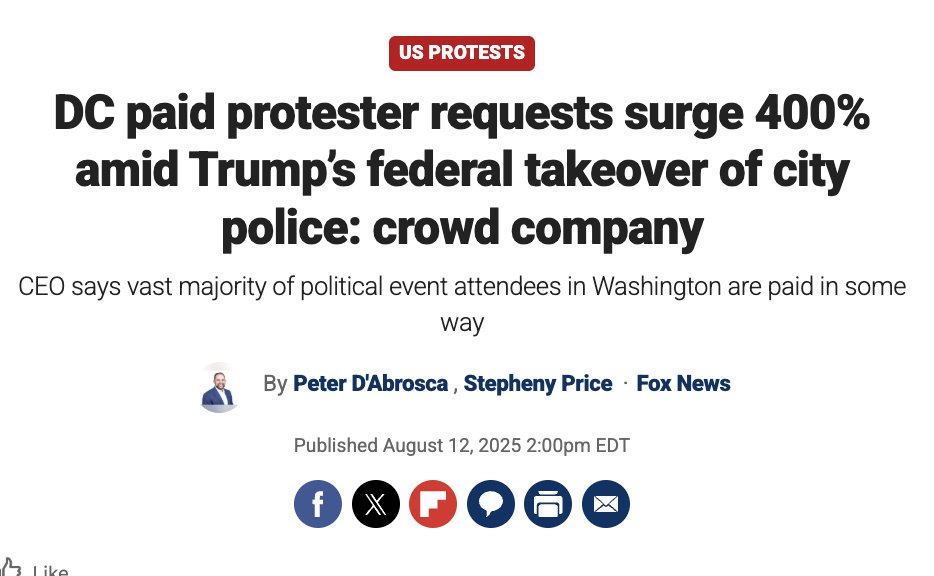
Second, an organization called "crowds on demand" that actually organizes astroturfed paid protests said their demand has surged 400% over this particular fight.
(YES, that is a real organization)
https://t.co/1b7cpqMgQj
@GabeGuidarini Avoid voicing that to the Boomers, Gen Xers, and Gen Yers who hold prominent HR roles for @POTUS@VP and most state office holders. Hell, the Silent Generation still comprises a disproportionately large cohort of these folks.
Digital health technology is the future—and it's already transforming care for Ohioans.
Wearables give patients more control over their health and equip providers with data to deliver smarter, more personalized care. #MAHA
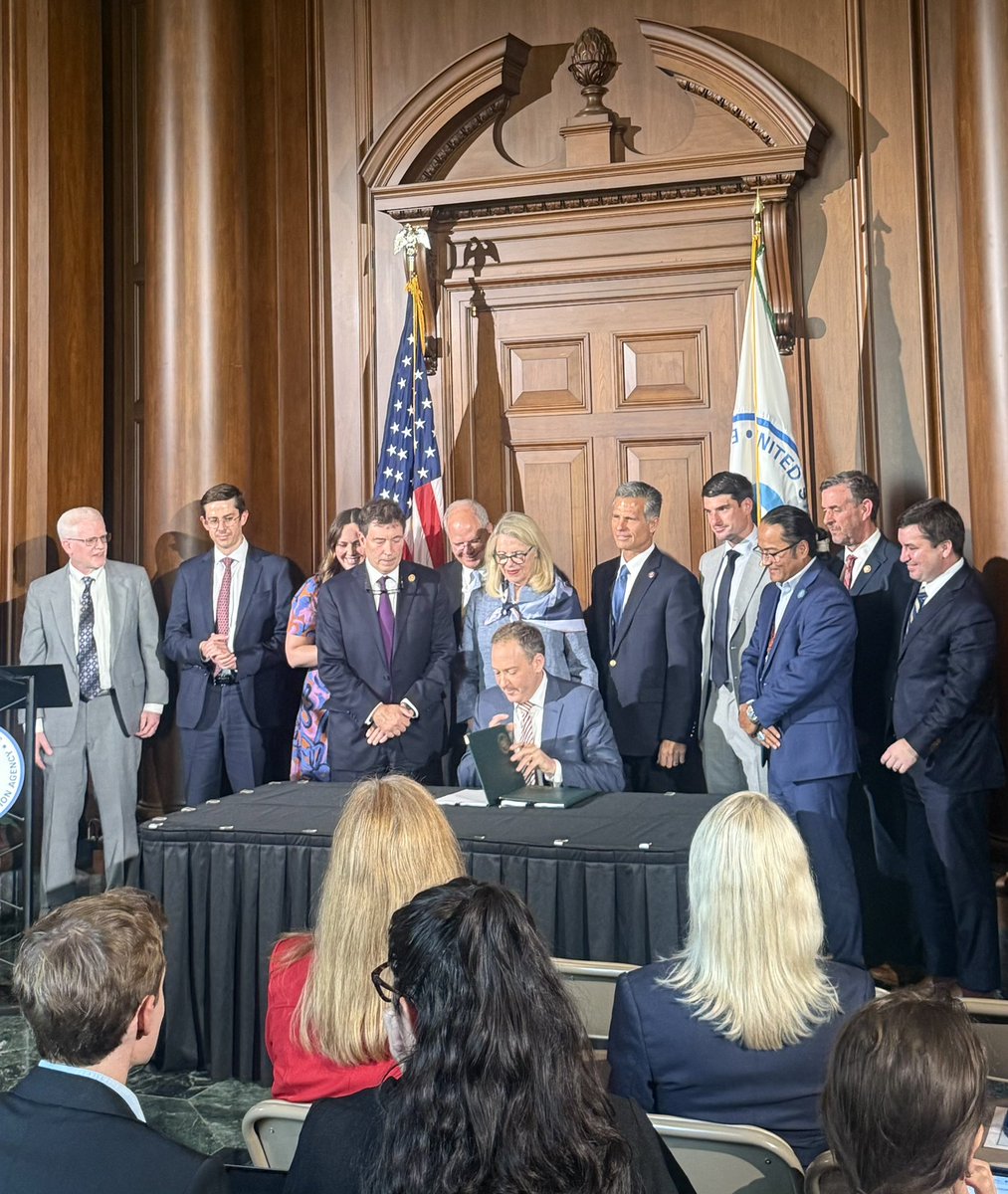
Thank you, @epaleezeldin, for leading the charge to repeal two disastrous Biden-era rules that threatened to shut down America’s most essential power plants.
It was an honor to be there today as we took an important step toward restoring American energy dominance.
Allowing California to dictate national vehicle emissions standards will raise costs for Americans & devastate consumer choice.
Today, I will vote to overturn Biden’s disastrous anti-consumer policies, ensuring Ohio families have access to the vehicles that best fit their needs.
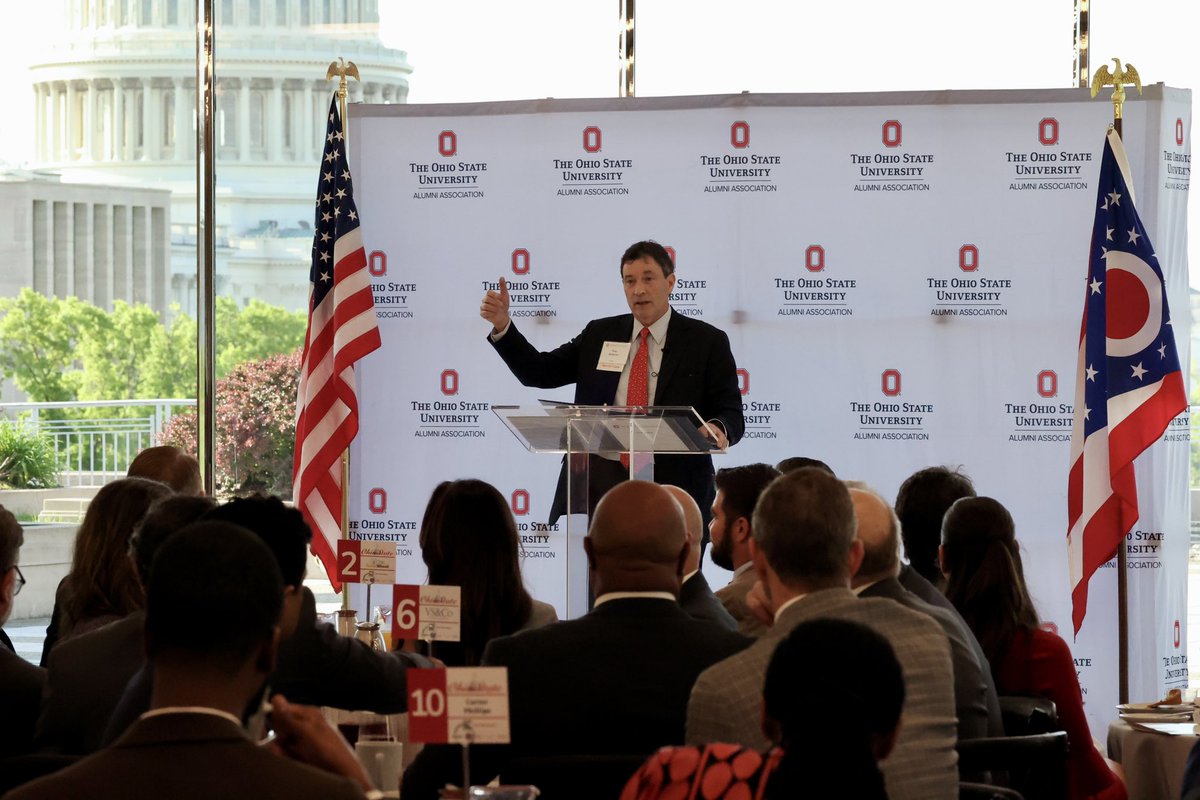
It was an honor to deliver the keynote address at the annual Scarlet and Gray Breakfast! I love seeing so many great #Buckeyes here in DC.
Thank you to @OhioStatePres Carter and @OhioStateAlumni for putting on such a great event! O-H!
My guest for President Trump's address tonight is Mark Weiner, who serves as the Licking County Victim Advocate. For 30 years, Mark has provided services for victims & witnesses of violent crimes, fatal crashes, & other tragedies.
Mark's selflessness and compassion for others is truly inspiring. The Licking County community is blessed to have him as their victim advocate.
The new NCAA policy is in direct conflict with President Trumps beautifully written Executive Order, "Keeping Men Out of Women's Sports".
We see you, @NCAA
“My dearest Annabelle,
I am pleased to inform you that we have routed the 9th Volunteers out of Knoxville. Those Southern Bastards never saw it coming!
Our campaign, however, must now continue. I have word that men from the Pacific Coast lie ahead.
Onward, to Atlanta.”
Achieving American energy dominance means:
✅ Unleashing reliable domestic energy
�� Strengthening our national security
✅ Bringing costs down for consumers
I look forward to leading HEAT and developing solutions that restore U.S. energy leadership.
🚨Just introduced the GRID Power Act to upgrade our interconnection queue & bolster our long-term electric grid reliability. ⚡️
To meet our growing electricity demands, we need more dispatchable energy in place to power America's future. Read more ⬇️
https://t.co/sLXTYw4Efe
📰We applaud @RepBalderson's recent legislation to improve interconnection of critical power plants to the grid. Interconnection reform is a key part of addressing reliability & price concerns, and today's legislation is a positive step forward. Read more: https://t.co/ELAQIt8gtM