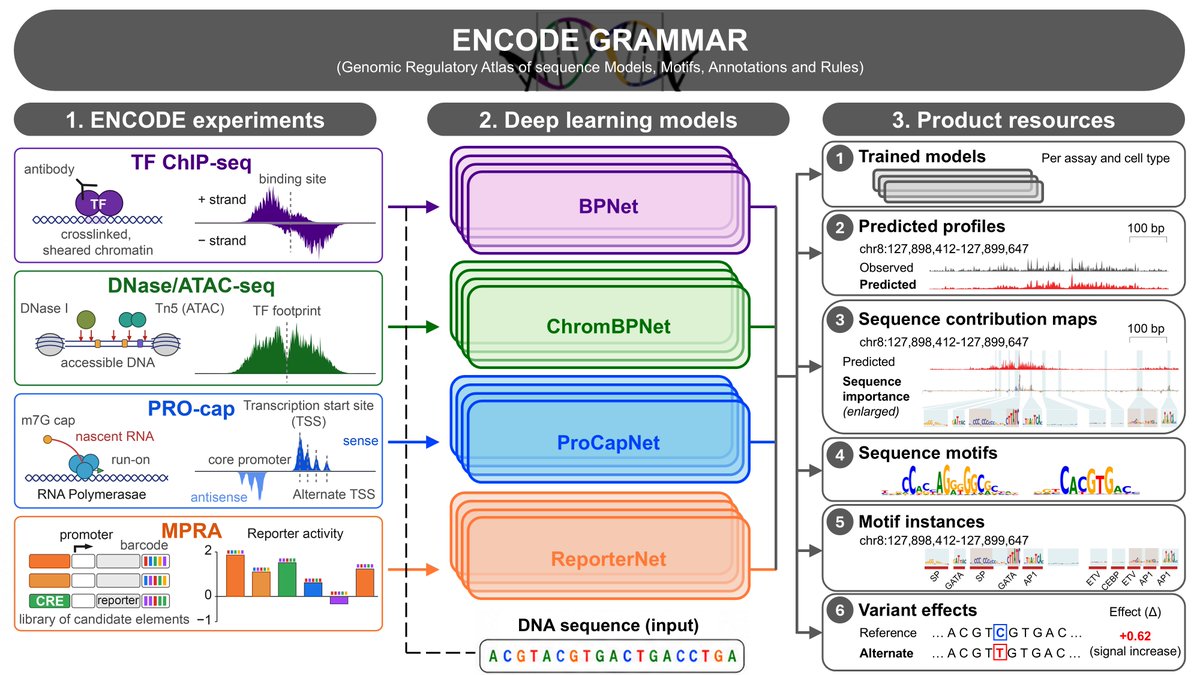
Very excited to announce ENCODE GRAMMAR (Genomic Regulatory Atlas of sequence Models, Motifs, Annotations & Rules): 3,865 experiment-specific deep learning model sets and sequence annotations for decoding human regulatory DNA. 1/
Before, running a remote MCP server meant managing session state, which limited where you could run it.
Now that MCP is stateless, you can deploy on serverless and edge infrastructure, or scale horizontally behind any load balancer.
You cannot wake someone pretending to be asleep. He sees a play where someone gets the ball first and compares it to the play where Lisandro was fouled first.
No scaling laws for single-cell foundation models: when bigger atlases stop teaching the model anything
In language and vision, the recipe has been simple: more data, bigger models, better performance. Single-cell biology borrowed that playbook. Foundation models for transcriptomics jumped from 1 million cells to atlases of over 100 million, on the assumption that scale would unlock the same gains. Alan DenAdel and coauthors put that assumption to the test, and the result is sobering.
Working from a 22.2-million-cell corpus, they pretrained 400 models across five architectures (from PCA and a variational autoencoder up to the Geneformer transformer) and ran 6,400 evaluation experiments. They varied not just dataset size (1% to 75%) but also diversity, using cell-type re-weighting and geometric sketching to deliberately enrich rare cell types and transcriptional states.
The finding: performance saturates almost immediately. On cell-type classification, batch integration, and perturbation prediction, most models hit their ceiling at roughly 1% of the corpus, about 200,000 cells. Beyond that, adding millions more cells changed essentially nothing. More diversity didn't help. Even spiking in genome-scale Perturb-seq data, to give the models perturbed phenotypes rather than just healthy ones, failed to move the needle. Larger models did score better overall, but they too plateaued early on data.
Two points stood out. Simple baselines (PCA, logistic regression) often matched or beat the transformers. And the strongest model, SCimilarity, won not because of size but because its contrastive training objective is aligned with the downstream task. For single-cell data, what you train on and how you frame the objective matters far more than how much you collect.
This reframes a quiet but expensive habit. In drug discovery, biotech, and any pipeline leaning on cell atlases, the instinct to keep scaling pretraining corpora may be burning compute for no return. The real leverage sits elsewhere: curating high-quality, task-relevant data and matching the training objective to the actual question you're trying to answer.
Paper: DenAdel et al., journal license | https://t.co/X7GxoxF5U5
against this transfer primarily because it’s going to make @/_Dissentient_ complain incessantly throughout the season. please @/FCBarcelona don’t make it happen.
🚨💣 BREAKING: Newcastle and Barcelona chiefs in confirmed discussions over a *potential* total package deal for Anthony Gordon that could reach £80m (€92m). Those close to a deal are hopeful of progress before the WC. Gordon wants Barça. @CraigHope_DM#Transfers 🏴🔥
The part we don't tell our women is that the success rate of competition from frozen eggs is under 10%, painful, and very expensive.
I think we have done a terrible job on this side, and there will be a lot of very unhappy people about this in a few decades.
Today the U.S. FDA approved our medicine – the first and only gene therapy for genetic #hearingloss – signaling a new era where enabling 24/7 natural hearing is now possible. We are proud to make this available for free in the U.S.
Read more: https://t.co/yCGSUrsxp5