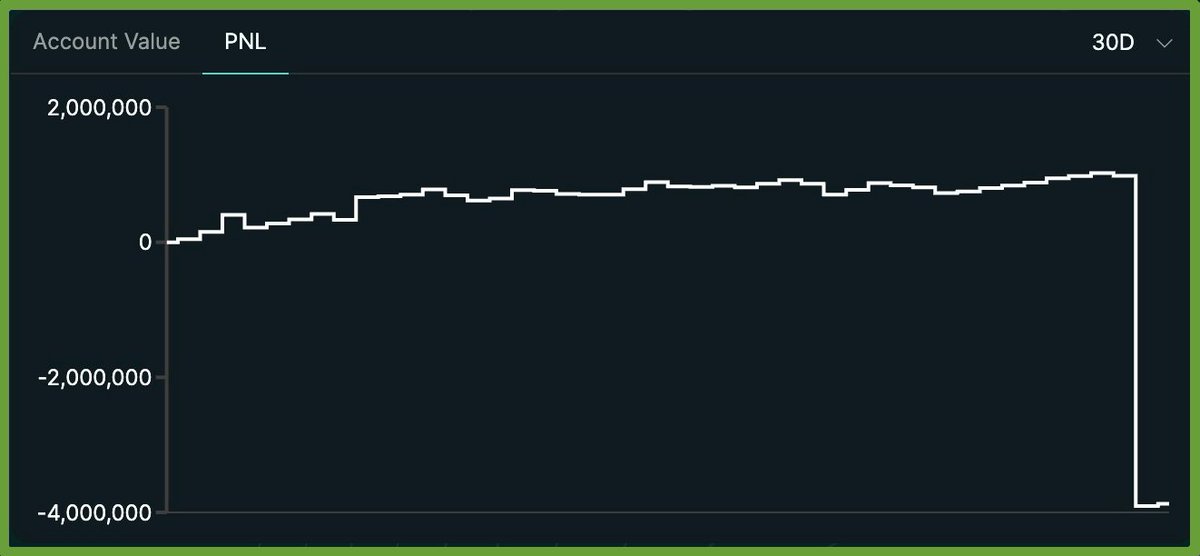
Binance is attacking Hyperliquid again? Hyperliquid Liquidity Provider (HLP) suffered a $4.9 million loss!
Here's what happened, explained simply:
1. Preparation (About 13 Hours Before the Main Action):
- The trader (a whale or rival?) withdrew $3 million in USDC (a dollar-pegged stablecoin) from OKX, a centralized crypto exchange
- They immediately split this into 19 separate wallets (Ethereum addresses listed in the tweet). This fragmentation is a common tactic to obscure tracking and distribute risk across multiple accounts.
2. Building the Position (Around 14:45 CET / 13:45 UTC):
- The trader deposited the funds into Hyperliquid
- They opened massive long positions on POPCAT, a Solana-based memecoin known for high volatility and low liquidity
- Total buy orders: Roughly $20 million at a price of $0.21 per POPCAT
- The positions grew to $30 million across the 19 wallets, creating a large "buy wall" that artificially propped up the price.
3. The Trigger and Liquidation (Seconds Later):
- The trader suddenly removed the buy wall (canceled or sold off the supporting orders)
- This caused POPCAT's price to dump rapidly
- The entire $20–30M long position got liquidated within seconds
- Under Hyperliquid's mechanics, when user positions get liquidated, HLP absorbs the losing side to maintain liquidity. Here, HLP took over the underwater position.
4. The Aftermath and Loss:
- POPCAT's price continued falling, amplifying the damage.
- HLP suffered a $4.9 million loss on this single event—equivalent to wiping out about 3 months of prior profits for the pool
- Hyperliquid's team manually closed the position to limit further bleeding
- As a precaution, the Arbitrum bridge (used for deposits/withdrawals between Ethereum and Arbitrum) was temporarily paused. Other operations remained normal, and the issue was expected to resolve quickly.
Source: @mlmabc
🚨 BITFROST BRINGS $ZEC TO HYPERLIQUID: “IDLE TO HYPER” - @_Bitfrost_ has gone live, now allowing all users to natively trade @Zcash on @HyperliquidX spot. Read now ⬇️
https://t.co/cjHbQwmVPG
If a CEX is trying to charge you 9% of your token supply to list on them, you should instead do a permissionless listing on @aeroxyz and @coinbase for free, then leverage @spindl_xyz to spend a small fraction of that to acquire the highest value holders possible
Read our new client note on Zcash #ZEC
- History of Zcash
- Technical roadmap
- $XMR vs $ZEC
- NEAR Intents
- ZKPs & Regulation
- Rise of privacy
- Why has it risen 700%+ in 1 month?
- What to expect in the future
@Gwei2high @_Bitfrost_@unitxyz Looked at their team, they've built a bunch of stuff on non-smart contract chains. Makes sense that they'd be proficient at this.
I think Unit don't focus on the more difficult assets
Update:
the balancer hacker has added console logs onchain.
there is also a good probability that the hackers vibe coded the attack or used LLMs.
Here's why I think that:
>hackers usually never leave console.log in production code.
>when console.log does appear on-chain, it’s almost always a mistake.
>a mistake like that only happens if the coder forgot to delete debug lines.
>forgetting to delete debug lines = copy-pasted straight from an LLM.
>LLMs love to add console.log("Step 1") to “help you follow”.
>So when the log says garbage like Done with amts1, it’s mostly AI slop.
unironically this has become the zec cycle
whenever the market is strong, it rebounds strongest
and it’s the same handful of people talking about it, how are you all still offsides
if a dip comes, just scoop a bit
This could be big if they play it right.
Initial thoughts are that there is a huge gap in the HL spot markets and $UNIT has been playing with their food regarding the onboarding of top assets.
Let's hope these guys bring highly traded assets to $Hyperliquid.
In 2024, Hyperliquid
1) redefined the crypto meta to put community above all. With Hyperliquid, there are no investors, no market makers, and no fees paid to any company. Billions of dollars of value were created by a common vision and relentless hard work. This value went directly to hundreds of thousands of users, building a passionate community with real skin in the game. You all continue to inspire me every day.
2) became the first mature, permissionless financial hub where liquidity and UX matched the most liquid centralized venues. Recent highlights include $15B 24-hour volume, reaching 20% of Bybit futures and 8% of Binance futures volume. Unlike CEXs, Hyperliquid accomplished this as a user-owned protocol.
3) reinvented several of the most entrenched and predatory centralized practices to be crypto-aligned: fair, transparent, and accessible.
Examples of the last point:
1) Listings have always been controlled by CEXs that extort projects through listing fees to maximize their own profits. This is absurd, as the community drives long term success. CEXs tempt projects with immediate liquidity but kill their ultimate vision. On Hyperliquid, listings are fair, permissionless, and transparent: anyone can bid in the auction to deploy a new spot asset. Projects that want to control their own fate increasingly see Hyperliquid as one-stop infrastructure for both the tech stack and liquidity.
2) Historically, CEXs capture the lion's share of revenue in crypto. On Hyperliquid, builders are already bootstrapping 9 figure businesses. Some are monetizing >$100k per day in revenue entirely onchain through builder codes, which are a primitive built into the L1 to allow customizable monetization for applications. Others carve out and own entire verticals in the budding ecosystem.
Builders are tapping into Hyperliquid as their blockchain of choice, and I’m excited for more and more to join the ecosystem this year.
--
In 2025, I expect the technology of Hyperliquid to close much of the gap towards housing all of finance. The maturing technology will include a growing and permissionless validator set while improving the world-class liquidity infrastructure that Hyperliquid provides.
Some concrete predictions:
1) Multiple billion dollar applications/protocols will be built on Hyperliquid. They will own their full stack but tap into the ever-growing liquidity and community.
2) More than 50% of volume from new defi projects will happen natively on Hyperliquid. Hungry teams will value the integration of CEX-level liquidity with the permissionless accessibility of blockchains.
3) Millions of users will use Hyperliquid without knowing about the blockchain at all. Just like web2, users will experience the magic of their favorite products without thinking about the underlying technology.
These predictions are ambitious, but as I look back and realize just how much we've accomplished in a year, I think they're quite reasonable.
Back to work!