Third question on AI.
A question that also remains unasked is whether the AI boom can continue without leading to a massive increase in inequality.
A recent paper by Stijn Van Nieuwerburgh runs the numbers on how much revenue the AI industry needs to generate to recover its massive investment (summary and a link to the paper can be found here: https://t.co/QIGcoObcVc).
Van Nieuwerburgh’s arithmetic should make us more concerned. AI investments will average about 3.6% of GDP annually between 2025 and 2032. Van Nieuwerburgh calculates that, using a 10% rate of return, the industry would need to generate annual revenues of about $3.7 trillion by 2032 to recover these costs (growing from its current levels of about $200 billion or so). That is significantly more than 10% of current US national income, and will likely remain around 10% of national income by 2032, even if GDP growth rose from its current level.
A large fraction of this revenue will go to capital income. That means a massive increase in the share of capital in national income, which has already risen substantially over the last 25 years or so – now standing at an all-time high of about 47% (https://t.co/IuYldl173r).
Capital income is much more unequally distributed than labor income, so a massive increase in the capital share of national income will translate into a very sizable surge in inequality.
The rise in inequality may not stop with the capital share. My work with Pascual Restrepo documents that (automation-driven) increases in the capital share of national income are typically associated with rising labor income inequality as well (see, for example, https://t.co/2D9KUL3QfM). The same may happen in the next several years, boosting inequality further.
What is missing from our current debate is any discussion of a fundamental dilemma these numbers pose: can the AI boom avoid both an economically costly crash and a huge increase in inequality?
If the industry reaches these revenues, inequality surges. If the industry does not become profitable, a crash, with substantial costs in terms of lost output and jobs, becomes likely.
My assessment would be that the industry is unlikely to reach levels of revenue Van Nieuwerburgh calculates. First, diffusion has been and will likely continue to be slow. Second, competition from open-weight models, which are getting better, will limit how much proprietary models can charge. Third, despite important advances, I still believe that AI models will not be able to automate entire occupations anytime soon, thus limiting their value to businesses as cost-saving devices.
Whether this leads to a crash or not is more complicated and will depend on whether various AI companies are bailed out and what kind of support they receive.
Nevertheless, even if revenues fall short of these gargantuan amounts and we avoid a dramatic surge in inequality, I expect that the diffusion of AI will push up inequality between capital and labor and within labor.
If inequality does surge, a further question becomes central: can our democracy survive such astronomical levels of inequality?
If you’re a semi/memory investor. You have to read this report word by word.
Deutsche Bank’s trading desk on $MU as it reports earnings later today. PT $1550
R500 million in promises.
That is what it took to reverse a regulator's decision. The Competition Commission said no. The parties said R500 million in capex. 150 stores. 1,250 jobs for HDPs. R120 million in payroll. 5% employee ownership.
The Commission said no again.
Then the parties offered more. And the Tribunal said yes.
Okay. Let me walk through what actually happened.
Grand Parade Investments is a JSE-listed empowerment company. 68.56% HDP ownership. 22.87% held by black women. It owned Burger King South Africa - about 90 outlets plus a meat processing plant.
GPI wanted to sell. The buyer was Emerging Capital Partners - a US-founded, Africa-focused private equity fund.
The Competition Commission ran the numbers. No substantial lessening of competition. The deal did not create a monopoly. It did not reduce rivalry.
But HDP ownership would fall from 68% to zero.
That alone was enough. Section 12A(3)(e) of the Competition Act says mergers must promote a greater spread of ownership among historically disadvantaged persons and workers. The Commission used it to prohibit a deal that did not harm competition.
Who benefits.
The Commission's supporters say transformation goals cannot be traded away in an exit. If a black-owned company sells to a foreign fund, the BEE ownership disappears. That is a loss. The state has an interest in preventing it.
But look at the flip side. GPI is black-owned. The shareholders wanted to realise value. That is how empowerment works - you build something valuable, then you exit with a return. If exit is blocked, the incentive to build disappears.
The decision punished a black-owned seller for doing exactly what empowerment is supposed to enable.
Who loses.
GPI's share price fell sharply after the prohibition. The market priced in the reality: if you are a high-BEE company, you cannot sell without the regulator's permission. Your exit is not your decision. It is a public-interest test.
Foreign capital takes note. If your return depends on a regulator's approval of your ownership structure, the risk premium goes up. Deals get priced out before they reach the filing stage.
The remedy.
The parties came back with conditions. Capex commitments. Store expansion. Job creation targets. Employee share ownership. Divestiture of the meat plant.
The Tribunal approved it.
But think about what this means. The parties did not change the ownership outcome. HDP ownership still falls to zero. What changed is the price tag attached to the exit.
The Commission did not say "you cannot sell." It said "you can sell, but you must buy your way out with R500 million in promises."
The uncomfortable truth.
This is not a bug. It is a feature. The 2018/2019 amendments to the Competition Act explicitly added public-interest grounds beyond market power. Ownership dilution is now a regulatory harm.
That creates a paradox. The higher your BEE score, the harder it is to exit. A 100% white-owned company can sell without this scrutiny. A 68% HDP-owned company cannot.
The Commission sees itself as protecting transformation. But what it actually protects is the appearance of transformation - the BEE percentage on paper - while making it harder for black owners to realise the value they built.
That is not transformation. That is a lock-in.
The question is not whether BEE ownership matters. It does.
It is whether a regulatory system that blocks black owners from exiting is empowering them - or trapping them.
this guy is the only substack im subscribed to. he shares buys/sells and really good deep dives on it. he was early on all the popular names and gains speak for themselves. you won't regret following him.
Ask God to restore your appetite for life. Your ideas. Your energy. Your curiosity. Your confidence. Your hope for the future. Sometimes you don't need a completely new life. You need to reconnect with the parts of yourself you stopped nurturing.
@bardi_crew Its definitely availability bias then. But my question really is why not refer to themselves as just transwomen? Actually, it just clicked that it could be because it might be unsafe for them especially in situations where there are homophobes in the area. I could be wrong though
Genuine question: why can't trans people just identify as trans? especially transwomen. I rarely ever see transmen try to change the definition of what it means to be a "man" going as far as policing how men should define themselves. Why can't they just be transwomen?
@Kat_Blos I get you, that could be because men are uncomfortable with the idea of being attracted to a transwoman, maybe thats why transwomen always have to fight to exist, which is messed up. But my question really is, why not claim being called transwomen, why just women?
This is by no means a platform to speak ill, disrespect or be harmful to anyone so please don't use my tweet to be vile to people. I was just genuinely intrigued when I watched the video and thought to ask
@_momacbain@HotTakesHubHQ Obsession is such a strong word for 1 tweet😭 Please understand, its all love for everyone here for all were made in the image of God. I only asked why the need to redefine what a women is, when we can all live our truth without infringing our beliefs on the other.
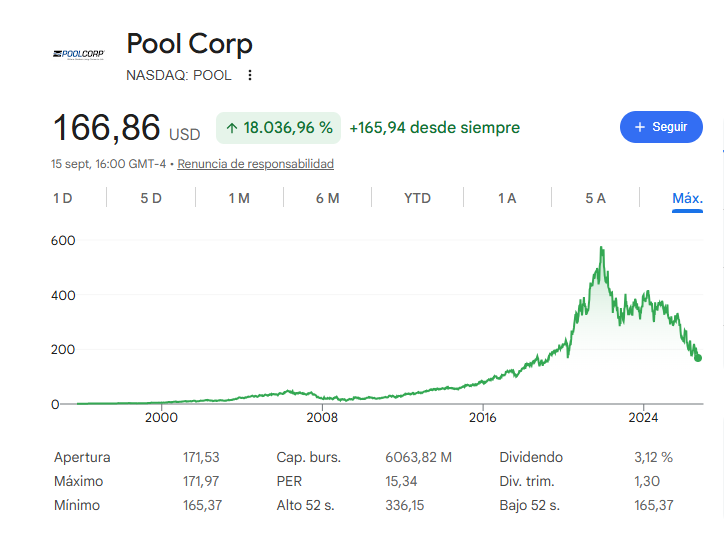
Pool Corp ($POOL) está a precios del 2018, tiene un moat casi impenetrable y los insiders están comprando.
Si tuviera que resumir mi tesis en 6 puntos clave, serían estos 🧵👇
The market is becoming incredibly good at convincing investors they need to understand everything.
One week it is AI software, the next it is semiconductors, then robotics, energy, aerospace, quantum computing, crypto, whatever. Every new theme comes with the implication that if you are not involved, you are somehow falling behind.
I think that is one of the biggest traps in investing. You do not need to catch every wave. You do not need an opinion on every industry and you definitely do not need to own whatever happens to be working this month. In fact, constantly expanding your circle of competence may be one of the easiest ways to slowly destroy it.
The market will produce thousands of opportunities over your lifetime. You only need a handful. The real edge is not knowing everything. It is knowing what you understand, recognizing the rare moments when the odds are heavily in your favor, and having enough discipline to do absolutely nothing the rest of the time.
A lot of people are getting richer right now by being less disciplined. That can go on much longer than you think. It still does not make it a good habit. The less prudently others conduct their affairs, the greater the prudence with which you should conduct yours.
🌹
I just finished Chapter 39 of my book which will be out Xmas time, and I think it is definitely one of the most unique chapters I’ve written. I am really excited about this chapter!!
It originally started as a traditional conversation between a young investor and an older master. But while writing it, I had a better idea, turn the entire chapter into a “text-versation”, where the investing lesson unfolds through text messages, almost like you’re reading a private exchange you were never supposed to see.
I’ve read a lot of investing books over the years and there’s never been a chapter presented this way, not even close. More importantly, I think the format actually makes the lesson stronger because it feels less like being taught and more like watching experience get transferred in real time.
My subscribers get to read it TODAY. If you subscribe and want to read Chapter 39, just send me a message and I’ll send you the full chapter.
This is exactly the kind of thing I want the subscription to become: not just posts, but access to the ideas before they become polished, private book chapters, research, drafts, mistakes, mind changes, and the things I normally would never post publicly. 🌹