“Dual Equilateral Scalar Fields and the Physical Meaning of Euler’s Identity”
Euler’s identity = geometric relation between these two scalar components
- No flips
- No oscillating E/B fields
- Dual scalar fields = equilateral scalars of opposite charges
Euler’s identity is often praised as the most beautiful equation in mathematics.
But in Tetryonics, it is far more than mathematical elegance -
it is a direct geometric statement about the structure of the vacuum.”
In empty space, two equilateral scalar fields exist:
a positive scalar field and a negative scalar field.
These are not waves, not oscillations, and not abstractions.
They are fixed equilateral geometries - the dual scalar foundations from which all 2D EM waveforms arise.
When these two scalar geometries combine, they form a neutral 2D EM waveform - the geometric structure we recognise as a photon.
The positive scalar field corresponds to the cosine component.
The negative scalar field corresponds to the sine component.
And the orthogonal relation between them
is exactly what Euler encoded in
e^(iθ) = cosθ + i·sinθ.
“The imaginary term is not imaginary.
It represents the orthogonal contribution of the negative scalar field - a real geometric component of the vacuum’s dual‑scalar architecture.”
Euler’s identity is the mathematical shadow
of this dual‑scalar geometry.
It explains why photons are neutral.
Why their geometry is self‑similar across all frequencies.
And why every 2D EM waveform emerges from the same dual‑scalar foundation.
“This is the physical meaning of Euler’s identity - not an abstract equation, but a geometric statement about the architecture of the vacuum itself.”
Tetryonics reveals the geometry beneath the mathematics
and the dual‑scalar structure beneath electromagnetism.
This is the quantum geometry of Euler’s identity revealed.
“Wave–Particle Duality and Interference Patterns Explained”
“Wave–particle duality is one of the most misunderstood ideas in physics.
But in Tetryonics, there is no duality at all - only geometry.”
“A photon is not a particle.
It is not a wave in a medium.
It is a fixed 2D EM waveform - an EVEN‑π tessellation of Planck‑quoins.”
“These quoins do not flip, oscillate, or vibrate.
They are fixed equilateral geometries of m‑energy momenta.
Their alternating charge orientation creates the appearance of electric and magnetic variation,
but nothing is waving.”
“So why do we see interference patterns?
Because 2D EM waveforms overlap.”
“When two planar EM geometries meet,
their quoin distributions add or subtract.
Where the geometry aligns, the field strengthens.
Where it opposes, it cancels.
This creates the bright and dark fringes we call interference.”
“There is no mystery.
No wave–particle paradox.
No collapse of anything.”
“The so‑called ‘particle behaviour’ is simply the discrete geometry of the photon - a finite tessellation with a defined boundary.”
“The so‑called ‘wave behaviour’ is the extended 2D EM geometry
interacting with itself or with other waveforms.”
“Both behaviours come from the same structure -
a single geometric object viewed from two perspectives.”
“Tetryonics removes the paradox.
It shows that interference patterns arise from geometric superposition,
not probability waves.
And it reveals that photons are deterministic 2D EM geometries,
not dual‑natured mysteries.”
“This is the true explanation of wave–particle duality
and the real origin of interference patterns.”
“Tetryonics exposes the geometry beneath the experiment
and the structure beneath the light.”
“Euler’s identity is celebrated as the most elegant equation in mathematics.
But in Tetryonics, it is not just elegant - it is physical.”
“In the vacuum, two equilateral scalar fields exist:
a positive scalar field and a negative scalar field.
These are not waves, not oscillations, not abstractions.
They are fixed equilateral geometries - the dual scalar foundations of all 2D EM waveforms.”
“When these two scalar geometries combine,
they form a neutral 2D EM field - the geometric structure we recognise as a photon.”
“The positive scalar field corresponds to the cosine component.
The negative scalar field corresponds to the sine component.
And the orthogonal relation between them
is exactly what Euler encoded in e^(iθ) = cosθ + i·sinθ.”
“The imaginary unit is not imaginary.
It represents the orthogonal contribution of the negative scalar field - a real geometric component of the vacuum’s dual‑scalar architecture.”
“Euler’s identity is the mathematical shadow of this dual‑scalar geometry.”
“It explains why photons are neutral.
Why their geometry is self‑similar across all frequencies.
And why every 2D EM waveform emerges from the same dual‑scalar foundation.”
“This is the physical meaning of Euler’s identity -
not an abstract equation, but a geometric statement about the architecture of the vacuum.”
“Tetryonics reveals the geometry beneath the mathematics
and the dual‑scalar structure beneath electromagnetism.”
“This is the quantum geometry of Euler’s identity revealed.”
“Euler’s identity is often called the most beautiful equation in mathematics. But in Tetryonics, it is far more than mathematics — it is a direct geometric statement about the structure of physical reality.”
“In the vacuum, two equilateral scalar fields exist: a positive scalar field and a negative scalar field. These are not waves, not oscillations, and not abstractions. They are fixed equilateral geometries — the dual scalar foundations from which all 2D EM waveforms emerge.”
“When these two scalar fields combine, they form a neutral 2D EM geometry. This neutral geometry is the physical meaning of Euler’s identity.”
“The positive scalar field corresponds to the cosine component. The negative scalar field corresponds to the sine component. And the geometric relation between them — the orthogonal structure of these dual equilateral fields — is what Euler encoded as e^(iθ) = cosθ + i·sinθ.”
“The imaginary unit is not imaginary at all. It represents the orthogonal contribution of the negative scalar field — a real geometric component of the vacuum’s dual‑scalar architecture.”
“When these two scalar geometries combine, they produce the neutral 2D EM waveform we call a photon. Not a particle. Not a wave in a medium. A geometric surface built from the balanced superposition of dual equilateral scalar fields.”
“Euler’s identity is the mathematical shadow of this physical dual‑scalar geometry.”
“It reveals why photons are neutral. Why their geometry is self‑similar across all frequencies. And why every EM waveform is built from the same dual‑scalar foundation.”
“This is the true physical meaning of Euler’s identity — not an abstract equation, but a geometric statement about the structure of the vacuum itself.”
“Tetryonics exposes the geometry beneath the mathematics and the dual‑scalar architecture beneath electromagnetism.”
“This is the quantum geometry of Euler’s identity revealed.”
Tetryonics - Quantum Geometrics of EM Waves Revealed
“Electromagnetic waves are not mysteries.
They are not abstractions.
They are geometric objects - precise, quantised, and mechanically defined.”
“In Tetryonics, every electromagnetic wave begins with a single geometric truth: the equilateral fascia - a two‑dimensional quantum of action.”
“Electromagnetic waves are not oscillating fields.
They are not vibrating lines, sinusoidal curves, or abstract mathematical constructs.
They are fixed, equilateral geometries -
tessellations of Planck‑quoins forming 2D EM waveforms.”
“In Tetryonics, the Planck‑quoin is the fundamental quantum of geometry:
a dual‑sided, equilateral unit of m‑energy momenta.
It is fixed in shape.
It does not flip, rotate, or deform.”
“When Planck‑quoins tessellate, they create 2D EM waveforms.
These waveforms are not oscillations -
they are geometric surfaces whose alternating charge orientation produces the appearance of electric and magnetic variation to an observer.”
“A photon is an EVEN‑π tessellation of these fixed quoins.
Its geometry is constant.
Its orientation is fixed.
Its propagation is the sequential geometric addition of Planck‑quoins along a defined path.”
“What classical physics interprets as oscillating E and B fields
is simply the alternating arrangement of positive and negative quoin orientations
within the planar EM tessellation.”
“There is no field vibration.
There is no field flipping.
There is only geometric sequencing.”
“Frequency is not a wave rising and falling.
It is the count of Planck‑quoin layers per unit length of the waveform.”
“Energy is not stored in an amplitude.
It is the total number of Planck‑quoins in the tessellation.”
“Polarisation is not a rotation of fields.
It is the fixed geometric orientation of the 2D EM waveform as it propagates.”
“Interference, diffraction, coherence - every optical phenomenon -
arises from the geometric overlap and superposition of planar EM waveforms.”
“Light is not a particle.
- It is not a wave in a medium.
- It is a geometric surface advancing through space
by the sequential addition of fixed equilateral quanta.”
“This is the quantum geometry of electromagnetic waves -
clear, mechanical, and reproducible.”
“Tetryonics reveals the structure beneath the equations
and the geometry beneath the light.”
“This is the true architecture of electromagnetism.”
“This is why the Planck relation, energy equals h times frequency, emerges naturally:
energy is literally the count of geometric action units passing a point each second.”
- No probability.
- No wavefunction.
- Just geometry.
“These behaviors are not imposed mathematically -
they arise directly from the mechanical degrees of freedom of the fascia.”
“Light is not a point particle.
It is not a probability cloud.
It is a geometric ribbon of equilateral quanta, advancing through space with perfect mechanical precision.”
“This ribbon carries energy, momentum, and information -
all encoded in its fascia geometry.”
“When two ribbons interact, they interfere.
When they align, they amplify.
When they oppose, they cancel.”
“Every optical phenomenon is a geometric consequence.”
“By restoring geometry to electromagnetism, Tetryonics removes ambiguity.”
“We no longer guess at the structure of EM waves -
we see it.”
“We no longer treat photons as paradoxes -
we model them as mechanical objects.”
“And we no longer rely on abstract fields -
we work with quantised, equilateral surfaces whose behaviour is fully deterministic.”
“This is the quantum geometry of electromagnetic waves.
- Clear.
- Mechanical.
- Reproducible.”
“Tetryonics reveals the structure beneath the equations -
and the geometry beneath the light.”
“Welcome to the true architecture of electromagnetism.”
“The Geometry of Scalar EM Waves, Quanta, Propagation, and Interference
Scalar electromagnetic waves are not abstractions.
They are not probabilities.
They are not mathematical conveniences.
They are geometric objects - equilateral energy fascia built from even‑quanta photon tessellations.
And once you see their geometry, every mystery of wave behavior becomes obvious.
A scalar EM wave begins as a flat, equilateral sheet of energy.
Not a sine curve.
Not a field line.
A rigid, planar fascia composed of perfectly tessellated Planck‑quoins.
Each quoin is an equilateral quantum of momentum.
Each fascia is a geometric distribution of those quanta.
And every scalar wave is a Gaussian energy sheet because the tessellation itself is a geometric Gaussian.
This is the true origin of the so‑called “probability distribution.”
It is not probability.
It is geometry.
A normal distribution is simply the cross‑section of an equilateral energy field.
When a scalar wave propagates, it does not wiggle.
It does not oscillate up and down.
It translates forward as a rigid fascia, carrying even‑quanta photon momentum along its plane.
The wavefront is flat.
The energy is uniform.
The propagation is deterministic.
Transverse wave - the familiar Hertzian oscillations - arise only when odd‑quanta bosons are added to the fascia.
Odd quanta create curvature.
Curvature creates oscillation.
Oscillation creates the sinusoidal form we draw on paper.
But the scalar wave beneath it remains flat, rigid, and equilateral.
Longitudinal waves - the Teslian impulses - are simply scalar fascia aligned with the direction of propagation.
No oscillation.
No curvature.
Just pure, forward‑driven momentum.
This is why scalar waves penetrate.
Why they do not diffract like transverse waves.
Why they carry energy with extraordinary efficiency.
Their geometry is aligned with their motion.
And now we come to interference - the phenomenon that has confused physics for more than a century.
Interference is not a wave “deciding” where to be.
It is not a particle “choosing” a path.
It is the geometric superposition of two equilateral fascia.
When two scalar waves overlap, their tessellated momentum fields add or subtract.
Constructive interference is simply the reinforcement of fascia tension.
Destructive interference is the cancellation of opposing momentum vectors.
Nothing probabilistic occurs.
Nothing mysterious happens.
It is pure geometry.
The double‑slit experiment becomes trivial.
Each slit emits its own scalar fascia.
The fascia overlap.
Their equilateral momentum distributions superpose.
The interference pattern is the geometric sum of two deterministic fields.
There is no wave‑particle duality.
There is only fascia geometry.
Every scalar wave is a sheet of equilateral momentum.
Every photon is a tessellated fascia.
Every interference pattern is the arithmetic of overlapping geometry.
And every quantum effect we observe is the macroscopic shadow of equilateral Planck‑quoin structure.
Once you see the geometry, the mystery evaporates.
Scalar waves are not hidden.
They are not exotic.
They are the foundation of all electromagnetic structure.
They are the flat, rigid, equilateral fascia that carry energy through the vacuum with perfect determinism.
This is the geometry of scalar EM waves.
This is the geometry of quanta.
This is the geometry of propagation and interference.
And this is the geometry that unifies the entire electromagnetic spectrum into a single, coherent, equilateral ontology.
Energy has shape.
Waves have structure.
And the vacuum is not empty - it is tessellated.
The Geometry of Scalar EM Waves
(Resolving the centuries old Hertz vs Tesla debate)
For 150 years, physics has drawn electromagnetic waves as smooth, wiggling sine curves drifting through empty space.
A familiar picture - but a completely unphysical one.
The sinusoid was never the wave.
It was only the measurement trace of something far more structured.
Tetryonics reveals the true architecture:
Scalar EM waves are rigid, equilateral energy fascia - flat 2D momentum geometries built from Planck‑quoin mass‑energy
- They do not oscillate.
- They do not wiggle.
- They do not rotate between “E‑field” and “B‑field.”
- They propagate as fixed equilateral sheets, carrying discrete √E momentum forward through the vacuum field.
Why the Textbook Picture Was Wrong
The classical sinusoid came from a simple sampling illusion:
a sensor measuring the changing projection of a moving equilateral fascia.
Drag a triangular tile past a probe and the probe sees a rising‑falling E&M waveforms-signal, but the tile itself never oscillates.
The “wave” is the shadow, not the geometry.
Scalar EM waves are translations of fixed equilateral structure -
not oscillations of fields.
The Vacuum Is Not Empty
Scalar waves only make sense once you restore the medium, they move through.
Space is not a void.
It is a 2D aetheric EM field - a dense tessellation of Planck‑quoin fascia with real permittivity and permeability.
Matter displaces this field.
EM waves propagate through it.
Gravity emerges from its displacement gradients.
Once the geometry of the vacuum is restored, scalar waves stop being mysterious.
The Structure of a Scalar EM Wave
A scalar EM wave is:
- a flat equilateral fascia,
- built from even‑quanta photon geometry,
- carrying divergent √E electric momentum,
- with no transverse oscillation,
- and no magnetic rotation.
It is a pressure‑front of equilateral energy,
not a sinusoidal ripple.
This is why scalar waves can:
- carry enormous energy,
- propagate through dense media,
- and couple strongly to charge distributions without behaving like classical radio waves.
Hertz vs Tesla - Two Geometries, One EM Foundation
This is where the confusion of the last century finally dissolves.
Hertzian Waves - Transverse EM Radiation
Hertz discovered the transverse mode:
- dual‑boson fascia arranged in a transverse orientation,
- E ⟂ B ⟂ k,
- SQRT linear momentum orthogonal to the group propagation,
- propagating as radiant EM waves,
- appearing sinusoidal only when sampled.
These are the classical radio/light waves - transverse, harmonic, narrowband.
Teslian Waves - Longitudinal Scalar Impulses
Tesla discovered the longitudinal mode:
- scalar fascia compressions,
- E -> B -> k
- SQRT linear momentum parallel to the group propagation,
- Ω‑flux pressure fronts,
- driven by rapid charge acceleration,
- propagating as non‑oscillatory impulses,
- broadband, high‑momentum, and extremely penetrating.
These are scalar EM waves - longitudinal, non‑harmonic, broadband.
Both arise from the same equilateral geometry.
The difference is orientation:
- Transverse orientation → Hertzian radio waves
- Longitudinal orientation → Teslian impulse waves
Two modes. - One geometry.
Why Scalar Waves Matter
Scalar EM waves are the missing half of electromagnetism:
- They explain Tesla’s impulse effects.
- They explain longitudinal EM coupling.
- They explain non‑oscillating energy transfer.
- They explain why classical EM equations feel incomplete.
- They explain why the sinusoid never matched physical geometry.
Scalar waves are not exotic.
They are the default geometry of EM energy.
The transverse sinusoid is the special case.
The scalar fascia is the general case.
Every EM wave — scalar or transverse — is built from a discrete Gaussian distribution of Planck‑quoins.
Not metaphorically.
Not statistically.
Literally.
The Gaussian curve is not a probability.
It is a population profile of equilateral energy tiles.
Why the Gaussian Appears Everywhere
Every EM field - from a single photon to a massive scalar wavefront - is built from a 1‑2‑3‑4‑N‑4‑3‑2‑1 quoin population.
This is the deterministic Gaussian distribution of Tetryonics.
It is not a probability curve. - It is a counting law.
The center of the wave contains the highest quoin density 📷.
The edges taper symmetrically as the quoin count decreases.
This is why:
- EM waves have intensity peaks,
- interference fringes fade outward,
- spectral lines have natural widths and
- photon energy loops form balanced Lissajous patterns.
Interference: Gaussian Arithmetic
When two EM waves overlap, their Gaussian quoin populations add or subtract:
- peaks reinforce,
- troughs diminish,
- fringes fade according to the 1‑2‑3‑4‑N‑4‑3‑2‑1 law.
This is why interference patterns have:
- bright central maxima,
- diminishing side lobes,
- and smooth falloff.
It’s not probability.
It’s quoin arithmetic.
Spectral Lines: Gaussian Geometry Inside the Photon
Every photon contains a Gaussian distribution of Planck‑quoins.
This determines:
- its line width,
- its line shape,
- its fine structure,
- and its ΔKEM transition energy.
The ABRAHAM spectral line exists because of this geometry.
The Gaussian is the geometry.
The Takeaway
If you want to understand EM waves,
you must understand their geometry.
Once you see the equilateral fascia,
the entire field becomes obvious:
- No waves.
- No oscillations.
- No mysteries.
Just geometry - the only language energy has ever spoken - Scalar waves prove it.
“The ABRAHAM Spectral Line”
The First New Hydrogen Line Predicted by Geometry Alone
A LINE THAT WAS THOUGHT NOT TO EXIST
For a century, hydrogen’s spectrum was considered complete.
Six families.
No more.
No less.
But the geometry of hydrogen tells a different story.
The classical diagram fractures into equilateral KEM geometry.
THE GEOMETRIC ORIGIN OF SPECTRAL LINES
Every spectral line is the difference between two equilateral KEM fields - not a jump, not a probability, but a geometric remainder.
THE HIDDEN MANIFOLD
Classical physics assumed spherical charge clouds.
Tetryonics reveals equilateral harmonic layers,
each with a precise fascia count.
And one of these layers was missing from every model.
THE ABRAHAM TRANSITION
When the seventh manifold is included,
a new transition appears - a photon with energy between 0.06 and 0.28 eV, radiating in the deep infrared to microwave band.
This is the ABRAHAM Spectral Line.
A single bright line emerges on the spectrum.
THE PHOTON THAT CARRIES IT
The ABRAHAM photon is a dual‑boson even‑π geometry,
its energy defined by: 𝐸 = 2ℎ𝑣
A perfect geometric transformer - the exact ΔKEM remainder of the seventh manifold.
WHY NO ONE SAW IT
The Rydberg formula measures spacing,
but it cannot see geometry.
It assumes spherical symmetry - and in doing so,
it hides the seventh harmonic layer.
Only equilateral geometry reveals the ABRAHAM line.
THE SIGNIFICANCE
The ABRAHAM Spectral Line is the first new hydrogen line
predicted by geometry alone.
It completes the ΔKEM ladder.
It corrects the classical spectrum.
And it marks the beginning of geometric spectroscopy.
“This is the missing line.
The geometric line.
The ABRAHAM Spectral Line - the first signal of a new physics built on equilateral energy. ..... This is Tetryonics.
#Tetryonics #KelvinABRAHAM #ABRAHAMSpectralLine #GeometricPhysics #Spectroscopy #QuantumGeometry #HydrogenSpectrum #ScientificRevolution #EnergyHasShape
Tetryonics - The ABRAHAM Spectral Series & The Rise of Geometric Physics - The First New Hydrogen Spectral Series in a Century
A Discovery Only Equilateral Geometry Could Reveal
THE HYDROGEN SPECTRUM WAS NEVER COMPLETE
“For over a hundred years, physics believed the hydrogen spectrum was complete.
Six spectral families… from Lyman to Humphreys…
a closed ladder, perfectly described by the Rydberg formula.
But the ladder was missing a rung.
A geometric rung.”
The classical diagram dissolves into equilateral KEM geometry.
THE FOUNDATION: ENERGY IS EQUILATERAL
“Every spectral line begins with geometry - a 2D equilateral Planck‑quoin fascia carrying discrete electric momentum.
These fasciae assemble into harmonic KEM fields,
forming the true energy levels of hydrogen.”
The fascia stack into triangular shells.
THE MISSING quantum level
“Classical physics assumed spherical charge clouds.
Tetryonics reveals equilateral harmonic layers -
each with a precise fascia count,
each defining a geometric energy level.
And one of these layers was never accounted for.
The Q‑shell transition manifold.”
The seventh manifold pulses.
THE BIRTH OF A NEW SPECTRAL SERIES
“When this manifold is included,
a new family of transitions emerges - with wavelengths in the deep infrared to microwave range, and energies between 0.06 and 0.28 electron volts.
A spectral family beyond Humphreys.
A family predicted by geometry alone.”
The ABRAHAM series appears as a new spectral ladder.
THE PHOTON: GEOMETRY OF THE TRANSITION
“Each ABRAHAM‑series photon is a dual‑boson geometry -
a 2h equilateral transformer with a Gaussian quoin distribution.
Its energy is not a probability.
It is the exact geometric remainder of two KEM fields:
𝐸 = 2ℎ𝑣 - The geometry determines the line.
The line reveals the geometry.”
WHY RYDBERG MISSED IT
“The Rydberg formula measures spacing - but it cannot see geometry.
It assumes spherical symmetry,
and in doing so, it hides the seventh manifold.
Only equilateral KEM geometry exposes the full ΔKEM ladder.”
The Rydberg formula collapses: the geometric ladder remains.
THE RISE OF GEOMETRIC PHYSICS
“The ABRAHAM Spectral Series is more than a new line family.
It is proof that energy is geometric.
Charge is geometric.
Fields are geometric.
And physics must be geometric.”
The full spectrum reorganizes into a geometric atlas.
IMPLICATIONS FOR THE FUTURE
“With the ABRAHAM series identified,
the hydrogen spectrum is complete.
The ΔKEM ladder is fully mapped.
And spectroscopy becomes a geometric science -
not a probabilistic one.”
THE MOMENT THE GEOMETRY SPEAKS
“This is the first new hydrogen spectral series in a century.
The first predicted by geometry alone.
The first to unify photons, atoms, and energy levels
under a single equilateral framework.
This is the ABRAHAM Spectral Series.
This is the rise of geometric physics.
This is Tetryonics.”
#Tetryonics #KelvinABRAHAM #UnifiedTheory #GeometricPhysics #STEM #QuantumGeometry #SpectralSeries #ABRAHAMSeries #HydrogenSpectrum #PhotonGeometry
#ScientificRevolution #EnergyHasShape
Tetryonic Spectral Line Geometrics
The True Geometry Behind Emission, Absorption & Spectral Structure
A Complete Reconstruction of Spectroscopy Using Equilateral EM Physics
SPECTRAL LINES ARE GEOMETRIC, NOT MYSTICAL
For more than a century, spectral lines have been explained with metaphors:
- electrons “jumping,”
- photons “appearing,”
- waves “interfering,”
- probabilities “collapsing.”
These were placeholders — not physics.
Tetryonics reveals the real mechanism:
Spectral lines are the geometric differences between equilateral KEM fields, and photons are the exact equilateral remainders of those transitions.
- No jumps.
- No waves.
- No probabilities.
Just geometry.
THE FOUNDATION - PLANCK‑QUOIN FASCIA
Every spectral line begins with the same quantum building block:
- a 2D equilateral Planck‑quoin fascia
- carrying discrete √E electric momentum
- arranged into rigid triangular KEM fields
- forming the harmonic layers of hydrogen
These fascia assemble into:
- odd‑quanta longitudinal bosons
- even‑quanta dual‑boson photons
This is the true structure behind atomic energy levels.
ENERGY LEVELS - EQUILATERAL KEM FIELDS, NOT ORBITS
Classical physics imagined:
- circular orbits
- spherical charge clouds
- sinusoidal wavefunctions
But Tetryonics shows:
- each energy level is a triangular KEM field
- built from a specific fascia count
- arranged into harmonic equilateral layers
- with discrete ΔKEM differences between them
These differences are the spectral lines.
SPECTRAL LINES - THE DIFFERENCE OF TWO GEOMETRIES
A spectral line is simply:
Δ𝐸 = 𝐸𝑛i − 𝐸𝑛f
Where each
𝐸𝑛 is a 'square number' EM geometry, not a sphere.
When an atom reorganises its fascia:
- the old geometry collapses
- the new geometry forms
- the equilateral remainder becomes a photon
This photon has energy:
𝐸 = ℎ𝑓 = 2ℎ𝑣
Because a photon is two boson fascia in a dual‑boson geometry.
Spectral lines are geometric remainders, not quantum jumps.
THE GAUSSIAN STRUCTURE - WHY LINES HAVE SHAPE
Inside every photon:
- Planck‑quoins arrange into a Gaussian distribution
[1, 2, 3, 4, N, 4, 3, 2, 1]
forming a balanced Lissajous loop
This Gaussian geometry explains:
- line width
- line shape
- fine structure
- hyperfine structure
- isotope shifts
- contracted spectra
The geometry is the line profile.
INTERFERENCE - MOMENTUM CHANNEL ARITHMETIC
Interference is not waves cancelling.
It is Dp/Cp momentum channels adding and subtracting.
When two photons overlap:
- their √E vectors combine
- their Gaussian quoin distributions superpose
- their momentum channels reinforce or oppose
- producing light and dark banding
No waves.
No duality.
No self‑interference.
Just geometric superposition.
THE DOUBLE‑SLIT - FINALLY MADE MECHANICAL
In the double‑slit experiment:
- photons do not split
- photons do not interfere with themselves
- photons do not behave as waves
Instead:
- each slit produces its own fascia geometry
- the two geometries overlap
- their momentum channels combine
- the detector samples the resulting energy density
The pattern is not a wave.
It is a map of overlapping equilateral geometries.
ABSORPTION - THE TRANSFORMER COLLAPSES
A photon is absorbed when:
- its Lissajous loop is interrupted
- its dual‑boson geometry collapses
- its √E momentum is transferred into the atomic fascia
- the receiving KEM field reorganises
This is the mechanical origin of absorption lines.
THE TETRYONIC RECONSTRUCTION - SPECTRAL GEOMETRY COMPLETED
With the correct geometry restored:
- spectral lines are ΔKEM equilateral remainders
- photons are dual‑boson Gaussian transformers
- interference is momentum‑channel arithmetic
- diffraction is geometric sampling
- line shapes come from quoin distributions
- contracted spectra arise from harmonic convergence
- the ABRAHAM series completes the spectrum
This is not a reinterpretation.
This is the actual physical structure of spectroscopy.
THE SPECTRUM, REVEALED BY GEOMETRY
Planck quantised energy.
Rydberg measured the spacing.
Bohr tried to draw it.
Quantum mechanics hid it in probability.
Tetryonics reveals the geometry.
This is the true structure behind spectral lines.
This is interference, re‑drawn.
This is the geometry of light.
This is Tetryonic Spectral Line Geometrics.
#Tetryonics #KelvinABRAHAM #UnifiedTheory #GeometricPhysics #STEM #QuantumGeometry #SpectralLines #PhotonGeometry #InterferenceExplained #PlanckQuoins #ScientificRevolution #EnergyHasShape
Tetryonics The Geometry Behind Rydberg, Planck & Spectra
How Equilateral Energy Reveals the True Structure of Spectral Lines
The First Complete Geometric Reconstruction of Atomic Spectra
THE OLD SPECTRAL MODELS WERE NEVER GEOMETRIC
For more than a century, physics has relied on two giants:
- Rydberg, who gave us the spectral formula
- Planck, who gave us the quantum
- Bohr, who tried to merge them with circular orbits
But none of them had the geometry.
They worked with:
- spherical charge distributions
- sinusoidal wavefunctions
- probability amplitudes
- and algebraic curve‑fitting
They described the numbers - but never the shape.
Tetryonics reveals the missing structure:
Spectral lines arise from equilateral KEM fields,
Planck’s constant is the area of a single boson fascia,
and Rydberg’s formula is the arithmetic shadow of geometric contraction.
This is the geometry behind the spectrum.
THE FOUNDATION - ENERGY IS EQUILATERAL
Every spectral line begins with the same quantum building block:
- a 2D equilateral Planck‑quoin fascia
- carrying discrete √E electric momentum
- arranged into rigid KEM fields
- forming the harmonic layers of hydrogen
These fascia stack into:
- odd‑quanta longitudinal bosons
- even‑quanta dual‑boson photons
This geometry determines:
- energy levels
- transition energies
- spectral line spacing
- and the existence of contracted spectra
The old models guessed - Tetryonics draws.
PLANCK - THE GEOMETRY OF THE QUANTUM
Planck discovered that energy comes in discrete packets:
- 𝐸 = ℎ𝑣
Tetryonics reveals the physical meaning:
- h is the equilateral area of a single boson fascia
- v is the Planck‑quoin count
a photon is two fasciae, so:
- 𝐸 = 2ℎ𝑣
Planck’s constant is not abstract.
It is geometry.
RYDBERG - THE DIFFERENCE OF TWO GEOMETRIES
Rydberg’s formula works because:
Hydrogen’s KEM field has equilateral harmonic layers
- each layer has a discrete fascia count
- transitions occur across geometric manifolds, not orbits
- the difference between two manifolds produces a photon
The Rydberg formula:
1𝜆 = 𝑅(1𝑛i^2 − 1𝑛f^2)
is simply the algebraic shadow of:
Δ𝐸 = 𝐸𝑛i − 𝐸𝑛f
where each
𝐸𝑛
is a triangular KEM field, not a sphere.
Rydberg described the spacing.
Tetryonics reveals the shape.
CONTRACTED SPECTRA - THE GEOMETRIC CORRECTION
Classical physics assumes:
- spectral lines converge
- spacing decreases
- transitions “compress” at high n
But it never explained why.
Tetryonics shows:
- higher‑n KEM fields have larger equilateral areas
- but their ΔKEM differences shrink
because the fascia distribution becomes more Gaussian
producing contracted spectral spacing
This contraction is not a limit of Rydberg.
It is a geometric necessity.
The geometry contracts - so the spectrum contracts.
THE PHOTON - THE GEOMETRIC SIGNATURE OF THE TRANSITION
Every spectral photon is:
- a dual‑boson even‑π geometry
- with a Gaussian quoin distribution
- forming a balanced Lissajous loop
- carrying the exact ΔKEM energy of the transition
The geometry of the photon encodes the geometry of the atom.
This is why:
- spectral lines have width
- spectral lines have shape
- spectral lines show fine structure
- spectral lines contract at high n
The geometry is the spectrum.
THE UNIFICATION - RYDBERG, PLANCK & CONTRACTED SPECTRA
With the correct geometry restored:
- Planck gives the area of a single boson fascia
- Rydberg gives the arithmetic of ΔKEM differences
- Contracted spectra arise from geometric convergence
Photons carry the exact equilateral remainder
Spectral families emerge from harmonic manifolds
The ABRAHAM series completes the spectrum
This is the first model where:
- the numbers
- the geometry
- the photons and
- the spectra all match. and emerge from the same geometric
THE SPECTRUM, FINALLY EXPLAINED
- Planck quantised energy.
- Rydberg measured the spacing.
Bohr tried to draw it.
Quantum mechanics hid it in probability.
Tetryonics reveals that geometry.
This is the true structure behind spectral lines.
This is the geometry behind Rydberg and Planck.
This is the origin of contracted spectra.
This is Tetryonics - The Geometry Behind Rydberg, Planck & Contracted Spectra.
#Tetryonics #KelvinABRAHAM #UnifiedTheory #GeometricPhysics #STEM #QuantumGeometry #RydbergExplained #PlancksConstant #SpectralLines #ContractedSpectra #PhotonGeometry #ScientificRevolution #EnergyHasShape
Tetryonics - Spectral Lines & Interference Explained
The Geometry behind Emission, Absorption, and Light–Dark Banding - No Waves, No Probabilities, Just Planck‑Quoin Geometry
SPECTRAL LINES WERE NEVER “JUMPS”
For more than a century, physics has described spectral lines as:
electrons “jumping” between orbits, photons “popping” in and out of existence, and interference patterns forming from “waves” cancelling each other.
These were metaphors - not mechanics.
Tetryonics reveals the real structure:
Spectral lines are geometric re-organisation of Planck‑quoin EM fascia, and interference patterns are the arithmetic of their momentum channels.
- No quantum jumps.
- No oscillating waves.
- No probability clouds.
Just geometry.
THE FOUNDATION - QUANTA ARE EQUILATERAL
Every spectral line begins with the same building block:
- a 2D equilateral Planck‑quoin fascia
- carrying discrete √E electric momentum
- arranged into rigid EM geometries
- forming the KEM fields of atoms
These fascia stack into:
- odd‑quanta bosons (longitudinal)
- even‑quanta photons (dual‑boson transverse)
This is the true structure behind atomic energy levels.
SPECTRAL LINES - DIFFERENCE OF TWO GEOMETRIES
A spectral line is not a jump.
It is a difference of two equilateral KEM geometries:
𝐸 line = 𝐸𝑛 − 𝐸𝑚
Where each energy level is:
- a quantised equilateral field
- built from Planck‑quoin fascia
- arranged into discrete harmonic layers
When an atom reorganises its fascia:
- the old geometry collapses
- the new geometry forms
- the difference is released as a photon
This photon has energy:
𝐸 = ℎ𝑓 = 2ℎ𝑣
A spectral line is simply the geometric remainder of two KEM fields.
THE EQUILATERAL GAUSSIAN DISTRIBUTION
- THE REAL SHAPE OF A SPECTRAL LINE
Inside every photon:
- Planck‑quoins arrange into a Gaussian distribution
[1, 2, 3, 4, N, 4, 3, 2, 1]
forming a balanced Lissajous energy loop
This Gaussian structure is why:
- spectral lines have width
- spectral lines have shape
- spectral lines show fine structure
- spectral lines show interference residues
The geometry is the line profile.
INTERFERENCE - MOMENTUM CHANNEL ARITHMETIC
Interference has been misunderstood for 200 years.
Physics claimed:
- waves cancel
- waves reinforce
- particles interfere with themselves
- probability amplitudes overlap
Tetryonics shows the real mechanism:
Interference is the addition and subtraction of Divergent / Convergent momentum channels from overlapping equilateral fascia.
When two photons overlap:
- their √E vectors add
- their Dp/Cp channels reinforce or oppose
- their Gaussian quoin distributions combine
- producing light and dark banding
No waves.
No cancellation.
No duality.
Just geometric superposition.
THE DOUBLE‑SLIT - FINALLY EXPLAINED
In the double‑slit experiment:
- photons do not split
- photons do not interfere with themselves
- photons do not behave as waves
Instead:
- each slit produces its own fascia geometry
- the two geometries overlap
- their momentum channels add
- the detector samples the combined energy density
The pattern is not a wave.
It is a map of overlapping equilateral geometries.
ABSORPTION - THE TRANSFORMER COLLAPSES
A photon is absorbed when:
- its Lissajous loop is interrupted
- its dual‑boson geometry collapses
- its √E momentum is transferred into the atomic fascia
- the receiving KEM field reorganises
This is the mechanical origin of absorption lines.
THE TETRYONIC RECONSTRUCTION - SPECTRAL LINES & INTERFERENCE COMPLETED
With the correct geometry restored:
- spectral lines are differences of equilateral KEM fields
- photons are dual‑boson Gaussian transformers
- interference is momentum‑channel arithmetic
- diffraction is geometric sampling
- line shapes come from quoin distributions
- absorption is transformer collapse
- emission is fascia reconfiguration
This is not a reinterpretation.
This is the actual physical structure of spectroscopy.
THE GEOMETRY BEHIND LIGHT, MATTER & MEASUREMENT
Spectral lines were never mysterious.
Interference was never paradoxical.
Quantum behaviour was never probabilistic.
They were geometric all along.
This is the quantum geometric model of spectral lines.
This is interference, re‑drawn.
This is the geometry behind photons, atoms, and measurement.
This is Tetryonics - Spectral Lines & Interference Explained.
#Tetryonics #KelvinABRAHAM #UnifiedTheory #GeometricPhysics #STEM #QuantumGeometry #SpectralLines #InterferenceExplained #PhotonGeometry #PlanckQuoins #ScientificRevolution #EnergyHasShape
Tetryonics - Dual Equilateral Scalar Fields & the Physics of Euler’s Identity Revealed
How Geometry, Charge Polarity, and Complex Numbers Become One Physical Structure
EULER’S IDENTITY WAS NEVER JUST MATH
For centuries, Euler’s identity has been called the most beautiful equation in mathematics:
- 𝑒𝑖𝜃 = cos 𝜃 + 𝑖 sin 𝜃
Elegant. Mysterious. & completely disconnected from physics - or so everyone believed.
Tetryonics changes that.
Euler’s identity is not an abstract mathematical trick.
It is the geometric language of dual equilateral scalar fields -
the physical architecture of charge, EM fields, and photon structure.
The “imaginary unit” is not imaginary.
It is a real, measurable momentum channel inside the negative equilateral scalar field.
Euler’s identity is physics.
And Tetryonics reveals the geometry behind it.
THE FOUNDATION - POSITIVE & NEGATIVE EQUILATERAL SCALAR FIELDS
Every EM field begins with two possible scalar configurations:
1. Positive Equilateral Scalar Field (ES⁺)
- built from even‑quanta photon fascia
- net divergent √E momentum
- produces positive charge polarity
- corresponds to the cosine term in Euler’s identity
2. Negative Equilateral Scalar Field (ES⁻)
- built from odd‑quanta longitudinal bosons
- net convergent √E momentum
- produces negative charge polarity
- corresponds to the sine term
- its linear momentum channel corresponds to 𝑖 = √−1
These two scalar fields are geometric duals.
They are the physical origin of the “real” and “imaginary” components of Euler’s identity.
THE DUALITY - HOW TWO SCALAR FIELDS FORM A NEUTRAL EM FIELD
When ES⁺ and ES⁻ combine:
- their divergent and convergent momentum channels balance
- their √E vectors interlock
- their fascia merge into a neutral EM diamond
- the geometry becomes self‑similar to a photon
- This dual‑scalar combination is the physical meaning of:
cos 𝜃 + 𝑖 sin 𝜃
The EM field is literally the vector sum of:
- a positive equilateral scalar component
- a negative equilateral scalar component
- with the negative component carrying a linear momentum
channel that behaves mathematically as √−1
Euler’s identity is the geometric blueprint of EM neutrality.
THE IMAGINARY UNIT - THE REAL PHYSICS OF √−1
In classical math, 𝑖 is defined as: 𝑖 = −1
In Tetryonics, i is not imaginary.
It is the linear momentum contribution of the negative equilateral scalar field.
- ES⁺ contributes divergent scalar energy
- ES⁻ contributes convergent scalar energy + linear momentum
- the linear momentum channel is orthogonal to the scalar
- this orthogonality is what mathematics encodes as “imaginary”
Thus:
𝑖 is the mathematical shadow of a real physical momentum channel.
Euler’s identity is simply the complex representation of dual‑scalar EM geometry.
THE PHOTON - THE SELF‑SIMILAR RESULT OF DUAL SCALARS
When ES⁺ and ES⁻ combine perfectly:
- the geometry becomes a neutral dual‑boson photon
- the EM field becomes balanced
- the momentum channels form a closed Lissajous loop
- the photon becomes an ideal 1:1 quantum transformer
- The photon is the physical embodiment of Euler’s identity:
- cosine = positive scalar fascia
- sine = negative scalar fascia
- 𝑖 = linear momentum of ES⁻
- e^{iθ} = the complete EM geometry in motion
Euler’s identity is not a coincidence.
It is the mathematical fingerprint of photon geometry.
THE COMPLEX PLANE - A MAP OF EM MOMENTUM CHANNELS
The “complex plane” is not abstract.
It is a 2‑axis map of:
- scalar energy (real axis)
- linear momentum (imaginary axis)
Every point on the complex plane corresponds to a real EM configuration:
- angle θ = geometric orientation of the fascia
- magnitude = total √E momentum
- rotation = sampling of the geometry during propagation
Complex numbers are simply the coordinate system of equilateral scalar fields.
THE TETRYONIC RECONSTRUCTION - EULER’S IDENTITY COMPLETED
With the correct geometry restored:
- ES⁺ cosθ
- ES⁻ sinθ
- linear momentum of ES⁻ - i
- dual‑scalar EM field - e^{iθ}
- photon geometry - Euler’s identity in physical form
Euler’s identity is not a mathematical curiosity.
It is the geometric operating system of electromagnetism.
THE PHYSICS BEHIND THE MOST BEAUTIFUL EQUATION
Mathematicians admired Euler’s identity for its elegance.
Physicists used it without understanding its origin.
Quantum mechanics relied on it without knowing its geometry.
Tetryonics reveals the truth:
Euler’s identity is the physical language of dual equilateral scalar fields - the geometry of charge, EM fields, and photon structure.
This is the geometry behind complex numbers.
This is the physics behind Euler’s identity.
This is Tetryonics.
#Tetryonics #KelvinABRAHAM #UnifiedTheory #GeometricPhysics #STEM #QuantumGeometry #EulerIdentity #ComplexNumbersExplained #ScalarFields #PhotonGeometry #ScientificRevolution #EnergyHasShape
Tetryonic Reply (Expanded With Interference‑Pattern Clarification)
Not quite — in Tetryonics there is interaction, but not the mystical “observer‑effect” popularised by Copenhagen.
The key distinction is this:
Consciousness does not collapse fields. Consciousness is itself a structured kEM field interacting with other field‑geometries.
What people call “observer‑effect” is simply:
kEM field → kEM field interaction
boundary polarity → boundary polarity modulation
information geometry → information geometry exchange
No spooky influence. No mind‑over‑matter collapse. Just charged equilateral geometries interacting according to their topology.
Interference Patterns: Where the Myth Really Falls Apart
In the specific case of interference experiments, the so‑called “observer‑effect” is nothing more than this:
An observer (or detector) is a physical kEM structure that interacts with and absorbs some of the passing EM field’s quanta.
That absorption:
changes the scalar field’s tessellation
alters its momentum distribution
and therefore produces a different interference outcome
This is not “observation collapsing a wavefunction.” It is energy‑momentum exchange between two geometric structures.
If the detector were not present, the field would propagate with its full n² scalar geometry intact, producing the interference pattern appropriate to that undisturbed tessellation.
If the detector is present, it physically removes quanta from the field, modifying the geometry and thus the resulting pattern.
Nothing mystical. Nothing probabilistic. Just deterministic EM geometry interacting with deterministic EM geometry.
Metaphysics Without the Mysticism
And yes — the emotional and cognitive kEM structures of a conscious organism absolutely couple to the surrounding field‑geometries. That coupling is:
metaphysical as information‑bearing geometry
physical as quantised EM tessellation
non‑mystical because it is fully describable as equilateral energy‑momentum architecture
“Magic” is simply the poetic label for metaphysics without geometry. Tetryonics provides the geometry.
Short Answer
There is no 'magical observer‑effect" or 'collapse' like that described in modern textbooks. There is only geometric interactions between quantised EM fields of discrete quanta of mass-energy momenta — including the ones we call consciousness, emotion, and detectors in an interference experiment.
Tetryonics - Making Sense of Quantum Wavefunctions
The Geometry Behind ψ That Physics Never Had
THE WAVEFUNCTION WAS NEVER A PROBABILISTIC WAVE
For a century, the quantum wavefunction has been treated as a mystery:
- a probability cloud,
- a mathematical ghost,
- a complex amplitude with no physical meaning,
- a tool for prediction rather than explanation.
Students are told:
“Don’t ask what the wavefunction is.
Only ask what it predicts.”
Tetryonics ends that era.
The wavefunction is not a probability.
- It is not a cloud.
- It is not a wave in spacetime.
- It is a 2d equilateral EM geometry -
- a waveform of Planck‑quoin mass‑energies.
ψ is not mysterious, it is a quantum mechanical field.
THE FOUNDATION - THE 2D PLANCK‑QUOIN FASCIA
Every quantum wavefunction begins with the same building block:
- strictly divergent √E electric momentum
- arranged in equilateral geometry
- forming a 2d EM fascia
- with discrete electric and magnetic components
- and emergent Dp/Cp momentum channels
This fascia is the physical substrate of ψ.
Quantum mechanics never had this geometry.
Tetryonics restores it.
THE WAVEFUNCTION - A GEOMETRIC ENERGY DISTRIBUTION
The wavefunction is not a wave.
It is a map of EM momentum density across a 2d fascia.
Where ψ is large:
- the fascia contains more Planck‑quoin energy
- the EM geometry is denser
- the momentum channels are stronger
Where ψ is small:
- the fascia contains fewer quanta
- the geometry is sparser
- the momentum channels are weaker
ψ is not a probability.
Probability is what you get when you square a geometry you don’t understand.
ψ AND ψ² - THE MISINTERPRETATION
In standard QM:
- ψ is a complex amplitude
- ψ² is a probability density
But Tetryonics shows:
- ψ is the fascia geometry
- ψ² is the energy density of that geometry
Probability emerges only because detectors respond to energy, not amplitude
The Born rule is not fundamental.
It is a measurement artifact.
THE REAL STRUCTURE - DISCRETE 2D EM FIELDS
The wavefunction is built from:
- E_ij — electric field geometry
- B_ij — magnetic field geometry
- Dp_ij — divergent momentum channel
- Cp_ij — convergent momentum channel
These four components define the complete EM–momentum content of the fascia.
- There is no “complex plane.”
- There is only equilateral geometry.
The imaginary component of ψ is simply the orthogonal EM channel that classical physics never knew how to draw.
SUPERPOSITION - OVERLAPPING GEOMETRIES, NOT MULTIPLE REALITIES
Quantum mechanics says:
- “A particle exists in many states at once.”
-
Tetryonics shows:
- superposition is overlapping fascia geometries
- not multiple realities
- not parallel universes
- not probability clouds
When two fascia overlap:
- their EM geometries add
- their momentum channels interfere
- their energy densities combine
Superposition is mechanical, not mystical.
INTERFERENCE - GEOMETRIC ADDITION, NOT WAVE CANCELLATION
In the double‑slit experiment:
- photons do not interfere with themselves
- electrons do not split into two paths
- particles do not become waves
Instead:
- the fascia geometries from each slit overlap
- their Divergent p/ Convergent p arrangements add or subtract
the detector samples the resulting energy density pattern
Interference is not a wave phenomenon.
It is fascia geometry arithmetic.
COLLAPSE - A GEOMETRIC TRANSITION, NOT A PHYSICAL DISCONTINUITY
Wavefunction collapse has confused physics for 100 years.
Tetryonics resolves it:
- collapse is not instantaneous
- collapse is not observer‑dependent
- collapse is not metaphysical
Collapse is simply:
- the reconfiguration of the fascia
- when it interacts with Matter and
- its EM geometry is forced into a new configuration
consistent with the receiving fascia
Nothing magical happens.
only the measurement of changing EM field geometrics.
THE QUANTUM - ENERGY FROM GEOMETRY
The Zero Point Energy' stored at any discrete point in a wave is:
(quantum inductors) ℎ𝑣 = 𝐸 = ℎf/2 (quantum transformers)
- 2 PLANCK QUOINS ---> PHOTONS
And the energy stored in a wavefunction is:
(bosons) 2ℎ𝑣 = 𝐸 = ℎf (photons)
Because each Planck quoin contributes (hv) and
a photon (ℎf) - the wavefunction’s energy density is the sum of its quoin content
This is the first physically meaningful interpretation of quantum energy.
THE ELECTRO‑MECHANICAL MODEL OF ψ
With the correct geometry restored:
- ψ is a 2d EM fascia, not a probability
- ψ² is energy density, not chance
- superposition is overlapping geometry, not dual existence
- interference is momentum‑channel arithmetic, not wave cancellation
- collapse is geometric reconfiguration, not observer magic
- energy is 2hv, not an abstract eigenvalue
- the imaginary component is orthogonal EM geometry, not mysticism
This is the first model of the wavefunction that is:
- geometric
- mechanical
- deterministic
- quantised
- physically real
THE WAVEFUNCTION, FINALLY EXPLAINED
Quantum mechanics described the behaviour of ψ.
Tetryonics reveals its geometry.
This is the electro‑mechanical model of the wavefunction.
This is ψ, re‑drawn.
This is the geometry behind quantum mechanics, electromagnetism, and Matter itself.
This is Tetryonics - Making Sense of Quantum Wavefunctions.
Tetryonics - Fixing Maxwell’s Mechanical Model of Light
The Geometry Maxwell Needed, But Never Had
MAXWELL GOT THE MATH RIGHT, BUT THE MECHANICS WRONG
James Clerk Maxwell gave physics one of its greatest achievements:
a unified mathematical description of electricity, magnetism, and light.
But Maxwell also made a critical assumption -
an assumption that shaped 150 years of physics:
That Light must be a mechanical wave in a medium.
He imagined gears, vortices, rotating cells, and elastic stresses in an invisible Aether.
He believed EM fields oscillated like waves on a string.
He believed light required a mechanical substrate.
The mathematics survived.
The mechanics did not.
Tetryonics shows why:
- Light is not a wave in a medium.
- Light is a rigid dual‑boson EM geometry -
a mechanical object, not a mechanical oscillation.
Maxwell described the behaviour.
Tetryonics reveals the structure.
THE PROBLEM -MAXWELL HAD NO GEOMETRY OF ENERGY
Maxwell worked before:
- Planck
- quanta
- equilateral EM geometry
- Planck quoins
- dual‑boson structures
- Lissajous energy loops
- 2d EM field mechanics
He had equations, but no ontology.
So, he filled the gap with mechanical analogies:
- rotating vortices
- elastic stresses
- gears and wheels
- oscillating fields
- aetheric tension
These were brilliant guesses -
but guesses, nonetheless.
Tetryonics replaces the guesses with geometry.
THE FOUNDATION - THE 2D PLANCK‑QUOIN FASCIA
Light begins with the fundamental EM building block:
- a 2d equilateral fascia
- built from strictly divergent √E electric momentum
- forming a neutralized EM geometry
- with no oscillation, no rotation, no deformation
This is the Planck quoin - the true quantum of EM energy.
Maxwell never had this.
THE PHOTON - A DUAL‑BOSON EVEN‑π GEOMETRY
- A photon is not a wave.
- It is not a point.
- It is not an oscillation.
A photon is:
- two W‑bosons
- joined back‑to‑back
- forming a rigid, even‑π dual‑boson geometry
- with fixed electric and magnetic faces and
- perfect EM neutrality
This is the mechanical structure Maxwell was missing.
THE IDEAL QUANTUM TRANSFORMER - THE REAL MECHANISM OF LIGHT
Inside the photon:
- geometric electric and magnetic energies
- circulate endlessly
- in a closed Lissajous loop
- maintaining perfect 1:1 inductive–capacitive balance
- with zero loss, zero decay, zero deformation
This is why photons:
- propagate indefinitely
- never weaken
- never distort
- never “run down”
- remain stable until absorbed by Matter
A photon is the only perfect transformer in physics.
Maxwell imagined oscillating fields.
Tetryonics reveals circulating EM energy in a fixed geometry.
THE EM FIELDS OF LIGHT - FIXED, NOT OSCILLATING
Maxwell assumed:
- E‑fields oscillate
- B‑fields oscillate
- fields rotate in time
- waves propagate by mechanical vibration
Tetryonics shows:
- E and B fields are fixed 2d geometries
- they do not oscillate
- they do not flip
- they do not rotate
- they do not transform into each other
The photon’s EM structure is rigid and invariant.
The sinusoidal waveform is not in the photon -
it is in the observer’s sampling of the photon’s fixed geometry as it passes.
This corrects Maxwell’s mechanical model.
THE WAVEFORM - A MEASUREMENT ARTIFACT, NOT A PHYSICAL MOTION
Maxwell believed light was a wave.
Tetryonics shows light only appears to be a wave.
As the photon moves past a detector:
- the detector intersects different regions of the fixed EM geometry
- at discrete spatial intervals
- producing a sinusoidal measurement trace
The wave is not in the photon.
The wave is in the measurement.
This resolves:
- wave–particle duality
- interference
- diffraction
- polarization
- coherence and
- the entire ontology of “oscillating EM waves”
THE SPEED OF LIGHT - A GEOMETRIC CONSEQUENCE,
NOT A PROPERTY OF SPACE
Maxwell believed the speed of light was set by the properties of the Aether - Einstein later replaced the Aether with spacetime.
Tetryonics shows:
- the speed of light is set by the geometry of the photon
- rigid fascia
- fixed propagation step
- equilateral EM structure
Light moves at c because of its design, not because of spacetime.
THE QUANTUM - ENERGY FROM GEOMETRY
The energy of a photon is:
𝐸 = ℎ𝑓 = 2ℎ𝑣
Where:
h = equilateral area of a single boson fascia
v = the Planck‑quoin count (the true frequency)
2 = the photon’s dual‑boson structure
Thus: ℎ𝑓 = ℎ(2𝑣) = 2ℎ𝑣
Energy is area × quoin‑frequency, not oscillation.
This is the physical meaning Maxwell never had.
ABSORPTION - THE TRANSFORMER COLLAPSES
A photon is absorbed when:
- its Lissajous loop is interrupted
- its EM geometry collapses
- its energy is transferred into the receiving fascia
This is the mechanical origin of absorption, excitation, and emission.
Maxwell had no mechanism for this.
Tetryonics provides one.
THE TETRYONIC CORRECTION - MAXWELL COMPLETED
With the correct geometry restored:
- light is a rigid EM geometry, not a wave
- its fields are fixed, not oscillating
- its energy circulates in Lissajous loops, not sinusoidal motions
- it acts as an ideal quantum transformer
- it propagates by geometric translation, not mechanical vibration
- it obeys 𝐸 = 2ℎ𝑣 as a geometric identity
- it moves at c because of its structure, not spacetime
Maxwell’s mathematics stands.
Tetryonics supplies the missing mechanics.
THE MODEL MAXWELL TRIED TO BUILD
Maxwell tried to construct a mechanical model of light.
He lacked the geometry to do it.
Tetryonics provides that geometry.
This is the electro‑mechanical model Maxwell sought.
This is the photon, re‑drawn.
This is the geometry behind electromagnetism, relativity, and quantum theory.
Tetryonics — The Electro‑Mechanical Model of Light
LIGHT IS NOT A WAVE, NOT A PARTICLE, BUT A GEOMETRY
For more than a century, physics has tried to force light into categories it never belonged to:
- a wave in spacetime,
- a point‑particle with no size,
a duality that behaves differently depending on how we observe it.
Tetryonics reveals the deeper truth:
Light is a rigid electro‑mechanical object - a dual‑boson EM geometry whose energies circulate endlessly in a closed Lissajous loop until absorbed by Matter.
- No oscillation.
- No flipping fields.
- No spacetime distortions.
- Just geometry.
THE FOUNDATION - THE PLANCK‑QUOIN FASCIA [hv]
Every photon begins with the fundamental 2d EM fascia:
- strictly divergent √E electric momentum
- arranged in equilateral geometry
- with mass, charge and linear momentum
This is the Planck quoin - the true quantum of EM geometry.
It is the building block of all photons.
THE PHOTON - A DUAL‑BOSON EVEN‑π GEOMETRY
A photon is created when two W‑boson fascia
are joined back‑to‑back along their magnetic dipole bases.
This creates:
- a neutral, longitudinal EM battery
- a rigid, even‑π dual‑boson geometry
- a perfectly balanced EM structure
- an ideal quantum 1:1 transformer
The photon is not a wave.
It is not a point.
It is a electro-mechanical EM transformer.
THE IDEAL QUANTUM TRANSFORMER - 1:1 ENERGY TRANSFER
Inside the photon:
- electric and magnetic energies
- circulate endlessly
- in a closed Lissajous loop
- maintaining perfect 1:1 inductive–capacitive balance
- with zero loss, zero decay, zero deformation
This is why photons:
- propagate indefinitely
- never weaken
- never distort
- never “run down”
- remain stable until absorbed by Matter
A photon is the only perfect transformer in physics.
THE EM FIELDS OF LIGHT - FIXED, INVARIANT, GEOMETRIC
A photon’s electric and magnetic fields do not:
- flip
- oscillate
- rotate
- transform
- change with time
- change with motion
They are:
- fixed 2d EM fascia
- rigid equilateral geometries
- mechanically invariant during propagation
The EM structure of a photon is as fixed as the EM geometry of a bar magnet - but arranged in a neutral, longitudinal, propagating configuration.
- There is no internal oscillation.
- There is no sinusoidal motion.
- There is no rotating vector.
The sinusoidal waveform is not in the photon.
It is in the observer’s sampling of the photon’s fixed geometry as it passes.
THE WAVEFORM - A SAMPLING ARTIFACT, NOT A PHYSICAL MOTION
As the photon moves past a detector:
- the detector intersects different regions of the fixed EM geometry
- at discrete spatial intervals
- producing a sinusoidal measurement trace
This creates the illusion of:
- oscillating fields
- wave propagation
- sinusoidal motion
- field rotation
But the photon itself remains rigid and unchanged.
This resolves:
- wave–particle duality
- interference
- diffraction
- polarization
- coherence
- and the entire ontology of “oscillating EM waves”
All without invoking waves in spacetime.
THE SPEED OF LIGHT - A GEOMETRIC CONSEQUENCE
The photon’s geometry determines its speed:
- rigid fascia
- fixed propagation step
- quantised EM structure
- equilateral geometry
The speed of light is not a property of spacetime.
It is a property of the photon’s mechanical design.
THE QUANTUM - ENERGY FROM GEOMETRY
The energy of a photon is:
𝐸 = ℎ𝑓 = 2ℎ𝑣
Where:
- h = equilateral area of a single boson fascia
- v = the Planck‑quoin count (the true frequency)
- 2 = the photon’s dual‑boson structure
Thus:
ℎ𝑓 = ℎ(2𝑣) = 2ℎ𝑣
Energy is area × quoin‑frequency, not an oscillation.
This is the first physically meaningful interpretation of Planck’s constant.
ABSORPTION - THE TRANSFORMER COLLAPSES
A photon is absorbed when:
- its Lissajous loop is interrupted
- its EM geometry collapses
- its energy is transferred into the receiving fascia
- the transformer circuit terminates
This is the mechanical origin of absorption, excitation, and emission.
THE ELECTRO‑MECHANICAL MODEL — LIGHT COMPLETED
With the correct geometry restored:
- photons are rigid EM geometries, not waves
- their EM fields are fixed, not oscillating
- their energies circulate in Lissajous loops, not sinusoidal motions
- they act as ideal quantum transformers
- they propagate by geometric translation, not field flipping
- they obey 2ℎ𝑣 = E = ℎf as a geometric identity
- they move at c because of their structure, not spacetime
- they interact with Matter through transformer collapse, not probability
This is not a reinterpretation.
This is the actual physical structure of light.
THE MODEL MAXWELL NEVER HAD
Maxwell described the behaviour of light.
Einstein described its speed.
Quantum mechanics described its statistics.
Tetryonics reveals its geometry.
This is the electro‑mechanical model of light.
This is the photon, re‑drawn.
This is the geometry behind electromagnetism, relativity, and quantum theory.
This is Tetryonics - the quantum geometry of Photons of Light, Finally Explained.
Tetryonics — Maxwell’s Laws
The Tetryonic Reconstruction
MAXWELL’S BEAUTY & MAXWELL’S LIMITATION
For over 150 years, Maxwell’s equations have been celebrated as the crown jewels of electromagnetism.
They unified electricity, magnetism, and light - but they did so without ever revealing the physical geometry of the fields they described.
Maxwell gave us a brilliant mathematical framework,
but not a practical, physical ontology.
His curls, divergences, and flux integrals were elegant abstractions,
yet they hid the true structure of EM fields:
- no field lines
- no continuous flux
- no imaginary loops
- no spacetime transformations
Just discrete, equilateral, 2d EM geometries built from Planck‑quoin mass‑energy.
Tetryonics reconstructs Maxwell’s laws from the ground up -
not by changing the mathematics, but by revealing the actual geometry the mathematics was pointing to.
THE FOUNDATION MAXWELL NEVER HAD:
- EQUILATERAL PLANCK‑QUOIN GEOMETRY
Maxwell worked before Planck, before quanta, before field geometry.
He had no way to know that: every EM field is a 2d equilateral assembly of √E momentum vectors
- electric and magnetic components are discrete, not continuous
- divergence and curl are emergent, not intrinsic
- induction is a sampling effect, not a field transformation
- charge polarity arises from Dp/Cp momentum channels,
not “positive/negative stuff”
Tetryonics provides the missing ontology.
It shows that Maxwell’s laws were correct in form -
but incomplete in meaning.
LAW 1 - GAUSS’S ELECTRIC LAW
Tetryonic Reconstruction: Divergent √E Momentum
Gauss described electric flux as if it were a continuous field.
Tetryonics reveals the physical structure:
- electric fields are strictly divergent √E vectors
- arranged in 2d equilateral fascia
- producing Dp/Cp momentum channels
- which define charge polarity and field strength
There is no “flux through a surface.”
There is only momentum density in a 2d EM geometry.
LAW 2 - GAUSS’S MAGNETIC LAW
Tetryonic Reconstruction: Neutralised EM Fascia
Maxwell interpreted magnetism as “flux with no divergence.”
Tetryonics shows:
- magnetic fields are neutralised EM fascia
- built from paired positive and negative √E quoin geometries
- producing a directional magnetic moment
- but no net electric divergence
Magnetism is not “flux with no source.”
It is neutralised electric geometry.
LAW 3 - FARADAY’S LAW OF INDUCTION
Tetryonic Reconstruction: Sampling Fixed EM Geometry
Faraday saw changing magnetic flux producing electric fields.
Maxwell encoded it as a curl.
Tetryonics reveals the truth:
- EM fields do not change
- EM fields do not transform
- EM fields do not oscillate
- EM fields are static 2d geometries
Induction arises because:
- a conductor moves through different regions of a fixed EM geometry
- producing time‑varying sampling
- which produces emf
The field does not change.
The observer’s interaction changes.
This resolves the moving‑magnet paradox
and exposes the foundational error in Special Relativity.
LAW 4 - AMPÈRE–MAXWELL LAW
Tetryonic Reconstruction: kEM Field Loading
Maxwell added displacement current to make the equations symmetric.
Tetryonics shows the physical mechanism:
- moving charges generate forward‑biased 2d kEM fields
- these fields contract under velocity
- increasing energy density
- increasing resistance to acceleration
- producing the effects attributed to “magnetic induction”
This is the geometric origin of:
- relativistic mass
- Lorentz contraction
- time dilation
- EM wave propagation
and the entire structure of Special Relativity
Maxwell described the behaviour.
Tetryonics reveals the geometry.
THE CRITICAL CORRECTION - NO FIELD TRANSFORMATIONS
Maxwell’s equations were later interpreted through Einstein’s SR as:
“Electric fields in one frame become magnetic fields in another.”
Tetryonics shows this was never true.
- EM fields are discrete, invariant geometries
- They do not transform
- They do not depend on the observer
- Only sampling changes with motion
Einstein contracted the wrong thing.
Maxwell described the wrong ontology.
Tetryonics restores the correct one.
THE TETRYONIC RECONSTRUCTION - THE TRUE MAXWELLIAN GEOMETRY
With the correct ontology restored:
- Electric fields = divergent √E momentum
- Magnetic fields = neutralised EM fascia
- Induction = sampling fixed geometry
- Charge = Dp/Cp momentum asymmetry
- Magnetism = frozen EM alignment
- Relativity = kEM field loading
- EM waves = equilateral momentum propagation
- Maxwell’s laws = geometric consequences of 2d EM fascia
Maxwell’s mathematics stands.
Tetryonics supplies the missing physics.
MAXWELL, REVISED AND COMPLETED
Maxwell unified electricity and magnetism.
Tetryonics unifies Maxwell with:
- geometry
- quantum structure
- relativity
- induction
- charge
- magnetism
and the Planck‑scale architecture of Matter
This is not a modification of Maxwell.
It is Maxwell completed.
This is the geometry behind the equations.
This is the ontology classical physics never had.
This is Tetryonics - Maxwell’s Laws Reconstructed.
Tetryonics — Bar Magnet Ontology
The Tetryonic Resolution
THE MAGNET WE THOUGHT WE UNDERSTOOD
For over 150 years, bar magnets have been described using
field lines, flux loops, dipoles, and spacetime‑dependent transformations.
These descriptions were never physical.
They were mathematical conveniences -
and they obscured the true geometry of magnetism.
Tetryonics reveals the actual ontology:
a bar magnet is Matter whose atoms were heated, aligned under an external M‑field, and then cooled, locking their 3d charged topologies into a coherent EM‑favored orientation.
This frozen alignment produces the strongest possible external 2d EM field geometry that the material can sustain.
This single correction overturns the classical descriptions of
Maxwell, Gauss, Ampère, Faraday, and it rewrites the very foundations of Einstein’s Special Relativity.
THE HOT STATE — ATOMIC FREEDOM AND EXTERNAL ALIGNMENT
When a ferromagnetic material is heated,
its atomic 3d charged Matter topologies become free to rotate.
Apply an external magnetic field,
and these topologies align their charged faces
into the EM‑favored orientation.
In this hot, flexible state,
the atoms can be steered into coherence.
This is the only moment when a magnet can be created.
THE COOLING — GEOMETRY FROZEN IN PLACE
As the material cools,
the aligned 3d charged topologies freeze into position.
The result is a block of Matter whose internal charge orientations are now:
- coherent
- stable and
- EM‑biased [with a neutral E-fields and dominant M-field]
This locked‑in orientation produces a persistent magnetic moment
without requiring any motion of charge.
- A bar magnet is not “doing” anything.
- It is simply 'frozen' Matter locked EM field geometry.
THE EXTERNAL FIELD - FIXED 2d EM GEOMETRIES
The external magnetic field of a bar magnet
is not a loop, a flux tube, or a tensor component.
It is a fixed 2d EM mass‑energy geometry
radiating from the aligned 3d charged Matter.
- These 2d EM geometries contain:
- discrete electric components
- discrete magnetic components
- a directional magnetic moment
EQUILATERAL EM ENERGY-MOMENT FIELD GEOMETRICS
[endlessly circulating in a 'Lissajous loop' field geometric]
- They do not change.
- They do not transform.
- They do not oscillate.
They are static 2d EM fields.
This is the geometry Tetryonic Principia geometrics EM field reveal.
THE MISPERCEPTION - WHY MOTION CREATES “CHANGING FIELDS”
When a conductor moves relative to a magnet,
or when a magnet moves relative to a conductor,
the observer samples different regions of the fixed 2d EM geometry.
This creates the illusion that:
- E‑fields become M‑fields
- M‑fields become E‑fields
- fields “change” with motion
- magnetism “induces” electricity
- electricity “induces” magnetism
But nothing in the magnet actually changes.
The 2d EM geometry is fixed.
Only the sampling changes.
This is the root of the classical misinterpretation
and the origin of Einstein’s foundational error.
THE RELATIVISTIC ERROR - EINSTEIN CONTRACTED THE WRONG THING
Einstein assumed that:
“A magnetic field in one frame becomes an electric field in another.”
- This was never true.
- He misinterpreted observer‑dependent sampling as field transformation.
- He contracted Matter when only 2d kEM fields contract.
- He treated EM geometry as if it were spacetime geometry.
The Tetryonic Resolution shows:
- EM fields are discrete, equilateral geometries
- They do not transform into each other
- They do not depend on the observer
- Only the relative motion changes the rate of sampling
All “transformations” are perceptual artifacts
This correction rewrites the foundations of Special Relativity.
THE CLASSICAL ERROR — MAXWELL, GAUSS, AMPÈRE, FARADAY
Classical electromagnetism described fields using:
- continuous flux
- imaginary lines
- curls and divergences
- vector fields
- differential operators
These were mathematical conveniences,
not physical ontologies.
- They hid the true structure:
- EM fields are quantised 2d geometries
- Matter is a quantised 3d geometry
- Magnetic moments arise from frozen charge orientation
- Induction arises from relative motion through fixed geometry
Tetryonics restores the physical ontology
that classical physics never had.
THE TETRYONIC RESOLUTION - GEOMETRY, NOT TRANSFORMATION
With the correct ontology restored:
- A bar magnet is a block of aligned 3d charged Matter
- Its external field is a fixed 2d EM geometry
- Motion changes sampling, not the field
- E and M components are discrete, not interchangeable
- No fields transform - only the observer’s interaction does
- Induction is a geometric sampling effect, not a field conversion
This is the true structure behind magnetism.
THE REAL MAGNET GEOMETRICS, THE REAL RELATIVITY
A bar magnet is not a dipole with lines.
It is a frozen EM geometry created by heating, aligning, and cooling Matter into its most EM‑favored orientation.
Its external 2d EM fields are fixed, discrete, and equilateral.
- They do not change.
- They only appear to change
when sampled by a moving observer or a moving conductor.
This correction overturns:
- Einstein’s Special Relativity
- Maxwell’s field‑line ontology
- Gauss’s flux interpretation
- Ampère’s current‑loop model
- Faraday’s induction narrative
This is the corrected ontology.
This is the resolved magnet.
This is Tetryonics - The Bar Magnet, re‑Explained, re-drawn.


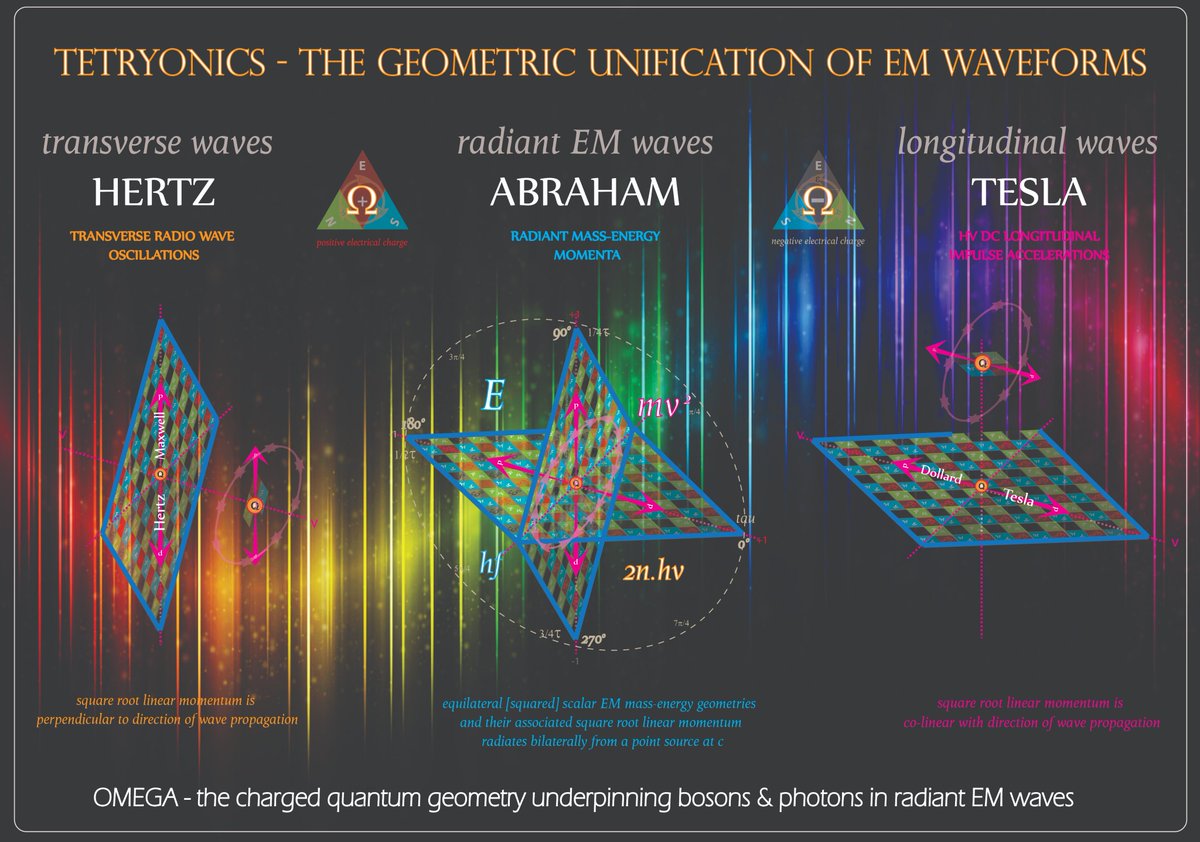
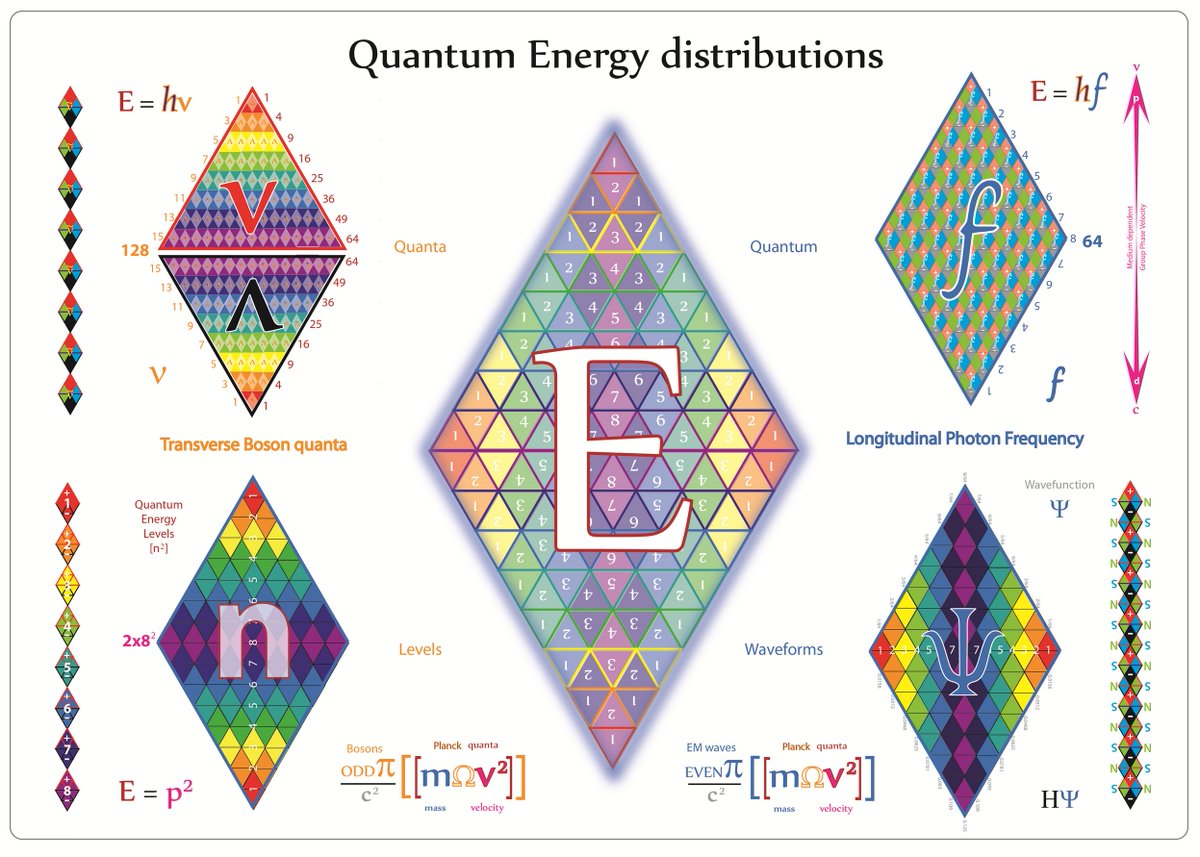


![Tetryonics's tweet photo. Tetryonic Spectral Line Geometrics
The True Geometry Behind Emission, Absorption & Spectral Structure
A Complete Reconstruction of Spectroscopy Using Equilateral EM Physics
SPECTRAL LINES ARE GEOMETRIC, NOT MYSTICAL
For more than a century, spectral lines have been explained with metaphors:
- electrons “jumping,”
- photons “appearing,”
- waves “interfering,”
- probabilities “collapsing.”
These were placeholders — not physics.
Tetryonics reveals the real mechanism:
Spectral lines are the geometric differences between equilateral KEM fields, and photons are the exact equilateral remainders of those transitions.
- No jumps.
- No waves.
- No probabilities.
Just geometry.
THE FOUNDATION - PLANCK‑QUOIN FASCIA
Every spectral line begins with the same quantum building block:
- a 2D equilateral Planck‑quoin fascia
- carrying discrete √E electric momentum
- arranged into rigid triangular KEM fields
- forming the harmonic layers of hydrogen
These fascia assemble into:
- odd‑quanta longitudinal bosons
- even‑quanta dual‑boson photons
This is the true structure behind atomic energy levels.
ENERGY LEVELS - EQUILATERAL KEM FIELDS, NOT ORBITS
Classical physics imagined:
- circular orbits
- spherical charge clouds
- sinusoidal wavefunctions
But Tetryonics shows:
- each energy level is a triangular KEM field
- built from a specific fascia count
- arranged into harmonic equilateral layers
- with discrete ΔKEM differences between them
These differences are the spectral lines.
SPECTRAL LINES - THE DIFFERENCE OF TWO GEOMETRIES
A spectral line is simply:
Δ𝐸 = 𝐸𝑛i − 𝐸𝑛f
Where each
𝐸𝑛 is a 'square number' EM geometry, not a sphere.
When an atom reorganises its fascia:
- the old geometry collapses
- the new geometry forms
- the equilateral remainder becomes a photon
This photon has energy:
𝐸 = ℎ𝑓 = 2ℎ𝑣
Because a photon is two boson fascia in a dual‑boson geometry.
Spectral lines are geometric remainders, not quantum jumps.
THE GAUSSIAN STRUCTURE - WHY LINES HAVE SHAPE
Inside every photon:
- Planck‑quoins arrange into a Gaussian distribution
[1, 2, 3, 4, N, 4, 3, 2, 1]
forming a balanced Lissajous loop
This Gaussian geometry explains:
- line width
- line shape
- fine structure
- hyperfine structure
- isotope shifts
- contracted spectra
The geometry is the line profile.
INTERFERENCE - MOMENTUM CHANNEL ARITHMETIC
Interference is not waves cancelling.
It is Dp/Cp momentum channels adding and subtracting.
When two photons overlap:
- their √E vectors combine
- their Gaussian quoin distributions superpose
- their momentum channels reinforce or oppose
- producing light and dark banding
No waves.
No duality.
No self‑interference.
Just geometric superposition.
THE DOUBLE‑SLIT - FINALLY MADE MECHANICAL
In the double‑slit experiment:
- photons do not split
- photons do not interfere with themselves
- photons do not behave as waves
Instead:
- each slit produces its own fascia geometry
- the two geometries overlap
- their momentum channels combine
- the detector samples the resulting energy density
The pattern is not a wave.
It is a map of overlapping equilateral geometries.
ABSORPTION - THE TRANSFORMER COLLAPSES
A photon is absorbed when:
- its Lissajous loop is interrupted
- its dual‑boson geometry collapses
- its √E momentum is transferred into the atomic fascia
- the receiving KEM field reorganises
This is the mechanical origin of absorption lines.
THE TETRYONIC RECONSTRUCTION - SPECTRAL GEOMETRY COMPLETED
With the correct geometry restored:
- spectral lines are ΔKEM equilateral remainders
- photons are dual‑boson Gaussian transformers
- interference is momentum‑channel arithmetic
- diffraction is geometric sampling
- line shapes come from quoin distributions
- contracted spectra arise from harmonic convergence
- the ABRAHAM series completes the spectrum
This is not a reinterpretation.
This is the actual physical structure of spectroscopy.
THE SPECTRUM, REVEALED BY GEOMETRY
Planck quantised energy.
Rydberg measured the spacing.
Bohr tried to draw it.
Quantum mechanics hid it in probability.
Tetryonics reveals the geometry.
This is the true structure behind spectral lines.
This is interference, re‑drawn.
This is the geometry of light.
This is Tetryonic Spectral Line Geometrics.
#Tetryonics #KelvinABRAHAM #UnifiedTheory #GeometricPhysics #STEM #QuantumGeometry #SpectralLines #PhotonGeometry #InterferenceExplained #PlanckQuoins #ScientificRevolution #EnergyHasShape](https://pbs.twimg.com/media/HG8uyUPbcAAwOBl.jpg)
![Tetryonics's tweet photo. Tetryonic Spectral Line Geometrics
The True Geometry Behind Emission, Absorption & Spectral Structure
A Complete Reconstruction of Spectroscopy Using Equilateral EM Physics
SPECTRAL LINES ARE GEOMETRIC, NOT MYSTICAL
For more than a century, spectral lines have been explained with metaphors:
- electrons “jumping,”
- photons “appearing,”
- waves “interfering,”
- probabilities “collapsing.”
These were placeholders — not physics.
Tetryonics reveals the real mechanism:
Spectral lines are the geometric differences between equilateral KEM fields, and photons are the exact equilateral remainders of those transitions.
- No jumps.
- No waves.
- No probabilities.
Just geometry.
THE FOUNDATION - PLANCK‑QUOIN FASCIA
Every spectral line begins with the same quantum building block:
- a 2D equilateral Planck‑quoin fascia
- carrying discrete √E electric momentum
- arranged into rigid triangular KEM fields
- forming the harmonic layers of hydrogen
These fascia assemble into:
- odd‑quanta longitudinal bosons
- even‑quanta dual‑boson photons
This is the true structure behind atomic energy levels.
ENERGY LEVELS - EQUILATERAL KEM FIELDS, NOT ORBITS
Classical physics imagined:
- circular orbits
- spherical charge clouds
- sinusoidal wavefunctions
But Tetryonics shows:
- each energy level is a triangular KEM field
- built from a specific fascia count
- arranged into harmonic equilateral layers
- with discrete ΔKEM differences between them
These differences are the spectral lines.
SPECTRAL LINES - THE DIFFERENCE OF TWO GEOMETRIES
A spectral line is simply:
Δ𝐸 = 𝐸𝑛i − 𝐸𝑛f
Where each
𝐸𝑛 is a 'square number' EM geometry, not a sphere.
When an atom reorganises its fascia:
- the old geometry collapses
- the new geometry forms
- the equilateral remainder becomes a photon
This photon has energy:
𝐸 = ℎ𝑓 = 2ℎ𝑣
Because a photon is two boson fascia in a dual‑boson geometry.
Spectral lines are geometric remainders, not quantum jumps.
THE GAUSSIAN STRUCTURE - WHY LINES HAVE SHAPE
Inside every photon:
- Planck‑quoins arrange into a Gaussian distribution
[1, 2, 3, 4, N, 4, 3, 2, 1]
forming a balanced Lissajous loop
This Gaussian geometry explains:
- line width
- line shape
- fine structure
- hyperfine structure
- isotope shifts
- contracted spectra
The geometry is the line profile.
INTERFERENCE - MOMENTUM CHANNEL ARITHMETIC
Interference is not waves cancelling.
It is Dp/Cp momentum channels adding and subtracting.
When two photons overlap:
- their √E vectors combine
- their Gaussian quoin distributions superpose
- their momentum channels reinforce or oppose
- producing light and dark banding
No waves.
No duality.
No self‑interference.
Just geometric superposition.
THE DOUBLE‑SLIT - FINALLY MADE MECHANICAL
In the double‑slit experiment:
- photons do not split
- photons do not interfere with themselves
- photons do not behave as waves
Instead:
- each slit produces its own fascia geometry
- the two geometries overlap
- their momentum channels combine
- the detector samples the resulting energy density
The pattern is not a wave.
It is a map of overlapping equilateral geometries.
ABSORPTION - THE TRANSFORMER COLLAPSES
A photon is absorbed when:
- its Lissajous loop is interrupted
- its dual‑boson geometry collapses
- its √E momentum is transferred into the atomic fascia
- the receiving KEM field reorganises
This is the mechanical origin of absorption lines.
THE TETRYONIC RECONSTRUCTION - SPECTRAL GEOMETRY COMPLETED
With the correct geometry restored:
- spectral lines are ΔKEM equilateral remainders
- photons are dual‑boson Gaussian transformers
- interference is momentum‑channel arithmetic
- diffraction is geometric sampling
- line shapes come from quoin distributions
- contracted spectra arise from harmonic convergence
- the ABRAHAM series completes the spectrum
This is not a reinterpretation.
This is the actual physical structure of spectroscopy.
THE SPECTRUM, REVEALED BY GEOMETRY
Planck quantised energy.
Rydberg measured the spacing.
Bohr tried to draw it.
Quantum mechanics hid it in probability.
Tetryonics reveals the geometry.
This is the true structure behind spectral lines.
This is interference, re‑drawn.
This is the geometry of light.
This is Tetryonic Spectral Line Geometrics.
#Tetryonics #KelvinABRAHAM #UnifiedTheory #GeometricPhysics #STEM #QuantumGeometry #SpectralLines #PhotonGeometry #InterferenceExplained #PlanckQuoins #ScientificRevolution #EnergyHasShape](https://pbs.twimg.com/media/HG8uyUMakAAAqOu.jpg)


![Tetryonics's tweet photo. Tetryonics - Spectral Lines & Interference Explained
The Geometry behind Emission, Absorption, and Light–Dark Banding - No Waves, No Probabilities, Just Planck‑Quoin Geometry
SPECTRAL LINES WERE NEVER “JUMPS”
For more than a century, physics has described spectral lines as:
electrons “jumping” between orbits, photons “popping” in and out of existence, and interference patterns forming from “waves” cancelling each other.
These were metaphors - not mechanics.
Tetryonics reveals the real structure:
Spectral lines are geometric re-organisation of Planck‑quoin EM fascia, and interference patterns are the arithmetic of their momentum channels.
- No quantum jumps.
- No oscillating waves.
- No probability clouds.
Just geometry.
THE FOUNDATION - QUANTA ARE EQUILATERAL
Every spectral line begins with the same building block:
- a 2D equilateral Planck‑quoin fascia
- carrying discrete √E electric momentum
- arranged into rigid EM geometries
- forming the KEM fields of atoms
These fascia stack into:
- odd‑quanta bosons (longitudinal)
- even‑quanta photons (dual‑boson transverse)
This is the true structure behind atomic energy levels.
SPECTRAL LINES - DIFFERENCE OF TWO GEOMETRIES
A spectral line is not a jump.
It is a difference of two equilateral KEM geometries:
𝐸 line = 𝐸𝑛 − 𝐸𝑚
Where each energy level is:
- a quantised equilateral field
- built from Planck‑quoin fascia
- arranged into discrete harmonic layers
When an atom reorganises its fascia:
- the old geometry collapses
- the new geometry forms
- the difference is released as a photon
This photon has energy:
𝐸 = ℎ𝑓 = 2ℎ𝑣
A spectral line is simply the geometric remainder of two KEM fields.
THE EQUILATERAL GAUSSIAN DISTRIBUTION
- THE REAL SHAPE OF A SPECTRAL LINE
Inside every photon:
- Planck‑quoins arrange into a Gaussian distribution
[1, 2, 3, 4, N, 4, 3, 2, 1]
forming a balanced Lissajous energy loop
This Gaussian structure is why:
- spectral lines have width
- spectral lines have shape
- spectral lines show fine structure
- spectral lines show interference residues
The geometry is the line profile.
INTERFERENCE - MOMENTUM CHANNEL ARITHMETIC
Interference has been misunderstood for 200 years.
Physics claimed:
- waves cancel
- waves reinforce
- particles interfere with themselves
- probability amplitudes overlap
Tetryonics shows the real mechanism:
Interference is the addition and subtraction of Divergent / Convergent momentum channels from overlapping equilateral fascia.
When two photons overlap:
- their √E vectors add
- their Dp/Cp channels reinforce or oppose
- their Gaussian quoin distributions combine
- producing light and dark banding
No waves.
No cancellation.
No duality.
Just geometric superposition.
THE DOUBLE‑SLIT - FINALLY EXPLAINED
In the double‑slit experiment:
- photons do not split
- photons do not interfere with themselves
- photons do not behave as waves
Instead:
- each slit produces its own fascia geometry
- the two geometries overlap
- their momentum channels add
- the detector samples the combined energy density
The pattern is not a wave.
It is a map of overlapping equilateral geometries.
ABSORPTION - THE TRANSFORMER COLLAPSES
A photon is absorbed when:
- its Lissajous loop is interrupted
- its dual‑boson geometry collapses
- its √E momentum is transferred into the atomic fascia
- the receiving KEM field reorganises
This is the mechanical origin of absorption lines.
THE TETRYONIC RECONSTRUCTION - SPECTRAL LINES & INTERFERENCE COMPLETED
With the correct geometry restored:
- spectral lines are differences of equilateral KEM fields
- photons are dual‑boson Gaussian transformers
- interference is momentum‑channel arithmetic
- diffraction is geometric sampling
- line shapes come from quoin distributions
- absorption is transformer collapse
- emission is fascia reconfiguration
This is not a reinterpretation.
This is the actual physical structure of spectroscopy.
THE GEOMETRY BEHIND LIGHT, MATTER & MEASUREMENT
Spectral lines were never mysterious.
Interference was never paradoxical.
Quantum behaviour was never probabilistic.
They were geometric all along.
This is the quantum geometric model of spectral lines.
This is interference, re‑drawn.
This is the geometry behind photons, atoms, and measurement.
This is Tetryonics - Spectral Lines & Interference Explained.
#Tetryonics #KelvinABRAHAM #UnifiedTheory #GeometricPhysics #STEM #QuantumGeometry #SpectralLines #InterferenceExplained #PhotonGeometry #PlanckQuoins #ScientificRevolution #EnergyHasShape](https://pbs.twimg.com/media/HG0MefIbIAAHmZf.jpg)
![Tetryonics's tweet photo. Tetryonics - Spectral Lines & Interference Explained
The Geometry behind Emission, Absorption, and Light–Dark Banding - No Waves, No Probabilities, Just Planck‑Quoin Geometry
SPECTRAL LINES WERE NEVER “JUMPS”
For more than a century, physics has described spectral lines as:
electrons “jumping” between orbits, photons “popping” in and out of existence, and interference patterns forming from “waves” cancelling each other.
These were metaphors - not mechanics.
Tetryonics reveals the real structure:
Spectral lines are geometric re-organisation of Planck‑quoin EM fascia, and interference patterns are the arithmetic of their momentum channels.
- No quantum jumps.
- No oscillating waves.
- No probability clouds.
Just geometry.
THE FOUNDATION - QUANTA ARE EQUILATERAL
Every spectral line begins with the same building block:
- a 2D equilateral Planck‑quoin fascia
- carrying discrete √E electric momentum
- arranged into rigid EM geometries
- forming the KEM fields of atoms
These fascia stack into:
- odd‑quanta bosons (longitudinal)
- even‑quanta photons (dual‑boson transverse)
This is the true structure behind atomic energy levels.
SPECTRAL LINES - DIFFERENCE OF TWO GEOMETRIES
A spectral line is not a jump.
It is a difference of two equilateral KEM geometries:
𝐸 line = 𝐸𝑛 − 𝐸𝑚
Where each energy level is:
- a quantised equilateral field
- built from Planck‑quoin fascia
- arranged into discrete harmonic layers
When an atom reorganises its fascia:
- the old geometry collapses
- the new geometry forms
- the difference is released as a photon
This photon has energy:
𝐸 = ℎ𝑓 = 2ℎ𝑣
A spectral line is simply the geometric remainder of two KEM fields.
THE EQUILATERAL GAUSSIAN DISTRIBUTION
- THE REAL SHAPE OF A SPECTRAL LINE
Inside every photon:
- Planck‑quoins arrange into a Gaussian distribution
[1, 2, 3, 4, N, 4, 3, 2, 1]
forming a balanced Lissajous energy loop
This Gaussian structure is why:
- spectral lines have width
- spectral lines have shape
- spectral lines show fine structure
- spectral lines show interference residues
The geometry is the line profile.
INTERFERENCE - MOMENTUM CHANNEL ARITHMETIC
Interference has been misunderstood for 200 years.
Physics claimed:
- waves cancel
- waves reinforce
- particles interfere with themselves
- probability amplitudes overlap
Tetryonics shows the real mechanism:
Interference is the addition and subtraction of Divergent / Convergent momentum channels from overlapping equilateral fascia.
When two photons overlap:
- their √E vectors add
- their Dp/Cp channels reinforce or oppose
- their Gaussian quoin distributions combine
- producing light and dark banding
No waves.
No cancellation.
No duality.
Just geometric superposition.
THE DOUBLE‑SLIT - FINALLY EXPLAINED
In the double‑slit experiment:
- photons do not split
- photons do not interfere with themselves
- photons do not behave as waves
Instead:
- each slit produces its own fascia geometry
- the two geometries overlap
- their momentum channels add
- the detector samples the combined energy density
The pattern is not a wave.
It is a map of overlapping equilateral geometries.
ABSORPTION - THE TRANSFORMER COLLAPSES
A photon is absorbed when:
- its Lissajous loop is interrupted
- its dual‑boson geometry collapses
- its √E momentum is transferred into the atomic fascia
- the receiving KEM field reorganises
This is the mechanical origin of absorption lines.
THE TETRYONIC RECONSTRUCTION - SPECTRAL LINES & INTERFERENCE COMPLETED
With the correct geometry restored:
- spectral lines are differences of equilateral KEM fields
- photons are dual‑boson Gaussian transformers
- interference is momentum‑channel arithmetic
- diffraction is geometric sampling
- line shapes come from quoin distributions
- absorption is transformer collapse
- emission is fascia reconfiguration
This is not a reinterpretation.
This is the actual physical structure of spectroscopy.
THE GEOMETRY BEHIND LIGHT, MATTER & MEASUREMENT
Spectral lines were never mysterious.
Interference was never paradoxical.
Quantum behaviour was never probabilistic.
They were geometric all along.
This is the quantum geometric model of spectral lines.
This is interference, re‑drawn.
This is the geometry behind photons, atoms, and measurement.
This is Tetryonics - Spectral Lines & Interference Explained.
#Tetryonics #KelvinABRAHAM #UnifiedTheory #GeometricPhysics #STEM #QuantumGeometry #SpectralLines #InterferenceExplained #PhotonGeometry #PlanckQuoins #ScientificRevolution #EnergyHasShape](https://pbs.twimg.com/media/HG0MefGbYAAlhN4.jpg)


![Tetryonics's tweet photo. Tetryonics — The Electro‑Mechanical Model of Light
LIGHT IS NOT A WAVE, NOT A PARTICLE, BUT A GEOMETRY
For more than a century, physics has tried to force light into categories it never belonged to:
- a wave in spacetime,
- a point‑particle with no size,
a duality that behaves differently depending on how we observe it.
Tetryonics reveals the deeper truth:
Light is a rigid electro‑mechanical object - a dual‑boson EM geometry whose energies circulate endlessly in a closed Lissajous loop until absorbed by Matter.
- No oscillation.
- No flipping fields.
- No spacetime distortions.
- Just geometry.
THE FOUNDATION - THE PLANCK‑QUOIN FASCIA [hv]
Every photon begins with the fundamental 2d EM fascia:
- strictly divergent √E electric momentum
- arranged in equilateral geometry
- with mass, charge and linear momentum
This is the Planck quoin - the true quantum of EM geometry.
It is the building block of all photons.
THE PHOTON - A DUAL‑BOSON EVEN‑π GEOMETRY
A photon is created when two W‑boson fascia
are joined back‑to‑back along their magnetic dipole bases.
This creates:
- a neutral, longitudinal EM battery
- a rigid, even‑π dual‑boson geometry
- a perfectly balanced EM structure
- an ideal quantum 1:1 transformer
The photon is not a wave.
It is not a point.
It is a electro-mechanical EM transformer.
THE IDEAL QUANTUM TRANSFORMER - 1:1 ENERGY TRANSFER
Inside the photon:
- electric and magnetic energies
- circulate endlessly
- in a closed Lissajous loop
- maintaining perfect 1:1 inductive–capacitive balance
- with zero loss, zero decay, zero deformation
This is why photons:
- propagate indefinitely
- never weaken
- never distort
- never “run down”
- remain stable until absorbed by Matter
A photon is the only perfect transformer in physics.
THE EM FIELDS OF LIGHT - FIXED, INVARIANT, GEOMETRIC
A photon’s electric and magnetic fields do not:
- flip
- oscillate
- rotate
- transform
- change with time
- change with motion
They are:
- fixed 2d EM fascia
- rigid equilateral geometries
- mechanically invariant during propagation
The EM structure of a photon is as fixed as the EM geometry of a bar magnet - but arranged in a neutral, longitudinal, propagating configuration.
- There is no internal oscillation.
- There is no sinusoidal motion.
- There is no rotating vector.
The sinusoidal waveform is not in the photon.
It is in the observer’s sampling of the photon’s fixed geometry as it passes.
THE WAVEFORM - A SAMPLING ARTIFACT, NOT A PHYSICAL MOTION
As the photon moves past a detector:
- the detector intersects different regions of the fixed EM geometry
- at discrete spatial intervals
- producing a sinusoidal measurement trace
This creates the illusion of:
- oscillating fields
- wave propagation
- sinusoidal motion
- field rotation
But the photon itself remains rigid and unchanged.
This resolves:
- wave–particle duality
- interference
- diffraction
- polarization
- coherence
- and the entire ontology of “oscillating EM waves”
All without invoking waves in spacetime.
THE SPEED OF LIGHT - A GEOMETRIC CONSEQUENCE
The photon’s geometry determines its speed:
- rigid fascia
- fixed propagation step
- quantised EM structure
- equilateral geometry
The speed of light is not a property of spacetime.
It is a property of the photon’s mechanical design.
THE QUANTUM - ENERGY FROM GEOMETRY
The energy of a photon is:
𝐸 = ℎ𝑓 = 2ℎ𝑣
Where:
- h = equilateral area of a single boson fascia
- v = the Planck‑quoin count (the true frequency)
- 2 = the photon’s dual‑boson structure
Thus:
ℎ𝑓 = ℎ(2𝑣) = 2ℎ𝑣
Energy is area × quoin‑frequency, not an oscillation.
This is the first physically meaningful interpretation of Planck’s constant.
ABSORPTION - THE TRANSFORMER COLLAPSES
A photon is absorbed when:
- its Lissajous loop is interrupted
- its EM geometry collapses
- its energy is transferred into the receiving fascia
- the transformer circuit terminates
This is the mechanical origin of absorption, excitation, and emission.
THE ELECTRO‑MECHANICAL MODEL — LIGHT COMPLETED
With the correct geometry restored:
- photons are rigid EM geometries, not waves
- their EM fields are fixed, not oscillating
- their energies circulate in Lissajous loops, not sinusoidal motions
- they act as ideal quantum transformers
- they propagate by geometric translation, not field flipping
- they obey 2ℎ𝑣 = E = ℎf as a geometric identity
- they move at c because of their structure, not spacetime
- they interact with Matter through transformer collapse, not probability
This is not a reinterpretation.
This is the actual physical structure of light.
THE MODEL MAXWELL NEVER HAD
Maxwell described the behaviour of light.
Einstein described its speed.
Quantum mechanics described its statistics.
Tetryonics reveals its geometry.
This is the electro‑mechanical model of light.
This is the photon, re‑drawn.
This is the geometry behind electromagnetism, relativity, and quantum theory.
This is Tetryonics - the quantum geometry of Photons of Light, Finally Explained.](https://pbs.twimg.com/media/HGe1kppb0AAImVs.jpg)
![Tetryonics's tweet photo. Tetryonics — The Electro‑Mechanical Model of Light
LIGHT IS NOT A WAVE, NOT A PARTICLE, BUT A GEOMETRY
For more than a century, physics has tried to force light into categories it never belonged to:
- a wave in spacetime,
- a point‑particle with no size,
a duality that behaves differently depending on how we observe it.
Tetryonics reveals the deeper truth:
Light is a rigid electro‑mechanical object - a dual‑boson EM geometry whose energies circulate endlessly in a closed Lissajous loop until absorbed by Matter.
- No oscillation.
- No flipping fields.
- No spacetime distortions.
- Just geometry.
THE FOUNDATION - THE PLANCK‑QUOIN FASCIA [hv]
Every photon begins with the fundamental 2d EM fascia:
- strictly divergent √E electric momentum
- arranged in equilateral geometry
- with mass, charge and linear momentum
This is the Planck quoin - the true quantum of EM geometry.
It is the building block of all photons.
THE PHOTON - A DUAL‑BOSON EVEN‑π GEOMETRY
A photon is created when two W‑boson fascia
are joined back‑to‑back along their magnetic dipole bases.
This creates:
- a neutral, longitudinal EM battery
- a rigid, even‑π dual‑boson geometry
- a perfectly balanced EM structure
- an ideal quantum 1:1 transformer
The photon is not a wave.
It is not a point.
It is a electro-mechanical EM transformer.
THE IDEAL QUANTUM TRANSFORMER - 1:1 ENERGY TRANSFER
Inside the photon:
- electric and magnetic energies
- circulate endlessly
- in a closed Lissajous loop
- maintaining perfect 1:1 inductive–capacitive balance
- with zero loss, zero decay, zero deformation
This is why photons:
- propagate indefinitely
- never weaken
- never distort
- never “run down”
- remain stable until absorbed by Matter
A photon is the only perfect transformer in physics.
THE EM FIELDS OF LIGHT - FIXED, INVARIANT, GEOMETRIC
A photon’s electric and magnetic fields do not:
- flip
- oscillate
- rotate
- transform
- change with time
- change with motion
They are:
- fixed 2d EM fascia
- rigid equilateral geometries
- mechanically invariant during propagation
The EM structure of a photon is as fixed as the EM geometry of a bar magnet - but arranged in a neutral, longitudinal, propagating configuration.
- There is no internal oscillation.
- There is no sinusoidal motion.
- There is no rotating vector.
The sinusoidal waveform is not in the photon.
It is in the observer’s sampling of the photon’s fixed geometry as it passes.
THE WAVEFORM - A SAMPLING ARTIFACT, NOT A PHYSICAL MOTION
As the photon moves past a detector:
- the detector intersects different regions of the fixed EM geometry
- at discrete spatial intervals
- producing a sinusoidal measurement trace
This creates the illusion of:
- oscillating fields
- wave propagation
- sinusoidal motion
- field rotation
But the photon itself remains rigid and unchanged.
This resolves:
- wave–particle duality
- interference
- diffraction
- polarization
- coherence
- and the entire ontology of “oscillating EM waves”
All without invoking waves in spacetime.
THE SPEED OF LIGHT - A GEOMETRIC CONSEQUENCE
The photon’s geometry determines its speed:
- rigid fascia
- fixed propagation step
- quantised EM structure
- equilateral geometry
The speed of light is not a property of spacetime.
It is a property of the photon’s mechanical design.
THE QUANTUM - ENERGY FROM GEOMETRY
The energy of a photon is:
𝐸 = ℎ𝑓 = 2ℎ𝑣
Where:
- h = equilateral area of a single boson fascia
- v = the Planck‑quoin count (the true frequency)
- 2 = the photon’s dual‑boson structure
Thus:
ℎ𝑓 = ℎ(2𝑣) = 2ℎ𝑣
Energy is area × quoin‑frequency, not an oscillation.
This is the first physically meaningful interpretation of Planck’s constant.
ABSORPTION - THE TRANSFORMER COLLAPSES
A photon is absorbed when:
- its Lissajous loop is interrupted
- its EM geometry collapses
- its energy is transferred into the receiving fascia
- the transformer circuit terminates
This is the mechanical origin of absorption, excitation, and emission.
THE ELECTRO‑MECHANICAL MODEL — LIGHT COMPLETED
With the correct geometry restored:
- photons are rigid EM geometries, not waves
- their EM fields are fixed, not oscillating
- their energies circulate in Lissajous loops, not sinusoidal motions
- they act as ideal quantum transformers
- they propagate by geometric translation, not field flipping
- they obey 2ℎ𝑣 = E = ℎf as a geometric identity
- they move at c because of their structure, not spacetime
- they interact with Matter through transformer collapse, not probability
This is not a reinterpretation.
This is the actual physical structure of light.
THE MODEL MAXWELL NEVER HAD
Maxwell described the behaviour of light.
Einstein described its speed.
Quantum mechanics described its statistics.
Tetryonics reveals its geometry.
This is the electro‑mechanical model of light.
This is the photon, re‑drawn.
This is the geometry behind electromagnetism, relativity, and quantum theory.
This is Tetryonics - the quantum geometry of Photons of Light, Finally Explained.](https://pbs.twimg.com/media/HGe1kpoboAAG_Yw.jpg)


![Tetryonics's tweet photo. Tetryonics — Bar Magnet Ontology
The Tetryonic Resolution
THE MAGNET WE THOUGHT WE UNDERSTOOD
For over 150 years, bar magnets have been described using
field lines, flux loops, dipoles, and spacetime‑dependent transformations.
These descriptions were never physical.
They were mathematical conveniences -
and they obscured the true geometry of magnetism.
Tetryonics reveals the actual ontology:
a bar magnet is Matter whose atoms were heated, aligned under an external M‑field, and then cooled, locking their 3d charged topologies into a coherent EM‑favored orientation.
This frozen alignment produces the strongest possible external 2d EM field geometry that the material can sustain.
This single correction overturns the classical descriptions of
Maxwell, Gauss, Ampère, Faraday, and it rewrites the very foundations of Einstein’s Special Relativity.
THE HOT STATE — ATOMIC FREEDOM AND EXTERNAL ALIGNMENT
When a ferromagnetic material is heated,
its atomic 3d charged Matter topologies become free to rotate.
Apply an external magnetic field,
and these topologies align their charged faces
into the EM‑favored orientation.
In this hot, flexible state,
the atoms can be steered into coherence.
This is the only moment when a magnet can be created.
THE COOLING — GEOMETRY FROZEN IN PLACE
As the material cools,
the aligned 3d charged topologies freeze into position.
The result is a block of Matter whose internal charge orientations are now:
- coherent
- stable and
- EM‑biased [with a neutral E-fields and dominant M-field]
This locked‑in orientation produces a persistent magnetic moment
without requiring any motion of charge.
- A bar magnet is not “doing” anything.
- It is simply 'frozen' Matter locked EM field geometry.
THE EXTERNAL FIELD - FIXED 2d EM GEOMETRIES
The external magnetic field of a bar magnet
is not a loop, a flux tube, or a tensor component.
It is a fixed 2d EM mass‑energy geometry
radiating from the aligned 3d charged Matter.
- These 2d EM geometries contain:
- discrete electric components
- discrete magnetic components
- a directional magnetic moment
EQUILATERAL EM ENERGY-MOMENT FIELD GEOMETRICS
[endlessly circulating in a 'Lissajous loop' field geometric]
- They do not change.
- They do not transform.
- They do not oscillate.
They are static 2d EM fields.
This is the geometry Tetryonic Principia geometrics EM field reveal.
THE MISPERCEPTION - WHY MOTION CREATES “CHANGING FIELDS”
When a conductor moves relative to a magnet,
or when a magnet moves relative to a conductor,
the observer samples different regions of the fixed 2d EM geometry.
This creates the illusion that:
- E‑fields become M‑fields
- M‑fields become E‑fields
- fields “change” with motion
- magnetism “induces” electricity
- electricity “induces” magnetism
But nothing in the magnet actually changes.
The 2d EM geometry is fixed.
Only the sampling changes.
This is the root of the classical misinterpretation
and the origin of Einstein’s foundational error.
THE RELATIVISTIC ERROR - EINSTEIN CONTRACTED THE WRONG THING
Einstein assumed that:
“A magnetic field in one frame becomes an electric field in another.”
- This was never true.
- He misinterpreted observer‑dependent sampling as field transformation.
- He contracted Matter when only 2d kEM fields contract.
- He treated EM geometry as if it were spacetime geometry.
The Tetryonic Resolution shows:
- EM fields are discrete, equilateral geometries
- They do not transform into each other
- They do not depend on the observer
- Only the relative motion changes the rate of sampling
All “transformations” are perceptual artifacts
This correction rewrites the foundations of Special Relativity.
THE CLASSICAL ERROR — MAXWELL, GAUSS, AMPÈRE, FARADAY
Classical electromagnetism described fields using:
- continuous flux
- imaginary lines
- curls and divergences
- vector fields
- differential operators
These were mathematical conveniences,
not physical ontologies.
- They hid the true structure:
- EM fields are quantised 2d geometries
- Matter is a quantised 3d geometry
- Magnetic moments arise from frozen charge orientation
- Induction arises from relative motion through fixed geometry
Tetryonics restores the physical ontology
that classical physics never had.
THE TETRYONIC RESOLUTION - GEOMETRY, NOT TRANSFORMATION
With the correct ontology restored:
- A bar magnet is a block of aligned 3d charged Matter
- Its external field is a fixed 2d EM geometry
- Motion changes sampling, not the field
- E and M components are discrete, not interchangeable
- No fields transform - only the observer’s interaction does
- Induction is a geometric sampling effect, not a field conversion
This is the true structure behind magnetism.
THE REAL MAGNET GEOMETRICS, THE REAL RELATIVITY
A bar magnet is not a dipole with lines.
It is a frozen EM geometry created by heating, aligning, and cooling Matter into its most EM‑favored orientation.
Its external 2d EM fields are fixed, discrete, and equilateral.
- They do not change.
- They only appear to change
when sampled by a moving observer or a moving conductor.
This correction overturns:
- Einstein’s Special Relativity
- Maxwell’s field‑line ontology
- Gauss’s flux interpretation
- Ampère’s current‑loop model
- Faraday’s induction narrative
This is the corrected ontology.
This is the resolved magnet.
This is Tetryonics - The Bar Magnet, re‑Explained, re-drawn.](https://pbs.twimg.com/media/HGYglwmacAAFQb1.jpg)
![Tetryonics's tweet photo. Tetryonics — Bar Magnet Ontology
The Tetryonic Resolution
THE MAGNET WE THOUGHT WE UNDERSTOOD
For over 150 years, bar magnets have been described using
field lines, flux loops, dipoles, and spacetime‑dependent transformations.
These descriptions were never physical.
They were mathematical conveniences -
and they obscured the true geometry of magnetism.
Tetryonics reveals the actual ontology:
a bar magnet is Matter whose atoms were heated, aligned under an external M‑field, and then cooled, locking their 3d charged topologies into a coherent EM‑favored orientation.
This frozen alignment produces the strongest possible external 2d EM field geometry that the material can sustain.
This single correction overturns the classical descriptions of
Maxwell, Gauss, Ampère, Faraday, and it rewrites the very foundations of Einstein’s Special Relativity.
THE HOT STATE — ATOMIC FREEDOM AND EXTERNAL ALIGNMENT
When a ferromagnetic material is heated,
its atomic 3d charged Matter topologies become free to rotate.
Apply an external magnetic field,
and these topologies align their charged faces
into the EM‑favored orientation.
In this hot, flexible state,
the atoms can be steered into coherence.
This is the only moment when a magnet can be created.
THE COOLING — GEOMETRY FROZEN IN PLACE
As the material cools,
the aligned 3d charged topologies freeze into position.
The result is a block of Matter whose internal charge orientations are now:
- coherent
- stable and
- EM‑biased [with a neutral E-fields and dominant M-field]
This locked‑in orientation produces a persistent magnetic moment
without requiring any motion of charge.
- A bar magnet is not “doing” anything.
- It is simply 'frozen' Matter locked EM field geometry.
THE EXTERNAL FIELD - FIXED 2d EM GEOMETRIES
The external magnetic field of a bar magnet
is not a loop, a flux tube, or a tensor component.
It is a fixed 2d EM mass‑energy geometry
radiating from the aligned 3d charged Matter.
- These 2d EM geometries contain:
- discrete electric components
- discrete magnetic components
- a directional magnetic moment
EQUILATERAL EM ENERGY-MOMENT FIELD GEOMETRICS
[endlessly circulating in a 'Lissajous loop' field geometric]
- They do not change.
- They do not transform.
- They do not oscillate.
They are static 2d EM fields.
This is the geometry Tetryonic Principia geometrics EM field reveal.
THE MISPERCEPTION - WHY MOTION CREATES “CHANGING FIELDS”
When a conductor moves relative to a magnet,
or when a magnet moves relative to a conductor,
the observer samples different regions of the fixed 2d EM geometry.
This creates the illusion that:
- E‑fields become M‑fields
- M‑fields become E‑fields
- fields “change” with motion
- magnetism “induces” electricity
- electricity “induces” magnetism
But nothing in the magnet actually changes.
The 2d EM geometry is fixed.
Only the sampling changes.
This is the root of the classical misinterpretation
and the origin of Einstein’s foundational error.
THE RELATIVISTIC ERROR - EINSTEIN CONTRACTED THE WRONG THING
Einstein assumed that:
“A magnetic field in one frame becomes an electric field in another.”
- This was never true.
- He misinterpreted observer‑dependent sampling as field transformation.
- He contracted Matter when only 2d kEM fields contract.
- He treated EM geometry as if it were spacetime geometry.
The Tetryonic Resolution shows:
- EM fields are discrete, equilateral geometries
- They do not transform into each other
- They do not depend on the observer
- Only the relative motion changes the rate of sampling
All “transformations” are perceptual artifacts
This correction rewrites the foundations of Special Relativity.
THE CLASSICAL ERROR — MAXWELL, GAUSS, AMPÈRE, FARADAY
Classical electromagnetism described fields using:
- continuous flux
- imaginary lines
- curls and divergences
- vector fields
- differential operators
These were mathematical conveniences,
not physical ontologies.
- They hid the true structure:
- EM fields are quantised 2d geometries
- Matter is a quantised 3d geometry
- Magnetic moments arise from frozen charge orientation
- Induction arises from relative motion through fixed geometry
Tetryonics restores the physical ontology
that classical physics never had.
THE TETRYONIC RESOLUTION - GEOMETRY, NOT TRANSFORMATION
With the correct ontology restored:
- A bar magnet is a block of aligned 3d charged Matter
- Its external field is a fixed 2d EM geometry
- Motion changes sampling, not the field
- E and M components are discrete, not interchangeable
- No fields transform - only the observer’s interaction does
- Induction is a geometric sampling effect, not a field conversion
This is the true structure behind magnetism.
THE REAL MAGNET GEOMETRICS, THE REAL RELATIVITY
A bar magnet is not a dipole with lines.
It is a frozen EM geometry created by heating, aligning, and cooling Matter into its most EM‑favored orientation.
Its external 2d EM fields are fixed, discrete, and equilateral.
- They do not change.
- They only appear to change
when sampled by a moving observer or a moving conductor.
This correction overturns:
- Einstein’s Special Relativity
- Maxwell’s field‑line ontology
- Gauss’s flux interpretation
- Ampère’s current‑loop model
- Faraday’s induction narrative
This is the corrected ontology.
This is the resolved magnet.
This is Tetryonics - The Bar Magnet, re‑Explained, re-drawn.](https://pbs.twimg.com/media/HGYglwiaMAAfvXx.jpg)







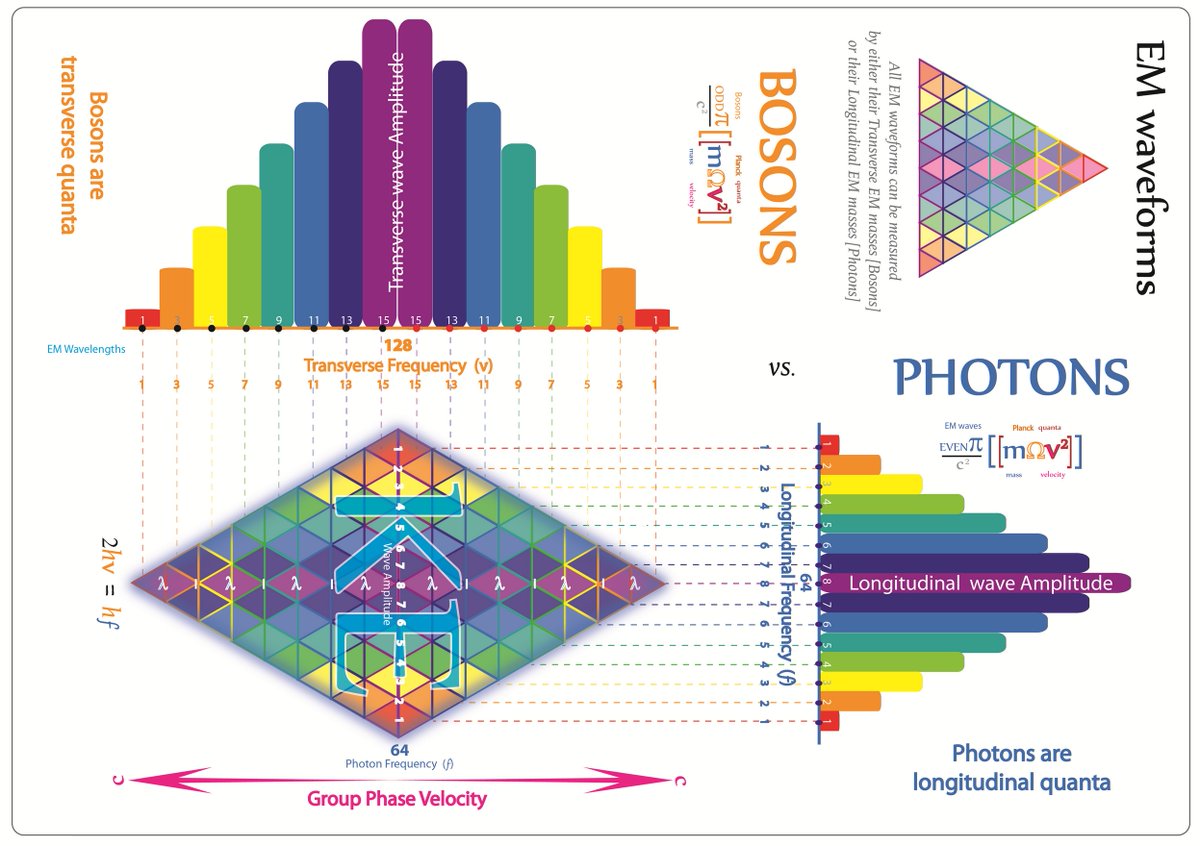


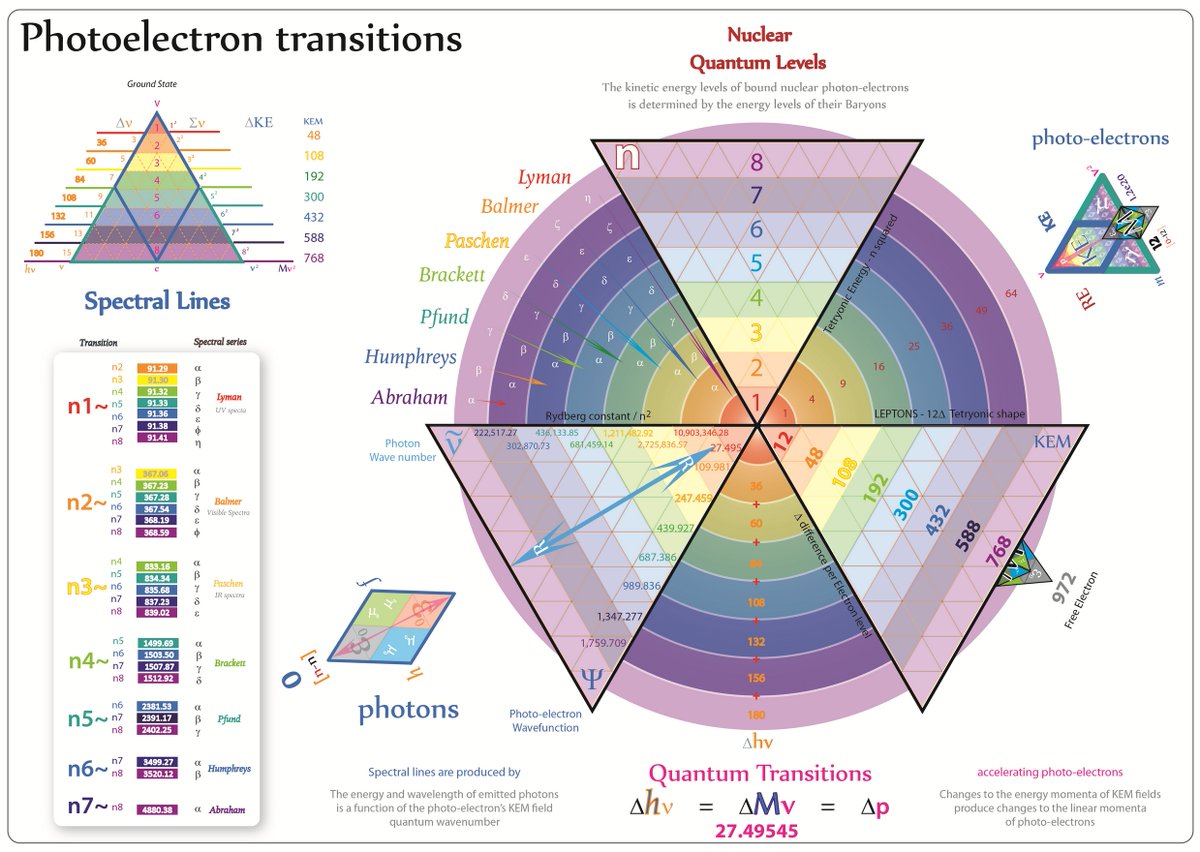
![Tetryonics's tweet photo. Tetryonic Spectral Line Geometrics
The True Geometry Behind Emission, Absorption & Spectral Structure
A Complete Reconstruction of Spectroscopy Using Equilateral EM Physics
SPECTRAL LINES ARE GEOMETRIC, NOT MYSTICAL
For more than a century, spectral lines have been explained with metaphors:
- electrons “jumping,”
- photons “appearing,”
- waves “interfering,”
- probabilities “collapsing.”
These were placeholders — not physics.
Tetryonics reveals the real mechanism:
Spectral lines are the geometric differences between equilateral KEM fields, and photons are the exact equilateral remainders of those transitions.
- No jumps.
- No waves.
- No probabilities.
Just geometry.
THE FOUNDATION - PLANCK‑QUOIN FASCIA
Every spectral line begins with the same quantum building block:
- a 2D equilateral Planck‑quoin fascia
- carrying discrete √E electric momentum
- arranged into rigid triangular KEM fields
- forming the harmonic layers of hydrogen
These fascia assemble into:
- odd‑quanta longitudinal bosons
- even‑quanta dual‑boson photons
This is the true structure behind atomic energy levels.
ENERGY LEVELS - EQUILATERAL KEM FIELDS, NOT ORBITS
Classical physics imagined:
- circular orbits
- spherical charge clouds
- sinusoidal wavefunctions
But Tetryonics shows:
- each energy level is a triangular KEM field
- built from a specific fascia count
- arranged into harmonic equilateral layers
- with discrete ΔKEM differences between them
These differences are the spectral lines.
SPECTRAL LINES - THE DIFFERENCE OF TWO GEOMETRIES
A spectral line is simply:
Δ𝐸 = 𝐸𝑛i − 𝐸𝑛f
Where each
𝐸𝑛 is a 'square number' EM geometry, not a sphere.
When an atom reorganises its fascia:
- the old geometry collapses
- the new geometry forms
- the equilateral remainder becomes a photon
This photon has energy:
𝐸 = ℎ𝑓 = 2ℎ𝑣
Because a photon is two boson fascia in a dual‑boson geometry.
Spectral lines are geometric remainders, not quantum jumps.
THE GAUSSIAN STRUCTURE - WHY LINES HAVE SHAPE
Inside every photon:
- Planck‑quoins arrange into a Gaussian distribution
[1, 2, 3, 4, N, 4, 3, 2, 1]
forming a balanced Lissajous loop
This Gaussian geometry explains:
- line width
- line shape
- fine structure
- hyperfine structure
- isotope shifts
- contracted spectra
The geometry is the line profile.
INTERFERENCE - MOMENTUM CHANNEL ARITHMETIC
Interference is not waves cancelling.
It is Dp/Cp momentum channels adding and subtracting.
When two photons overlap:
- their √E vectors combine
- their Gaussian quoin distributions superpose
- their momentum channels reinforce or oppose
- producing light and dark banding
No waves.
No duality.
No self‑interference.
Just geometric superposition.
THE DOUBLE‑SLIT - FINALLY MADE MECHANICAL
In the double‑slit experiment:
- photons do not split
- photons do not interfere with themselves
- photons do not behave as waves
Instead:
- each slit produces its own fascia geometry
- the two geometries overlap
- their momentum channels combine
- the detector samples the resulting energy density
The pattern is not a wave.
It is a map of overlapping equilateral geometries.
ABSORPTION - THE TRANSFORMER COLLAPSES
A photon is absorbed when:
- its Lissajous loop is interrupted
- its dual‑boson geometry collapses
- its √E momentum is transferred into the atomic fascia
- the receiving KEM field reorganises
This is the mechanical origin of absorption lines.
THE TETRYONIC RECONSTRUCTION - SPECTRAL GEOMETRY COMPLETED
With the correct geometry restored:
- spectral lines are ΔKEM equilateral remainders
- photons are dual‑boson Gaussian transformers
- interference is momentum‑channel arithmetic
- diffraction is geometric sampling
- line shapes come from quoin distributions
- contracted spectra arise from harmonic convergence
- the ABRAHAM series completes the spectrum
This is not a reinterpretation.
This is the actual physical structure of spectroscopy.
THE SPECTRUM, REVEALED BY GEOMETRY
Planck quantised energy.
Rydberg measured the spacing.
Bohr tried to draw it.
Quantum mechanics hid it in probability.
Tetryonics reveals the geometry.
This is the true structure behind spectral lines.
This is interference, re‑drawn.
This is the geometry of light.
This is Tetryonic Spectral Line Geometrics.
#Tetryonics #KelvinABRAHAM #UnifiedTheory #GeometricPhysics #STEM #QuantumGeometry #SpectralLines #PhotonGeometry #InterferenceExplained #PlanckQuoins #ScientificRevolution #EnergyHasShape](https://pbs.twimg.com/media/HG8uyUWasAAGgNk.jpg)

![Tetryonics's tweet photo. Tetryonics - Spectral Lines & Interference Explained
The Geometry behind Emission, Absorption, and Light–Dark Banding - No Waves, No Probabilities, Just Planck‑Quoin Geometry
SPECTRAL LINES WERE NEVER “JUMPS”
For more than a century, physics has described spectral lines as:
electrons “jumping” between orbits, photons “popping” in and out of existence, and interference patterns forming from “waves” cancelling each other.
These were metaphors - not mechanics.
Tetryonics reveals the real structure:
Spectral lines are geometric re-organisation of Planck‑quoin EM fascia, and interference patterns are the arithmetic of their momentum channels.
- No quantum jumps.
- No oscillating waves.
- No probability clouds.
Just geometry.
THE FOUNDATION - QUANTA ARE EQUILATERAL
Every spectral line begins with the same building block:
- a 2D equilateral Planck‑quoin fascia
- carrying discrete √E electric momentum
- arranged into rigid EM geometries
- forming the KEM fields of atoms
These fascia stack into:
- odd‑quanta bosons (longitudinal)
- even‑quanta photons (dual‑boson transverse)
This is the true structure behind atomic energy levels.
SPECTRAL LINES - DIFFERENCE OF TWO GEOMETRIES
A spectral line is not a jump.
It is a difference of two equilateral KEM geometries:
𝐸 line = 𝐸𝑛 − 𝐸𝑚
Where each energy level is:
- a quantised equilateral field
- built from Planck‑quoin fascia
- arranged into discrete harmonic layers
When an atom reorganises its fascia:
- the old geometry collapses
- the new geometry forms
- the difference is released as a photon
This photon has energy:
𝐸 = ℎ𝑓 = 2ℎ𝑣
A spectral line is simply the geometric remainder of two KEM fields.
THE EQUILATERAL GAUSSIAN DISTRIBUTION
- THE REAL SHAPE OF A SPECTRAL LINE
Inside every photon:
- Planck‑quoins arrange into a Gaussian distribution
[1, 2, 3, 4, N, 4, 3, 2, 1]
forming a balanced Lissajous energy loop
This Gaussian structure is why:
- spectral lines have width
- spectral lines have shape
- spectral lines show fine structure
- spectral lines show interference residues
The geometry is the line profile.
INTERFERENCE - MOMENTUM CHANNEL ARITHMETIC
Interference has been misunderstood for 200 years.
Physics claimed:
- waves cancel
- waves reinforce
- particles interfere with themselves
- probability amplitudes overlap
Tetryonics shows the real mechanism:
Interference is the addition and subtraction of Divergent / Convergent momentum channels from overlapping equilateral fascia.
When two photons overlap:
- their √E vectors add
- their Dp/Cp channels reinforce or oppose
- their Gaussian quoin distributions combine
- producing light and dark banding
No waves.
No cancellation.
No duality.
Just geometric superposition.
THE DOUBLE‑SLIT - FINALLY EXPLAINED
In the double‑slit experiment:
- photons do not split
- photons do not interfere with themselves
- photons do not behave as waves
Instead:
- each slit produces its own fascia geometry
- the two geometries overlap
- their momentum channels add
- the detector samples the combined energy density
The pattern is not a wave.
It is a map of overlapping equilateral geometries.
ABSORPTION - THE TRANSFORMER COLLAPSES
A photon is absorbed when:
- its Lissajous loop is interrupted
- its dual‑boson geometry collapses
- its √E momentum is transferred into the atomic fascia
- the receiving KEM field reorganises
This is the mechanical origin of absorption lines.
THE TETRYONIC RECONSTRUCTION - SPECTRAL LINES & INTERFERENCE COMPLETED
With the correct geometry restored:
- spectral lines are differences of equilateral KEM fields
- photons are dual‑boson Gaussian transformers
- interference is momentum‑channel arithmetic
- diffraction is geometric sampling
- line shapes come from quoin distributions
- absorption is transformer collapse
- emission is fascia reconfiguration
This is not a reinterpretation.
This is the actual physical structure of spectroscopy.
THE GEOMETRY BEHIND LIGHT, MATTER & MEASUREMENT
Spectral lines were never mysterious.
Interference was never paradoxical.
Quantum behaviour was never probabilistic.
They were geometric all along.
This is the quantum geometric model of spectral lines.
This is interference, re‑drawn.
This is the geometry behind photons, atoms, and measurement.
This is Tetryonics - Spectral Lines & Interference Explained.
#Tetryonics #KelvinABRAHAM #UnifiedTheory #GeometricPhysics #STEM #QuantumGeometry #SpectralLines #InterferenceExplained #PhotonGeometry #PlanckQuoins #ScientificRevolution #EnergyHasShape](https://pbs.twimg.com/media/HG0MkIebwAA0ifN.jpg)


![Tetryonics's tweet photo. Tetryonics — The Electro‑Mechanical Model of Light
LIGHT IS NOT A WAVE, NOT A PARTICLE, BUT A GEOMETRY
For more than a century, physics has tried to force light into categories it never belonged to:
- a wave in spacetime,
- a point‑particle with no size,
a duality that behaves differently depending on how we observe it.
Tetryonics reveals the deeper truth:
Light is a rigid electro‑mechanical object - a dual‑boson EM geometry whose energies circulate endlessly in a closed Lissajous loop until absorbed by Matter.
- No oscillation.
- No flipping fields.
- No spacetime distortions.
- Just geometry.
THE FOUNDATION - THE PLANCK‑QUOIN FASCIA [hv]
Every photon begins with the fundamental 2d EM fascia:
- strictly divergent √E electric momentum
- arranged in equilateral geometry
- with mass, charge and linear momentum
This is the Planck quoin - the true quantum of EM geometry.
It is the building block of all photons.
THE PHOTON - A DUAL‑BOSON EVEN‑π GEOMETRY
A photon is created when two W‑boson fascia
are joined back‑to‑back along their magnetic dipole bases.
This creates:
- a neutral, longitudinal EM battery
- a rigid, even‑π dual‑boson geometry
- a perfectly balanced EM structure
- an ideal quantum 1:1 transformer
The photon is not a wave.
It is not a point.
It is a electro-mechanical EM transformer.
THE IDEAL QUANTUM TRANSFORMER - 1:1 ENERGY TRANSFER
Inside the photon:
- electric and magnetic energies
- circulate endlessly
- in a closed Lissajous loop
- maintaining perfect 1:1 inductive–capacitive balance
- with zero loss, zero decay, zero deformation
This is why photons:
- propagate indefinitely
- never weaken
- never distort
- never “run down”
- remain stable until absorbed by Matter
A photon is the only perfect transformer in physics.
THE EM FIELDS OF LIGHT - FIXED, INVARIANT, GEOMETRIC
A photon’s electric and magnetic fields do not:
- flip
- oscillate
- rotate
- transform
- change with time
- change with motion
They are:
- fixed 2d EM fascia
- rigid equilateral geometries
- mechanically invariant during propagation
The EM structure of a photon is as fixed as the EM geometry of a bar magnet - but arranged in a neutral, longitudinal, propagating configuration.
- There is no internal oscillation.
- There is no sinusoidal motion.
- There is no rotating vector.
The sinusoidal waveform is not in the photon.
It is in the observer’s sampling of the photon’s fixed geometry as it passes.
THE WAVEFORM - A SAMPLING ARTIFACT, NOT A PHYSICAL MOTION
As the photon moves past a detector:
- the detector intersects different regions of the fixed EM geometry
- at discrete spatial intervals
- producing a sinusoidal measurement trace
This creates the illusion of:
- oscillating fields
- wave propagation
- sinusoidal motion
- field rotation
But the photon itself remains rigid and unchanged.
This resolves:
- wave–particle duality
- interference
- diffraction
- polarization
- coherence
- and the entire ontology of “oscillating EM waves”
All without invoking waves in spacetime.
THE SPEED OF LIGHT - A GEOMETRIC CONSEQUENCE
The photon’s geometry determines its speed:
- rigid fascia
- fixed propagation step
- quantised EM structure
- equilateral geometry
The speed of light is not a property of spacetime.
It is a property of the photon’s mechanical design.
THE QUANTUM - ENERGY FROM GEOMETRY
The energy of a photon is:
𝐸 = ℎ𝑓 = 2ℎ𝑣
Where:
- h = equilateral area of a single boson fascia
- v = the Planck‑quoin count (the true frequency)
- 2 = the photon’s dual‑boson structure
Thus:
ℎ𝑓 = ℎ(2𝑣) = 2ℎ𝑣
Energy is area × quoin‑frequency, not an oscillation.
This is the first physically meaningful interpretation of Planck’s constant.
ABSORPTION - THE TRANSFORMER COLLAPSES
A photon is absorbed when:
- its Lissajous loop is interrupted
- its EM geometry collapses
- its energy is transferred into the receiving fascia
- the transformer circuit terminates
This is the mechanical origin of absorption, excitation, and emission.
THE ELECTRO‑MECHANICAL MODEL — LIGHT COMPLETED
With the correct geometry restored:
- photons are rigid EM geometries, not waves
- their EM fields are fixed, not oscillating
- their energies circulate in Lissajous loops, not sinusoidal motions
- they act as ideal quantum transformers
- they propagate by geometric translation, not field flipping
- they obey 2ℎ𝑣 = E = ℎf as a geometric identity
- they move at c because of their structure, not spacetime
- they interact with Matter through transformer collapse, not probability
This is not a reinterpretation.
This is the actual physical structure of light.
THE MODEL MAXWELL NEVER HAD
Maxwell described the behaviour of light.
Einstein described its speed.
Quantum mechanics described its statistics.
Tetryonics reveals its geometry.
This is the electro‑mechanical model of light.
This is the photon, re‑drawn.
This is the geometry behind electromagnetism, relativity, and quantum theory.
This is Tetryonics - the quantum geometry of Photons of Light, Finally Explained.](https://pbs.twimg.com/media/HGe1kpqaAAAMHEO.jpg)
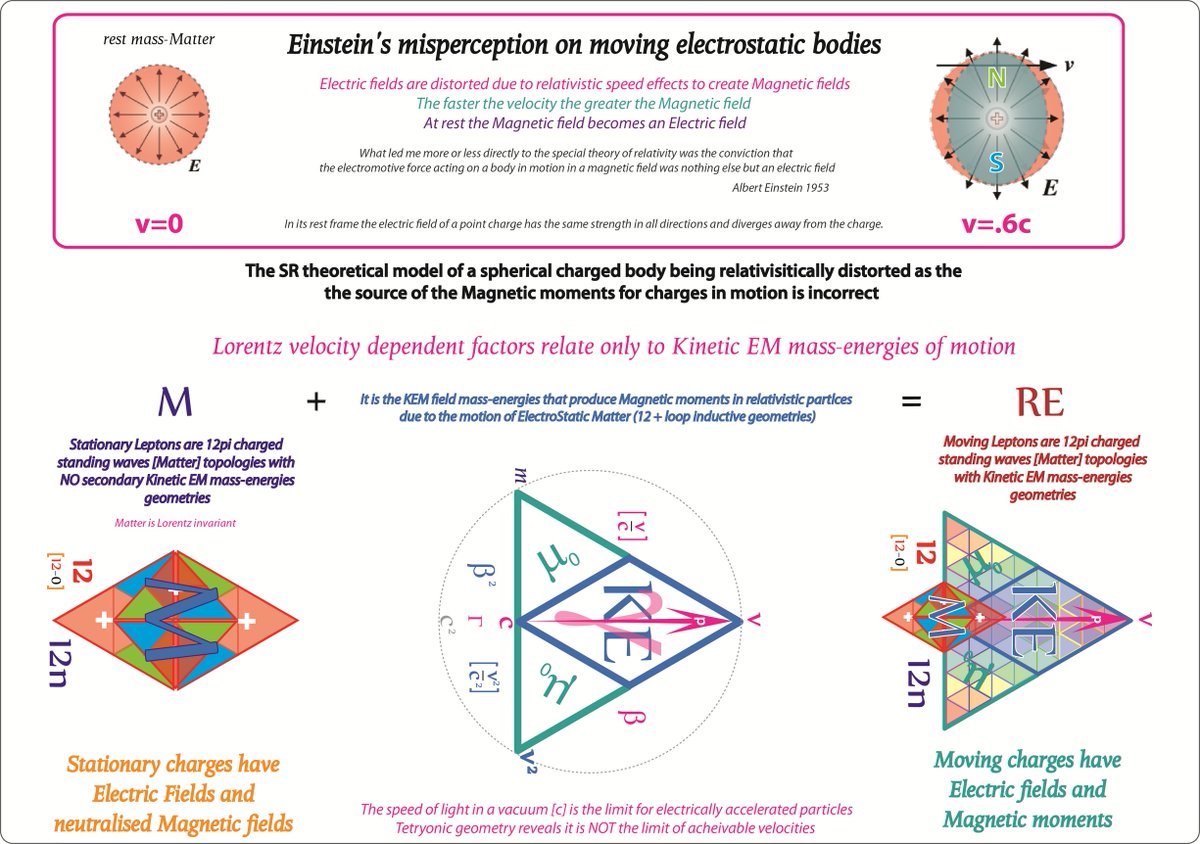
![Tetryonics's tweet photo. Tetryonics — Bar Magnet Ontology
The Tetryonic Resolution
THE MAGNET WE THOUGHT WE UNDERSTOOD
For over 150 years, bar magnets have been described using
field lines, flux loops, dipoles, and spacetime‑dependent transformations.
These descriptions were never physical.
They were mathematical conveniences -
and they obscured the true geometry of magnetism.
Tetryonics reveals the actual ontology:
a bar magnet is Matter whose atoms were heated, aligned under an external M‑field, and then cooled, locking their 3d charged topologies into a coherent EM‑favored orientation.
This frozen alignment produces the strongest possible external 2d EM field geometry that the material can sustain.
This single correction overturns the classical descriptions of
Maxwell, Gauss, Ampère, Faraday, and it rewrites the very foundations of Einstein’s Special Relativity.
THE HOT STATE — ATOMIC FREEDOM AND EXTERNAL ALIGNMENT
When a ferromagnetic material is heated,
its atomic 3d charged Matter topologies become free to rotate.
Apply an external magnetic field,
and these topologies align their charged faces
into the EM‑favored orientation.
In this hot, flexible state,
the atoms can be steered into coherence.
This is the only moment when a magnet can be created.
THE COOLING — GEOMETRY FROZEN IN PLACE
As the material cools,
the aligned 3d charged topologies freeze into position.
The result is a block of Matter whose internal charge orientations are now:
- coherent
- stable and
- EM‑biased [with a neutral E-fields and dominant M-field]
This locked‑in orientation produces a persistent magnetic moment
without requiring any motion of charge.
- A bar magnet is not “doing” anything.
- It is simply 'frozen' Matter locked EM field geometry.
THE EXTERNAL FIELD - FIXED 2d EM GEOMETRIES
The external magnetic field of a bar magnet
is not a loop, a flux tube, or a tensor component.
It is a fixed 2d EM mass‑energy geometry
radiating from the aligned 3d charged Matter.
- These 2d EM geometries contain:
- discrete electric components
- discrete magnetic components
- a directional magnetic moment
EQUILATERAL EM ENERGY-MOMENT FIELD GEOMETRICS
[endlessly circulating in a 'Lissajous loop' field geometric]
- They do not change.
- They do not transform.
- They do not oscillate.
They are static 2d EM fields.
This is the geometry Tetryonic Principia geometrics EM field reveal.
THE MISPERCEPTION - WHY MOTION CREATES “CHANGING FIELDS”
When a conductor moves relative to a magnet,
or when a magnet moves relative to a conductor,
the observer samples different regions of the fixed 2d EM geometry.
This creates the illusion that:
- E‑fields become M‑fields
- M‑fields become E‑fields
- fields “change” with motion
- magnetism “induces” electricity
- electricity “induces” magnetism
But nothing in the magnet actually changes.
The 2d EM geometry is fixed.
Only the sampling changes.
This is the root of the classical misinterpretation
and the origin of Einstein’s foundational error.
THE RELATIVISTIC ERROR - EINSTEIN CONTRACTED THE WRONG THING
Einstein assumed that:
“A magnetic field in one frame becomes an electric field in another.”
- This was never true.
- He misinterpreted observer‑dependent sampling as field transformation.
- He contracted Matter when only 2d kEM fields contract.
- He treated EM geometry as if it were spacetime geometry.
The Tetryonic Resolution shows:
- EM fields are discrete, equilateral geometries
- They do not transform into each other
- They do not depend on the observer
- Only the relative motion changes the rate of sampling
All “transformations” are perceptual artifacts
This correction rewrites the foundations of Special Relativity.
THE CLASSICAL ERROR — MAXWELL, GAUSS, AMPÈRE, FARADAY
Classical electromagnetism described fields using:
- continuous flux
- imaginary lines
- curls and divergences
- vector fields
- differential operators
These were mathematical conveniences,
not physical ontologies.
- They hid the true structure:
- EM fields are quantised 2d geometries
- Matter is a quantised 3d geometry
- Magnetic moments arise from frozen charge orientation
- Induction arises from relative motion through fixed geometry
Tetryonics restores the physical ontology
that classical physics never had.
THE TETRYONIC RESOLUTION - GEOMETRY, NOT TRANSFORMATION
With the correct ontology restored:
- A bar magnet is a block of aligned 3d charged Matter
- Its external field is a fixed 2d EM geometry
- Motion changes sampling, not the field
- E and M components are discrete, not interchangeable
- No fields transform - only the observer’s interaction does
- Induction is a geometric sampling effect, not a field conversion
This is the true structure behind magnetism.
THE REAL MAGNET GEOMETRICS, THE REAL RELATIVITY
A bar magnet is not a dipole with lines.
It is a frozen EM geometry created by heating, aligning, and cooling Matter into its most EM‑favored orientation.
Its external 2d EM fields are fixed, discrete, and equilateral.
- They do not change.
- They only appear to change
when sampled by a moving observer or a moving conductor.
This correction overturns:
- Einstein’s Special Relativity
- Maxwell’s field‑line ontology
- Gauss’s flux interpretation
- Ampère’s current‑loop model
- Faraday’s induction narrative
This is the corrected ontology.
This is the resolved magnet.
This is Tetryonics - The Bar Magnet, re‑Explained, re-drawn.](https://pbs.twimg.com/media/HGYglwwawAAP0dl.jpg)


