I never stopped being a football fan. I just started asking why.
Why does one player make another better?
Why can the same player look completely different in another system?
Why does a team dominate without dominating the ball?
Why can one movement, ten yards away from the action, decide what happens next?
The longer I watched football, the more I realised that the ball tells only part of the story.
There is structure. Space. Timing. Decision-making. Psychology. Identity. History. Supporters. Cities. Culture.
And behind what happens, there is usually another question:
Why did it happen?
That is what The Football Strategist is about.
Not pretending to have every answer.
Learning to ask better questions.
Tactics • People • Culture
Welcome to TFS Journal.
The game within the game. ⚽
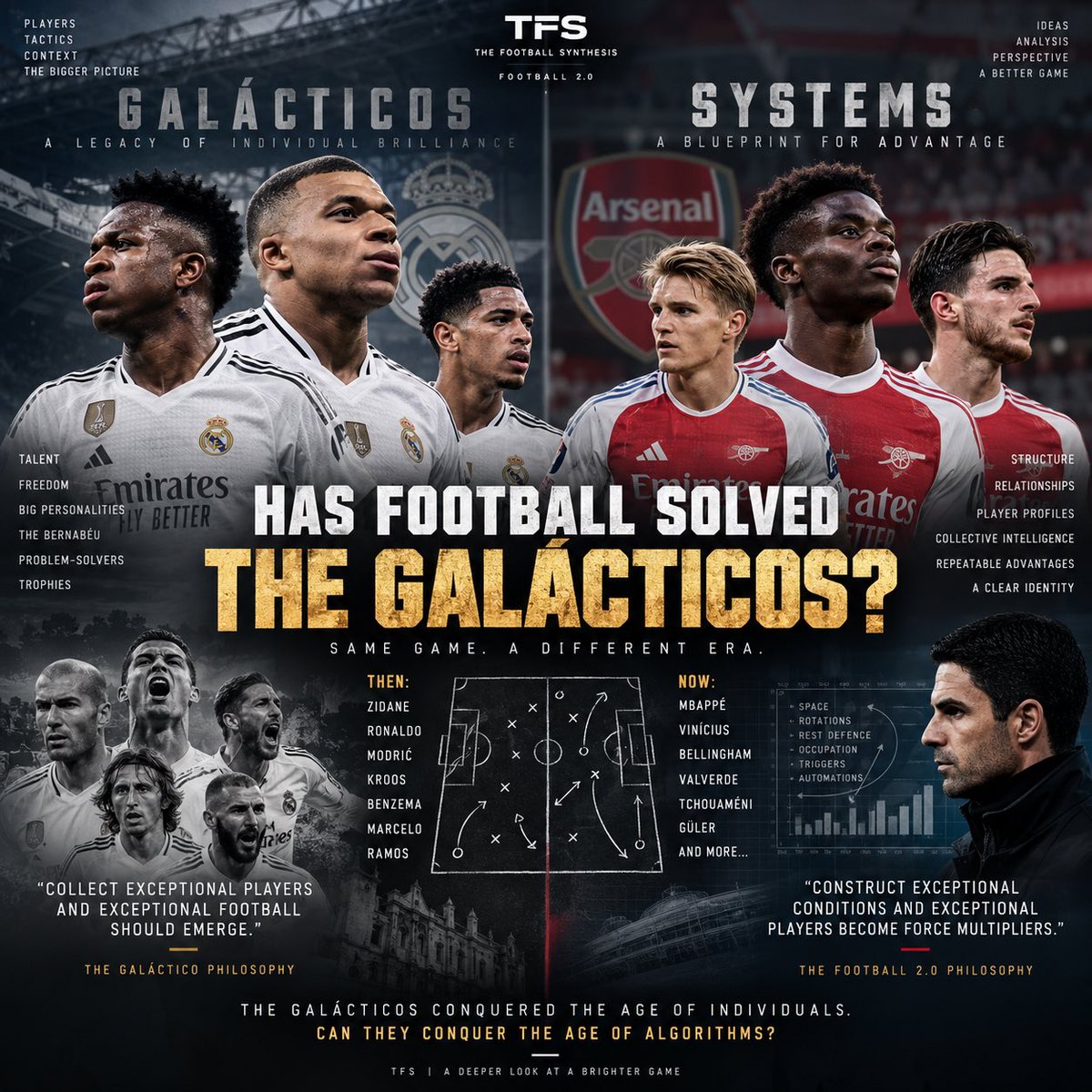
HAS FOOTBALL SOLVED THE GALÁCTICOS?
Real Madrid may have one of the most talented squads in football.
That might also be hiding their biggest problem.
For decades, Madrid possessed football’s ultimate cheat code: collect extraordinary problem-solvers and give them enough freedom to solve the game.
Zidane. Ronaldo. Modrić. Kroos. Benzema. Marcelo. Ramos.
The structure mattered, of course. But Madrid could survive moments of structural imperfection because individual intelligence was overwhelming.
Now look at the modern game.
Elite teams increasingly manufacture advantages before the star receives the ball.
The winger doesn’t simply beat his man. The structure isolates him 1v1.
The midfielder doesn’t simply find space. Rotations create it.
The defence doesn’t reorganize after losing possession. Rest-defence was already positioned before possession was lost.
That is Football 2.0.
And it creates an uncomfortable question for Real Madrid.
What happens when the opponent designs the problem before your superstar receives the ball?
Mbappé, Vinícius and Bellingham are extraordinary individual problem-solvers.
But extraordinary individuals do not automatically create extraordinary collective geometry.
Who holds the width?
Who pins the centre-backs?
Who dictates rhythm?
Who connects phases?
Who occupies the space when another player roams?
Who protects the transition?
Compare that philosophy with Arteta’s Arsenal.
Arteta doesn’t simply collect the best eleven players available. He searches for profiles that complete relationships.
Saka is not merely Saka.
He is Saka + the right 8 + the fullback + the No.9 occupying defenders + the rest-defence behind them.
The player exists inside an ecosystem designed to multiply his qualities.
That may be the fundamental difference between the Galáctico model and the emerging systems model.
Galácticos:
Collect exceptional players → exceptional football should emerge.
Football 2.0:
Construct exceptional conditions → exceptional players become force multipliers.
This is where Madrid’s situation reminds me—not in scale, but philosophically—of Manchester United after Ferguson.
United spent years trying to recover Manchester United rather than defining what an elite football operation needed to become in a changing game.
Madrid are nowhere near that institutional crisis.
But there is a similar question quietly approaching:
Is being Real Madrid itself still a football methodology?
Football hasn’t solved Mbappé.
It hasn’t solved Vinícius.
It hasn’t solved individual brilliance.
But modern football has become extraordinarily good at suppressing unstructured individual superiority.
That distinction matters.
Real Madrid may not need another superstar.
They may need to decide what Real Madrid football is supposed to look like in the age of systems.
The Galácticos conquered the age of individuals.
Can they conquer the age of algorithms?
— TFS | Football 2.0
Brighton didn’t prove Arsenal’s system was broken.
They gave it a problem it couldn’t solve that afternoon.
Perhaps Arsenal’s next stage is organized unpredictability:
disciplined enough to understand the algorithm, intelligent enough to depart from it.
What is Arsenal’s Move 78?
TFS | The game within the game.
ARSENAL’S MOVE 78
In 2016, Lee Sedol faced AlphaGo and discovered something unsettling: solutions built from a lifetime of expertise were no longer producing the expected answers.
Watching Arsenal against Brighton reminded me of that.
Here’s why.
Modern elite football increasingly resembles competitive computation:
If X → Y.
Pressing triggers. Rotations. Overloads. Rest defence. Counter-solutions to counter-solutions.
But football still contains something no tactical board can completely program:
human improvisation.
Perhaps they don’t need a revolutionary manager as much as a revolutionary institution—one where football determines recruitment, recruitment supplies the correct profiles, the academy supports the model and the idea survives whichever manager eventually leaves.
Cesc could be the architect.
United would still have to provide the land, materials, engineers and planning permission—and resist demolishing the bloody thing halfway through construction.
For years United have asked:
Who can bring Manchester United back?
Football 2.0 asks something far more interesting:
Who can build what comes next?
TFS | Football 2.0
MANCHESTER UNITED AND FOOTBALL 2.0
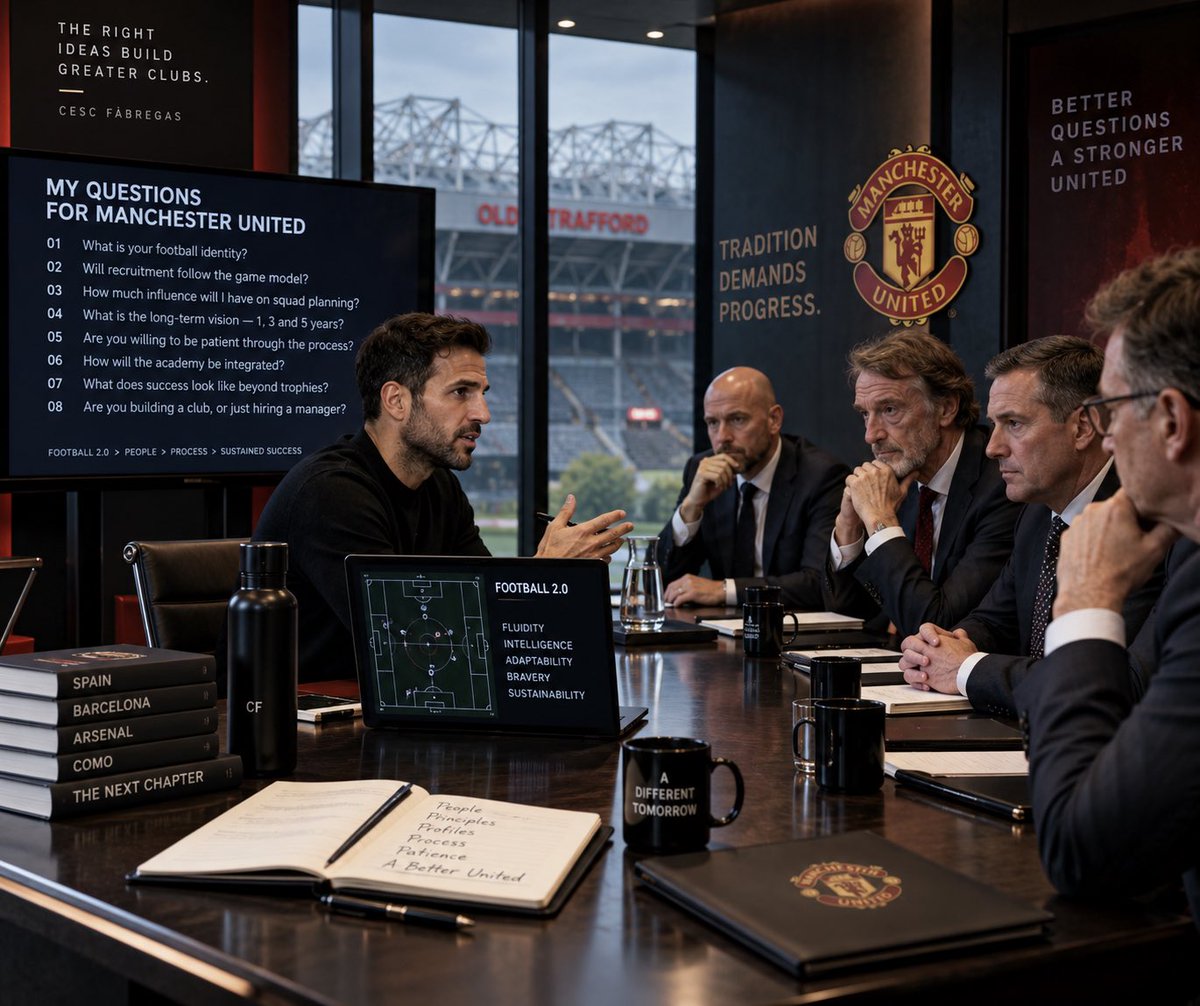
The search for a revolutionary — a case for Cesc Fàbregas.
Manchester United have spent more than a decade searching for their way back.
Perhaps back is the problem.
Football is evolving. Elite teams increasingly operate through multiple structures, rotations, pressing triggers, rest-defence calculations and players capable of solving changing problems in real time.
If traditional tactical football was algebra, Football 2.0 is beginning to resemble algorithmic calculus.
The equation changes while you’re solving it.
Interrogate the operating system.
Ask him to show you Manchester United three years from now.
What profiles does he need?
How does the team build?
How does it press?
How does it protect transitions?
Which players fit?
What should Carrington produce?
But there is a catch.
Como didn’t merely hire Cesc. They created conditions in which Cesc could build.
And that’s where United’s real revolution would have to begin.
Chelsea’s problem may be less about players failing their individual defensive responsibilities and more about structural immaturity making those responsibilities difficult to execute collectively.
When the ball is lost, the distances, cover and counterpress aren’t yet synchronized. One failed action exposes the next player, then the next — until what began as a structural failure appears on television as a defender losing a duel.
And agreed on set pieces — that’s a separate structural problem. Five conceded can’t be explained by transition defence.
CHELSEA ARE NOT IN A TITLE RACE.
Chelsea want Arsenal/City levels of possession without Arsenal/City levels of control.
8.8 xG conceded. 12 goals conceded. 5 from set pieces. 4.4 saves per game.
And the fire often starts before the back line.
Chelsea commit numbers forward → lose possession → the counterpress doesn’t kill the transition → midfield is bypassed → defenders are forced to retreat toward their own goal.
Then there’s the separate set-piece problem, where they’re conceding even with the defence fully reset.
That’s the difference.
Arsenal and City don’t just dominate the ball. Their attacking structure is designed to protect against losing it — control space, win second balls, suppress transitions and keep opponents away from goal.
Chelsea are trying to play the football of a title contender without yet possessing the defensive architecture of one.
Chelsea have the ball.
Arsenal and City control the game.
Same league. Different level.
Beyond individual lapses, there are issues in Manchester United’s defensive approach that start far further from their own goal.
Trying to create chances from high-turnovers is pleasing to fans when United pull it off. Supporters, and Michael Carrick, want to be excited by United’s football — but at the moment, attempts to press more aggressively are backfiring.
On average, United’s last defender is 33.4m away from their own goal without possession — the highest in the league.
The graphic above, where United’s defensive end is on the right, demonstrates how opponents are bypassing United in wide areas.
That Brighton lined up in a back three with wing-backs — which was unusual for Fabian Hurzeler’s side — signifies that pace on the flanks is becoming a recognised way to get at Carrick’s side.
Not only do United look easier to play through, but they are also finding it increasingly difficult to escape opposition pressure. Brighton won the ball 13 times in United’s defensive third, the highest figure recorded by any visiting side at Old Trafford over the last eight seasons. United simply could not live with their brilliantly coordinated, relentless press.
📝 @reallycerys & @Conor0Neill_
🔗 https://t.co/Cpi1aiZ8DS
WHERE UNITED GO FROM HERE
So I wouldn’t judge Manchester United’s rebuild by whether next week’s running numbers improve.
And I wouldn’t ask whether they’re “back.”
I’d watch something deeper.
Do Tielemans/Mainoo/Santos provide the platform that allows Baleba to attack space?
Does Bruno remain high enough to create rather than constantly dropping down to repair buildup?
Does Šeško give the attack a reference point?
Do Cunha and Mbeumo receive in advantageous areas?
Does United’s counterpress become coordinated?
And most importantly:
Does the structure survive changes in personnel?
Because if Manchester United finally know what each position is supposed to do, recruitment becomes easier.
Academy development becomes clearer.
Manager selection becomes easier.
And replacing a manager no longer requires replacing the football club with him.
That brings us back to the question underneath everything we’ve discussed:
Manchester United don’t need to run their way back to the top.
They need to build a football structure in which every run has a reason.
The badge already tells Manchester United where they belong.
The blueprint must tell them how to get there.
FOOTBALL 2.0 | TFS
The game within the game.
THEN WE FOUND CASEMIRO
This is where Manchester United become interesting.
Carrick’s transformation last season wasn’t simply attacking freedom.
He moved Bruno back into his natural creative territory and built underneath him with Mainoo + Casemiro.
Mainoo could receive deeper and progress.
Casemiro supplied defensive security, second-ball presence and positional experience behind the attack. Carrick even moved him higher during buildup at times to create room for Mainoo.
United became more direct, produced more fast breaks and high turnovers, while conceding fewer chances during Carrick’s early run.
Then Casemiro left.
Perhaps United didn’t merely lose a midfielder.
They lost a function.
THE REAL CARRICK TEST
And now we arrive at Michael Carrick.
Last season Carrick inherited a team particularly suited to answering questions.
Defend.
Recover.
Transition.
Release Bruno.
Attack space.
It worked.
This season presents the harder examination.
United have four points from four league matches, and against ten-man Manchester City their Mainoo–Tielemans midfield struggled to impose control.
Now opponents can ask:
“Fine. You have the ball. What are you going to do with it?”
That’s different football.
Carrick now has to construct a team capable of:
creating space rather than receiving it.
controlling games rather than surviving them.
pressing collectively rather than merely running harder.
protecting attacks before transitions even begin.
That’s the evolution we’re looking for.