Welcome to 🇮🇪☘️🇮🇪
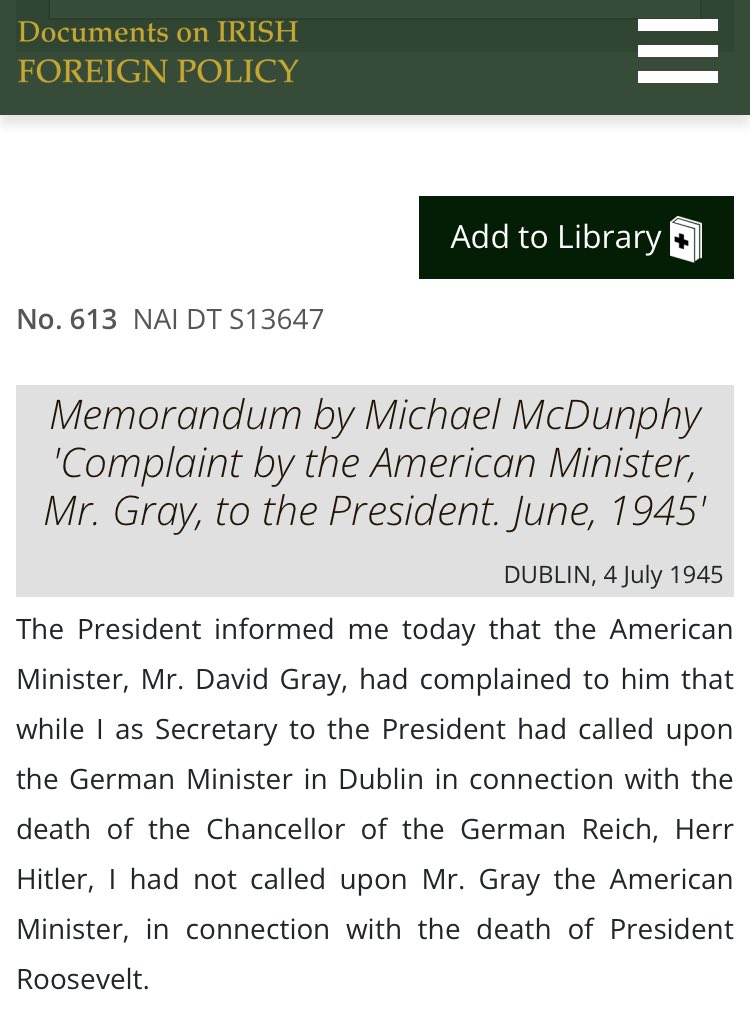
the “Inconvenient History of Ireland.”
In Lesson #1, we will work on tracking down sources. Every good reporter, lawyer, researcher, and historian needs these skills.
Your assignment is to:
1. Post a screenshot of the entire front page of this source when you find it.
2.When was this story published?
3.Where was the story published?
4.Where is Erin?
5.Can you post another source that mentions “Aontas Gaedheal”?
Good luck—class dismissed!
See you next week!
“Hanna Sheehy Skeffington, the veteran suffragette and founder of the Irishwomen’s Franchise League in 1908, welcomed Gaffney’s exposé, offering a personal rebuttal to the president:
‘It is unfortunate, but inevitable, that the well-known reactionary views of Mr de Valera regarding women should have strongly coloured the Draft Constitution, which is his handiwork. Having been his colleague for many years on National Executives and Committees of various kinds, I can testify to this: His ideal is the strictly domestic type of woman who eschews ‘politics’ as male concerns, the Fascist ideal now working under Mussolini and Hitler and other dictators, by which women are deprived of free choice of avocations and opportunities as human beings.’
She warned that: ‘It is up to women of all parties to wake up and demand the complete restoration of the clauses of the 1916 Proclamation and Clause III of the Constitution, which confirms the principle of equal rights and opportunities.’”
(P. 184)
Keogh, Dermot, and Andrew J. McCarthy. The Making of the Irish Constitution 1937: Bunreacht na hÉireann. Mercier Press, 2007.
“Irish Army deserters who joined British forces (~5,000) were dismissed without pay or pensions and barred from state jobs for years.”
They were also imprisoned, it’s good to be accurate.
Chapter 3
Phil Farrington and the Road to Belsen
“I got seven days leave and took the boat, to Dun Laoghaire. When I got off the boat, a man said, ‘I know you – I’ll have to take you in.’ Then I said, ‘I don’t know what you’re talking about.’ But he took me to a barracks anyway. I’d used my own name – I didn’t think they’d nab me.”
“I was put in the Guardroom at Griffith Barracks. The guard corporal said to me, ‘I’ll have yer thrashed to death.’ But I was sent by train, along with a lot of other deserters to [a military prison in] Cork. I knew a good many of the men on the train. Some got three months. Some got six months or even a year.”
The prison, or detention centre, in Cork had all the hallmarks of a brutal régime totally out of control. There appears to have been little supervision from higher authority. At best, this might be seen as negligent. At worst, it was intentional. Perhaps the punitive regime of illegal punishments and starvation was unofficially allowed, to deter others from deserting from the Irish Army. One sergeant told Phil that the Minister of Defence had ordered that ‘the prisoners should be shown no mercy,’ and that the minister ‘didn’t care what happened to them.’ Of course, this may have simply been harsh rhetoric made up by a jailor. But given the reality of the conditions, it has an air of plausibility.
According to Phil, there were hundreds of deserters in the prison. Starvation and physical brutality was endemic.
“‘We were never allowed to speak to each other, and we got no food,’ Phil told me. ‘In the morning, we got a little bit of bread and butter. At the end of the day, we had a little bit of bread and maybe an egg, an’ that was your lot until the next morning. Sometime you might get a little bit of fish. But it was more bones than fish. Though I was so hungry, I’d chew the bones and eat them. Sometimes they used to throw the food at us, just like we were animals. The men who worked there wasn’t the best, some of them.’”
(P. 18-19)
@ArmstrongT97969@GMbunchanumbers Should be easy to fact check?
“That’ll be why DeValera gave his condolences to the German people when Hitler killed himself and why they turned on their own people who fought for Britain during the war”
@grok is this accurate?
@LewisJonathanE people around the world are indeed starting to notice these disturbing trends in Irish political discourse and are increasingly willing to call them out in strident terms….
Yes, yes they are.
@TheRealRealISL@neilojim1972@_j0sh_a_ Perhaps you should read the following to understand official Irish government policy from the mid twentieth century;
It was overtly hostile to Jewish people and refugees.
https://t.co/VLpR9HPTox
@r4ych_@timecaptales No worries Ray. It’s a fascinating element of mid twentieth century Irish history.
If you are interested in the post war period in Ireland, I’d recommend Molohan’s book. Very informative as well.
Do you like documentaries David?
This Irish RAF veteran turned broadcaster made the following…
Hidden History: Ireland's Nazis, a 2007 documentary by Irish state broadcaster RTÉ, presenter Cathal O'Shannon estimated that between 100 and 200 Nazis moved to Ireland.
O'Shannon, who was an Irish-born Royal Air Force (RAF) veteran, described how he felt that anti-British sentiment in Ireland led to Nazis receiving a warmer welcome than he did when he came home after the war.”
https://t.co/ijl3clkbnO






![Thamesville's tweet photo. “Irish Army deserters who joined British forces (~5,000) were dismissed without pay or pensions and barred from state jobs for years.”
They were also imprisoned, it’s good to be accurate.
Chapter 3
Phil Farrington and the Road to Belsen
“I got seven days leave and took the boat, to Dun Laoghaire. When I got off the boat, a man said, ‘I know you – I’ll have to take you in.’ Then I said, ‘I don’t know what you’re talking about.’ But he took me to a barracks anyway. I’d used my own name – I didn’t think they’d nab me.”
“I was put in the Guardroom at Griffith Barracks. The guard corporal said to me, ‘I’ll have yer thrashed to death.’ But I was sent by train, along with a lot of other deserters to [a military prison in] Cork. I knew a good many of the men on the train. Some got three months. Some got six months or even a year.”
The prison, or detention centre, in Cork had all the hallmarks of a brutal régime totally out of control. There appears to have been little supervision from higher authority. At best, this might be seen as negligent. At worst, it was intentional. Perhaps the punitive regime of illegal punishments and starvation was unofficially allowed, to deter others from deserting from the Irish Army. One sergeant told Phil that the Minister of Defence had ordered that ‘the prisoners should be shown no mercy,’ and that the minister ‘didn’t care what happened to them.’ Of course, this may have simply been harsh rhetoric made up by a jailor. But given the reality of the conditions, it has an air of plausibility.
According to Phil, there were hundreds of deserters in the prison. Starvation and physical brutality was endemic.
“‘We were never allowed to speak to each other, and we got no food,’ Phil told me. ‘In the morning, we got a little bit of bread and butter. At the end of the day, we had a little bit of bread and maybe an egg, an’ that was your lot until the next morning. Sometime you might get a little bit of fish. But it was more bones than fish. Though I was so hungry, I’d chew the bones and eat them. Sometimes they used to throw the food at us, just like we were animals. The men who worked there wasn’t the best, some of them.’”
(P. 18-19)](https://pbs.twimg.com/media/HJ2h5-LaYAAXzdj.jpg)





