HBM memory prices are rising.
India doesn't manufacture HBM chips.
So I asked myself a different question...
Can India still benefit from the AI memory boom?
After digging deeper into the semiconductor supply chain, I found one Indian company that could quietly benefit, not by making chips, but by supplying the specialty chemicals used to manufacture them.
The timing is interesting too: the stock has just hit a fresh 52-week high and entered blue-sky territory, with no historical resistance overhead.
Here's what I found. 🧵👇
🔍 First, what is HBM?
HBM (High Bandwidth Memory) is the next generation of memory used in AI GPUs.
Unlike the DDR4/DDR5 RAM in our laptops, HBM stacks multiple DRAM chips vertically, delivering much higher bandwidth while consuming less power.
That's why it's become the preferred memory for AI training and inference workloads in modern data centres.
🧠 AI isn't just creating GPU winners.
Everyone is focused on NVIDIA, Micron and SK Hynix.
But every HBM chip goes through dozens of complex manufacturing steps.
Each wafer requires highly specialized chemicals like photoresists, wet chemicals and electronic-grade formulations.
If AI inference continues to grow...
➡️ More HBM demand
➡️ More semiconductor production
➡️ Higher demand for semiconductor chemicals
That's where this company enters the picture.
🧪 Why this company caught my attention
It isn't making chips.
Instead, it's building a semiconductor chemicals business.
A few things stood out:
• India's only semi-grade photoresist manufacturer
• Already shipping semiconductor chemicals to customers in Japan & Korea
• Strong export presence across Asia & Europe
• Korean JV focused on higher-value semiconductor chemicals
• Management expects semiconductor chemicals to become an independent growth engine by FY28
If semiconductor manufacturing continues expanding globally, this could become an interesting long-term opportunity.
🔋 And that's not the only tailwind...
The company isn't betting only on semiconductors.
Management is building three long-term growth engines:
✅ Pharma & CDMO
✅ Battery Chemicals
✅ Semiconductor Chemicals
The battery chemicals business has already started commercial production, and management says the current capacity is backed by customer contracts for the next three years.
If execution goes well, that's exposure to two structural themes—AI infrastructure and EVs.
📈 The numbers support the story
Growth has been impressive.
• Sales CAGR (5Y): 32%
• Profit CAGR (5Y): 46%
• TTM Profit Growth: 124%
Management has guided for around 25% revenue growth in FY27 while maintaining healthy margins.
🏦 Institutions seem to agree
Over the past few years:
• FIIs increased their stake from ~7% to ~19%
• DIIs increased from ~5% to ~20%
• Public shareholding reduced significantly
Institutional ownership has steadily increased alongside improving business fundamentals, which is generally a positive sign.
👀 So which company is it?
Acutaas Chemicals (formerly Ami Organics).
Until recently, many investors viewed it primarily as a pharma and specialty chemicals company.
Management now appears to be building a much broader platform with meaningful exposure to semiconductor chemicals and battery materials.
That's what caught my attention.
⚠️ But I wouldn't chase it here...
The stock has had an incredible run over the last year and is now trading near all-time highs.
Valuation has also expanded.
• Historical median P/E: ~59
• Current P/E: ~80+
While strong EPS growth can naturally compress valuations over time, it's fair to say that a good amount of optimism is already priced in.
📊 Technical view
From a chart perspective, the long-term trend remains very strong.
✅ Higher highs and higher lows remain intact.
✅ The stock continues to respect its long-term uptrend.
That said, the stock looks a bit stretched in the short term.
• Weekly RSI is around 77, close to levels where the stock has historically cooled off.
• Price is trading well above its 10-week EMA.
Personally, I'd be more comfortable accumulating on a pullback towards the 10-week EMA, which is currently around ₹3,100, rather than chasing a vertical move.
🎯 My takeaway
I'm not calling this an "AI stock."
I'm looking at it as a potential second-order beneficiary of the global semiconductor manufacturing cycle, with additional optionality from battery chemicals.
Definitely a company I'll be tracking closely over the next few years and would invest on small dip.
What do you think? Am I missing anything in this thesis?
Not a buy/sell recommendation. Please do your own research.
My Momentum Stock Plays for July 👇
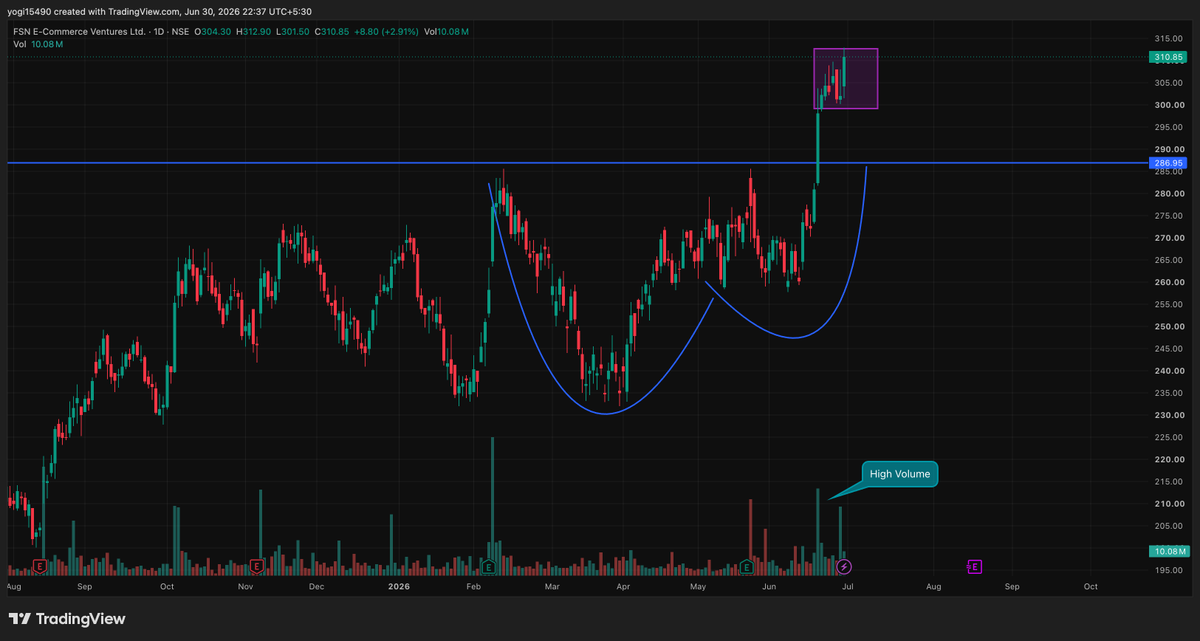
1) Nykaa (CMP : 310/-)
Nykaa first caught my attention after its long-term trend reversal in Aug'25, when it broke above a multi-year trendline.
That breakout was backed by strong business performance and management's long-term growth vision, giving the technical move fundamental support.
Instead of correcting sharply after rallying from ~₹220 to ~₹273, the stock spent nearly 7 months consolidating near its highs. This is often where supply gets absorbed while impatient investors exit.
Now the stock has decisively moved above the key ₹290 (May'22) resistance and is trading around ₹310, potentially entering a new price zone.
What I like:
• Long-term trend reversal remains intact
• Strong fundamentals supporting the chart
• 7-month time-wise correction instead of a price-wise correction
• Major resistance breakout with bullish structure intact
• Daily and Weekly RSI above 60, showing momentum is intact.
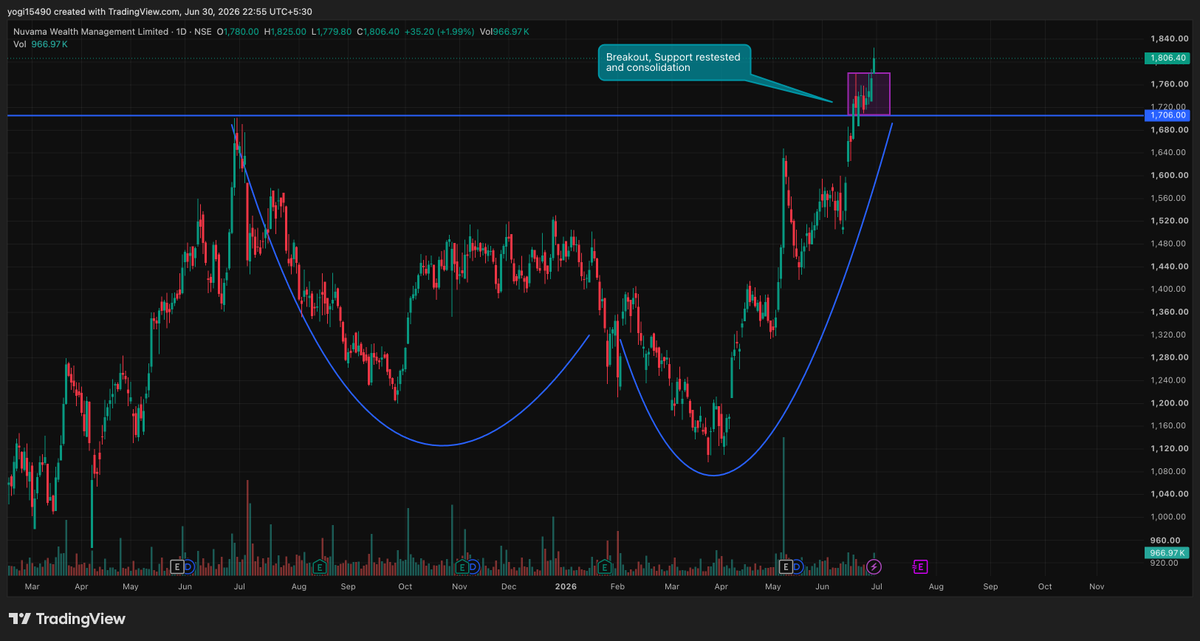
2) Nuvama Wealth Management (CMP : 1806/-)
Another chart that has been on my watchlist.
After making highs around ₹1,700, the stock spent almost a year consolidating at higher levels instead of giving up its gains.
The repeated tests of the ₹1,675–1,700 zone, followed by a strong move above resistance, suggest supply has largely been absorbed.
What stands out:
• Tight range action at higher levels
• Volume buildup during consolidation
• Bullish market structure with higher highs & higher lows intact
• Breakout above a year-long resistance zone
• Daily and Weekly RSI above 60, showing momentum is intact.
Many of the strongest momentum stocks follow the same pattern:
Breakout → Consolidation → Supply Absorption → Next Leg Higher.
These are the two charts I'll be watching closely in July, and I currently have active positions in both.
Not investment advice. Please do your own research.
Which stocks are in your radar for playing momentum in july?
#momentumtrading #stockmarket
A new engineer joined our team recently.
During lunch, he asked me:
"I just got my first salary. Everyone is recommending stocks... Where do I even start?"
I told him:
You don't have to pick individual stocks on Day 1.
Start with ETFs (Exchange Traded Funds).
Think of an ETF as buying an entire basket instead of choosing one fruit.
Here's a cheat sheet I wish someone had shared with me when I started 👇
🥇 GOLDBEES → Gold
🥈 SILVERBEES → Silver (tracks domestic silver prices)
💰 LIQUIDBEES → Government Securities (park idle cash)
🏦 LIQUIDCASE → Zerodha Nifty 1D Rate Liquid ETF
📈 NIFTYBEES → Nifty 50
📊 NEXT50 / JUNIORBEES → Nifty Next 50
🇮🇳 MONIFTY500 → Nifty 500 (broad Indian market)
📉 MID150BEES → Nifty Midcap 150
🚀 SMALLIETF / HDFCSML250 → Nifty Smallcap 250
💻 ITBEES → Nifty IT
🏦 BANKBEES → Nifty Bank
🏛️ PSUBNKBEES → Nifty PSU Bank
🚗 AUTOBEES → Nifty Auto
💊 PHARMABEES → Nifty Pharma
🏥 HEALTHIETF → Nifty Healthcare
🛒 FMCGIETF → Nifty FMCG
🏗️ INFRABEES → Nifty Infrastructure
⚙️ METALIETF → Nifty Metal
🛡️ MODEFENCE → Nifty India Defence
🏢 MOCAPITAL → Nifty Capital Market
📈 MOMENTUM50 → Nifty 500 Momentum 50
⚡ MOM30IETF → Nifty 200 Momentum 30
🎯 ALPHA → Nifty Alpha 50
🏭 CPSEETF → CPSE (Public Sector Enterprises)
🌏 MON100 → Nasdaq 100 (US)
🇭🇰 HNGSNGBEES → Hang Seng Index (Hong Kong)
You don't need to become a stock-picking expert to start investing.
Sometimes the best first investment is simply owning an index.
🔖 Bookmark this thread for future reference.
It'll save you the next time:
• you start investing,
• a friend asks where to begin,
• or a fresher in your team wants to learn about ETFs.
Which ETF was your first investment?
Not investment advice. Always understand what an ETF tracks before investing.
Completely agree. I usually avoid taking any trades before 9:30 AM. The first 15–30 minutes are often driven by panic buying/selling from participants reacting to overnight news, global cues, or data releases.
Once that noise settles and the real trend emerges, I look for high-probability setups. Patience pays. 📈
@Invest_AndGrow Congratulations on the milestone! 💯
Onwards to 10K and beyond. 🚀
Let’s stay connected. I share insights on investing, breakout stocks, option selling, and occasionally AI & engineering. Always happy to connect with fellow market enthusiasts.
Arunima, You’ve been one of the most supportive people on this platform. ❤️
Always encouraging fellow creators, celebrating their wins, and building a genuine community instead of chasing numbers.
Wishing you nothing but success—you deserve every bit of it. Looking forward to seeing you hit that 500k milestone. 🚀
OpenAI reportedly cut inference costs by ~50% through software optimisations on existing models..
Most people will read this as bearish for AI infrastructure.
A pure software win. (The Information)
The second-order implications are much more interesting:
AI Data Centers & Hyperscalers
Very bullish, in my view.
The same hardware can now serve significantly more traffic, improving utilization and ROI on expensive AI clusters.
$MSFT , $AMZN and $GOOG could benefit from lower AI serving costs, better margins, or even pass those savings on to accelerate adoption.
And then comes the interesting part...
Lower inference costs could trigger the classic Jevons Paradox.
Cheaper AI → More AI products → More enterprise adoption → More inference workloads.
The bottleneck shifts from "Can we afford to run AI?" to "How quickly can we scale it?"
Chipmakers & the AI Semiconductor Ecosystem (NVIDIA, Micron and others)
This is where it gets nuanced.
Short term: Better efficiency means fewer GPUs and less memory are needed for the same workload. That could create some near-term efficiency pressure.
Long term: Every major efficiency breakthrough, whether it's quantization, or better software, has historically expanded AI adoption rather than reduced infrastructure demand.
Cheaper inference makes AI viable for far more applications, leading to more deployed models, higher inference volumes, and eventually more demand across the AI hardware stack.
Overall
I don't see this as bearish for AI infrastructure.
If anything, it makes the AI infrastructure supercycle even stronger.
Software is making AI cheaper to deploy, and that could end up increasing, not decreasing, the total demand for compute.
What's your take? Does software efficiency reduce the need for AI hardware, or does it ultimately expand the market? 👇
#AI #datacenter
HBM memory prices are rising.
India doesn't manufacture HBM chips.
So I asked myself a different question...
Can India still benefit from the AI memory boom?
After digging deeper into the semiconductor supply chain, I found one Indian company that could quietly benefit, not by making chips, but by supplying the specialty chemicals used to manufacture them.
The timing is interesting too: the stock has just hit a fresh 52-week high and entered blue-sky territory, with no historical resistance overhead.
Here's what I found. 🧵👇
🔍 First, what is HBM?
HBM (High Bandwidth Memory) is the next generation of memory used in AI GPUs.
Unlike the DDR4/DDR5 RAM in our laptops, HBM stacks multiple DRAM chips vertically, delivering much higher bandwidth while consuming less power.
That's why it's become the preferred memory for AI training and inference workloads in modern data centres.
🧠 AI isn't just creating GPU winners.
Everyone is focused on NVIDIA, Micron and SK Hynix.
But every HBM chip goes through dozens of complex manufacturing steps.
Each wafer requires highly specialized chemicals like photoresists, wet chemicals and electronic-grade formulations.
If AI inference continues to grow...
➡️ More HBM demand
➡️ More semiconductor production
➡️ Higher demand for semiconductor chemicals
That's where this company enters the picture.
🧪 Why this company caught my attention
It isn't making chips.
Instead, it's building a semiconductor chemicals business.
A few things stood out:
• India's only semi-grade photoresist manufacturer
• Already shipping semiconductor chemicals to customers in Japan & Korea
• Strong export presence across Asia & Europe
• Korean JV focused on higher-value semiconductor chemicals
• Management expects semiconductor chemicals to become an independent growth engine by FY28
If semiconductor manufacturing continues expanding globally, this could become an interesting long-term opportunity.
🔋 And that's not the only tailwind...
The company isn't betting only on semiconductors.
Management is building three long-term growth engines:
✅ Pharma & CDMO
✅ Battery Chemicals
✅ Semiconductor Chemicals
The battery chemicals business has already started commercial production, and management says the current capacity is backed by customer contracts for the next three years.
If execution goes well, that's exposure to two structural themes—AI infrastructure and EVs.
📈 The numbers support the story
Growth has been impressive.
• Sales CAGR (5Y): 32%
• Profit CAGR (5Y): 46%
• TTM Profit Growth: 124%
Management has guided for around 25% revenue growth in FY27 while maintaining healthy margins.
🏦 Institutions seem to agree
Over the past few years:
• FIIs increased their stake from ~7% to ~19%
• DIIs increased from ~5% to ~20%
• Public shareholding reduced significantly
Institutional ownership has steadily increased alongside improving business fundamentals, which is generally a positive sign.
👀 So which company is it?
Acutaas Chemicals (formerly Ami Organics).
Until recently, many investors viewed it primarily as a pharma and specialty chemicals company.
Management now appears to be building a much broader platform with meaningful exposure to semiconductor chemicals and battery materials.
That's what caught my attention.
⚠️ But I wouldn't chase it here...
The stock has had an incredible run over the last year and is now trading near all-time highs.
Valuation has also expanded.
• Historical median P/E: ~59
• Current P/E: ~80+
While strong EPS growth can naturally compress valuations over time, it's fair to say that a good amount of optimism is already priced in.
📊 Technical view
From a chart perspective, the long-term trend remains very strong.
✅ Higher highs and higher lows remain intact.
✅ The stock continues to respect its long-term uptrend.
That said, the stock looks a bit stretched in the short term.
• Weekly RSI is around 77, close to levels where the stock has historically cooled off.
• Price is trading well above its 10-week EMA.
Personally, I'd be more comfortable accumulating on a pullback towards the 10-week EMA, which is currently around ₹3,100, rather than chasing a vertical move.
🎯 My takeaway
I'm not calling this an "AI stock."
I'm looking at it as a potential second-order beneficiary of the global semiconductor manufacturing cycle, with additional optionality from battery chemicals.
Definitely a company I'll be tracking closely over the next few years and would invest on small dip.
What do you think? Am I missing anything in this thesis?
Not a buy/sell recommendation. Please do your own research.
1600. 1300. 1100. 1000.
At every level, #Infosys was called a "value buy" after falling from nearly 2000.
Is ₹1000 finally the right value, or is it still too early? 👇
#IT
@Ishan_Narayan_ I'm into momentum investing, options selling, and microcaps.
Always happy to connect with like-minded investors, exchange ideas, and learn from each other. 👋
Here's what ₹10L can look like in four different hands.
Day Trader 📈
₹10L → ₹13L → ₹8L → ₹11L → ₹7L
Long-Term Investor 🏦
₹10L → ₹11.5L after 1 year.
Crypto Investor ₿
₹10L → ₹18L → ₹6L → ₹8L
Option Seller 📊 (assuming a disciplined 3% monthly return)
₹10L → ₹10.3L → ₹10.61L → ₹10.93L → ₹11.26L
Same ₹10L. Different journeys.
Different returns.
Different stress levels.
Different psychology.
If you had ₹10L today, where would you put it?
👇 Day Trading | Investing | Crypto | Option Selling
@KanjiBambhaniy@Saurabh_TyagiX I use the Coin app by Zerodha.
I make three SIP investments every month - one at the beginning of the month, one in the middle of the month, and one at the end of the month.
Microcap investing isn't about going all in.
It's about finding a few businesses where the upside is many times larger than the downside.
You don't need 100 winners.
A handful of exceptional businesses can define an entire investing journey.
#Microcaps#Investing