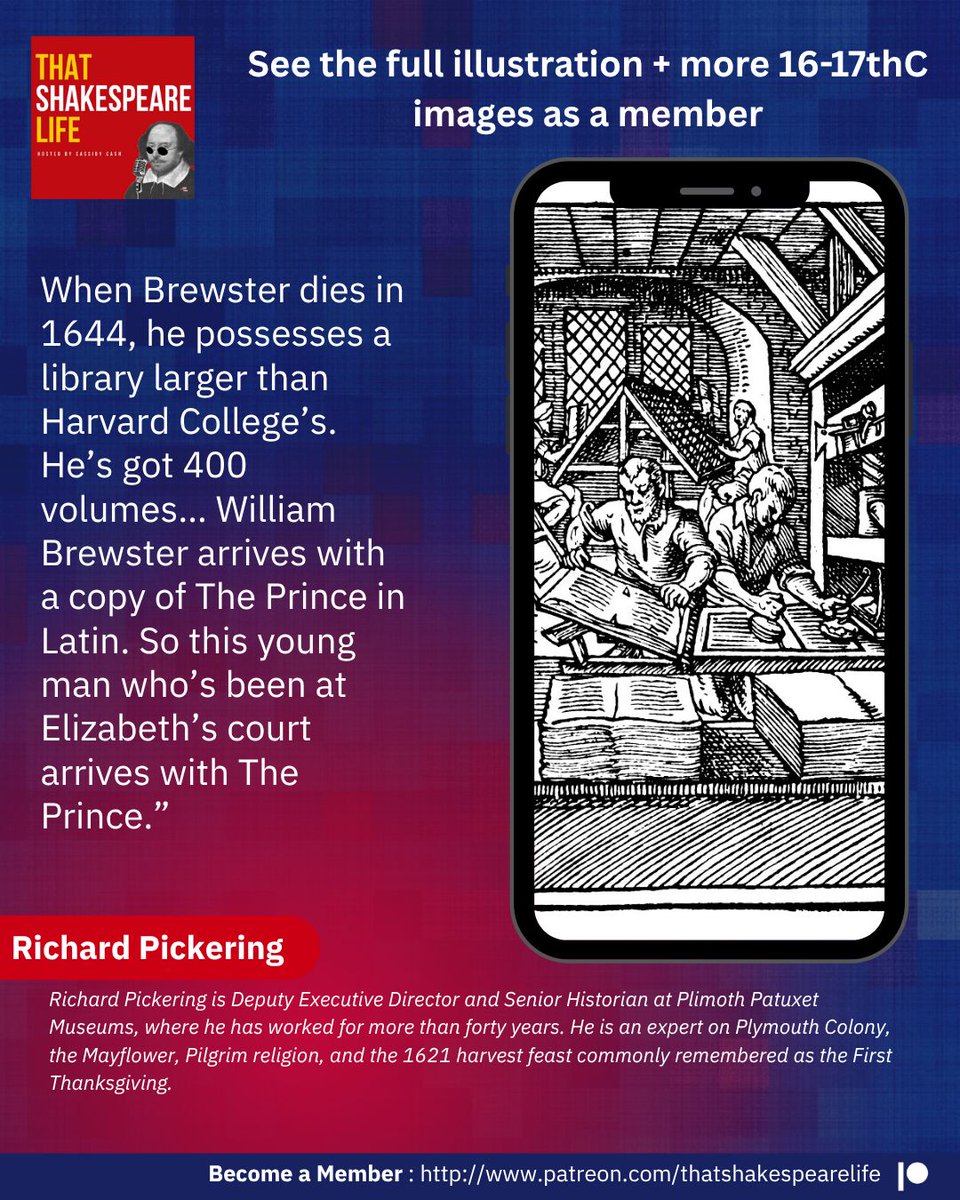
When William Brewster died in 1644, his library contained around 400 volumes—larger than Harvard College’s. And among his books? Machiavelli’s The Prince in Latin. https://t.co/XJiFlM2R0Q
A welcome move, but now the real work needs to begin, to work with UoB to ensure the long-term viability of the Institute for the benefit of Shakespeare Studies as a global area of scholarship and practice.
We have paused the planned move of the Shakespeare Institute from Mason Croft in Stratford-upon-Avon to our Edgbaston campus. Here is a statement from our Principal and Vice Chancellor, Professor Adam Tickell
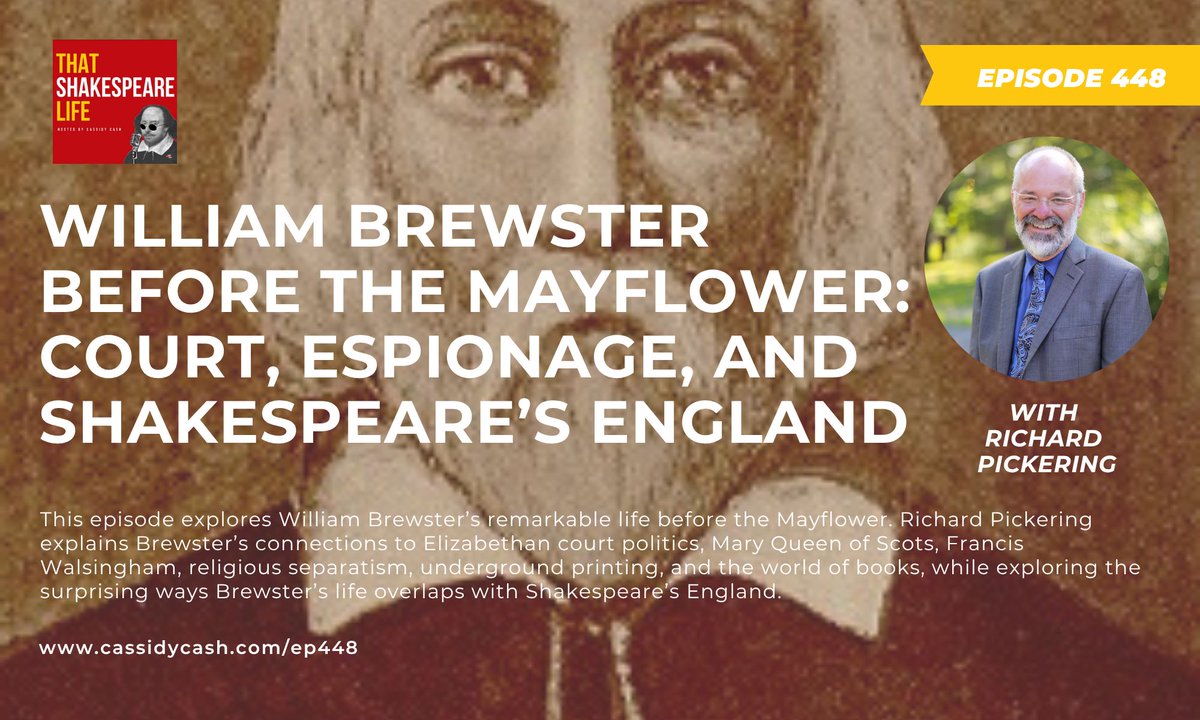
Before William Brewster became a Pilgrim aboard the Mayflower, he moved through the dangerous world of Elizabethan court politics—and those experiences may later have helped him evade James I’s investigators. https://t.co/XJiFlM2R0Q
NEW EPISODE 🎙��� Before William Brewster boarded the Mayflower, he had already lived an extraordinary life in Shakespeare’s England. This week, Richard Pickering @plimothpatuxet
joins us to explore Brewster’s connections to Elizabethan court politics, Mary Queen of Scots, espionage, underground printing, and even Hamlet. https://t.co/G7O18YL9tZ
I had to draw it with students and faculty sitting outside in the garden. 😢🩷
There’s still time to sign the petition to try and save her. https://t.co/UOZAZakxuM
"Our revels now are ended. These our actors,
As I foretold you, were all spirits and
Are melted into air, into thin air:
And, like the baseless fabric of this vision,
The cloud-capp'd towers, the gorgeous palaces,
The solemn temples, the great globe itself,
Ye all which it inherit, shall dissolve
And, like this insubstantial pageant faded,
Leave not a rack behind. We are such stuff
As dreams are made on, and our little life
Is rounded with a sleep. Sir, I am vex'd;
Bear with my weakness; my, brain is troubled..."
- The Tempest (IV.1)
I am just in tears at the loss of The Shakespeare Institute. It is as if the grandfather of our community has died and that same uncertainly of "how do we go forward without them?" hangs over all of us. I wish we could have done something before now. I can only imagine what pain is felt by the staff and community at The Shakespeare Institute by not being informed, nor consulted, about this decision. You have my deepest sympathies and strongest solidarity. This betrayal is no way to treat all of you and Birmingham should be ashamed of themselves. Not necessarily for the decision on its' own, because I know universities everywhere are struggling painfully to just keep open at all, and I know many difficult choices like this one have to be made (We've seen situations here locally at our liberal arts universities--a major one in my hometown didn't survive at all because they couldn't overcome their debt. They closed permanently.) I get that Birmingham is likely in the same boat, and maybe this decision wasn't (as it looks) callous disregard, but maybe there is some as yet hidden requirement that made it needed but what's hard for me to comprehend is why the larger Shakespeare community wasn't given the option to crowdfund finances if that was the problem, or to stand up and say "We'll move it to privately funded and save it!" Maybe the Birthplace could adopt it? What will happen to all the books? The beautiful gardens. Oh, my heart. I don't know what's possible, but I'm sure I echo a cry from so many when I say, "Why didn't you let us consider options here?" and "Can we yet save it? Please, let us try!" Of course our collective Shakespeare family will carry on, but what a hole is being left. As another Shakespearean and I were commiserating together, we mentioned it feels like the light in our lighthouse has gone out. Truly, the way that we all learn and explore Shakespeare, his plays, and his history is going to be different (and likely not university based). If we wanted to pretend otherwise, I think we must set aside such thoughts in the face of this decision now. And I know the university is framing this as a relocation, but I think if it was merely just changing venues Dr. Dobson nor Dr. Stern would have taken the actions they announced this week. People closer than I to the situation seem confident this is not just changing classrooms, it is indeed the end of The Shakespeare Institute. The implications of that choice for how Shakespeare Studies will go forward represents great and significant change, and while I know that with change comes the promise of opportunity, a glint of hope on the horizon, sure, but what a slog through the painful unexpected sea of goodbyes it seems it will take to realize a new future. 😢 As Dr. Dobson has indicated in his message, I do not think this petition will result in a change of the ultimate decision, but I felt like I needed to do something, so I stand in solidarity with those who wish it would make a difference. I signed it, and if you like to as well, here's the link:
https://t.co/66adqV6Hm2 via
@UKChange
The @unibirmingham has announced it will close @ShakesInstitute in Stratford-on-Avon & relocate its operations to the Edgbaston campus. It breaks up a mutually-productive golden triangle of @TheRSC theatre & @ShakespeareBT Birthplace houses & archives. https://t.co/zoVhCBeHOn
You can help try to reverse the University of Birmingham’s appalling decision, which imperils the @ShakesInstitute, by writing in protest to the following people:
I spent four happy years as a research fellow @ShakesInstitute *in Stratford-upon-Avon* which is exactly where it should be.
This ⬇️ is vandalism and folly by @unibirmingham who should reverse their crazy (and clandestine) decision.
Do you think garlic can stop a magnet from working? They thought so in the 16th century, and a 1594 household manual outlines how to do it. Let's try it and see if it works. https://t.co/eWDuWCCOwC
Where will you go? I am so sorry. For your family, the community, so much upheaval and unwelcome change. I just can’t believe it. I wish there was a way to crowdfund a private Shakespeare community so we could keep The Shakespeare Institute and the library and the gardens and let it live on outside the university.
Even Shakespeare had to get dressed for work every morning. And the pieces to an outfit for a 16-17th century man could be quite elaborate: From a doublet and pumpkin pants, to his weapons and a hat, men of Shakespeare's lifetime new how to make a good first impression.
In Ep 447 this week, our guest and historical men's dress expert, Mark Wallis and I explore all the parts to a man's outfit, which includes more details than you might expect (and some stereotypes I bet you'll recognize).
Listen to the entire conversation right now at https://t.co/fx8DtYDPDa and click the member's button to access all period extras.
#history #mensclothing #historyofmen #historyofclothing #ShakespearesEngland #ThatShakespeareLife #Podcast
If anyone was a sharp dressed man of the 17th century, it was Robert Dudley. Seen here, dressed to the nines, his outfit showcases many of the elite fashion choices for men of this time period. https://t.co/lBwOYI2PsD
Are you exploring the oceans of ancient Phoenicia & how sea snails connect with Shakespeare's plays? Well, we are, because it's Tuesday, and that means-- we are talking Shakespeare! Join this maritime adventure by subscribing and listening to this episode that's coming soon. #ToddBorlik #Pericles #PrinceofTyre
Elizabethan men carried jeweled toothpicks.
Not the little wooden kind you get at a restaurant.
We’re talking about luxury accessories made from gold, decorated with pearls and precious stones, and worn or carried as part of fashionable court dress.
In 1579, Queen Elizabeth I received a gold toothpick set with an emerald, a diamond, rubies, and pearls—which tells you just how elaborate these tiny objects could become.
For fashionable men in Shakespeare’s England, getting dressed could involve far more than a doublet and hose. Hats, gloves, swords, purses, jewelry, and even toothpicks could all become part of the look.
And suddenly Shakespeare’s men seem a little more glamorous than we usually picture them.
Learn more: https://t.co/2RKMHVdJcz