'The timing of this book could hardly be better... a deep & rewarding exploration of human motivation in sport, politics, business & our personal lives.' Lovely review of 'The Long Win' in the @FinancialTimes https://t.co/zhBpPOeghT @M_Heffernan@jerichochambers@citizenrobert
The World Cup begins tomorrow, and many will watch the matches. Soccer reminds us of something we must not forget: life is not a race to show off on our own, but a path we learn to walk together. Anyone who does not know how to pass the ball, even if they have talent, has not yet understood the game. Anyone who does not know how to live with and for others has not yet understood life. #ApostolicJourney
Nearly half of secondary schools have produced extra paperwork for new Ofsted inspections, Teacher Tapp polling reveals – despite the watchdog promising that the new inspection framework would not add to staff workload
https://t.co/hqtiLMdcFX
https://t.co/PeF4uBWWCy Such an important article for the sports world to read and let go of some old myths and start thinking about new ways to create real not fictional social change through sport @seaningle
After noticing a similar habit among highly creative people (Einstein, Mozart, da Vinci, etc), the neuroscientist Dr. Nancy Andreasen designed a brain-imaging study to explore the neural basis of this habit.
Essentially, these creative people all carved out time each day for...
“Free-floating periods of thought,” Dr. Andreasen writes in her book, “The Creating Brain: The Neuroscience of Genius.”
The specifics of the habit differ from person to person.
Leonardo da Vinci, for example, would often sit in front of a painting “and simply think, sometimes for as long as a half day.”
Mozart liked to go to billiard/pool halls—he'd bring bundles of music paper and compose while waiting his turn.
And Einstein loved to aimlessly drift at sea on a little wooden boat he called the “Tinef” (Yiddish for “piece of junk”). He had to be rescued the Coast Guard so frequently that a friend eventually bought him an outboard motor for emergency use, but Einstein refused to use it.
“To the average person, being becalmed for hours might be a terrible trial,” the friend said. “To Einstein, this could simply provide more time to think.”
In any case, Dr. Andreasen conducted the first brain-imaging study, looking at brain activity during “free-floating periods of thought,” when the body is in a “resting state” and the mind is free to wander.
“We found activations in multiple regions of the association cortex,” Dr. Andreasen wrote. “We were not [seeing] a passive silent brain during the ‘resting state,’ but rather a brain that was actively connecting thoughts and experiences.”
Essentially, Dr. Andreasen found that the brain defaults to creativity. When the body is still and the mind is allowed to float freely, the brain engages in what she termed REST (“random episodic silent thinking”).
And during REST, Dr. Andreasen writes, the brain “uses its most human and complex parts...areas known to gather information and link it all together—in potentially novel ways.”
Separate from those that led to Dr. Andreasen's study, I’ve collected many examples of creative people describing their own REST-ful habits:
The legendary designer Paula Scher: “I think I figured out every identity program I’ve ever done in a taxicab…Taxicabs, for me, are very special because you sit in the back, you don’t have to talk to anybody, you can look out the window and you can sort of let your mind wander.”
One of the great songwriters of all time, Paul Simon: “I used to go off in the bathroom...I’d turn on the faucet so that water would run—I like that sound, it’s very soothing to me—and I’d play, in the dark, letting my imagination wander.” (During one of these REST sessions in his dark bathroom, these words came to him: “Hello darkness, my old friend / I’ve come to talk with you again”—which became the opening verse of “The Sound of Silence”).
The filmmaker Quentin Tarantino: “I have a pool, and I keep it heated, so it’s nice. And I hop in my pool and just kind of float around in the warm water…and then a lot of shit will come to me. Literally, a lot of ideas will come to me. Then I get out and make little notes on that. But not do it. That will be my work for tomorrow.”
So whether it’s sitting in front of painting, drifting in a boat, riding in a taxi, playing the guitar in a dark bathroom, or floating in a pool, if you want to be more creative, carve out time each day for “free-floating periods of thought,” for “random episodic silent thinking.”
- - -
“Men of genius are sometimes producing most when they seem least to labor, for their minds are then occupied in the shaping of those conceptions to which they afterward give form.” — Leonardo da Vinci
Follow @bpoppenheimer for more content like this!
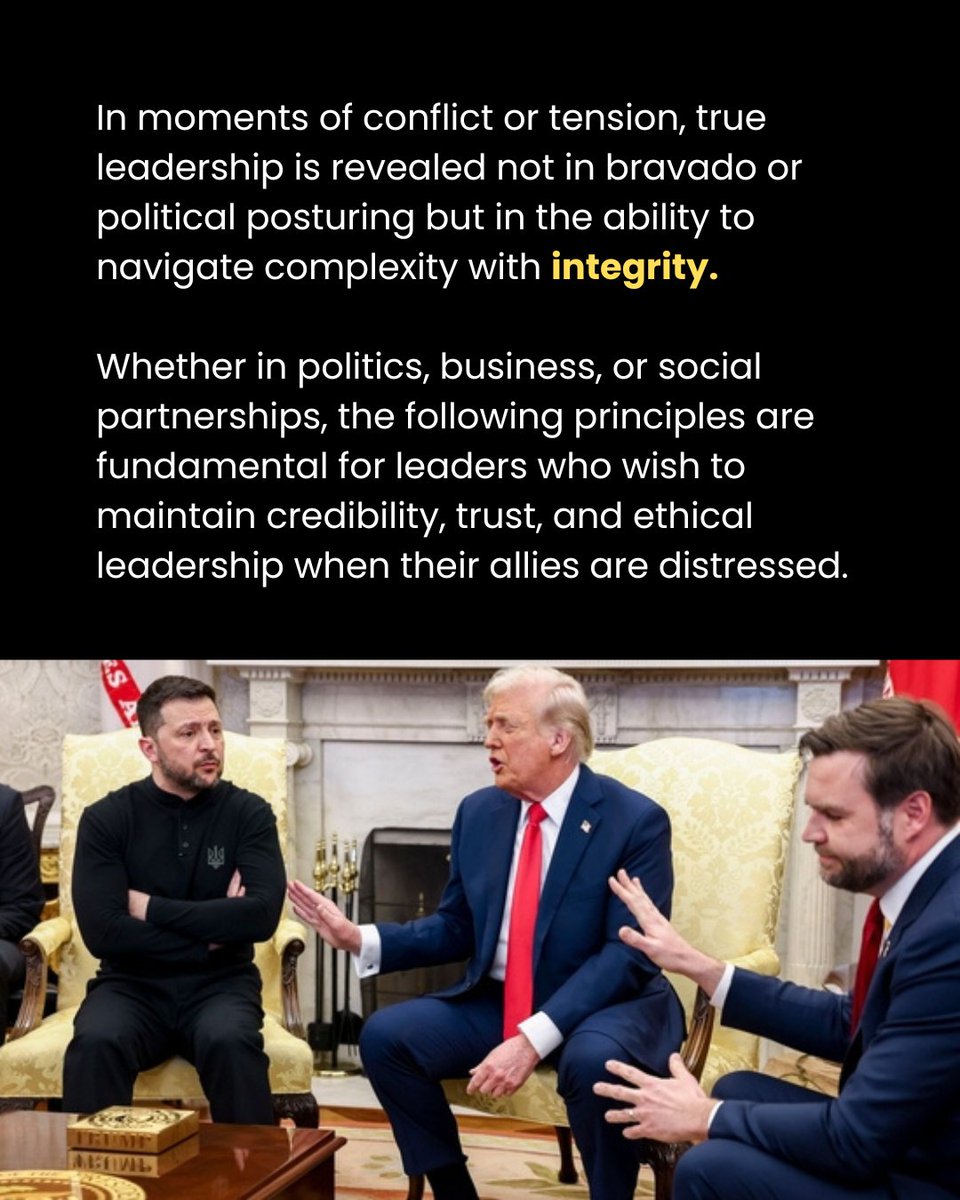
🧵1/7 These are my 6 Leadership Principles During Conflict. Whether you apply these principles to political, business or social and romantic partnerships examples, you will see the truth of the benefits of upholding them, and the danger of ignoring them.
If leaders are serious about ending war, women need a seat at the table.
International data, 1989-2011: When women are involved in agreements, peace is 35% more likely to last 15+ years.
Gender balance is especially important when the stakes are high and tempers run hot.
Trump’s sickening performance should wake up the free world. America is slipping towards authoritarianism. Only by spending big on defence can Europe hope to deal with its acute vulnerability and signal to decent Americans that we are finally stepping up
https://t.co/k5y80mJPJD
Yesterday, Rubio terminated 5800 USAID contracts – more than 90% of its foreign aid programs – in defiance of the courts.
Here’s a list of just some of the lifesaving awards that were terminated. Nearly all were Congressional mandated. They've saved millions of lives. 🧵
We can all pretend Trump and Vance are some sort of inspired geniuses. Or we can see two soft bullies haranguing a man who has been fighting a war to save his country for three years.
The next episode is now live! 🔥
I spoke to @thecathbishop about the concept of winning, whether it's the be all and end all, and if people pay a price for only focusing on winning.
Click the link below to watch ⬇️
https://t.co/mWAr3qI3LK
We often mistake being serious with being dedicated.
That's often not the case.
We are our most dedicated when we are having fun and experiencing joy
We often create teams & cultures devoid of joy in the misplaced notion that seriousness means we are more committed. It doesn't





![bpoppenheimer's tweet photo. After noticing a similar habit among highly creative people (Einstein, Mozart, da Vinci, etc), the neuroscientist Dr. Nancy Andreasen designed a brain-imaging study to explore the neural basis of this habit.
Essentially, these creative people all carved out time each day for...
“Free-floating periods of thought,” Dr. Andreasen writes in her book, “The Creating Brain: The Neuroscience of Genius.”
The specifics of the habit differ from person to person.
Leonardo da Vinci, for example, would often sit in front of a painting “and simply think, sometimes for as long as a half day.”
Mozart liked to go to billiard/pool halls—he'd bring bundles of music paper and compose while waiting his turn.
And Einstein loved to aimlessly drift at sea on a little wooden boat he called the “Tinef” (Yiddish for “piece of junk”). He had to be rescued the Coast Guard so frequently that a friend eventually bought him an outboard motor for emergency use, but Einstein refused to use it.
“To the average person, being becalmed for hours might be a terrible trial,” the friend said. “To Einstein, this could simply provide more time to think.”
In any case, Dr. Andreasen conducted the first brain-imaging study, looking at brain activity during “free-floating periods of thought,” when the body is in a “resting state” and the mind is free to wander.
“We found activations in multiple regions of the association cortex,” Dr. Andreasen wrote. “We were not [seeing] a passive silent brain during the ‘resting state,’ but rather a brain that was actively connecting thoughts and experiences.”
Essentially, Dr. Andreasen found that the brain defaults to creativity. When the body is still and the mind is allowed to float freely, the brain engages in what she termed REST (“random episodic silent thinking”).
And during REST, Dr. Andreasen writes, the brain “uses its most human and complex parts...areas known to gather information and link it all together—in potentially novel ways.”
Separate from those that led to Dr. Andreasen's study, I’ve collected many examples of creative people describing their own REST-ful habits:
The legendary designer Paula Scher: “I think I figured out every identity program I’ve ever done in a taxicab…Taxicabs, for me, are very special because you sit in the back, you don’t have to talk to anybody, you can look out the window and you can sort of let your mind wander.”
One of the great songwriters of all time, Paul Simon: “I used to go off in the bathroom...I’d turn on the faucet so that water would run—I like that sound, it’s very soothing to me—and I’d play, in the dark, letting my imagination wander.” (During one of these REST sessions in his dark bathroom, these words came to him: “Hello darkness, my old friend / I’ve come to talk with you again”—which became the opening verse of “The Sound of Silence”).
The filmmaker Quentin Tarantino: “I have a pool, and I keep it heated, so it’s nice. And I hop in my pool and just kind of float around in the warm water…and then a lot of shit will come to me. Literally, a lot of ideas will come to me. Then I get out and make little notes on that. But not do it. That will be my work for tomorrow.”
So whether it’s sitting in front of painting, drifting in a boat, riding in a taxi, playing the guitar in a dark bathroom, or floating in a pool, if you want to be more creative, carve out time each day for “free-floating periods of thought,” for “random episodic silent thinking.”
- - -
“Men of genius are sometimes producing most when they seem least to labor, for their minds are then occupied in the shaping of those conceptions to which they afterward give form.” — Leonardo da Vinci
Follow @bpoppenheimer for more content like this!](https://pbs.twimg.com/media/Gl8VMqRWwAATF3l.png)