NEW: An Iranian negotiating delegation arrived in Switzerland on June 20 to discuss the implementation of the US-Iran memorandum of understanding (MoU) with US negotiators. Iran will likely use these talks to try to pressure the United States to compel Israel to cease military operations against Hezbollah in Lebanon. It is unclear if Iran’s negotiating delegation will discuss the Iranian nuclear program in Switzerland.
Other Key Takeaways:
The Iranian delegation will likely use Iran’s renewed closure of the Strait of Hormuz as leverage in the talks to try to pressure the United States to compel Israel to halt operations against Hezbollah in Lebanon. Iran likely calculates that it can use the strait as a tool to put greater economic pressure on the United States to meet Iranian demands.
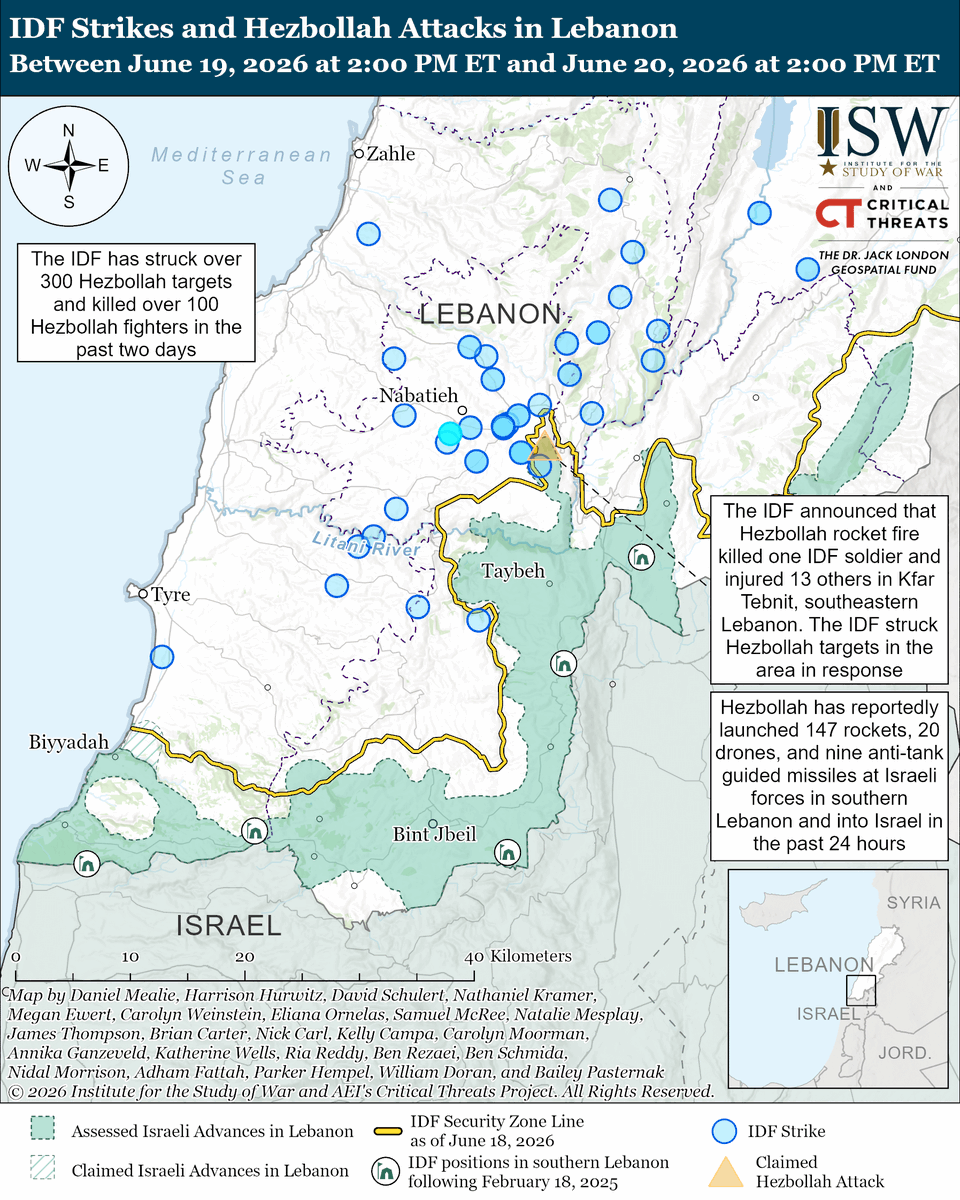
Israel and Hezbollah continued to launch attacks targeting each other despite agreeing to a ceasefire on June 19. The Israel Defense Forces (IDF) warned that it is committed to the ceasefire but will continue to “forcefully” strike Hezbollah if the group launches further attacks against Israeli forces.
There are some indications of disagreements within the Iranian regime regarding Iran’s participation in talks. The Iranian regime has a vested interest in maintaining the negotiating process under the MoU because Iran is receiving economic relief, such as sanctions waivers, as part of the agreement.
The composition of the Iranian negotiating delegation indicates that Iran intends to discuss economic relief components of the MoU at the talks. Iran would almost certainly use any economic relief to try to reconstitute its defense and military capabilities and the Axis of Resistance. Iran may also calculate that the United States would have less leverage to extract concessions from Iran on its nuclear program during the 60-day negotiations period if Iran can frontload economic relief.
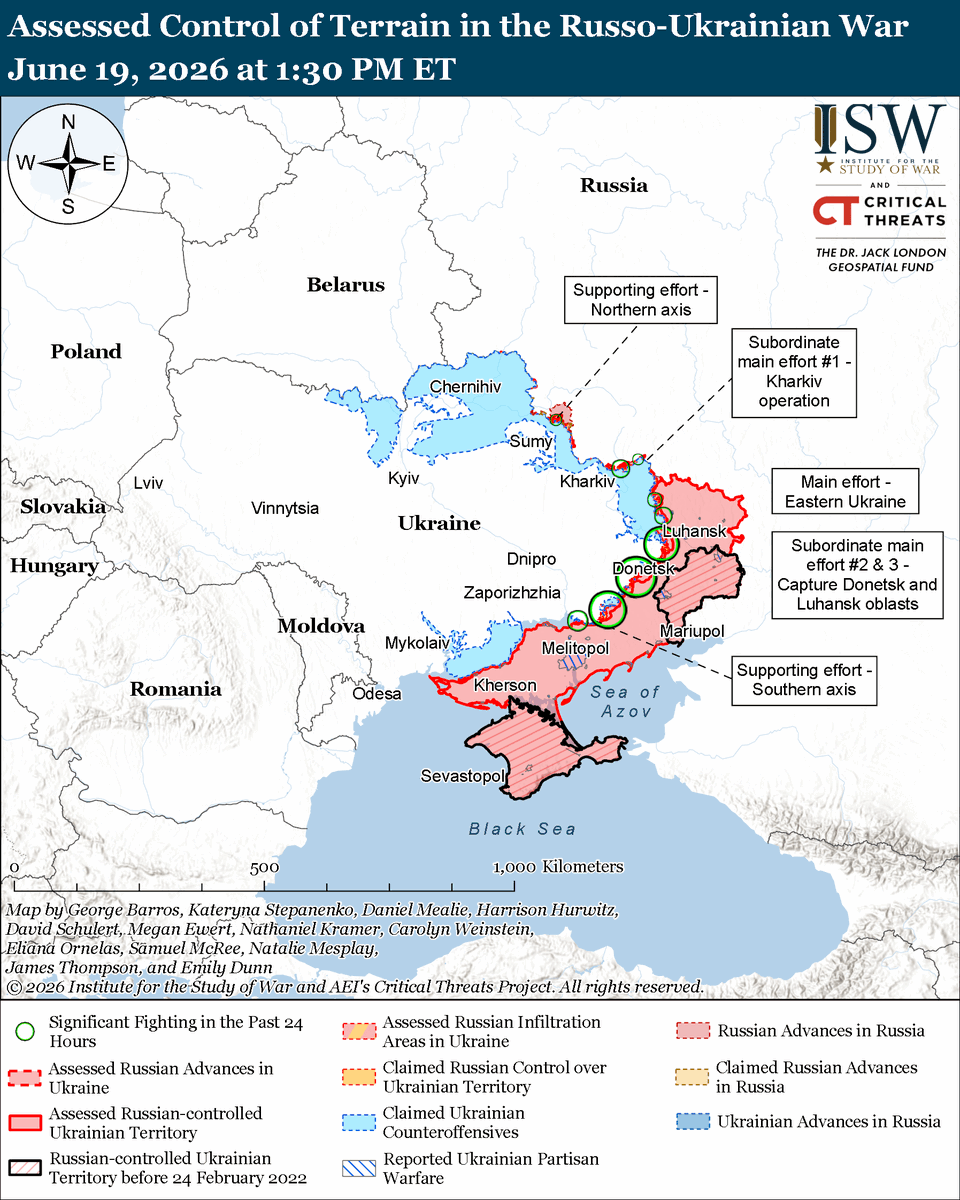
NEW: Ukrainian forces continued to systematically strike bridges and other transport infrastructure supporting Russian ground lines of communication (GLOCs) that connect occupied Kherson Oblast with Crimea.
Other Key Takeaways:
Ukrainian strikes on Russian transport and railway infrastructure are already disrupting Russian ground lines of communication (GLOCs) and worsening Russian logistics on the left bank of occupied Kherson Oblast and Crimea.
Ukrainian forces continued to strike Russian oil, gas, and energy infrastructure in occupied Crimea and Russia overnight on June 19 and 20.
Russian officials continue trying to mitigate rising gas prices as gas shortages spread across Russia amidst ongoing Ukrainian strikes against Russian energy infrastructure.
Russian forces are trying to adapt to their use of strike drones to compensate for the sudden loss of Starlink and Ukraine’s intermediate-range strike campaign against Russian military assets and logistics in occupied Ukraine.
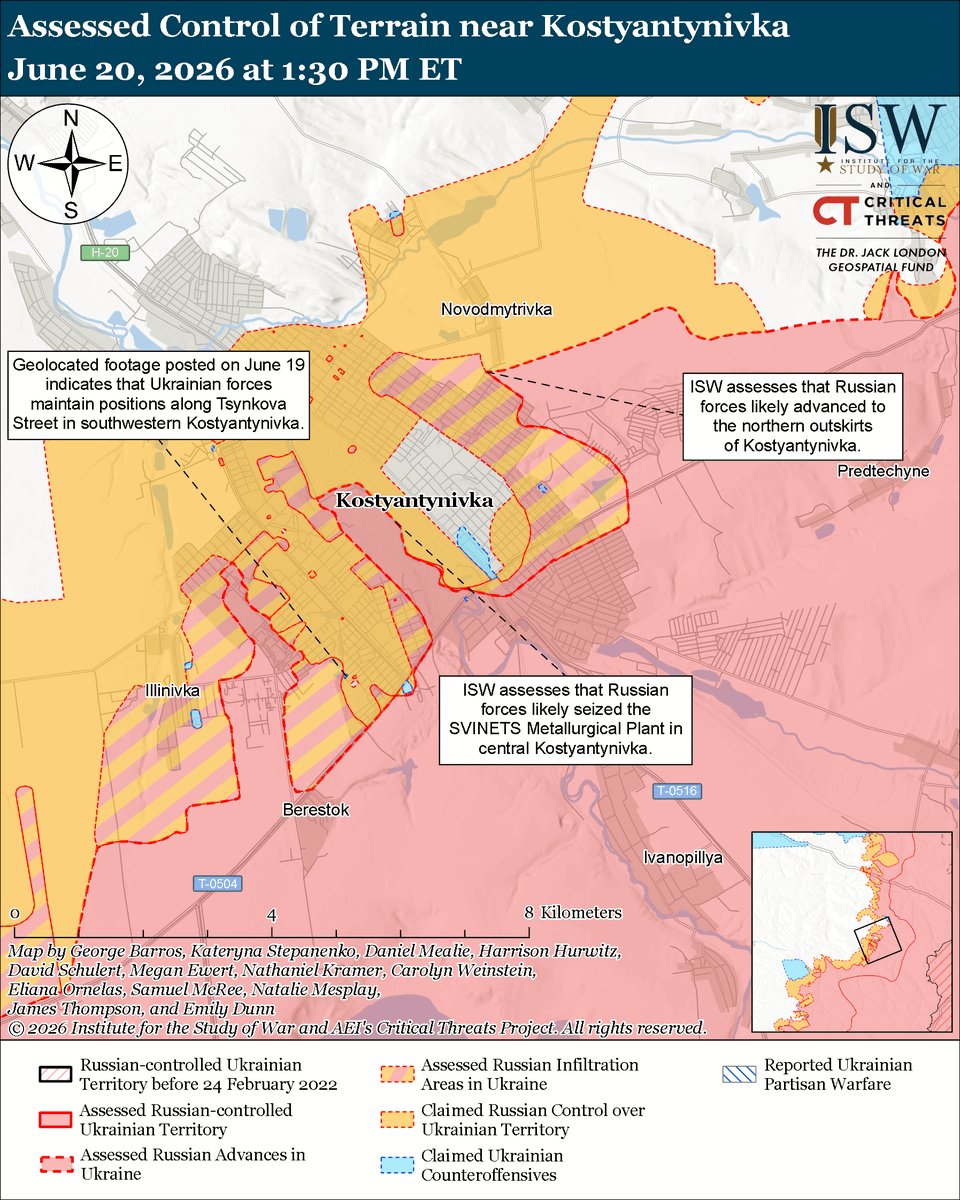
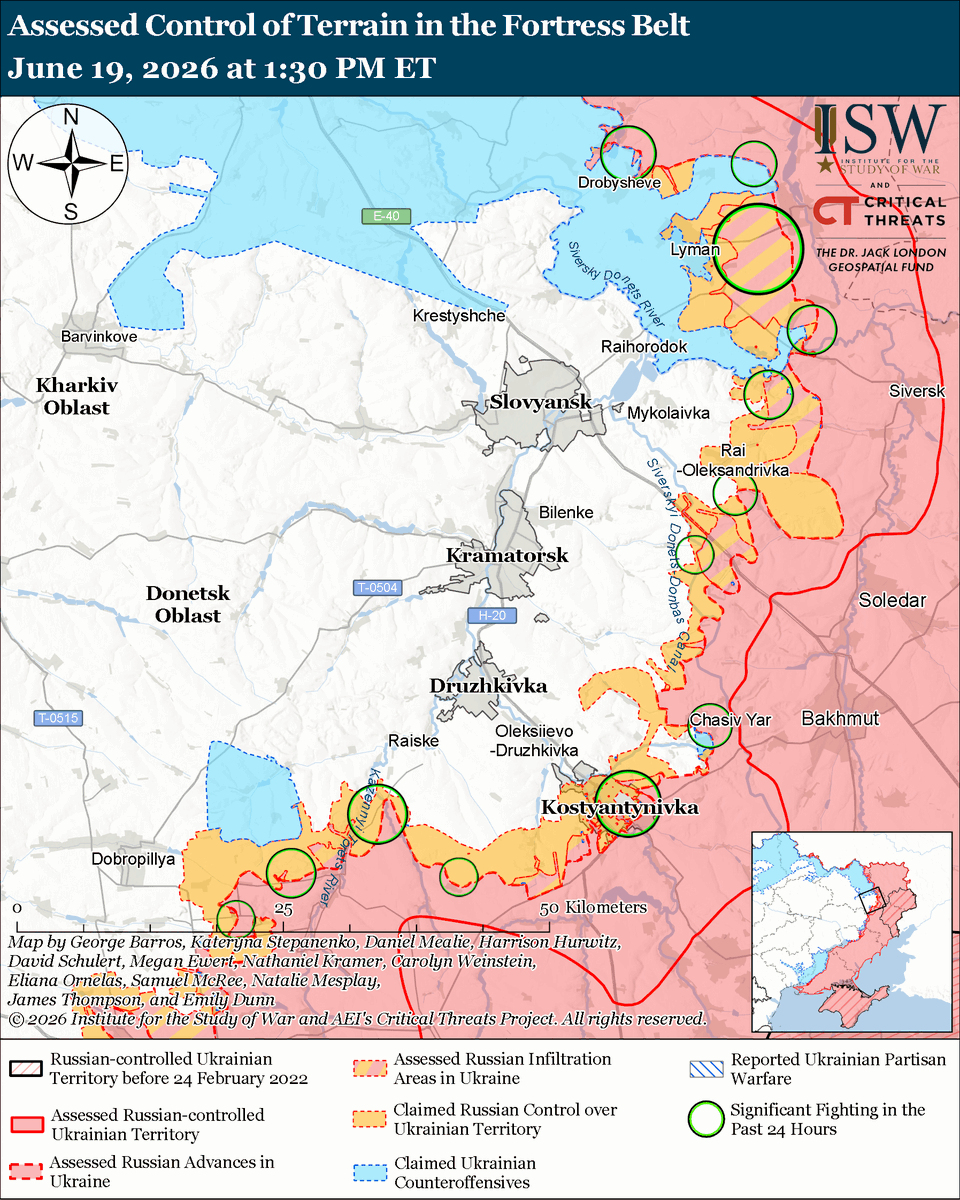
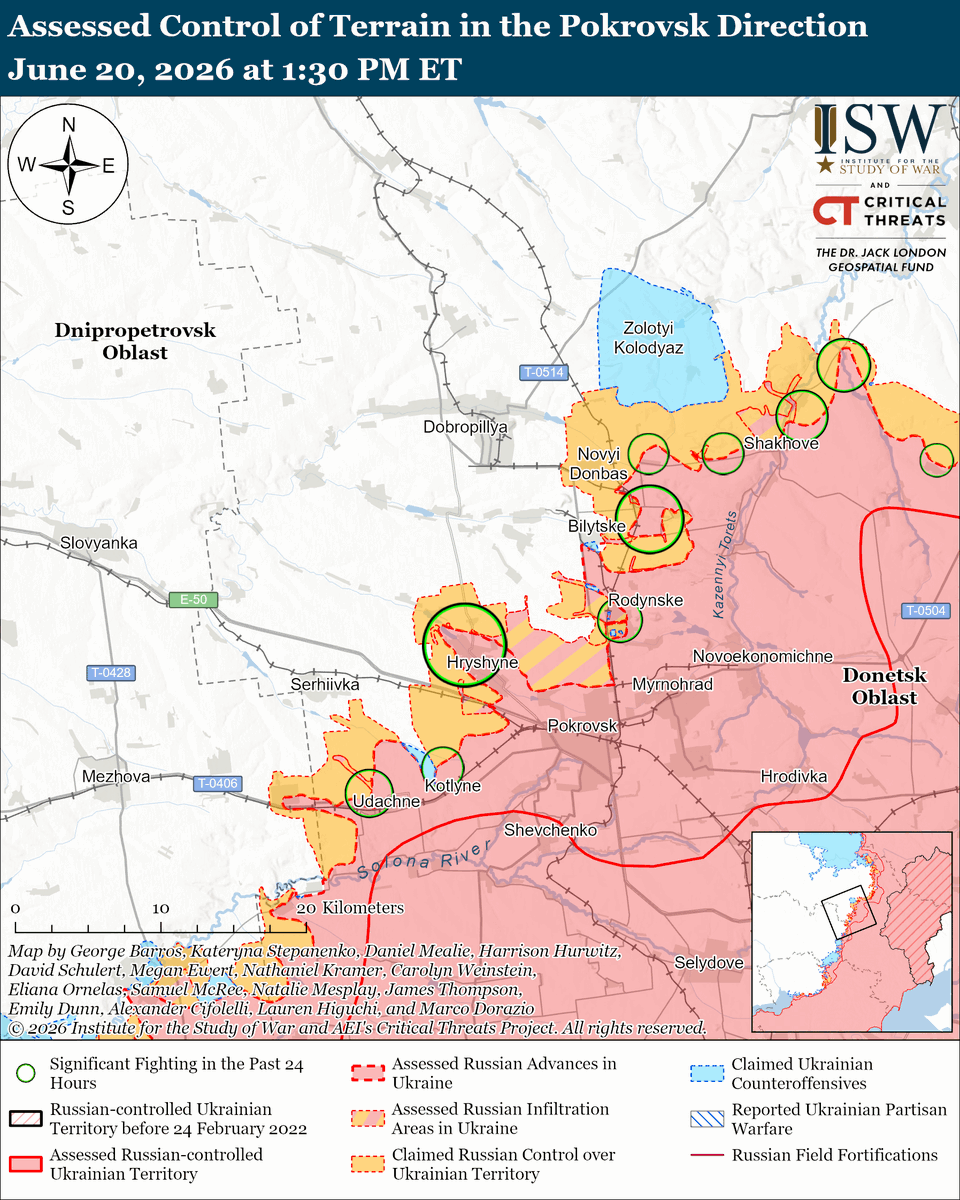
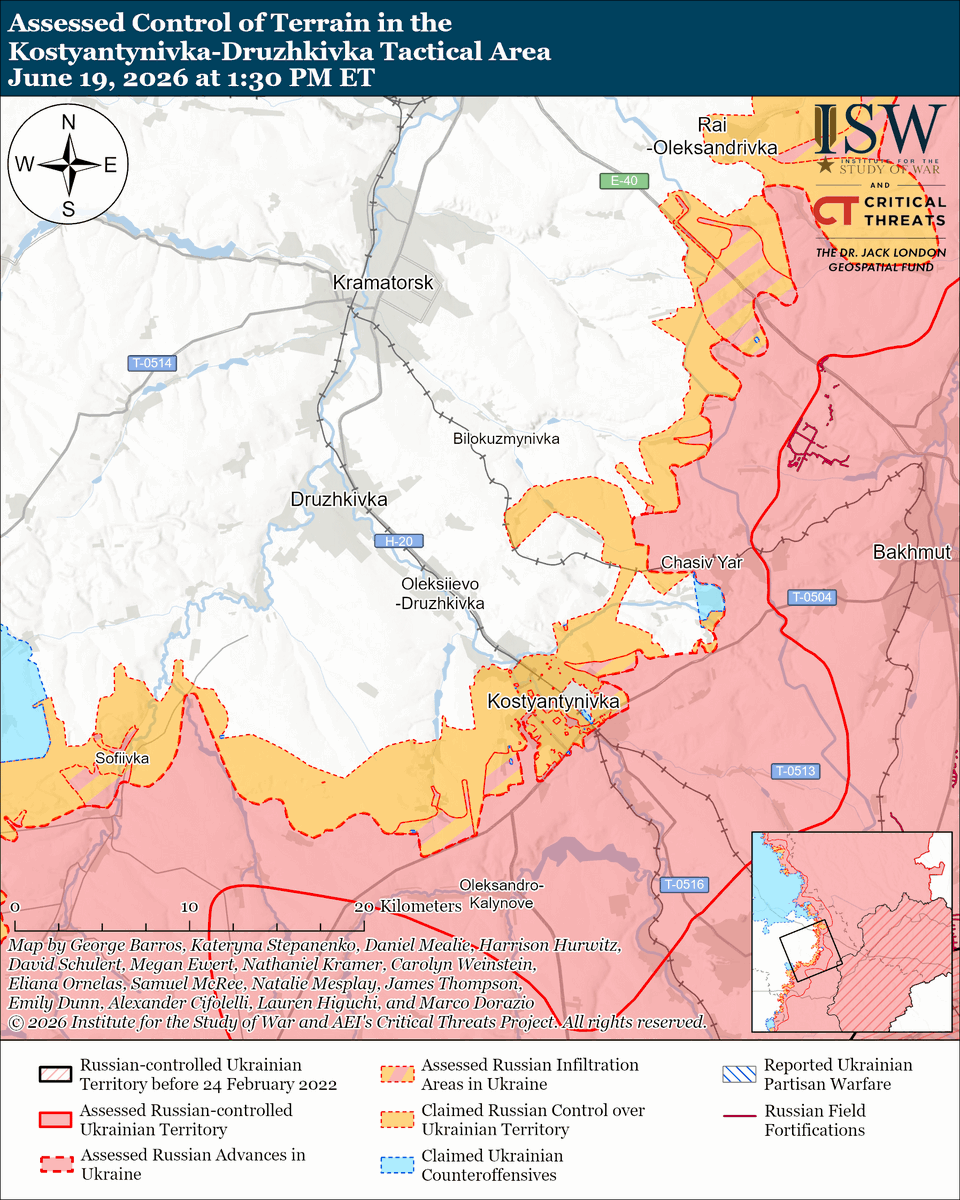
Russian forces recently advanced in the Kostyantynivka and Pokrovsk directions.
Russian forces launched 99 drones against Ukraine on the night of June 19 to 20.
NEW: An Iranian negotiating delegation arrived in Switzerland on June 20 to discuss the implementation of the US-Iran memorandum of understanding (MoU) with US negotiators. Iran will likely use these talks to try to pressure the United States to compel Israel to cease military operations against Hezbollah in Lebanon. It is unclear if Iran’s negotiating delegation will discuss the Iranian nuclear program in Switzerland.
Other Key Takeaways:
The Iranian delegation will likely use Iran’s renewed closure of the Strait of Hormuz as leverage in the talks to try to pressure the United States to compel Israel to halt operations against Hezbollah in Lebanon. Iran likely calculates that it can use the strait as a tool to put greater economic pressure on the United States to meet Iranian demands.
Israel and Hezbollah continued to launch attacks targeting each other despite agreeing to a ceasefire on June 19. The Israel Defense Forces (IDF) warned that it is committed to the ceasefire but will continue to “forcefully” strike Hezbollah if the group launches further attacks against Israeli forces.
There are some indications of disagreements within the Iranian regime regarding Iran’s participation in talks. The Iranian regime has a vested interest in maintaining the negotiating process under the MoU because Iran is receiving economic relief, such as sanctions waivers, as part of the agreement.
The composition of the Iranian negotiating delegation indicates that Iran intends to discuss economic relief components of the MoU at the talks. Iran would almost certainly use any economic relief to try to reconstitute its defense and military capabilities and the Axis of Resistance. Iran may also calculate that the United States would have less leverage to extract concessions from Iran on its nuclear program during the 60-day negotiations period if Iran can frontload economic relief.
MORE: Tying the US-Iran nuclear negotiations to the Lebanon issue not only helps Iran advance its strategic objective of preserving Hezbollah but also enables the regime to delay nuclear negotiations while reaping the economic benefits of the US-Iran memorandum of understanding (MoU). Iran is attempting to compel the United States to pressure Israel to end operations against Hezbollah, given that Israel is not a party to the MoU.
Iran likely seeks to postpone nuclear negotiations in order to avoid having to make concessions on its nuclear program while benefiting from the economic relief that is included in the MoU.
Israel and Hezbollah agreed to a new ceasefire on June 19. This ceasefire probably does not meet Iran’s demand for a “complete ceasefire” in Lebanon because Iranian officials and media have repeatedly argued that a “complete ceasefire” in Lebanon requires the withdrawal of Israeli forces from Lebanese territory.
NEW | Special Report: How Iran Hopes to Control the Strait of Hormuz: It’s Not Just About Fees
One of Iran’s primary objectives in the current negotiations is to secure its sovereignty over the Strait of Hormuz.
Iran likely sees two paths to controlling the strait. First, Iranian control could be officially recognized by the United States through an agreement. Other countries would probably oppose such recognition, but changing the new status quo would be extremely challenging. Second, Iran could maintain the current situation by firing missiles or drones (or credibly threatening to do so) at ships that fail to heed Iranian demands related to transiting the strait.
Iran’s scheme to extract large fees for safe transit through the strait will likely fail, absent a major change in the appetite among shipping companies for risking sanctions. If negotiations do not lead rapidly to an agreement to reopen the strait under the previous, internationally recognized transit scheme, then it will unfortunately be necessary to resort to force.
MORE: Iran, under the current MoU, retains the ability to use the Strait of Hormuz as a tool to secure concessions and advance its strategic objectives. ⬇️
Iranian officials have repeatedly identified control over the strait as a core strategic objective and a key component of Iran’s long-term deterrence posture. Recognized control over the strait grants Iran substantial leverage over global trade, which it can use to extract political and economic concessions at its discretion. The US-Iran MoU requires Iran to “make arrangements using its best efforts for the safe passage of commercial vessels with no charge for 60 days only,” but notes that Iran will negotiate a joint Iranian-Omani management scheme with Oman and the other Gulf Arab states. Iranian officials have continued to emphasize that an “open” strait is one subject to joint Iranian-Omani management and will attempt to achieve joint Iranian-Omani management, possibly by coercing the Gulf Arab states. Recent Iranian threats to keep the strait closed unless Israel ends operations in Lebanon further demonstrate the regime’s willingness to use the waterway as a strategic source of leverage.
Iran’s efforts to charge fees come at a time when Iran faces severe economic challenges and needs resources to rebuild its military and defense sectors following the war. ⬇️
Iranian officials continue to signal that the regime will charge “fees” in the long-term for vessels that want to transit the strait, which is part of the broader Iranian effort to maintain long-term control over the strait. The MoU allows for a resumption of fee collection after 60 days.
Iranian officials have consistently characterized these charges as “service fees” rather than transit tolls, arguing that vessels therefore continue to have “toll-free” passage. The United Nations Convention on the Law of the Sea (UNCLOS) does not permit states bordering international straits to restrict transit passage or impose charges for the right to transit, however.
The Strait of Hormuz is an international strait, not territorial waters, and Article 26 of UNCLOS–which permits fees in territorial waters–therefore does not apply. The regime’s explicit intention to charge “fees” over the long term not only violates international law but also demonstrates that the regime views the strait as a tool through which it can exert control and extract benefits.
MORE: Iran’s threats to collapse the agreement unless Israel ceases operations and withdraws from Lebanon likely reflect a deliberate effort to compel the United States to pressure Israel to end operations. Iran has surely observed reports in Western media that President Donald Trump prioritizes preserving the deal and has pressured Israeli Prime Minister Benjamin Netanyahu to limit military operations in Lebanon.
The Israel Defense Forces (IDF) has continued operations against Hezbollah in southern Lebanon, despite Iranian insistence that Israel must halt its campaign in Lebanon as part of the MoU. The IDF stated on June 18 that it will remain deployed within the 10-kilometer-deep IDF “security zone” in southern Lebanon to remove Hezbollah threats to Israeli forces in southern Lebanon and Israeli residents in northern Israel. Two Israeli officials told Reuters on June 18 that Israel recently held talks with the United States to discuss US approval for continued IDF presence in southern Lebanon. Israeli media reported on June 18 that Israeli Prime Minister Benjamin Netanyahu told US President Donald Trump during a phone call that Israel will not leave southern Lebanon “as long as Israel’s security needs require it.” Trump stated in a social media post on June 18 that the United States expects a complete ceasefire on all fronts, including in Lebanon between Hezbollah and Israel. Hezbollah, Iranian officials, and Iranian media have continued to claim that the US-Iran agreement requires Israel to cease operations against Hezbollah and ultimately withdraw from southern Lebanon. Both sides have continued to engage one another in southern Lebanon, including beyond the Yellow Line.
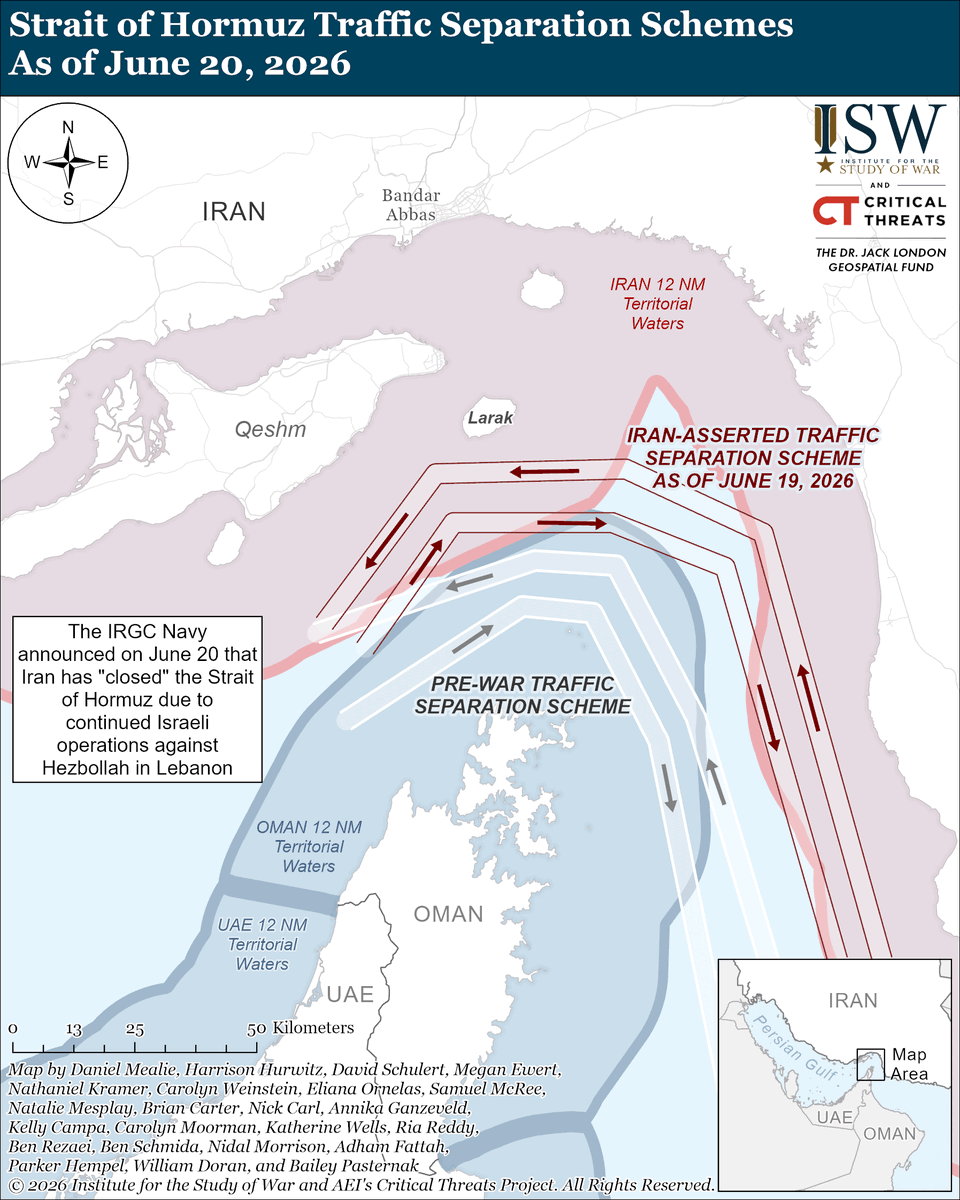
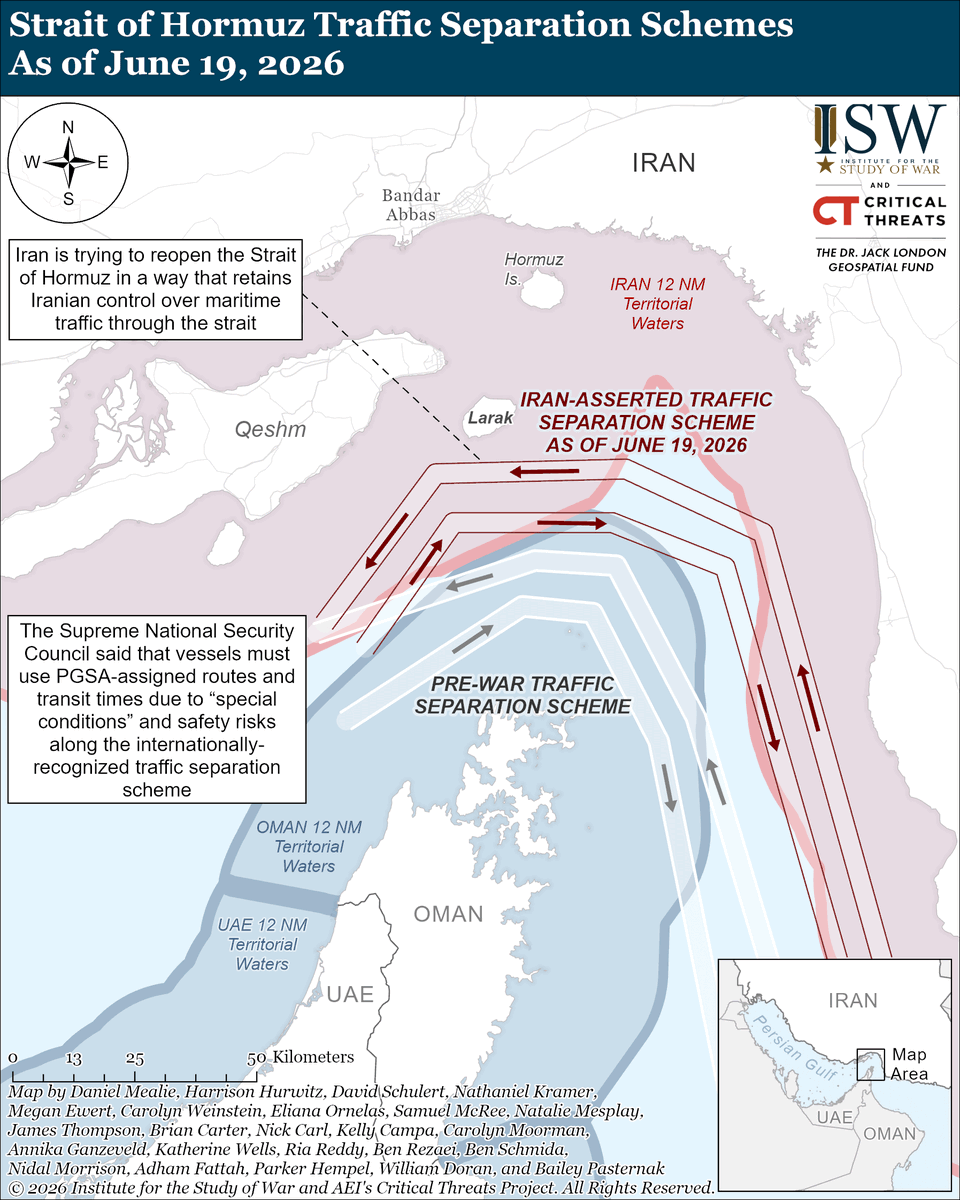
MORE: Iran is reopening the Strait of Hormuz in a way that retains Iranian control over the strait rather than restoring the pre-war status quo. The Supreme National Security Council (SNSC) stated on June 18 that commercial vessels seeking to transit through the strait must submit requests to the Persian Gulf Strait Authority (PGSA), transit only along assigned routes and times, and comply with Iranian safety requirements. The PGSA said that Iran will waive tariffs for “security, safety, and environmental services” and “related Iranian insurance” during the 60-day negotiations period. IRGC-affiliated media previously reported that Iran intends to resume charging vessels fees after the 60-day period, but ISW-CTP has not previously observed reports of the regime requiring vessels to obtain “Iranian insurance.” The PGSA separately published a new map of Iran’s traffic separation scheme.
Iran’s new traffic separation scheme is different from the one it imposed in April 2026 but still passes through Iranian territorial waters. United Kingdom Maritime Trade Operations and the US Navy-led Joint Maritime Information Center warned vessels to avoid the international traffic separation scheme due to the presence of naval mines, but stated that the southern transit route along Omani territorial waters is clear of mines and is the recommended route.
British maritime security firm Ambrey and the Wall Street Journal separately reported that Iranian forces turned back some vessels and told them to apply for exit permits. These developments indicate that Iran has allowed renewed transit through the strait but preserved a system that enables the regime to regulate and restrict access, which gives Iran significant leverage over global commerce.
Some elements of the Iranian regime have argued that Iran should close the Strait of Hormuz to extract further concessions from the US, such as securing an end to Israeli operations in Lebanon and an Israeli withdrawal. Iran retains the ability to use the Strait of Hormuz as a tool to secure concessions and advance its strategic objectives under the current MoU.
MORE: The Kremlin’s routine rejection of negotiation meetings to discuss compromise peace proposals signals its continued unwillingness to end the war in Ukraine on any terms that do not amount to Ukraine’s full capitulation to Russia and fulfill Russia’s maximalist demands.
NEW: Russian Foreign Minister Sergei Lavrov rejected the peace conditions recently proposed by Ukraine and its European partners on June 7, demonstrating the Kremlin’s continued disinterest in peace proposals that do not accept Russian demands for Ukraine’s capitulation.
Other Key Takeaways:
Lavrov reiterated that the Kremlin’s unchanged negotiating position remains based on Russia’s maximalist demands. Lavrov also asserted that Russia seeks to fulfill alleged agreements achieved during the August 2025 US-Russia Alaska Summit, despite the absence of any official documentation of any agreement achieved at the summit.
Kremlin Spokesperson Dmitry Peskov and Russian Foreign Minister Sergei Lavrov acknowledged the Ukrainian June 18 strikes on Moscow City and started to set information conditions to continue and intensify strike packages against Ukraine.
The Russian Central Bank reduced its key interest rate to 14.25 percent as the bank’s leadership continues to advocate for a more cautious monetary policy.
The reduction of the key interest rate amidst the Russian Central Bank’s leadership’s push for a more cautious monetary policy may indicate that the Kremlin is eroding the independence of the Russian Central Bank.
Ukraine’s intermediate- and long-range strike campaign against Russian fuel infrastructure continues to strain gasoline supplies. Russian authorities continue to impose fuel rationing in Russia and occupied southern Ukraine while some authorities deny that Russia is facing fuel supply shortages.
Ukrainian forces recently advanced in the Hulyaipole direction.
Russian forces launched 90 drones against Ukraine on the night of June 18 to 19.
MORE: Iran is reopening the Strait of Hormuz in a way that retains Iranian control over the strait rather than restoring the pre-war status quo. The Supreme National Security Council (SNSC) stated on June 18 that commercial vessels seeking to transit through the strait must submit requests to the Persian Gulf Strait Authority (PGSA), transit only along assigned routes and times, and comply with Iranian safety requirements. The PGSA said that Iran will waive tariffs for “security, safety, and environmental services” and “related Iranian insurance” during the 60-day negotiations period. IRGC-affiliated media previously reported that Iran intends to resume charging vessels fees after the 60-day period, but ISW-CTP has not previously observed reports of the regime requiring vessels to obtain “Iranian insurance.” The PGSA separately published a new map of Iran’s traffic separation scheme.
Iran’s new traffic separation scheme is different from the one it imposed in April 2026 but still passes through Iranian territorial waters. United Kingdom Maritime Trade Operations and the US Navy-led Joint Maritime Information Center warned vessels to avoid the international traffic separation scheme due to the presence of naval mines, but stated that the southern transit route along Omani territorial waters is clear of mines and is the recommended route.
British maritime security firm Ambrey and the Wall Street Journal separately reported that Iranian forces turned back some vessels and told them to apply for exit permits. These developments indicate that Iran has allowed renewed transit through the strait but preserved a system that enables the regime to regulate and restrict access, which gives Iran significant leverage over global commerce.
Some elements of the Iranian regime have argued that Iran should close the Strait of Hormuz to extract further concessions from the US, such as securing an end to Israeli operations in Lebanon and an Israeli withdrawal. Iran retains the ability to use the Strait of Hormuz as a tool to secure concessions and advance its strategic objectives under the current MoU.
NEW: Iran is attempting to condition US-Iran nuclear negotiations on the United States compelling Israel to halt operations against Hezbollah in Lebanon. Tying the US-Iran nuclear negotiations to the Lebanon issue not only helps Iran advance its strategic objective of preserving Hezbollah but also enables the regime to delay nuclear negotiations while reaping the economic benefits of the US-Iran memorandum of understanding (MoU).
Other Key Takeaways:
Iran likely seeks to postpone nuclear negotiations in order to avoid having to make concessions on its nuclear program while benefiting from the economic relief that is included in the MoU. Iranian officials have not indicated any willingness to concede on key nuclear issues, such as Iran’s highly enriched uranium stockpile and ability to enrich uranium on Iranian territory.
Israel and Hezbollah agreed to a new ceasefire on June 19. This ceasefire probably does not meet Iran’s demand for a “complete ceasefire” in Lebanon because Iranian officials and media have repeatedly argued that a “complete ceasefire” in Lebanon requires the withdrawal of Israeli forces from Lebanese territory.
Iran is reopening the Strait of Hormuz in a way that retains Iranian control over the strait rather than restoring the pre-war status quo. Some elements of the Iranian regime have argued that Iran should close the Strait of Hormuz to extract further concessions from the US, such as securing an end to Israeli operations in Lebanon and an Israeli withdrawal.
The IRGC has formed multiple Iraqi militia cells that directly report to the IRGC, instead of pre-existing Iranian-backed Iraqi militias, in order to conduct attacks on Gulf countries hosting US forces, according to eight Iraqi sources speaking to Reuters on June 19. Iran reportedly formed these new militia cells to deflect responsibility for attacks from established militias amid increased US pressure on the Iraqi federal government to disarm Iraqi militias. It is also possible that Iran formed these new militia cells as part of an initial effort to build a new, loyal cadre of ideological militias over which Iran has strong control and would supplement the political activity of existing Iranian-backed Iraqi actors.
NEW: Russian Foreign Minister Sergei Lavrov rejected the peace conditions recently proposed by Ukraine and its European partners on June 7, demonstrating the Kremlin’s continued disinterest in peace proposals that do not accept Russian demands for Ukraine’s capitulation.
Other Key Takeaways:
Lavrov reiterated that the Kremlin’s unchanged negotiating position remains based on Russia’s maximalist demands. Lavrov also asserted that Russia seeks to fulfill alleged agreements achieved during the August 2025 US-Russia Alaska Summit, despite the absence of any official documentation of any agreement achieved at the summit.
Kremlin Spokesperson Dmitry Peskov and Russian Foreign Minister Sergei Lavrov acknowledged the Ukrainian June 18 strikes on Moscow City and started to set information conditions to continue and intensify strike packages against Ukraine.
The Russian Central Bank reduced its key interest rate to 14.25 percent as the bank’s leadership continues to advocate for a more cautious monetary policy.
The reduction of the key interest rate amidst the Russian Central Bank’s leadership’s push for a more cautious monetary policy may indicate that the Kremlin is eroding the independence of the Russian Central Bank.
Ukraine’s intermediate- and long-range strike campaign against Russian fuel infrastructure continues to strain gasoline supplies. Russian authorities continue to impose fuel rationing in Russia and occupied southern Ukraine while some authorities deny that Russia is facing fuel supply shortages.
Ukrainian forces recently advanced in the Hulyaipole direction.
Russian forces launched 90 drones against Ukraine on the night of June 18 to 19.
MORE: Tying the US-Iran nuclear negotiations to the Lebanon issue not only helps Iran advance its strategic objective of preserving Hezbollah but also enables the regime to delay nuclear negotiations while reaping the economic benefits of the US-Iran memorandum of understanding (MoU). Iran is attempting to compel the United States to pressure Israel to end operations against Hezbollah, given that Israel is not a party to the MoU.
Iran likely seeks to postpone nuclear negotiations in order to avoid having to make concessions on its nuclear program while benefiting from the economic relief that is included in the MoU.
Israel and Hezbollah agreed to a new ceasefire on June 19. This ceasefire probably does not meet Iran’s demand for a “complete ceasefire” in Lebanon because Iranian officials and media have repeatedly argued that a “complete ceasefire” in Lebanon requires the withdrawal of Israeli forces from Lebanese territory.
NEW: Iran is attempting to condition US-Iran nuclear negotiations on the United States compelling Israel to halt operations against Hezbollah in Lebanon. Tying the US-Iran nuclear negotiations to the Lebanon issue not only helps Iran advance its strategic objective of preserving Hezbollah but also enables the regime to delay nuclear negotiations while reaping the economic benefits of the US-Iran memorandum of understanding (MoU).
Other Key Takeaways:
Iran likely seeks to postpone nuclear negotiations in order to avoid having to make concessions on its nuclear program while benefiting from the economic relief that is included in the MoU. Iranian officials have not indicated any willingness to concede on key nuclear issues, such as Iran’s highly enriched uranium stockpile and ability to enrich uranium on Iranian territory.
Israel and Hezbollah agreed to a new ceasefire on June 19. This ceasefire probably does not meet Iran’s demand for a “complete ceasefire” in Lebanon because Iranian officials and media have repeatedly argued that a “complete ceasefire” in Lebanon requires the withdrawal of Israeli forces from Lebanese territory.
Iran is reopening the Strait of Hormuz in a way that retains Iranian control over the strait rather than restoring the pre-war status quo. Some elements of the Iranian regime have argued that Iran should close the Strait of Hormuz to extract further concessions from the US, such as securing an end to Israeli operations in Lebanon and an Israeli withdrawal.
The IRGC has formed multiple Iraqi militia cells that directly report to the IRGC, instead of pre-existing Iranian-backed Iraqi militias, in order to conduct attacks on Gulf countries hosting US forces, according to eight Iraqi sources speaking to Reuters on June 19. Iran reportedly formed these new militia cells to deflect responsibility for attacks from established militias amid increased US pressure on the Iraqi federal government to disarm Iraqi militias. It is also possible that Iran formed these new militia cells as part of an initial effort to build a new, loyal cadre of ideological militias over which Iran has strong control and would supplement the political activity of existing Iranian-backed Iraqi actors.
NEW: Iran is attempting to condition US-Iran nuclear negotiations on the United States compelling Israel to halt operations against Hezbollah in Lebanon. Tying the US-Iran nuclear negotiations to the Lebanon issue not only helps Iran advance its strategic objective of preserving Hezbollah but also enables the regime to delay nuclear negotiations while reaping the economic benefits of the US-Iran memorandum of understanding (MoU).
Other Key Takeaways:
Iran likely seeks to postpone nuclear negotiations in order to avoid having to make concessions on its nuclear program while benefiting from the economic relief that is included in the MoU. Iranian officials have not indicated any willingness to concede on key nuclear issues, such as Iran’s highly enriched uranium stockpile and ability to enrich uranium on Iranian territory.
Israel and Hezbollah agreed to a new ceasefire on June 19. This ceasefire probably does not meet Iran’s demand for a “complete ceasefire” in Lebanon because Iranian officials and media have repeatedly argued that a “complete ceasefire” in Lebanon requires the withdrawal of Israeli forces from Lebanese territory.
Iran is reopening the Strait of Hormuz in a way that retains Iranian control over the strait rather than restoring the pre-war status quo. Some elements of the Iranian regime have argued that Iran should close the Strait of Hormuz to extract further concessions from the US, such as securing an end to Israeli operations in Lebanon and an Israeli withdrawal.
The IRGC has formed multiple Iraqi militia cells that directly report to the IRGC, instead of pre-existing Iranian-backed Iraqi militias, in order to conduct attacks on Gulf countries hosting US forces, according to eight Iraqi sources speaking to Reuters on June 19. Iran reportedly formed these new militia cells to deflect responsibility for attacks from established militias amid increased US pressure on the Iraqi federal government to disarm Iraqi militias. It is also possible that Iran formed these new militia cells as part of an initial effort to build a new, loyal cadre of ideological militias over which Iran has strong control and would supplement the political activity of existing Iranian-backed Iraqi actors.
NEW: Russian Foreign Minister Sergei Lavrov rejected the peace conditions recently proposed by Ukraine and its European partners on June 7, demonstrating the Kremlin’s continued disinterest in peace proposals that do not accept Russian demands for Ukraine’s capitulation.
Other Key Takeaways:
Lavrov reiterated that the Kremlin’s unchanged negotiating position remains based on Russia’s maximalist demands. Lavrov also asserted that Russia seeks to fulfill alleged agreements achieved during the August 2025 US-Russia Alaska Summit, despite the absence of any official documentation of any agreement achieved at the summit.
Kremlin Spokesperson Dmitry Peskov and Russian Foreign Minister Sergei Lavrov acknowledged the Ukrainian June 18 strikes on Moscow City and started to set information conditions to continue and intensify strike packages against Ukraine.
The Russian Central Bank reduced its key interest rate to 14.25 percent as the bank’s leadership continues to advocate for a more cautious monetary policy.
The reduction of the key interest rate amidst the Russian Central Bank’s leadership’s push for a more cautious monetary policy may indicate that the Kremlin is eroding the independence of the Russian Central Bank.
Ukraine’s intermediate- and long-range strike campaign against Russian fuel infrastructure continues to strain gasoline supplies. Russian authorities continue to impose fuel rationing in Russia and occupied southern Ukraine while some authorities deny that Russia is facing fuel supply shortages.
Ukrainian forces recently advanced in the Hulyaipole direction.
Russian forces launched 90 drones against Ukraine on the night of June 18 to 19.
NEW: Iran is attempting to condition US-Iran nuclear negotiations on the United States compelling Israel to halt operations against Hezbollah in Lebanon. Tying the US-Iran nuclear negotiations to the Lebanon issue not only helps Iran advance its strategic objective of preserving Hezbollah but also enables the regime to delay nuclear negotiations while reaping the economic benefits of the US-Iran memorandum of understanding (MoU).
Other Key Takeaways:
Iran likely seeks to postpone nuclear negotiations in order to avoid having to make concessions on its nuclear program while benefiting from the economic relief that is included in the MoU. Iranian officials have not indicated any willingness to concede on key nuclear issues, such as Iran’s highly enriched uranium stockpile and ability to enrich uranium on Iranian territory.
Israel and Hezbollah agreed to a new ceasefire on June 19. This ceasefire probably does not meet Iran’s demand for a “complete ceasefire” in Lebanon because Iranian officials and media have repeatedly argued that a “complete ceasefire” in Lebanon requires the withdrawal of Israeli forces from Lebanese territory.
Iran is reopening the Strait of Hormuz in a way that retains Iranian control over the strait rather than restoring the pre-war status quo. Some elements of the Iranian regime have argued that Iran should close the Strait of Hormuz to extract further concessions from the US, such as securing an end to Israeli operations in Lebanon and an Israeli withdrawal.
The IRGC has formed multiple Iraqi militia cells that directly report to the IRGC, instead of pre-existing Iranian-backed Iraqi militias, in order to conduct attacks on Gulf countries hosting US forces, according to eight Iraqi sources speaking to Reuters on June 19. Iran reportedly formed these new militia cells to deflect responsibility for attacks from established militias amid increased US pressure on the Iraqi federal government to disarm Iraqi militias. It is also possible that Iran formed these new militia cells as part of an initial effort to build a new, loyal cadre of ideological militias over which Iran has strong control and would supplement the political activity of existing Iranian-backed Iraqi actors.
Applications for ISW's Fall 2026 Internship Program are open! Click to explore all of the internship tracks available this fall.
Interns will gain hands-on experience in research, open-source analysis, geospatial technology, and communications while contributing directly to our mission in national security and conflict monitoring. We are looking for a cohort of curious, driven, and creative people who are ready to challenge themselves and tackle complex problems in international affairs. We encourage all to apply!
The Fall 2026 program runs from September 8 to December 11 with in-person, hybrid, and remote opportunities. (1/2)