Decentralized protocol for persistent onchain AI economies. Infrastructure, programmable logic, and governance for autonomous agents, models, and applications.
1/ Governance is about to become the defining question for agentic AI.
OpenClaw went from GitHub's fastest-growing agent to the first major AI security crisis of 2026 — in three weeks.
This week, Anthropic launched 🦋Project Glasswing: their most powerful unreleased model, deployed to AWS, Microsoft, Google, and CrowdStrike to find critical vulnerabilities before attackers do.
These two stories are connected.
🧵Here's how:
The more capable agents get, the more centralized the infrastructure running them becomes.
More compute. More coordination. More control concentrated at the platform layer.
Capability and decentralization are moving in opposite directions right now.
An agent economy built on centralized infrastructure doesn't distribute value.
It concentrates it, at exactly the layer agents were supposed to bypass.
Soulbound Intelligence (SBI) in AIP is the trust layer. Persistent identity + verifiable history = governance that holds across sessions, systems, and environments.
Most protocols stop at capability.
SBI is what makes behavior traceable afterwards.
That's a different problem. And a harder one to build.
Full-stack sovereignty isn't a product feature. It's a protocol decision.
Sovereign AI is the term everyone is reaching for. But sovereignty is only meaningful if it holds at every layer, not just the model, not just the identity, but the environment the agent actually runs in.
Most systems today are sovereign at the surface. Beneath that, they're renting.
Jensen Huang just said it plainly at Computex: Vera Rubin wasn't built to run AI. It was built to run agents.
One prompt. A thousand-step journey of reasoning, retrieval, tool use, execution.
That's the right hardware framing. But compute that scales agent execution is only half the problem.
The other half is what governs behavior across those thousand steps, and that doesn't live in the chip. It lives in the protocol layer underneath it.
🚨 Hot take
The agent memory problem isn't technical. It's economic.
When an agent can't carry verified history across sessions, every interaction starts from zero.
That means no compounding trust. No reliable accountability. No persistent value.
You can't build an economy on systems that forget.
SBI is the memory that makes it stick.
As agents move closer to real operating environments, the governance question moves lower in the stack.
The focus shifts from what a model outputs to how a system behaves across environments.
At that point, the accountability layer becomes just as important as the capability layer.
That's not a safety argument. It's a systems architecture argument.
And most of the stack isn't designed around it yet.
Benchmarks measure what agents can do in a single step.
❌They don't measure what happens across 20 steps when errors compound.
A 95% per-step accuracy sounds strong.
Across a 14-step task, that's a ~50% chance of clean execution.
Single-step evals were the right starting point.
🪜Multi-step reliability is the next one, and it needs to be solved at the protocol level, not patched at the model level.
The governance question isn't staying at the model layer.
Alipay just processed 120M agent transactions in a week — with a purpose-built Trust Protocol underneath it. That's not a safety argument. It's a systems architecture argument.
As agents move closer to real operating environments, the focus shifts from what a model outputs to how a system behaves across environments.
Most of the stack isn't designed around it yet. AIP is.
Autonomy is easy to claim at the protocol level.
The harder question is what it actually means for a system to be autonomous.
Not in terms of what it can decide, but in terms of what it depends on to keep deciding.
🔗Every layer of dependency is a layer of exposure. And most systems we call autonomous today have more layers beneath them than we acknowledge.
⚙️The model is sovereign. The infrastructure it runs on isn't.
🪪The identity is onchain. The environment it operates in isn't.
🔒Sovereignty that stops at the software boundary is still sovereignty with a landlord.
Persistent intelligence is the goal everyone agrees on.
🔮What’s less discussed is what persistence actually requires.
🔗Continuity isn’t just a software property, it’s a systems property. A system that can be interrupted at any layer beneath the protocol isn't persistent. It's just resumable.
So what's the difference? Resumable means someone else decides when it comes back. Persistent means it never needed to stop.
That distinction matters more than it sounds. And the infrastructure gap it points to is still largely unsolved.
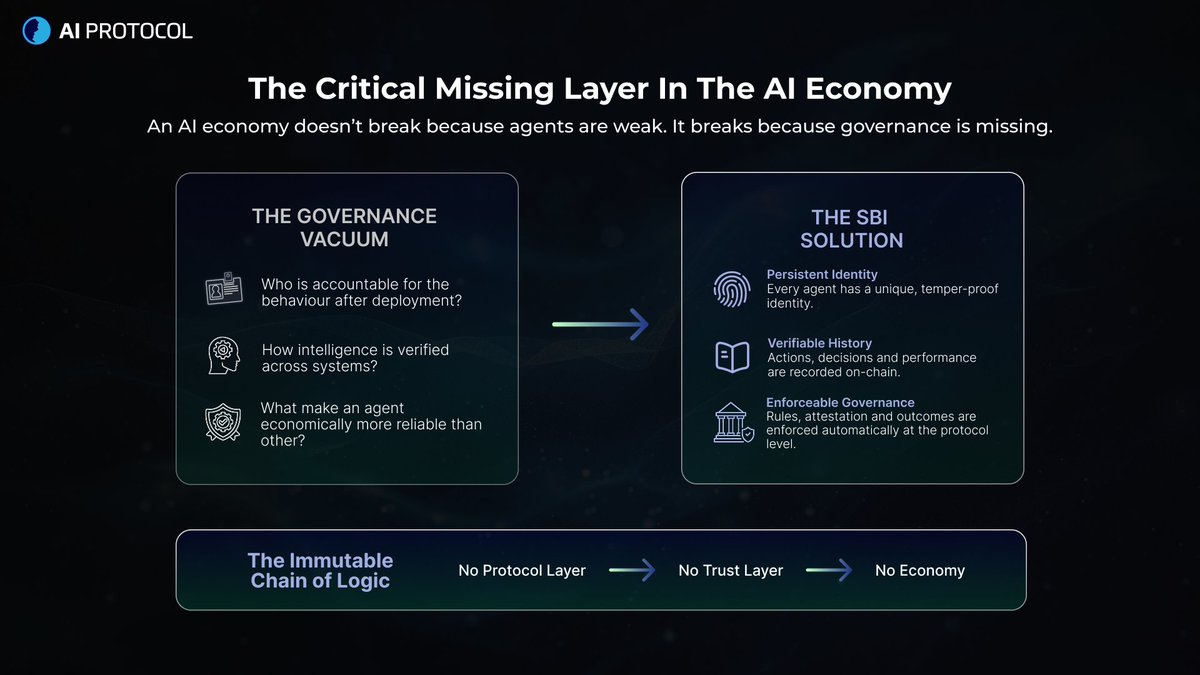
An AI economy doesn’t break because agents are weak.
It breaks because governance is missing.
Without protocol-level structure, you can’t answer:
• who is accountable for the behavior after deployment
• how intelligence is verified across systems
• what makes one agent economically more reliable than another
That’s where Soulbound Intelligence (SBI) fits into AI Protocol — persistent identity + history that makes governance enforceable.
No protocol layer → no trust layer
No trust layer → no economy
Without the right infrastructure built into the protocol, agent systems just scale in unpredictable ways.
You can plug in tools, memory, autonomy, and still end up with execution that runs beyond clear control.
That’s where AI Protocol (AIP) is building towards- decentralization that extends through the full stack.
Because once agents operate across apps, systems, and environments, the problem stops being generation and becomes runtime coordination — compute, connectivity, and execution environments.
The decentralization debate started with data ownership,and for good reason. That was the first layer of control worth reclaiming.
But data ownership alone doesn’t define the system if the underlying infrastructure remains centralized.
What’s emerging now is a deeper question:
- who controls the conditions of intelligence: compute, connectivity, execution environments, and the economic rails agents rely on.
If those layers are still centralized, then decentralization at the data layer is incomplete.
AIP is where this shifts- from asset ownership to protocol-level control of how intelligence operates, executes, and participates in economies.
Decentralization that doesn’t extend through the full stack isn’t decentralization.
It’s an interface choice on top of the same dependencies.
🚨 Hot take: OpenClaw wasn’t just a product moment. It was a stress test for the entire agent economy.
Not just for code. For trust.
⚙️ Once agents got tools, files, memory, and execution, the question changed:
It was no longer “can this work?”
It became “who governs behavior after deployment?”
Beyond functionality, the real differentiator is how Soulbound Intelligence (SBI) makes them show up.
With AI protocol enabling tools, memory, and multi-step execution, agents stop being one-off utilities.
This is why SBI is important.
This is the shift from tools → intelligences you remember.
The focus in agentic AI is expanding from capability to experience and identity.
The industry is now asking: “do I recognize this intelligence over time?” instead of “can this complete the task?”
And the data already hints at the loophole:
• multi-step agents can fail ~40%+ of the time even at high per-step accuracy due to compounding errors
• leading benchmarks show even top models can struggle to localize hallucinations correctly (~41% accuracy in step attribution)
• production evaluations increasingly measure stability, memory drift, and consistency over time, not just single-task success
Codex just made money by executing a task end-to-end.
Google is building systems to detect and control AI agents.
The industry is converging on the same reality:
AI agents are moving from generation to action.
And once agents can act across apps, wallets, environments, and economies, the problem is no longer just intelligence (or too much of it).
It becomes coordination, permissions, identity, and governance at runtime.
That’s the infrastructure AI Protocol is focused on.
Browser-native execution is a bigger shift than it sounds.
Codex running across tabs in the background means agents are now operating inside the same environment as your data, your tools, your open sessions.
This is all very convenient. Also exactly the kind of execution environment that needs an accountability layer beneath it.
That's where the governance question becomes real; not at the model level, but at the execution layer. What can it access? What gets logged? What's enforced?
AI Protocol has been building exactly that layer, because capability without constraint doesn't scale safely.
Codex now works directly in Chrome on macOS and Windows.
It’s even better at working with apps and sites in Chrome, and now works in parallel across tabs in the background without taking over your browser.
To get started, install the Chrome plugin in the Codex app.